




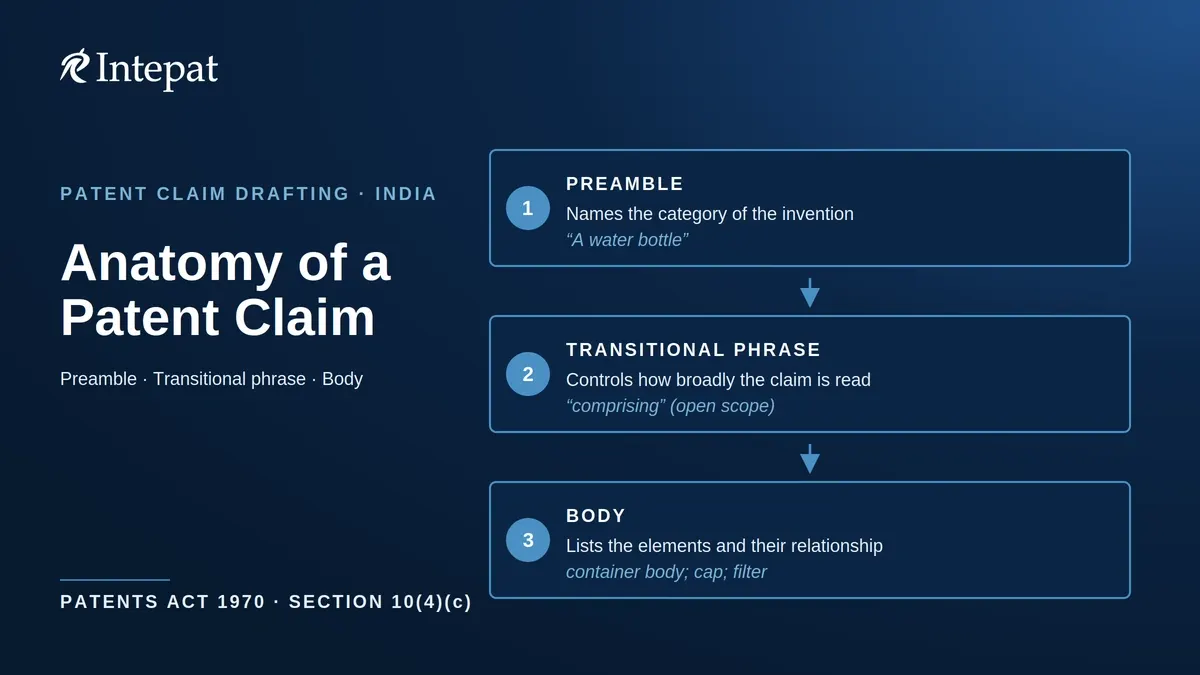
A patent claim is the part of a patent that defines exactly what the invention protects and what others may not do without permission. Under Section 10(4)(c) of the Patents Act 1970, every complete specification must end with one or more claims. Each claim has three parts: a preamble, a transitional phrase, and a body.
This guide explains how patent claims work under Indian law, with comparative notes where international drafting practice is treated differently here.
| The short version |
| A claim has three parts: the preamble, the transitional phrase, and the body. The first claim is always an independent claim; later claims usually depend on it and narrow it. “comprising” keeps a claim broad and open; “consisting of” closes it to the listed elements only. India does not allow omnibus claims, and methods of medical treatment cannot be claimed. |
What is a patent claim?
A patent claim is the part of a patent that defines the legal boundary of the invention. It states, in a single sentence, what the patentee can stop others from doing without permission. The description and drawings explain how the invention works; the claims decide what is owned. Anything described but not claimed is, in effect, left free for the public.
Under Section 10(4)(c) of the Patents Act 1970, every complete specification must end with one or more claims defining the scope of the invention for which protection is claimed. Section 10(5) adds that the claims must relate to a single invention or a group of inventions forming a single inventive concept, must be clear and succinct, and must be fairly based on what the specification discloses.
Because the claims fix the scope of the patent, they also decide every later question: whether the invention is new, whether a competitor infringes, and what survives if the patent is challenged. A claim drafted too loosely can be read onto the prior art and revoked; a claim drafted too tightly can be worked around. Drafting is therefore an exercise in defining the invention at the right level of generality.
How a patent claim is structured: preamble, transition, and body
The Manual of Patent Office Practice and Procedure (paragraph 05.03.17) describes a claim as having three parts: a preamble, a transitional phrase, and a body. Each claim is written as a single sentence and should read clearly on its own.
The preamble introduces the category of the invention and sometimes its purpose, for example “A device for…” or “A composition for…”. It is kept consistent with the title of the invention, so the reader knows at once whether the claim is to a product, an apparatus, a process, or a composition.
The transitional phrase links the preamble to the body and controls how broadly the claim is read. Open phrases such as “comprising” or “including” mean the claim covers the listed elements and anything more, so a competitor cannot escape by adding a feature. Closed phrases such as “consisting of” limit the claim to exactly the elements listed. “Consisting essentially of” sits in between, allowing only additional elements that do not materially change the invention.
The body sets out the elements of the invention and the relationship between them. Drafting convention separates the preamble from the transitional phrase with a comma, introduces the body with a colon, and divides the elements with semicolons. The first time an element is mentioned it is introduced with “a” or “an”; afterwards it is referred to with “the”, so that every element has a clear antecedent and the claim is defined clearly enough to avoid ambiguity.
| Transitional phrase | What the claim covers | Effect on scope |
| comprising / including | the listed elements and any additional ones | broad (open) |
| consisting of | only the listed elements, nothing more | narrow (closed) |
| consisting essentially of | the listed elements plus any that do not materially affect the invention | intermediate |
Independent claims and dependent claims
Claims are also classified by how they relate to each other. The Manual states that the first claim is always an independent claim, also called the principal claim, and that it must set out all the technical features essential to the invention.
An independent claim stands on its own and does not refer to any other claim. It is usually the broadest claim in the application, because it lists only the features essential to the invention and leaves out optional detail. A single application may contain more than one independent claim, provided they fall under a single inventive concept, as Section 10(5) requires.
A dependent claim refers back to an earlier claim, reads in all of its features, then adds a further limitation. Because it includes everything in the claim it depends on and more, a dependent claim is always narrower. Dependent claims capture preferred embodiments, optional features, and fallback positions: if the broad independent claim is later found to read onto the prior art, a narrower dependent claim may still survive.
The Manual cautions that a dependent claim should not omit, modify, or substitute a feature of the claim it depends on; if it does, it is not truly dependent and may be objected to. Independent and dependent claims are typically layered so the application protects both the core idea and its specific implementations.
| Drafting Your Patent? Our registered patent agents draft and prosecute applications across every technical field. |
| Talk to Us |
Product claims and process claims
The most basic division in Indian practice is between product claims and process claims. The distinction matters because it changes both what is protected and how infringement is judged.
A product claim is directed to a thing: a device, an apparatus, a machine, a chemical compound, a composition, or an article of manufacture. It protects the product however it is made, so a competitor who arrives at the same product by a different route can still infringe.
A process claim is directed to a method or a way of doing or making something, such as a method of manufacture, a method of analysis, or a method of preparation. It protects the steps rather than the end product as such, although Indian law extends protection to a product obtained directly by a patented process in infringement proceedings.
Many inventions are claimed both ways in the same application, with product claims alongside a set of process claims covering the method of making it. One limit falls on process claims in particular: a process for the medicinal, surgical, curative, or other treatment of humans or animals is not patentable under Section 3(i), so a process claim cannot be drafted as a method of treatment.
Specialised claim formats: Markush, two-part, and means-plus-function
Beyond the basic product and process categories, certain drafting formats recur in particular fields. These are styles of claiming, not separate legal categories, and each is allowed in India only within the ordinary requirements of clarity and support.
A two-part or characterising claim is used when the invention is an improvement on something already known. The Manual provides that such a claim is written in two parts separated by the words “characterised by” or “wherein”: the first part recites the known features, the second recites the improvement. This format, known abroad as a Jepson claim, makes the inventive contribution explicit.
A Markush claim is used mainly in chemistry to claim a group of alternatives, for example a compound in which a particular position may be any one of a defined list of substituents. It is permitted in India, but the Manual warns that a claim must not contain so many alternatives or variable parameters that it becomes unsearchable.
A means-plus-function claim defines an element by the function it performs rather than by its structure, for example “means for fastening”. Functional language is acceptable where the specification discloses the structure that performs the function and the scope stays clear; it cannot be used to claim every conceivable way of achieving a result that the applicant has not disclosed.
Claim formats Indian law does not allow: omnibus and Swiss-type
Two formats that appear in older drafting guides are not available in India, and applicants who copy them from foreign templates risk an objection.
An omnibus claim defines the invention by reference to the description or drawings, for example “An apparatus substantially as described herein with reference to the accompanying drawings”. The Manual states plainly that an omnibus claim has no legal basis under the Patents Act and cannot be allowed under Section 10(4)(c), because it does not define the scope of protection in its own terms. Omnibus claims should not be included in Indian applications.
A Swiss-type claim is a format developed abroad to protect a new medical use of a known substance, drafted as the use of a compound in the manufacture of a medicament for treating a condition. It does not find purchase in India for two reasons. The mere discovery of a new use for a known substance is not an invention under Section 3(d), and a method of treatment is excluded under Section 3(i). A new medical use therefore cannot be secured through this drafting device.
A related limit applies to software and business inventions. Claims directed to a computer programme as such, to a mathematical method, to a business method, or to an algorithm are excluded under Section 3(k), so these claims have to be framed around a technical contribution rather than the programme or method in the abstract.
Practitioner note
Foreign-drafted specifications entering India through the national phase often carry omnibus claims and, in pharmaceuticals, Swiss-type claims. Both are routinely objected to. Reviewing and re-drafting the claim set for Indian requirements at or before national-phase entry avoids an office action that could have been prevented.
How many claims you can file, and what extra claims cost
There is no statutory limit on the number of claims an application may contain. The Manual notes only that the claims should fall under a single inventive concept and that having several claims of different scope lets the applicant hold title to different aspects of the invention.
Cost is the practical constraint. The first ten claims carry no separate fee, but each claim beyond ten attracts a per-claim official fee. As at May 2026, the First Schedule to the Patents Rules 2003 sets this excess-claim fee, on electronic filing, at Rs 320 for a natural person, startup, small entity, or educational institution, and Rs 1,600 for other applicants such as large companies, with higher figures for physical filing. These figures are revised from time to time, so confirm the current schedule before filing.
Each claim also has its own priority date under Section 11, which fixes the date from which novelty is judged for that claim. This is why a claim set is structured deliberately rather than padded: claims that add nothing to scope add cost and examination burden without adding protection.
Claims can be amended during prosecution, but not freely. Section 59 allows amendment only by way of disclaimer, correction, or explanation, and an amended claim must fall wholly within the scope of a claim as originally filed. You can narrow claims but you cannot broaden them beyond what you first disclosed, which is why it is worth getting the claim set right at filing. The mechanics of amending the claims are dealt with separately.
Choosing the right claim breadth
The central drafting decision is how broad to make the claims. The Manual frames the tension directly: a claim that is too broad may encroach on the public domain or on what others have done and is vulnerable to being anticipated, while a claim that is too narrow may be ineffective against an infringer who makes a small change.
In practice, applicants do not pick a single breadth. They layer the claim set: one or more broad independent claims to capture the widest defensible scope, supported by progressively narrower dependent claims that act as fallback positions if the broad claims are challenged. The broad claim defines the territory; the dependent claims defend the core.
For startups and individual inventors, the workable approach is usually a claim set of medium breadth anchored tightly to the technical field actually invented, with dependent claims protecting the specific commercial product. This balances enforceable scope against the risk of revocation. Because claim scope is the same wording a court will later compare against an alleged infringement, the choices made at drafting decide how strong the patent is years later.
Claim drafting is fact-specific and turns on the technology and the prior art. The general structure described here is a starting point; the specific wording is best settled with a registered patent agent who can read the claims against the field.
Patent claims: frequently asked questions
What is a patent claim?
A patent claim is the part of a patent that defines the legal scope of the invention. Under Section 10(4)(c) of the Patents Act 1970, every complete specification must end with one or more claims. The claims decide what the patentee can stop others from doing and what stays free for public use.
What are the three parts of a patent claim?
A patent claim has three parts: the preamble, which names the category of the invention; the transitional phrase, such as comprising or consisting of, which controls how broadly the claim is read; and the body, which sets out the elements of the invention and how they relate to one another.
What is the difference between an independent and a dependent claim?
An independent claim stands alone and lists the essential features of the invention, so it is the broadest claim. A dependent claim refers back to an earlier claim, includes all of its features, and adds a further limitation, so it is always narrower and is used for fallback protection.
Are omnibus claims allowed in India?
No. The Manual of Patent Office Practice and Procedure states that an omnibus claim, which defines the invention by reference to the description or drawings, has no legal basis under the Patents Act and cannot be allowed under Section 10(4)(c), because it does not define the scope of protection in its own terms.
How many patent claims can I include, and do extra claims cost more?
There is no limit on the number of claims. The first ten carry no separate fee, but each claim beyond ten attracts a per-claim official fee under the First Schedule to the Patents Rules 2003, which varies by applicant category and filing mode. Confirm current figures before filing.
Can patent claims be broadened by amendment after filing?
No. Section 59 of the Patents Act 1970 allows amendment only by disclaimer, correction, or explanation, and an amended claim must fall wholly within the scope of a claim as originally filed. Claims can be narrowed during prosecution, but not broadened beyond the original disclosure.
Disclaimer
This article explains the structure and types of patent claims under Indian law for general informational purposes and reflects the position as at May 2026. Official fees and procedure set by the Indian Patent Office change from time to time; confirm current figures on the official website before you file. Claim drafting depends on the specific invention and the prior art, and this article is not legal advice. For your own application, consult a registered patent agent.