




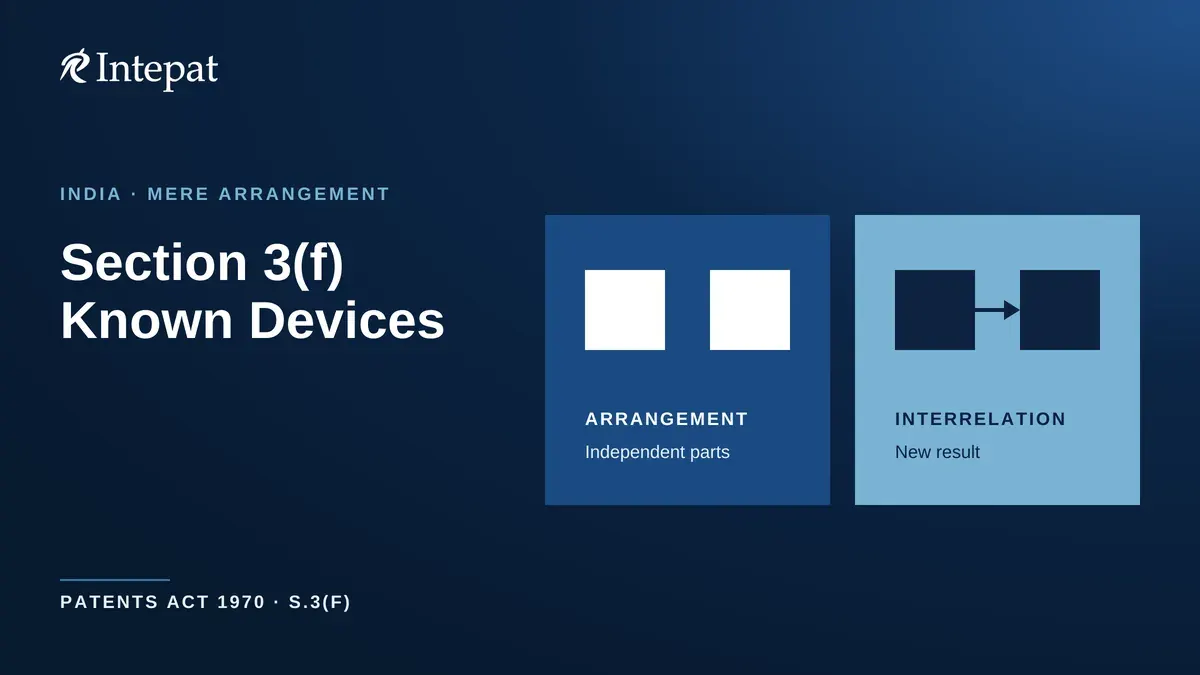
The Section 3(f) Patents Act exclusion says the mere arrangement, re-arrangement or duplication of known devices, each working independently in a known way, is not an invention. Where known parts are only moved or placed side by side and each still works independently, the exclusion applies. The Patent Office looks for parts that work together to give a new or improved result.
This guide is for founders and product teams filing patents in India for mechanical, hardware or product inventions. It explains how the Indian Patent Office reads the exclusion, what a November 2026 Madras High Court decision on a TVS Motor application did and did not decide, and how to describe an invention so that its parts are shown working together.
Quick answer: Section 3(f) targets claims where known devices only sit side by side or change position, each still working independently in a known way. The Patent Office’s Manual says a combination can be patentable subject matter when its parts have a working interrelation that produces a new or improved result. Show that interaction in your specification and claims, with a technical effect. A new position or added convenience on its own may not be enough.
What the Section 3(f) Patents Act exclusion says
Section 3(f) lists the mere arrangement, re-arrangement or duplication of known devices, each functioning independently of one another in a known way, among the things that are not inventions. It is a subject matter exclusion. A claim that passes Section 3(f) must still be new, involve an inventive step and be capable of industrial application.
The clause is about known devices that keep doing their own separate jobs after they are arranged or duplicated. Three words carry the weight: “mere”, “known” and “independently”. A claim to a mere arrangement of known devices is what the clause targets. A claim that adds a part nobody had before, or makes known parts act on each other, is not described by the clause. The Manual also says that a combination of known matters must independently satisfy the test of inventive step, so clearing Section 3(f) does not finish the job. For the wider list of exclusions, see our guide to what cannot be patented in India.
How the Patent Office applies it
The Patent Office’s Manual (2019 version) treats a mere juxtaposition of known devices, each working independently, as not patentable. It says a combination may be patentable where the parts have a working interrelation producing a new or improved result. Its unpatentable examples include an umbrella with a fan and a bucket fitted with a torch.
The Manual also gives a machinery example. In an application for an apparatus for producing metallic bellows, a hydraulic machine and a roll forming machine functioned as separate machines independently of each other, and the Manual says there is no invention in that claim. The Manual also says a new combination may be the subject of a patent even though every part is old, because the new article is the assembling and working of the parts together. It says the merit of a new combination depends very much on the result produced.
Treat the Manual as office practice, not law. What it gives you is the question an examiner is likely to ask: do these parts have a working interrelation, and what result does it produce? Our guide to inventive step in Indian patents covers the separate test that every claim also has to meet.
What the Madras High Court decided in the TVS Motor case
On 12 November 2026 the Madras High Court dismissed TVS Motor’s appeal against refusal of a patent for a vehicle with a fuel tank biometric recognition system. Section 3(f) was among the objections. The court upheld the refusal on obviousness and did not rule on Section 3(f).
The application, titled “A Vehicle”, claimed a biometric recognition system based on fingerprint, voice or retina recognition, mounted on the fuel tank assembly. TVS argued that the system interacts with the wiring harness and gives ergonomic benefits, so it fell outside Section 3(f) on the Manual’s test. The Patent Office argued that the invention is a mere rearrangement of known devices with no new or improved result.
The court recorded that TVS admitted similar features were available and claimed that the placement was more advantageous. It said technical advantage can be considered, but on notable prior art it cannot make a new invention. The two cited documents were identical to the claimed invention except for placement of the biometric device, and placing it on a different surface of the vehicle did not remove them from consideration. It found the invention obvious to a person skilled in the art, said the further grounds “need not be answered”, and made no order as to costs.
Do not read the decision as a ruling on what Section 3(f) covers, because the court did not analyse it. Its reasoning shows how an argument based on placement fared against cited documents that were identical to the claim except for placement. It is one obviousness decision on its own facts, not a general rule.
How to draft around a Section 3(f) objection
Describe the parts as one working system. State the technical problem, show how each part affects the others, say what new or better result follows, and claim that interaction instead of a list of parts. These are drafting practices drawn from the Manual’s test. They do not guarantee that an examiner will withdraw an objection.
The table uses a hypothetical parcel box with a lock, a tracker and a display, all of them known parts. It is an illustration, not a real filing.
| Point | Weak drafting | Stronger drafting |
|---|---|---|
| Claim 1 | A box comprising a lock, a tracker and a display. | A box where the tracker reads the lock state and sends an alert when the lock opens off the set route. |
| Description | Lists the parts and where they sit. | Explains the signal from the lock to the tracker and what the user then sees. |
| Effect | Says the box is more convenient. | States the problem solved and the measured result, from your own tests. |
| Fallback claims | One claim to the whole arrangement. | Dependent claims that add each interaction, one by one. |
In the TVS case the claimed benefits were ergonomics, wiring and placement, and the court found that placement did not set the claim apart from prior art that already showed the device. Tie any claimed ergonomic, wiring or other benefit to a feature that differs from the prior art, and explain why that difference is not obvious.
Write the interaction into the specification before you file, so the claims and your arguments can point to it. Keep dependent claims that recite each interaction, so a narrower claim can be argued if the broadest one is held to be a mere arrangement.
If the objection appears in your examination report
An objection under Section 3(f) can be raised in the examination report. In the TVS case it was raised there and kept in the hearing notice. A reply that only denies the label does little more than restate the claim, so the reply should show how the parts interact.
Reply with technical arguments on the interaction and its effect, pointing to the passages of your specification that describe them. Where the original disclosure supports the interaction and the amended claims stay within the scope of the claims before amendment, amend the claims to recite it. The reply should also deal with inventive step, because the two objections can be raised together, as they were in the TVS case. Our guide to patent claims and their types explains how to build the fallback set.
A quick check before you file
For each known part, ask whether it acts on another part, whether that changes the result, and whether the change is written in your specification. If the claim only brings together known devices that keep functioning independently, assess the risk of an objection and describe any working interrelation you rely on.
If the real difference is only where a part sits, say so inside your team before you spend on a filing. A patentability search can show whether the same device already appears in other positions, which is the situation that decided the TVS appeal. Our note on patentability search in India explains what that search covers, and our guide for startups preparing to file covers the filing steps.
FAQ
It means that arranging, rearranging or repeating known devices, where each still works independently in a known way, is not an invention. A product made only that way is excluded. The Manual says parts with a working interrelation that produces a new or improved result can be patentable subject matter.
Yes, it can be. The Manual says a combination may be patentable subject matter where the parts have a working interrelation that produces a new or improved result, even if every part is old. The claim must also be new, involve an inventive step and be capable of industrial application.
No. Section 3(f) was among the objections, but the court decided the appeal on obviousness alone. It said the further grounds raised by the appellant need not be answered. The decision therefore does not set out what Section 3(f) covers.
A change of position alone did not save the TVS claim, because the cited documents were identical to it except for placement and the court found the invention obvious. Each case turns on its own prior art and technical effect. A position change that makes parts act together in a new way is a different case.
No. It is an objection raised in the examination report, and you can answer it with arguments and amended claims. A reply that shows interaction and effect gives the examiner something to assess. In the TVS case, TVS argued that the Controller had wrongly applied Section 3(f), and the refusal was upheld on obviousness.
This article explains the law on Section 3(f) in India as at November 2026 and is for general information only. It is not legal advice. Government fees, forms, and procedures change; confirm current figures with the Indian Patent Office before you file. For advice on your specific invention, consult a registered patent agent.
Sources
- The Patents Act, 1970, Section 3(f) (as on 5 May 2026), India Code, Government of India.
- Manual of Patent Office Practice and Procedure, Version 3.0 (26 November 2019), clause 09.03.05.06, Indian Patent Office.
- TVS Motor Company Limited v. Deputy Controller of Patents and Designs, CMA(PT) No. 61 of 2024, Madras High Court, 12 November 2026 (reproduction of the order; confirm against the court’s own copy).