




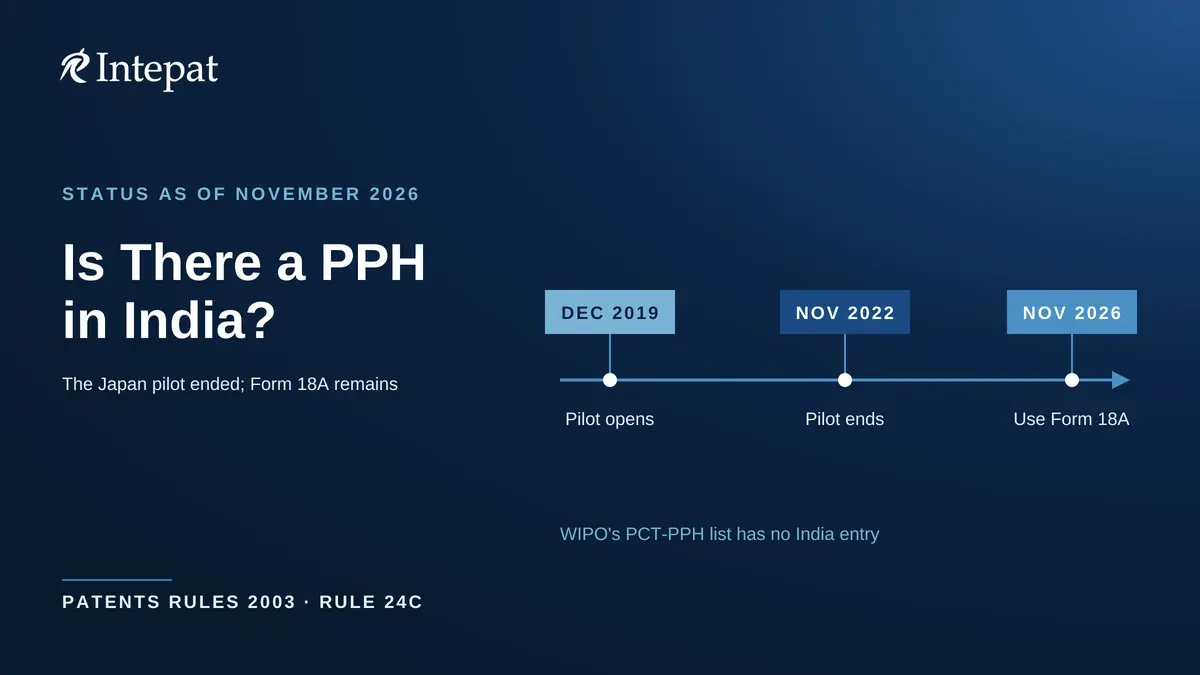
We found no Patent Prosecution Highway in India that is open for new requests. The one PPH we could trace, a pilot between the Indian Patent Office and the Japan Patent Office, ended on 20 November 2022. To move an Indian application faster today, you use expedited examination under the Patents Rules, 2003.
This guide is for applicants and counsel with applications in India, and for Indian applicants filing abroad through the Patent Cooperation Treaty (PCT). It reflects the Rules and fee schedule as read on the Indian Patent Office website on 14 November 2026, the Japan Patent Office page and WIPO’s PCT-PPH page as read on 13 November 2026, and WIPO’s PCT Applicant’s Guide as read on 24 October 2026.
Quick answer: We found no PPH arrangement that lets you rely on a foreign grant to speed up an Indian application. The India and Japan pilot ended in November 2022, and WIPO’s list of PCT-PPH arrangements has no entry for India. In India, the available tool is a request for expedited examination on Form 18A, on one of ten listed grounds. Abroad, an Indian applicant may still use PCT-PPH at participating offices.
Is the Patent Prosecution Highway in India still available?
Not on the sources we checked. The Japan Patent Office records that its PPH pilot with the Indian Patent Office was terminated on 20 November 2022, and that both offices stopped accepting requests under it after 21 November 2022. We found no later arrangement for India on WIPO’s list of PCT-PPH arrangements.
The pilot was small. It started on 5 December 2019, and each office limited the number of requests to 100 cases a year. It was a bilateral pilot between two offices, not a membership of a wider PPH network.
WIPO keeps a public list of PPH arrangements that use PCT work products, with its status shown as 12 February 2026. India does not appear among the offices in the Global PPH pilot or the IP5 PPH pilot. When we read the page on 13 November 2026, India did not appear in its list of bilateral PCT-PPH agreements either. WIPO notes that its list leaves out agreements based only on national work products, and we could not locate a current PPH page on the Indian Patent Office website.
One trace remains in the Rules. The grounds for expedited examination still include an applicant who is eligible under an arrangement made under an agreement between the Indian Patent Office and a foreign patent office. That ground needs an agreement behind it. Until a new one is announced, treat it as unavailable.
What a PPH request does, and what you lose without it
A PPH request asks a second patent office to process your application faster because another office has already done search or examination work on the same invention. WIPO describes it as worksharing: examiners make use of the earlier office’s work products. The second office still decides for itself whether to grant.
For PCT applications, WIPO lists the work products that can support a request: the written opinion of the International Searching Authority (ISA), the written opinion of the International Preliminary Examining Authority (IPEA), and the international preliminary examination report. Each is subject to conditions.
Without a PPH, an Indian application cannot be accelerated on the strength of a grant or a favourable report elsewhere. A foreign grant does not change your place in the queue. In India, the queue changes only on the grounds in the Rules.
Faster examination in India without PPH
The route that remains in India is expedited examination. You file a request on Form 18A, online only, with the fee, within the period allowed for requesting examination. You must fit one of ten grounds. If you do, the Rules set short periods for the examiner and the Controller.
| Ground for Form 18A (Rule 24C) | Who it helps |
|---|---|
| India was the ISA, or was elected as IPEA, in the corresponding international application | PCT applicants who chose the Indian Patent Office in the international phase |
| The applicant is a startup or a small entity | Indian and foreign entities that meet the definitions in the Rules |
| All applicants are natural persons and at least one applicant is female | Individual applicants |
| The applicant is a Government department, an institution set up by a Central, Provincial or State Act and owned or controlled by the Government, a Government company as defined in the Companies Act, 2013, or an institution wholly or substantially financed by the Government | Public sector applicants |
| The application is in a sector notified by the Central Government on a request from the head of a Central Government department, after public comments are invited | Applicants in a notified sector |
| The applicant is eligible under an agreement between the Indian Patent Office and a foreign patent office | The PPH-type ground; we found no arrangement in force |
The table groups the ten grounds into six rows. Form 18A lists the proof for each ground. An Indian startup files its recognition certificate from the Department for Promotion of Industry and Internal Trade. An Indian small entity files evidence of registration under the Micro, Small and Medium Enterprises Development Act, 2006.
A foreign entity files any document that shows its eligibility. A startup or small entity also files Form 28 with the request. For the ISA or IPEA ground, you give the ISA or IPEA number issued by the Indian office.
A large foreign company usually fits none of the status grounds. The ISA or IPEA ground is open to it only if the international application was filed at a receiving office for which the Indian Patent Office is competent: India, Iran or Japan (at the Japanese receiving office, as ISA only for applications filed in English), or the International Bureau for an applicant entitled to file at one of them. That choice is made in the international phase and cannot be added at national phase entry. Our guide to choosing India as your PCT ISA explains who can make that choice.
Form 18A fees, steps and the examination clock
A request for expedited examination costs Rs 8,000 or Rs 60,000, and it can be filed only online. If you have already filed an ordinary request for examination, you can convert it by paying a conversion fee and filing the documents for your ground.
| Request | Natural person, startup, small entity or educational institution | Others |
|---|---|---|
| Expedited examination (Form 18A, Rule 24C) | Rs 8,000 | Rs 60,000 |
| Convert an ordinary request to expedited (Form 18A) | Rs 4,000 | Rs 40,000 |
| Ordinary request for examination (Form 18, Rule 24B) | Rs 4,000 | Rs 20,000 |
| Express request to examine a PCT national phase application before 31 months (Form 18, Rule 20) | Rs 5,600 | Rs 28,000 |
These are e-filing fees from the First Schedule, verified as of November 2026. Form 18A cannot be filed on paper.
The request must come with a request for publication, unless the application has already been published on a request for early publication or such a request is already on file. If the request does not meet the rule, the office treats it as an ordinary request and tells you. It keeps the date on which you filed it.
Once the request is in order, the Rules set the pace. Requests are referred to an examiner in the order of filing. The examiner’s report is due ordinarily in one month and not later than two months from the reference. The Controller disposes of that report within one month, and the first statement of objections issues within fifteen days after that.
You then have six months from the first statement of objections to put the application in order for grant. That period can be extended by up to three months on Form 4, with a fee for each month. Ask for it before the period runs out; we file it before the first six months end. A separate general power lets the Controller extend a time or condone a delay by up to six months, on a request in Form 4 made before those six months run out. Treat that as discretionary, not as time you can plan on.
After the last reply, or the last date to put the application in order, whichever is earlier, the Controller is to dispose of the application within three months. That limit does not apply where there is a pre-grant opposition.
Two cautions. The Controller may limit the number of expedited requests in a year by a notice in the official journal. And expedited examination changes the timetable, not the test: the application is examined under the same Act.
PCT-PPH abroad for Indian applicants
An Indian applicant can still use PCT-PPH outside India. Whether you can depends on which office acted as your ISA or IPEA, because a PPH request rests on that office’s work product. The Indian Patent Office as ISA does not give you that route, on the lists we checked.
An applicant filing at the Indian receiving office can choose among eight ISAs: the offices of Austria, Australia, China, Japan, Sweden and the United States, the European Patent Office, and the Indian Patent Office. The offices of Austria, Australia, Japan, Sweden and the United States take part in the Global PPH pilot. The offices of China, Japan and the United States and the European Patent Office take part in the IP5 PPH pilot.
Under the Global PPH pilot, WIPO states that a request for accelerated processing can be made at any participating office based on work products, including PCT work products, from any other participating office, under unified criteria. So a written opinion from an ISA that is a Global PPH office can support a PPH request at other Global PPH offices, if the request meets the programme’s requirements. WIPO’s page links the guidelines and forms for each office.
So the ISA choice matters for both routes. Naming the Indian Patent Office as ISA gives you a ground for expedited examination in India. Naming a Global PPH or IP5 office may give you PCT-PPH in other countries. Electing the Indian Patent Office as IPEA is a separate ground for expedited examination in India; check each office’s conditions before you count on both. Our comparison of ISA options for applicants filing from India sets out the other factors, and our guide to filing a patent in the USA from India covers the US route.
If you are a foreign applicant entering India
For a foreign applicant, the plan is simple: check the grounds, then decide between Form 18A and an early ordinary request. A grant in your home office will not move the Indian application forward on its own, so the choice turns on the grounds in the Rules, chiefly your status and your ISA or IPEA.
- If you meet the Rules’ definition of a startup or a small entity, file Form 18A with Form 28 and a document that shows it. For a foreign startup, the definition applies the Startup India turnover and age criteria and needs a declaration.
- If India was your ISA or IPEA, use Form 18A with the ISA or IPEA number.
- If none of the ten grounds applies, file the ordinary request for examination and reply to objections promptly.
- If you enter the national phase early, note that the office does not start processing a national phase application before 31 months from the priority date unless you file an express request on Form 18 with its higher fee, after which the office may process it early. Form 18A carries its own wording asking for examination without waiting for the 31 months. It does not replace the express request: the Patent Office Manual describes filing Form 18A with its fee, along with the express request on Form 18 with its own fee.
Our guide to PCT national phase entry in India covers the entry papers and deadlines.
FAQ
No PPH is open for requests at the Indian Patent Office on the sources we checked in November 2026. The pilot with the Japan Patent Office ended on 20 November 2022, and WIPO’s list of PCT-PPH arrangements, with status as on 12 February 2026, has no entry for India.
Not through a PPH request, because we found no arrangement in force for India. A foreign grant does not change the order in which the Indian office takes up your application. To go faster you need a ground for expedited examination on Form 18A (Rule 24C), such as startup or small entity status.
No. WIPO’s page lists 29 offices in the Global PPH pilot and five in the IP5 PPH pilot, and the Indian Patent Office is in neither list. The page shows its status as on 12 February 2026. Check WIPO’s page again before you rely on this for a new filing.
Yes, at offices that accept it, if the ISA or IPEA that produced your written opinion or report is an office whose work products those offices accept. For an applicant filing at the Indian receiving office, that points to ISAs other than the Indian Patent Office. Each office sets its own conditions and forms.
Form 18A costs Rs 8,000 for a natural person, startup, small entity or educational institution, and Rs 60,000 for others, by e-filing only (First Schedule, entry 29). Converting an ordinary request costs Rs 4,000 or Rs 40,000 (entry 30). The fee does not give you a ground; you must still qualify under Rule 24C.
This article explains the law on the Patent Prosecution Highway and expedited examination in India as at November 2026 and is for general information only. It is not legal advice. Government fees, forms, and procedures change; confirm current figures with the Indian Patent Office before you file. For advice on your specific invention, consult a registered patent agent.
Sources
- PPH pilot program between the Japan Patent Office and the Indian Patent Office, Japan Patent Office, page last updated 15 January 2024.
- PCT-Patent Prosecution Highway Program (PCT-PPH and Global PPH), World Intellectual Property Organization, status on 12 February 2026.
- The Patents Rules, 2003, Office of the Controller General of Patents, Designs and Trade Marks, read 14 November 2026.
- Forms and official fees, including the First Schedule and Form 18A, Indian Patent Office, First Schedule PDF dated 31 July 2026, read 14 November 2026; Form 18A as downloaded 27 October 2026.
- PCT Applicant’s Guide, India, Annexes C, D and E, with the Japan, Iran and International Bureau chapters, World Intellectual Property Organization, as read on 24 October 2026 (India chapter valid as from 1 July 2026).