




Tamil Nadu reimburses 75 percent of what an eligible manufacturing enterprise spends on filing a patent, up to Rs 3 lakh per patent registered. The Tamil Nadu patent subsidy covers patents registered in India or abroad, and is claimed from the District Industries Centre after the patent is granted.
This is the MSME Department route, administered through the District Industries Centres and open to enterprises across the State. It rests on the Micro, Small and Medium Enterprises Policy 2021 and on the incentive guidelines issued with G.O.(Ms) No. 37 of 6 July 2021, which superseded the earlier subsidy orders. The policy runs from the date of its notification with no stated end date, and those guidelines remain the operative text.
Quick answer: A micro, small or medium manufacturing enterprise in Tamil Nadu can recover 75 percent of the cost of filing a patent application, including the first maintenance fee of the granted application, capped at Rs 3 lakh per patent registered. The guidelines do not define what the cost of filing includes, and professional charges are usually the larger part of the bill. Patents registered in India or abroad qualify, and the claim goes online to the District Industries Centre within six months of obtaining the patent.
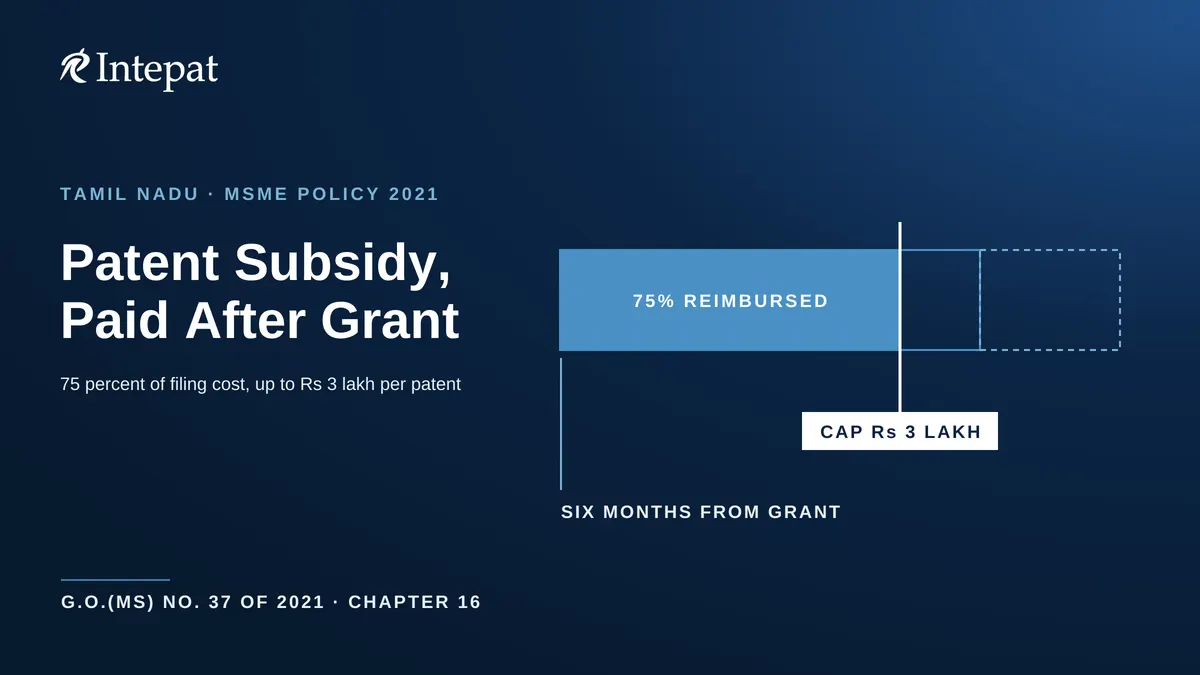
What the Tamil Nadu patent subsidy pays
The State pays 75 percent of the cost of filing the application for patent registration, including the cost of the first maintenance fee of the granted application, subject to a maximum of Rs 3 lakh per patent registered. Patents registered in India or abroad both qualify.
The ceiling attaches to each patent rather than to the enterprise, and no aggregate or annual ceiling across patents appears in the chapter that governs this subsidy. The general terms of the guidelines do carry a paragraph headed “Overall Ceiling on subsidy”, but its arithmetic is addressed to a project and its expansion rather than to intellectual property claims. An enterprise planning several claims in one year should put that question to its District Industries Centre rather than assume the chapter stands alone.
| The subsidy at a glance | |
| Rate | 75 percent of the cost of filing the application; the guidelines do not define what that cost includes |
| Cap | Rs 3 lakh per patent registered |
| Also covered | The first maintenance fee of the granted application |
| Filings covered | Patents registered in India or abroad |
| Who may claim | New and existing micro, small and medium manufacturing enterprises located anywhere in Tamil Nadu, under the 2021 guidelines; four other official documents word this more widely |
| When | Claimed after the patent is obtained; Chapter 16 sets no release mechanism of its own, so the general terms of the guidelines govern |
| Claim window | Within six months, run from the date of obtaining the patent in the guidelines and from the date of receipt of the patent registration in two other official documents |
| Where | Online, to the General Manager of the District Industries Centre; the Regional Joint Director of Industries and Commerce for Chennai district |
| Rs 1 lakh component | Rs 1 lakh disbursed under the same scheme: on proof of patent registration alone in the Policy Note for 2023-24, and without any documentary proof in the Policy Note for 2024-25; no Government Order for it was traced |
Verified as of October 2026.
Who qualifies, and the wording you should check
The 2021 guidelines open the scheme to all new and existing micro, small and medium manufacturing enterprises located anywhere in Tamil Nadu, for innovations capable of industrial application. On that wording, service enterprises are outside it. The guidelines do not elaborate on what makes an innovation capable of industrial application.
A granted patent will ordinarily have cleared that question already. There is no age limit and no requirement of startup recognition either, but the size limits are built into the eligible class itself. Classification runs on a composite criterion of investment and turnover, and the central limits were raised with effect from 1 April 2025: a medium enterprise may now have investment in plant and machinery or equipment of up to Rs 125 crore and annual turnover of up to Rs 500 crore, with export turnover excluded from the calculation.
That revision matters to anyone working from the guidelines alone, because the 2021 text recites the older limits of Rs 50 crore and Rs 250 crore. Udyam registration classifies on the current notification, so check your present Udyam classification rather than the figures in the guidelines. Classification settles size and nothing else: the separate manufacturing requirement still applies. A Udyam registration is also the ordinary way an enterprise evidences its status.
The State’s other documents are worded more widely, and the difference is material enough to check before you budget. The annexure to the MSME Policy 2021 describes the beneficiary as any individual, institution, MSME or start-up. The Citizens’ Charter uses the same formula, the Policy Notes for 2022-23 and 2023-24 extend the scheme to all MSMEs including individuals, institutions and startups, and the Policy Note for 2024-25 states no eligibility condition at all. The wide wording therefore runs unbroken through four official restatements between 2021 and 2024, against the single narrower clause in the guidelines.
The safer assumption is the narrower one, so a services business or an individual inventor should put the question to the District Industries Centre in writing. A company shut out on that wording is not necessarily outside State support: two newer Tamil Nadu policies carry patent money of their own, set out below.
When and how the money is claimed
The subsidy is a reimbursement after grant, not a discount at filing. The enterprise applies online within six months to the General Manager of the District Industries Centre for its district, or to the Regional Joint Director of Industries and Commerce in Chennai district. Chapter 16 sets no release mechanism of its own, so the general terms govern.
Count the six months from the earlier of two dates. The guidelines run the window from the date of obtaining the patent, while the policy annexure and the Citizens’ Charter both run it from the date of receipt of the patent registration. Those can differ by weeks, and a claim in the fifth month is not the place to test which controls.
The window is the part most often missed, because it runs from a date that arrives years after the money was spent. Keep the invoices, the fee receipts and the bank entries for the whole prosecution in one place from the start, because assembling them against a six-month clock after the grant certificate arrives is the harder path.
If the window has already closed, do not assume the claim is gone. The general terms of the guidelines give the Industries Commissioner and Director of Industries and Commerce, or the Managing Director of TIIC, a power to condone delay on the merits. The outer limit on that power is expressed against the date of commencement of commercial production, which has no obvious counterpart in a patent claim, so put a late claim to the District Industries Centre and ask for it to be referred rather than writing it off.
Two further clocks run after filing. If the District Industries Centre returns the application asking for more particulars, the general terms require it to be resubmitted within 90 days of the enterprise receiving it back. A discretionary extension of up to a further 90 days exists, but it carries its own outer limit of 18 months from the commencement of commercial production, which runs into the same mismatch as the condonation power above, so do not plan on 180 days as of right. Processing itself is tied to the timelines in the Tamil Nadu Business Facilitation Rules rather than to a period stated in the scheme.
Two points about payment matter before you treat the subsidy as cash. Where the enterprise is assisted by a bank or by TIIC, the general terms release subsidies through that lender rather than to the enterprise, and only a self-financed enterprise is paid into its own account. Those terms also provide for a single instalment on subsidies up to Rs 50 lakh, but tie it to the commencement of commercial production, which has no obvious counterpart in a patent claim. The guidelines further require the enterprise’s existence to be verified at the time of disbursement, which matters more here than in most incentives because years separate the spending from the claim.
Filing a provisional application first is frequently the right commercial decision, and the law then requires the complete specification within twelve months of that date, failing which the application is deemed abandoned; that rule does not reach a convention application or an international application designating India. The subsidy attaches to the patent eventually registered rather than to a filing stage, so a provisional filing starts no clock here.
The Rs 1 lakh component
Alongside the 75 percent reimbursement, the MSME Department has announced a flat Rs 1 lakh. The Policy Note for 2023-24 says it is disbursed under this scheme on proof of patent registration alone, without any other documentation. The Note for 2024-25 says it needs no documentary proof.
The amount appears in neither the policy annexure nor the chapter that governs the subsidy, and no Government Order for it was traced. The Note for 2024-25 sets the two out side by side: Rs 1 lakh without any documentary proof, and, based on documents, 75 percent up to Rs 3 lakh. It does not say whether an enterprise chooses between them or may have both.
The two Notes do not even say the same thing about proof. The 2023-24 Note keeps proof of patent registration and excuses everything else, while the 2024-25 Note asks for no documentary proof at all. Neither wording displaces the eligibility conditions in the guidelines, so treat the registration certificate as the minimum your District Industries Centre will want, and ask what else it expects.
The Tamil Nadu Startup and Innovation Policy 2023 states it differently again. Its summary table presents the subsidy as a minimum of Rs 1 lakh or 75 percent up to a maximum of Rs 3 lakh, whichever is higher, which makes the Rs 1 lakh a floor. Its narrative text restates the subsidy as 75 percent up to Rs 3 lakh per patent registered, with no floor.
Which route your district operates, and what it asks for, is a question for your own District Industries Centre rather than one to settle from the documents. Keep the scale of the scheme in view when you weigh the paperwork against the money. The department reported disbursing Rs 18.05 lakh to 53 MSMEs in 2022-23 towards patent and trade mark registration, and Rs 9 lakh to 15 enterprises in 2023-24 towards registration of intellectual property rights generally. Both totals mix patents with other rights, so neither shows what a patent claim by itself typically pays.
What the guidelines leave open
Three gaps in the published text matter to anyone planning a claim. They concern what counts as the cost of filing, what documents must be uploaded, and how the first maintenance fee fits the timetable. A fourth question, whether the subsidy can be combined with a central reimbursement, is taken up in the last section.
The phrase “cost of filing” is not defined. Whether it reaches only the statutory fees, or extends to agent and attorney charges, drafting and search costs, and the fees on a foreign application, is left open. Since professional charges are usually the larger part of a patent bill, settle this in writing before the expenditure statement is prepared.
The documents are a second gap. The guidelines direct applicants to a list at Annexure II, and the portion of that annexure readable for this article sets out lists for other incentives without an entry for patent registration. Ask the District Industries Centre what must be uploaded.
The first maintenance fee is a third. It is expressly inside the claim, but the guidelines do not say whether a maintenance fee paid after the claim has gone in can be added to it. If the fee falls due close to the end of the six-month window, ask before you file rather than after.
If the District Industries Centre refuses a claim, ask for the decision in writing, and ask the Commissionerate of Industries and Commerce which review or grievance procedure applies to an incentive decision. The department’s published charter names appellate authorities for MSME matters without stating what they have jurisdiction over, so it is not a safe basis for assuming that an appeal lies against a subsidy refusal.
Why some sources still say 50 percent and Rs 2 lakh
Those figures come from the earlier scheme. Under the Micro, Small and Medium Industries (MSMI) Policy 2008, issued with G.O.(Ms) No. 14 of 7 May 2008, the State paid 50 percent of the cost of filing a patent or Rs 2 lakh, whichever was less. The 2021 guidelines superseded the earlier subsidy orders.
That older scheme reached only manufacturing enterprises having in-house or stand-alone research and development laboratories, a condition the current one does not carry. The older numbers persist because the 2008 guidelines are still hosted on the department’s own application portal, and because aggregator sites copy from one another. If a page quotes 50 percent, or a Rs 2 lakh ceiling, or conditions the subsidy on a research and development laboratory, it is describing the superseded scheme.
The 2024-25 Policy Note restates the current framework in the present tense, and no Government Order amending the patent subsidy appears on the department’s own orders list. That list was checked in October 2026, and its latest entry is dated 4 January 2022, so it shows nothing either way about the years since. It does carry orders issued after the 2021 guidelines that amend other incentives under them, such as G.O.(Ms) No. 64 of 3 November 2021, on the rate of incentive and maximum eligible subsidy for IPO listing expenditure of SMEs.
Other Tamil Nadu routes for deep tech and animation companies
Two newer State policies carry patent money of their own, on terms more generous than the MSME subsidy but aimed at narrow sectors. Each runs for five years from its notification. Confirm the current policy period and the claim route with the nodal agency named below.
The Tamil Nadu Deep Tech Startup Policy 2025-26 offers reimbursement of up to Rs 10 lakh per deep tech startup for domestic and international patent filings. The cap is per startup rather than per patent, and covers both kinds of filing together. The incentive table covers patent filing fees, legal expenses and IP consultancy costs, which is more than Chapter 16 says about its own cost base. The policy states no percentage, no disbursement stage and no claim window.
Access is a gated selection rather than a checklist. A startup applies online with a self-declaration and goes through a three-stage assessment ending in evaluation by the Tamil Nadu Deep Tech Advisory Group, which the policy expects to complete within 45 to 60 days. Recognition under the central DPIIT criteria is expressly not a mandatory condition. The written conditions are a registered office or an operational presence in Tamil Nadu and a workforce threshold: at least a quarter of the total non-contract workforce in the State, or, for an entity based outside Tamil Nadu with a substantial footprint in it, at least a fifth of its workforce or a minimum of twenty full-time employees there. iTNT Hub is the nodal implementing agency.
The policy describes its provisions as a top-up on existing State and national support, and says that entities which have already drawn benefits under earlier policies may explore top-up options under it. It states no bar on double recovery of its own. That describes how the policy is designed rather than granting permission to recover the same expenditure twice, so settle admissible costs and sanction terms with iTNT Hub and your District Industries Centre before you budget on both.
The Tamil Nadu AVGC-XR Policy goes further for animation, visual effects, gaming, comics and extended reality companies with registered offices and operations in the State. It offers a 100 percent rebate on IP filing and legal consultation costs, capped at Rs 8 lakh for domestic filings and Rs 20 lakh for international filings, per sanction, per company, per year. A company may take up to five sanctions during the policy period, and copyrights, trademarks and patents relating to the same IP count as a single sanction. ELCOT, the Electronics Corporation of Tamil Nadu, is the nodal agency for the sector and for implementing the policy.
How the State subsidy sits with central support
Central support comes in two forms: a lower fee scale at the Patent Office, which is a discount at the counter, and the Ministry of MSME’s Innovative Scheme, which is money back after grant. The State subsidy and the central reimbursement are competing claims on one patent, because the central scheme bars it from its side.
On official patent fees the lower scale is substantial. The base electronic application fee is Rs 1,600 where every applicant is a natural person, startup, small entity or educational institution, against Rs 8,000 where any other applicant is on the form, alone or jointly with one of those. The request for examination is Rs 4,000 against Rs 20,000, and a request for expedited examination is Rs 8,000 against Rs 60,000, which is an electronic filing only. Small entity and startup are separately defined, and a company can be one without being the other.
Three conditions attach to that scale. A small entity, a startup or an educational institution files Form 28 with each fee-bearing document, where a natural person does not. If the application is later transferred, wholly or in part, to someone outside those categories, the fee difference becomes payable with the request for transfer, though outgrowing startup recognition or the turnover threshold triggers no repayment. And expediting carries a cost absent from the fee table: unless the application has published or a publication request has gone in, a request for expedited examination must carry a request for early publication, so the specification goes public ahead of the ordinary eighteen-month point. Being a startup or small entity is itself a ground for expediting, but confidentiality can be worth more than the time saved.
The central reimbursement repays 100 percent of the actual cost of registration, up to Rs 1 lakh for a domestic patent and Rs 5 lakh for a foreign one, claimed after grant by a Udyam-registered enterprise through an IP Facilitation Centre; the patent benefits for an MSME guide sets out the route. The support is one-time per registration, and an enterprise may claim for any number of registrations. Its guidelines require a self-declaration that the applicant is not claiming funding from any central or State government source for the same patent, and that declaration is drawn by patent rather than by invoice line, so splitting the official fees to one scheme and the professional fees to the other is not a route the text leaves open. The scheme also ties the patent to the Udyam holder: an individual claimant needs the Udyam registration in his or her own name and full ownership of the enterprise, and a partner claiming through a firm needs proof of at least 51 percent ownership. Check how the patent owner, the claimant and the Udyam-registered enterprise relate to one another before you file the claim.
| Choosing between the two reimbursements | Tamil Nadu subsidy | Central MSME scheme |
| Rate and ceiling | 75 percent against documents, up to Rs 3 lakh per patent; or the Rs 1 lakh the Policy Notes describe on the registration certificate alone | 100 percent, up to Rs 1 lakh for a domestic patent and Rs 5 lakh for a foreign one |
| Deadline | Six months from obtaining the patent | No post-grant period identified in the cited 2022 guidelines; confirm current portal and facilitation-centre requirements |
| Who | Manufacturing MSMEs in Tamil Nadu | Udyam-registered MSMEs, with the registration in the claimant’s own name |
Which route pays more turns on the ceilings rather than on the headline rate. On a domestic patent, 100 percent up to Rs 1 lakh pays more than 75 percent until eligible spend passes about Rs 1.3 lakh; on a foreign patent the central ceiling of Rs 5 lakh exceeds the State’s Rs 3 lakh cap, so the central route pays more across almost the whole range. Where the Rs 1 lakh the Policy Notes describe is available, it matches the central ceiling on a domestic patent and the central advantage disappears. Compare what is actually admissible under each route, and confirm the deadlines each one is operating, before choosing. One central route has run its term: SIPP, the facilitator scheme for recognised startups and, on its own terms, for Indian innovators using a TISC and for Indian educational institutes, ran for three years to 31 March 2026 on its published terms, and no extension or successor had been notified on the pages checked in October 2026, though the Patent Office page still lists it. That is a statement about the published term, not about what becomes of a claim already supported.
There is also help outside the subsidies. The Patent Information Centre run by the Tamil Nadu State Council for Science and Technology was set up with the Patent Facilitating Cell of TIFAC under the central Department of Science and Technology, and offers facilitation rather than a State payment of its own. Where a facilitation centre quotes Rs 1 lakh and Rs 5 lakh, those are the central scheme’s caps and not a Tamil Nadu entitlement. Summaries of patent reimbursement schemes in other States are useful for comparison, but the terms differ from State to State, and patent reimbursement in Tamil Nadu under the MSME Department route described above is claimed only after grant.
Frequently Asked Questions
The 2021 guidelines open it to new and existing micro, small and medium manufacturing enterprises located anywhere in Tamil Nadu. On that wording, service enterprises are outside it. Four other official documents, including the policy annexure and the Citizens’ Charter, word it more widely to cover individuals, institutions and start-ups. Confirm your position with the District Industries Centre.
After the patent is obtained, and within six months of that date. The subsidy is a reimbursement rather than a discount at filing, and Chapter 16 sets no release mechanism of its own, so the general terms apply. Because grant usually arrives years after the spending, keep fee receipts, invoices and bank records from the beginning of prosecution.
The guidelines do not define what the cost of filing includes, so this is unsettled. Professional charges are usually the larger part of a patent bill, which makes the answer worth several times the official fees on most claims. Ask the District Industries Centre in writing before the expenditure statement is prepared.
Yes. The guidelines cover the cost of patent registration in India or abroad, and the Rs 3 lakh ceiling applies per patent registered rather than per enterprise. Each foreign patent carries its own six-month window running from its own grant, so a portfolio filed together will not become claimable all at once.
No. It is an amount announced in the MSME Department’s Policy Notes for 2023-24 and 2024-25, disbursed under the same scheme. The 2023-24 Note makes it payable on proof of patent registration alone; the 2024-25 Note says only that it needs no documentary proof. No Government Order for it was traced.
The central scheme bars it from its side, through a self-declaration against other government funding for the same patent. The Tamil Nadu guidelines impose no equivalent condition on this subsidy, although they do impose one on a different incentive, so the bar operates from the central side only.
Online, to the General Manager of the District Industries Centre for your district, or to the Regional Joint Director of Industries and Commerce if you are in Chennai. The department’s scheme page publishes neither the application link nor a document checklist, so ask your District Industries Centre for both well before the window opens.
The Deep Tech Startup Policy is drafted as a top-up on existing State support rather than a replacement, and states no bar on double recovery of its own. The MSME guidelines impose no bar either. Neither text settles the point expressly, so confirm with iTNT Hub and your District Industries Centre before budgeting on both.
Neither is a condition in the 2021 guidelines, which turn on being a manufacturing MSME in Tamil Nadu. Recognition by the Department for Promotion of Industry and Internal Trade supports the startup category for Patent Office fees, though that scale also reaches a small entity or a natural person. The Deep Tech route needs Advisory Group approval.
This article explains the law on the Tamil Nadu patent subsidy in India as at October 2026 and is for general information only. It is not legal advice. Government fees, forms, and procedures change; confirm current figures with the Indian Patent Office before you file. For advice on your specific invention, consult a registered patent agent. Scheme terms, eligibility and available funds are matters for the Tamil Nadu MSME Department and the District Industries Centre, which should be asked to confirm the position for your claim.
Sources
- Guidelines for Administration of Incentives and Concessions under the MSME Policy 2021, issued with G.O.(Ms) No. 37, MSME (D2) Department, dated 6 July 2021: Chapter 16 (printed page 46) and the general terms at paragraphs 5.9(x), 5.10, 5.11, 5.12, 5.13, 5.16, 5.17, 5.18 and 5.19. Government of Tamil Nadu, Single Window Portal. This copy carries the appended guidelines in full; the department’s own Government Order PDF carries the cover order alone. https://tnswp.com/DIGIGOV/StaticAttachment?AttachmentFileName=%2Fpdf%2FHomepage%2FG+O+37+MSME+Policy+dt+06_07_2021+1.pdf
- 1A. G.O.(Ms) No. 37, MSME (D2) Department, dated 6 July 2021, cover order, paragraphs 1 to 5 (supersession of earlier subsidy orders). Government of Tamil Nadu. https://kygcms.tn.gov.in/cms_migrated/document/GO/msme_e_37_2021.pdf
- 1B. Notification S.O. 1364(E), dated 21 March 2025, revising the micro, small and medium enterprise classification criteria with effect from 1 April 2025, amending S.O. 2119(E) of 26 June 2020, whose paragraph 5(1) carries the export-turnover exclusion and is not reproduced at this link. Ministry of Micro, Small and Medium Enterprises. https://dcmsme.gov.in/Notification-S.O-no-1364-E-dated-21.03.2025-Revised-Definition.pdf
- Micro, Small and Medium Enterprises Policy 2021, Annexure I, Section 3, item 3.1 (page 23) and section 4.13 (page 17). Government of Tamil Nadu. https://www.tansidco.tn.gov.in/pdf/Policy_Notes/msme_policy_2021.pdf
- MSME Department, New Schemes: Schemes for Leveraging the Intellectual Property Regime. Government of Tamil Nadu. https://www.msmetamilnadu.tn.gov.in/new-schemes.php
- MSME Department, Government Orders list (checked October 2026; latest entry G.O.(Ms) No. 3 dated 4 January 2022). Government of Tamil Nadu. https://www.msmetamilnadu.tn.gov.in/govt-orders.php
- Citizens’ Charter 2021-2022, MSME Department, page 6, scheme 3.1. Government of Tamil Nadu. https://www.msmetamilnadu.tn.gov.in/pdf/citi-english.pdf
- MSME Department Policy Note 2023-2024, section 2.4.8 (pages 35 to 36). Government of Tamil Nadu. https://www.msmetamilnadu.tn.gov.in/pdf/msme_e_pn_2023_24.pdf
- MSME Department Policy Note 2024-2025, section 2.3.8 (page 34). Government of Tamil Nadu. https://tn.gov.in/rti/msme/msme_e_pn_2024_25.pdf
- MSME Department Policy Note 2022-2023, section 2.3.8 (pages 24 to 25). Government of Tamil Nadu. https://financedept.tn.gov.in/en/my-documents/2020/07/d44_2022_23.pdf
- MSMI Policy 2008 and Guidelines, G.O.(Ms) No. 14 dated 7 May 2008, Annexure I, paragraph 6.1.7 (page 18), superseded. Government of Tamil Nadu. https://www.msmeonline.tn.gov.in/incentives/pdf/msmi_guidlines.pdf
- Tamil Nadu Startup and Innovation Policy 2023, section 7.3.12 table item 14 (page 28) and section 7.5.3 (page 35), which state the subsidy inconsistently. StartupTN. https://startuptn.in/pdf/Tamil-Nadu-Startup-and-Innovation-Policy-2023.pdf
- Tamil Nadu Deep Tech Startup Policy 2025-26: incentive table (printed page 25), section 3 and its footnote 5 (pages 10 to 12), sections 8 and 9. iTNT Hub. The searchable text of the policy book carries no notification date; the order approving the policy was not read for this article. https://itnthub.tn.gov.in/assets/deep-tech-policy-book.pdf
- Tamil Nadu AVGC-XR Policy: section 7.7 (printed page 26) and section 8.3 (eligibility), section 2.4 (policy period) and section 9.1 (nodal agency). Information Technology and Digital Services Department, Government of Tamil Nadu. The searchable text carries no notification date; the order approving the policy was not read for this article. https://tamildigitallibrary.in/assets/docs/uploads/catalogue_article_file/BOK/upload/2026/03/TVA_TVA_BOK_062979/upload_primary_20260314041755935_20260314040143.pdf
- The First Schedule, Patents Rules 2003, entries 1, 28 and 29, including the column heading “Other(s), alone or with natural person or startup or small entity or educational institution”. Office of the CGPDTM. https://www.ipindia.gov.in/writereaddata/Portal/ev/schedules/Schedule_1.pdf
- Patents Rules 2003, rule 2(fb) (definition of startup) and rule 7 (fees, Form 28, and the sub-rule (3) difference on transfer with its Explanation). Intellectual Property India. https://ipindia.gov.in/acts/patent-rules-2003/rule-2 ; https://ipindia.gov.in/acts/patent-rules-2003/rule-7
- Patents Rules 2003, rule 24C, including sub-rule (1)(b) and (c) and the sub-rule (3) publication requirement. Intellectual Property India. https://ipindia.gov.in/acts/patent-rules-2003/rule-24c
- Patents Act 1970, section 9(1) (complete specification within 12 months, and the convention and international application carve-outs). Government of India. https://ipindia.gov.in/frontend/pdf/patents/1_113_1_The_Patents_Act__1970___incorporating_all_amendments_till_1-08-2024.pdf
- MSME Innovative Scheme Guidelines, section 4.3 (100 percent reimbursement, ceilings, one-time support per registration, the self-declaration scoped to the same patent, Udyam and ownership conditions). Office of the Development Commissioner, Ministry of MSME. https://dcmsme.gov.in/CLCS_TUS_Scheme/MSME%20Innovative%20Scheme%20Guidelines.pdf
- Scheme for Facilitating Start-Ups Intellectual Property Protection (SIPP), approved scheme document and scheme page. Intellectual Property India. https://www.ipindia.gov.in/writereaddata/Portal/News/885_1_approved_SIPP_scheme.pdf ; https://ipindia.gov.in/page-content/startups-intellectual-property-protection-sipp
- Patent Information Centre. Tamil Nadu State Council for Science and Technology. https://www.tanscst.tn.gov.in/intro_pic