




Most MSMEs in India pay about 80% less in government patent fees than large companies, and the saving runs for the full 20-year life of the patent, not just at filing. The catch is that it is not automatic. You claim it by filing one form, Form 28, with your Udyam Registration Certificate when you file. Miss that step and the patent office charges the full large-entity rate, with no way to claim the difference back.
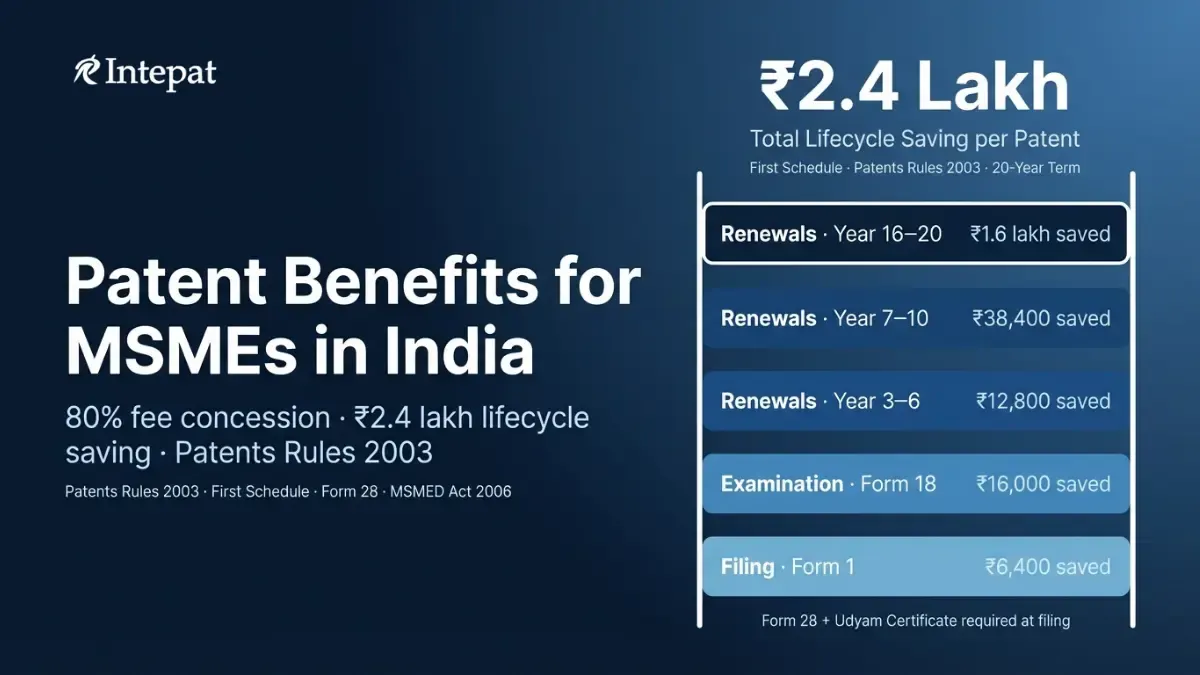
The numbers are large enough to matter. A small engineering firm pays roughly Rs 8,100 in government fees to file and request examination as a qualifying MSME. The same application as a large entity costs about Rs 40,500. Over 20 years, the gap per patent runs past Rs 2.4 lakh. For a business holding three or four patents, that is real money saved by getting one form right.
This guide covers who qualifies, what you pay at each stage, the government scheme that refunds part of your cost after grant, and the filing traps that catch established businesses most often. For the full fee schedule across all forms, see patent filing fees in India.
QUICK ANSWER
• File Form 28 with your Udyam certificate at the time of filing. Without it you pay the full large-entity rate, and it cannot be fixed later.
• The 80% concession covers every government fee: application, examination, and renewals, all the way to year 20.
• All Udyam-registered MSMEs qualify, including Medium enterprises (Rule 2(fa), Patents Rules 2003).
• After grant, the MSME Innovative Scheme refunds up to Rs 1 lakh for an Indian patent and up to Rs 5 lakh for a foreign one.
• File before you show or sell the invention. India has no general grace period for prior disclosure.
What Is the Patent Fee Concession for MSMEs?
The patent office runs two fee scales. One is for individual inventors, startups, small entities, and educational institutions; the other is for everyone else. The small-entity scale is about 80% lower, and an MSME pays on it at every fee-bearing stage, not only when it files. (First Schedule, Patents Rules 2003.) To estimate the total for your own filing, use the patent fees calculator.
| Form or stage | Small entity (e-filing) | Large entity (e-filing) | Your saving |
| Form 1, application (up to 30 pages, 10 claims) | Rs 1,600 | Rs 8,000 | Rs 6,400 |
| Form 9, early publication request | Rs 2,500 | Rs 12,500 | Rs 10,000 |
| Form 18, request for examination | Rs 4,000 | Rs 20,000 | Rs 16,000 |
| Form 18A, expedited examination | Rs 8,000 | Rs 60,000 | Rs 52,000 |
| Renewal, years 3 to 6 (per year) | Rs 800 | Rs 4,000 | Rs 3,200 |
| Renewal, years 7 to 10 (per year) | Rs 2,400 | Rs 12,000 | Rs 9,600 |
| Renewal, years 16 to 20 (per year) | Rs 8,000 | Rs 40,000 | Rs 32,000 |
(Source: First Schedule, Patents Rules 2003, verified as of July 2026. Physical filing adds a 10% surcharge.)
| PRACTITIONER NOTE |
| Form 28 switches the concession on; it is not applied by default. File it with your Udyam Registration Certificate at the time of filing, through the IP India e-filing portal. If it is missing, the office charges the large-entity fee, and you cannot reclaim the difference later. A sole individual inventor is the only applicant who does not need Form 28. |
Does Your MSME Qualify as a Small Entity?
Almost every MSME qualifies. The test is simple in practice: if your investment and turnover sit within the medium-enterprise limits, you are in. Since 1 April 2025 those limits are Rs 125 crore investment and Rs 500 crore turnover, so micro, small, and medium units all fall inside, as long as you hold a valid Udyam Registration Certificate. (Rule 2(fa), Patents Rules 2003, read with the MSMED Act 2006.)
A Medium enterprise still gets the full 80% concession. This is more generous than the trademark fee concession, which uses a tighter test.
Documents You Need
- Indian applicants: a valid Udyam Registration Certificate and Form 28, filed with the application.
- Foreign applicants: a CA-certified statement showing investment and turnover within the medium-enterprise limit, a signed affidavit in English, and Form 28.
- Sole individual inventors: no Form 28 needed.
If Your Business Grows Past the Limit Later
Growth does not claw back what you have already saved. If you cross the threshold after filing, you keep the small-entity rate on fees already paid; only future fees move to the large-entity rate. The practical move is to file your application and your examination request while you still qualify. For the faster route, see expedited patent examination in India.
If You Also Hold DPIIT Startup Recognition
DPIIT-recognised startups get the same 80% concession plus one extra benefit: the SIPP scheme, under which government-empanelled facilitators handle prosecution at no cost. A plain Udyam-registered MSME without DPIIT recognition does not get SIPP; its scheme is the MSME Innovative Scheme instead. (DPIIT is the Department for Promotion of Industry and Internal Trade; SIPP is its Startups Intellectual Property Protection scheme.) The IP India Patents portal carries Form 28 guidance and the facilitator list.
Does the 80% Concession Apply to Renewals Too?
Yes, and this is where most owners underestimate the saving. The lower scale covers every government fee through year 20: annual renewals, extension fees, and opposition fees. File correctly once and the concession follows automatically at every later stage.
One timing point matters if you are growing. Lock in the lower rate by filing your application and examination request before you cross the threshold. Once the examination request is filed at the small-entity rate, that request stays at the lower rate even if your status changes before the first report arrives.
| WORKED EXAMPLE |
| A small engineering firm files at the small-entity rate. Government fees to grant (Form 1, Form 9, Form 18) come to about Rs 8,100, against roughly Rs 40,500 as a large entity. Renewals over 20 years add about Rs 53,200 at the small-entity rate, against about Rs 2,66,000 as a large entity. Total saving per patent: over Rs 2.4 lakh. Official fees only; professional fees are separate. |
Getting Part of Your Cost Back: The MSME Innovative Scheme
After your patent is granted, you can claim back part of what you spent. The MSME Innovative Scheme (IPR component), run by the Ministry of MSME, reimburses a Udyam-registered MSME for patent costs. It is separate from the fee concession and does not need DPIIT recognition. It is not automatic: you apply after grant, and payment depends on the scheme rules, available funds, and approval.
| IP right | Maximum reimbursement |
| Indian patent | Up to Rs 1 lakh |
| Foreign patent | Up to Rs 5 lakh |
| Trademark registration | Up to Rs 10,000 |
| Geographical Indication registration | Up to Rs 2 lakh |
(Source: Ministry of MSME, MSME Innovative Scheme guidelines. Verify current figures on the scheme portal before relying on them.)
Keep these ready before you apply: your Udyam certificate, the patent grant certificate, original invoices and receipts (filing fees, professional fees, related costs), and a bank mandate form. Claims go through the MSME Innovative Scheme portal. Because the money comes after grant, treat it as a refund that offsets cost, not as upfront funding.
| SIPP NOTE |
| SIPP versus the MSME Innovative Scheme. SIPP gives free facilitator support upfront, but only to DPIIT-recognised startups. The MSME Innovative Scheme gives a refund after grant, to any Udyam-registered MSME. A business with both recognitions can use both, as long as it has not already claimed the same cost from another government scheme. |
File Before You Show It to Anyone
This is the trap that catches established businesses most often. An MSME usually thinks about patents after the product is built, on sale, or shown at a trade fair. By then it may be too late. India has no general grace period for your own disclosure, and novelty is judged as at your filing date. A product you have already sold or displayed can be used as prior art against your own application.
The exceptions are narrow. Showing the invention at a government-notified exhibition, or reading a paper before a learned society, is saved only if you file within twelve months and follow the prescribed steps. Public use is saved only where it was a reasonable trial that genuinely needed to be in public. An ordinary commercial sale is not a reasonable trial. (Sections 29 to 34, Patents Act.)
The safe rule is simple: file before you disclose. If the invention is still taking shape, a provisional application locks in your date for twelve months at a low cost while you finish development. And sharing under a signed non-disclosure agreement is not public disclosure, so NDAs protect early conversations with buyers, distributors, and investors. They do not replace a filing once the product reaches the open market.
Filing Abroad: The Foreign Filing Licence
If you plan to patent abroad, there is an Indian step to clear first. A person resident in India cannot file a patent outside India unless either the same invention was filed in India at least six weeks earlier with no secrecy direction in place, or the Controller has given written permission. That permission is the foreign filing licence, requested on Form 25, and the office usually decides within 21 days. (Section 39.) Skip it and your Indian application can be treated as abandoned and any Indian patent revoked.
On cost, the MSME Innovative Scheme refunds up to Rs 5 lakh of a foreign patent. And a single PCT application lets you defer the country-by-country spend to around 30 or 31 months from your priority date, depending on the country (India’s own national phase is 31 months), which suits an MSME still testing which markets are worth it.
How a Patent Creates Business Value for an MSME
A granted patent does more than protect an idea. For an MSME it creates five commercial levers that move revenue, valuation, and competitive position.
1. Market Exclusivity
A granted patent lets you stop others making, using, selling, or importing your product or process in India. For a manufacturer that is pricing power: a rival who cannot legally copy your process must either pay for access or carry a cost disadvantage. (Section 48.)
2. Licensing Income
A patent you cannot fully exploit at your own scale can still earn royalties. Licensing a process patent to a larger manufacturer brings recurring income with no extra capital and no need to scale production yourself.
3. Investment and Due-Diligence Signal
A granted patent is a balance-sheet asset that shows up in due diligence. In engineering, food technology, and industrial chemicals, where Indian MSMEs cluster, a patent portfolio can improve loan terms, open equity conversations, and lift valuation at exit.
4. E-Commerce and Export Credibility
Selling online often needs registered IP. Amazon Brand Registry and similar programmes require it before they give you tools to remove counterfeit listings. A product patent, paired with trademark registration for MSMEs, is the strongest position for protecting your brand online.
5. Deterrence Against Copying
Your application publishes at 18 months and puts rivals on notice; pending status discourages copying at no extra cost. After grant you can send cease-and-desist notices and sue. That standing changes competitor behaviour well before any case is filed.
Filing Decisions Specific to an MSME
Provisional or Complete Specification?
A provisional patent application (Form 2, provisional) costs Rs 1,600 at the small-entity rate and holds your priority date for twelve months, giving you time to test the market before paying for full prosecution. The twelve months cannot be extended. Miss the complete specification and you lose both the date and the application. For the full sequence, see patent filing procedure in India.
When Must You Request Examination?
Examination does not start until you ask for it. File the request (Form 18, or Form 18A to expedite) within 31 months of your earliest priority or filing date. Miss it and the application is treated as withdrawn under Section 11B(4), with no way back. Diarise this date the day you file. (Rule 24B(1)(i). For the detail, see patent examination procedure in India.)
Do You Own What Your Staff Invent?
Do not assume you do. India has no rule that automatically gives an employer its employees’ inventions; ownership follows the employment contract. If you have R&D or product staff, put a written patent-assignment clause in every contract so the company is the rightful applicant. (Section 6.)
Managing Your Patent After Grant
- Renewals from year 3: renewal fees fall due every year from the third year, and become payable once the patent is granted. Non-payment lets the patent lapse; late payment is possible within six months with a surcharge. Plan ahead with the patent renewal fees calculator.
- Working statement (Form 27): after grant you must tell the patent office how you are working the patent, once every three financial years (Section 146). Not filing can be raised if someone later seeks a compulsory licence on the ground that the patent is not worked in India, though such cases are rare.
- Status tracking: you can follow your application from filing to grant on InPASS, the patent office’s free online status tracker, with no separate sign-up.
- Claim scope: claims that are too narrow are easy to design around; claims that are too broad invite invalidity challenges. The balance is technical, and it cannot be fixed after filing (Section 59).
When to Bring in a Registered Patent Agent
Self-filing is allowed, and the fee savings are real. But the quality of the specification decides how much your patent is actually worth. Mistakes made while drafting are hard to undo: you cannot add new matter after the filing date, and a patent granted with narrow claims protects little, however strong the underlying idea.
- FER responses: the First Examination Report (FER) is the examiner’s list of objections on novelty, inventive step, and Section 3 exclusions. A weak reply can leave you with a patent whose claims are too narrow to be worth much.
- Section 3(k) objections: MSMEs with software-driven manufacturing inventions often face Section 3(k) objections. Answering them well needs familiarity with the CRI Guidelines 2025, the patent office’s rules for computer-related inventions.
- Professional fees: for a straightforward mechanical or process invention, registered patent-agent fees usually run Rs 50,000 to Rs 1,50,000 for a complete specification and prosecution to grant. Complex fields such as biotech, pharma, or software-embedded systems cost more.
Summary
The 80% concession applies to every government fee across a patent’s 20-year life, but only if you claim it with Form 28 at filing. Miss that and you pay five times more, with no recovery. The MSME Innovative Scheme then refunds up to Rs 1 lakh for an Indian patent and up to Rs 5 lakh for a foreign one after grant. Together they make the real cost of protection far lower than the published fees suggest. Patent filings by startups and MSMEs grew 310% over five years to 6,120 in FY 2023-24 (DPIIT). The full benefit reaches only the businesses that file correctly, and early enough.
Frequently Asked Questions
It is a roughly 80% reduction in government patent fees. An MSME that qualifies as a small entity pays the lower of the two fee scales in the First Schedule, the same scale as startups and individual inventors. The base e-filing application fee is Rs 1,600 against Rs 8,000 for large entities. Form 28 activates it.
Yes. Rule 2(fa) ties the patent small-entity test to the medium-enterprise ceiling under the MSMED Act, currently Rs 125 crore investment and Rs 500 crore turnover since 1 April 2025. So micro, small, and medium enterprises all qualify, provided they hold a valid Udyam Registration Certificate and file Form 28.
Form 28 is the declaration that claims small-entity status. It must accompany every fee-bearing document, filed with your Udyam Registration Certificate. Without it, the patent office charges the full large-entity rate by default, and the difference cannot be reclaimed later. A sole individual inventor is the only applicant exempt from Form 28.
Two main routes. The MSME Innovative Scheme (IPR component) refunds patent costs after grant, up to Rs 1 lakh for an Indian patent and Rs 5 lakh for a foreign patent, for any Udyam-registered MSME. SIPP provides free facilitator support, but only to DPIIT-recognised startups. They are separate tracks.
No. SIPP, the Startups Intellectual Property Protection scheme, is open only to DPIIT-recognised startups, who get government-empanelled facilitators handling prosecution at no cost. A Udyam-registered MSME without DPIIT recognition does not qualify; its route is the MSME Innovative Scheme, which reimburses cost after grant instead.
The request for examination (Form 18, or Form 18A to expedite) must be filed within 31 months of the earliest priority or filing date, under Rule 24B(1)(i). Miss it and the application is treated as withdrawn under Section 11B(4), with no reinstatement. Diarise the deadline the day you file.
Yes. The 80% reduction covers every government fee across the 20-year life, including annual renewals from year three, extension fees, and opposition fees. At the small-entity rate, 20 years of renewals cost over Rs 2 lakh less per patent than the large-entity rate, provided Form 28 was filed correctly at the outset.
Nothing is clawed back. Fees already paid at the small-entity rate stand, with no back-payment due. Only future fees move to the large-entity rate. If you expect to cross the medium-enterprise limit, file your application and examination request while you still qualify, to lock the lower rate on those stages.
It depends on the employment contract. India has no rule automatically vesting employee inventions in the employer. To be sure the company can file as applicant under Section 6, include a written patent-assignment clause in the contracts of all R&D and product-development staff. Without it, ownership can be disputed.
At the small-entity e-filing rate, a patent application on Form 1 starts at Rs 1,600 for up to 30 pages and 10 claims. A provisional application costs the same. Extra sheets and claims add modest amounts. Examination on Form 18 is a separate Rs 4,000. These are official fees only, excluding professional charges.
The patent lapses. Renewal fees are due annually from the third year, and non-payment ends the patent’s effect. A lapsed patent can be paid late within six months of the due date with a surcharge, and restoration is possible in defined circumstances after that. Track renewal dates closely; the calendar matters as much as filing.
Self-filing is allowed and saves professional fees, but specification quality decides how much the patent is worth. Drafting errors cannot be fixed after filing: no new matter can be added, and narrow claims protect little. For anything commercially important, a registered patent agent usually pays for itself in the scope it secures.
Only with caution. India has no general grace period, so a product sold or displayed before filing can be used as prior art against your own application. Narrow savings exist for notified exhibitions and genuine public trials, but an ordinary sale is not covered. The safe course is to file before any public disclosure.
Usually, yes. Under Section 39, a resident cannot file abroad unless the invention was filed in India at least six weeks earlier with no secrecy direction, or a foreign filing licence (Form 25) is granted. The office decides within about 21 days. Filing in breach can render the Indian patent liable to revocation.
DISCLAIMER This guide states the position under the Patents Act 1970 and the Patents Rules 2003, as amended up to the Patents (Amendment) Rules 2024, with MSME classification under the revision effective 1 April 2025. Fee figures come from the First Schedule to the Patents Rules 2003 and are verified as of June 2026. Reimbursement amounts under the MSME Innovative Scheme are set by the scheme and change from time to time; confirm current figures and eligibility on the official MSME and IP India portals before relying on them. This article is for general information and is not legal advice. For your specific situation, consult a registered Indian patent agent.