




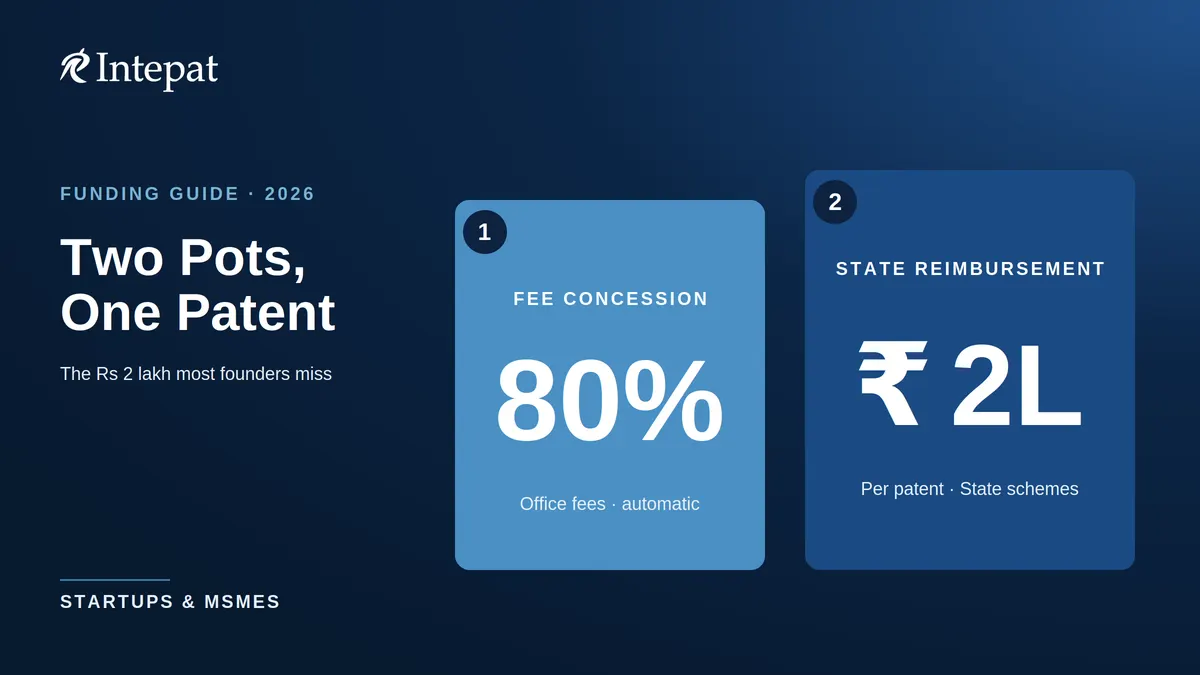
Beyond the 80% fee concession every recognised startup already gets, India runs a second layer of patent support that most founders never claim: patent reimbursement schemes that pay back the cost of a filing after grant. Several states refund up to Rs 2 lakh for an Indian patent, and a central scheme reimburses up to Rs 1 lakh after grant. Here is which pot covers which cost, and how to actually claim it.
The two pots: a fee cut is not the same as money back
Startup patent support comes in two mechanically different forms, and conflating them is the most common mistake founders make.
A fee concession lowers what you pay the Patent Office in the first place. Every recognised startup, small entity, and natural person sits in the lower fee slab, paying one-fifth of the large-entity rate at filing. Nothing is claimed back; the bill is simply smaller. This is the well-known “80% rebate,” and it applies at filing once you submit the small-entity / startup status declaration. It is covered in detail in our guide to the 80% fee concession for startups and MSMEs.
A reimbursement scheme is the opposite. You pay the full cost yourself, official fees and your attorney’s fees both, and then apply separately to a government scheme to get some of that money back, usually after filing milestones or after the patent is granted.
The distinction matters because of where each pot reaches. The fee concession touches official fees only. It does nothing for your attorney’s drafting and prosecution fees, which is where most of the cost of a patent actually sits: government fees are usually a small share of the total, and professional fees account for the rest.
Reimbursement schemes are the only support that reaches those professional fees. So the concession trims a small slice, and the reimbursement schemes are where the real recovery is. This article is about the second pot.
Quick answer: The 80% concession reduces your official Patent Office fees at filing. Reimbursement schemes pay back your spend, including attorney fees, after filing or grant. The concession applies once you file the status declaration; if you qualify, you can also claim one reimbursement scheme, but you cannot stack two reimbursement schemes on the same filing.
| Support type | What it does | Covers attorney fees? | When the benefit arrives |
| 80% fee concession | Reduces official Patent Office fees | No | At filing, examination, and renewal |
| State reimbursement | Pays back patent spend, subject to scheme | Usually yes | Across filing, prosecution, and grant milestones |
| MSME Innovative Scheme | Central reimbursement | Yes, subject to scheme | Generally after grant |
State patent reimbursement schemes: where the largest refunds sit
Most Indian states with a startup policy will refund part of the cost of a patent. The pattern repeats across states: a modest cap for an Indian patent, a larger cap for a foreign one, money released in stages tied to filing and grant, and a requirement that you first register with the state’s startup cell. The three strongest programmes for an Indian patent are below.
Karnataka reimburses up to Rs 2 lakh for an Indian patent and up to Rs 10 lakh for a foreign patent on a single subject matter. The money comes in two stages, 75% after the patent is filed and the balance 25% after it is granted, and it covers both government fees and attorney charges for drafting and consultation. The applicant must be a startup registered with the Karnataka Startup Cell with a valid registration number and be incubated, physically or virtually, and the patent must be filed within the validity of the prevailing Karnataka Startup Policy. The scheme is administered through KITS, the Karnataka Innovation and Technology Society, under the Department of Electronics, IT, Bt and S&T, Government of Karnataka. The scheme also carries time-bound application windows after filing and after grant, and a cumulative limit on patent reimbursement per startup; confirm the specific numbers and timelines against the current operational guidelines before claiming.
Confirm before relying on Karnataka’s figures. Karnataka has two policies running in parallel: the Karnataka Startup Policy (live figures on startup.karnataka.gov.in/incentives/) and the newer Karnataka Startup Policy 2025-30 published by the Department of EITBT. The 2025-30 instrument may have updated caps, percentages, per-year limits, or application windows. Confirm the live position on the relevant portal, or with KITS directly, before you file a claim.
Kerala, through the Kerala Startup Mission, reimburses up to Rs 2 lakh for an Indian patent and up to Rs 10 lakh for a foreign patent, released across three stages covering filing, prosecution, and grant, with no advance payment. It covers consultation and IP attorney fees alongside provisional filing, search, drafting, claims, and prosecution. It does not cover renewals or appeals against a rejection. The applicant needs a KSUM Unique ID and Startup India DPIIT recognition and/or Udyog Aadhaar / Udyam registration, as required by the current KSUM portal, with the startup registered in Kerala as a private limited company or LLP within ten years of incorporation. Student innovators apply through their college IEDC. Only patents filed on or after 9 November 2015 qualify. A useful detail: where a patent has already been granted, KSUM forwards the proposal to the MSME route at DIC Thrissur, so the state and central schemes are designed to hand off to each other rather than overlap.
Telangana offers 100% reimbursement of patent registration expenses, capped at Rs 2 lakh for an Indian patent and up to Rs 10 lakh for a foreign one, released 50% after filing and 50% after grant, for startups incubated and incorporated in the state.
Verify before you rely on Telangana’s figures. As of June 2026, the official Startup Telangana funding-incentives page still ties eligibility to “GO No 10 i.e 25-07-2017 to 25-07-2022,” a window that has lapsed. The figures are published, but the validity period on the page is expired. Confirm the current Government Order with the Telangana Innovation Cell before counting on this reimbursement.
A few other states run comparable schemes drawn from their startup policies. The figures below are policy-attributed and indicative; confirm each against the current state portal or Government Order before you rely on it.
| State | Indian patent | Foreign patent | Notes |
| Assam | up to Rs 1 lakh | up to Rs 5 lakh | 100% of actual costs (filing, attorney, search, maintenance); staging varies across policy vintage, verify with the Assam Startup portal |
| Madhya Pradesh | up to Rs 5 lakh | (covered) | Patent assistance up to Rs 5 lakh under the current Startup MP framework; structure to be confirmed |
| Gujarat | share of cost | share of cost | Reimburses up to 75% of cost, with caps that vary by policy vintage and operative period; check the current IT/ITeS Startup Policy 2022-27 |
| Tamil Nadu | facilitation + support | facilitation + support | TNSCST’s IP Facilitation Centre offers patent search, drafting, filing, and prosecution support, plus reimbursement support for Udyam-registered MSMEs |
The state entries above are indicative. State schemes change with each policy cycle and require live portal verification before any filing or claim.
MSME Innovative Scheme: central reimbursement after grant
If you are an MSME rather than (or as well as) a DPIIT-recognised startup, the central route is the MSME Innovative Scheme run by the Ministry of MSME. It reimburses the cost of obtaining a patent after the patent is granted: up to Rs 1 lakh for an Indian patent and up to Rs 5 lakh for a foreign patent. The same scheme also reimburses trademarks, designs, and GIs, though this article stays with patents.
Three conditions decide eligibility. The applicant needs a valid Udyam registration; the support is one-time; and it cannot be claimed if the same IP has been funded under any other central or state scheme. Applications are made through the MSME Innovative portal at innovative.msme.gov.in. This scheme is open to eligible MSMEs with a valid Udyam registration, subject to the current MSME Innovative Scheme guidelines, which makes it the natural central option for an MSME that does not qualify for the startup-only facilitator route.
The 80% concession, in one paragraph
The first pot is worth stating plainly so you can set it aside. Every recognised startup pays the natural-person fee slab, which is one-fifth of the large-entity rate: Rs 1,600 to file instead of Rs 8,000, and the same proportion across examination and renewals. To get it, you must attach the small-entity and startup status declaration (Form 28) to every fee-bearing document; miss it and the application is billed at the full large-entity rate with no recovery.
Expedited examination is also open to startups, at Rs 8,000 against Rs 60,000 for a large entity. The mechanics, including the forms and the full fee table, are in our 80% concession guide and our note on expedited examination, and you can model your own numbers with the patent fees calculator. None of this is reimbursement; it simply lowers the bill at source.
Can you stack schemes? The one-pot rule
You cannot fund the same filing from two reimbursement schemes. Almost every scheme requires a self-declaration that you have not drawn funds from another government scheme for the same patent. The MSME Innovative Scheme is explicitly one-time and excludes IP already funded elsewhere; the state schemes carry the same exclusivity; and the SIPP facilitator route, a separate third pot for DPIIT-recognised startups, asks for the same declaration.
The fee concession is the exception, because it is a statutory fee rate rather than a scheme. It always applies, and it stacks with whichever reimbursement scheme you choose. So the real decision is not whether to combine, but which single reimbursement pot is richest for a given filing. For an Indian patent, a state cap of up to Rs 2 lakh (where the state offers it and you qualify) beats the Rs 1 lakh central MSME cap. Holding both DPIIT recognition and Udyam registration widens your options across tracks, but it does not let you double-fund one filing.
How to claim, and when the money actually arrives
The paperwork is consistent across schemes: original invoices and receipts for both government and attorney fees, a bank statement evidencing payment, the patent application and the grant certificate, proof of the fee-slab declaration, and the scheme’s own forms (Karnataka, for instance, uses its Annexure I and asks for a valid Form 27, the Statement of Working of Patents under Section 146 read with Rule 131, which the 2024 amendment now requires once every three financial years rather than annually).
The harder reality is timing. Almost none of this money is upfront. Karnataka pays 25% only on grant; Kerala’s final stage is the award; Telangana holds 50% to grant; and the MSME Innovative Scheme is entirely post-grant. A patent in India can take years to grant even in a faster queue, and several states disburse on a seniority basis subject to that year’s budget allocation. So the practical sequencing is this: bank the immediate levers first, the fee concession at filing and expedited examination, and treat reimbursement as a recovery that lands later, sometimes much later, not as cash you can spend on the filing itself.
Lock in what you qualify for before you file
The avoidable losses on this topic all happen at or before filing, not after. Get DPIIT recognition or Udyam registration in place first, because both are gateways to the concession and the schemes. Attach the fee-slab status declaration at filing, or pay five times the fee for nothing. Register with your state startup cell before you file, because schemes like Karnataka’s require a valid registration number to claim.
Then pick the single richest reimbursement scheme for the filing, keep every invoice, and claim at each staged milestone. The founder who does this recovers a real share of the cost; the one who assumes the 80% concession is the whole story leaves the larger pot untouched.
Frequently asked questions
No. The 80% rebate is a fee concession: it lowers the official Patent Office fee at filing, and nothing is claimed back. A reimbursement scheme pays back money you have already spent, including attorney fees, after filing or grant. You can have both at once.
No. Reimbursement schemes require a declaration that you have not drawn funds from another government scheme for the same filing. You choose one reimbursement pot per patent. For an Indian patent, the state cap (up to Rs 2 lakh) is usually higher than the central MSME cap (up to Rs 1 lakh).
No. The concession reduces official Patent Office fees only. Professional drafting and prosecution fees, which make up most of the real cost of a patent, are untouched by it. Those professional fees are exactly what the reimbursement schemes are designed to refund, in whole or in part.
Later than founders expect. Most schemes release funds in stages tied to filing and grant; the MSME Innovative Scheme pays only after grant. Fund the filing yourself upfront and treat the reimbursement as a deferred recovery, sometimes years away.
It varies. Kerala asks for Startup India DPIIT and/or MSME/Udyam eligibility per the current KSUM portal; Karnataka requires Karnataka Startup Cell registration and incubation. Check your state portal, because the registration step often has to be completed before you file the patent.
It is Form 28, the declaration that establishes startup or small-entity status so the Patent Office charges the lower fee slab. It must accompany every fee-bearing document. Miss it and the application is billed as large-entity, with no recovery.
It is open to MSMEs with a valid Udyam registration, subject to current scheme guidelines. Unlike SIPP, it does not require DPIIT recognition, which makes it the main central reimbursement option for a general MSME.
Often no. Several state schemes, Karnataka among them, require a valid startup-cell registration number as a precondition, and only patents filed within the policy’s validity qualify. Register first, then file. Filing before you register can disqualify the spend you most wanted to recover.
This article is for general information and does not constitute legal advice. Government scheme figures, caps, eligibility conditions, and validity periods change frequently and vary by state. Verify the current position on the relevant official portal, or with a registered patent agent, before relying on any figure here for a filing decision.