




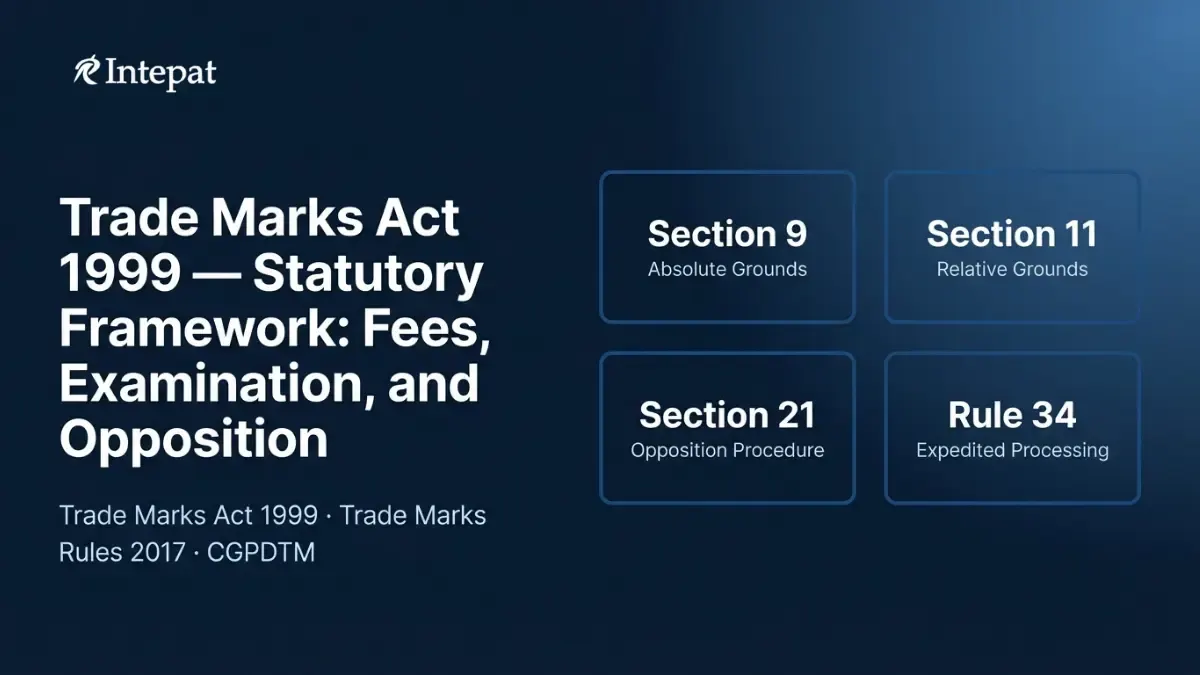
Scope: This article documents the statutory and regulatory framework under the Trade Marks Act 1999 and Trade Marks Rules 2017. It covers applicant eligibility criteria, the prescribed fee schedule under the First Schedule, examination grounds, opposition procedure under Rules 42 to 51, and expedited processing under Rule 34.
1. Legislative Framework
The Trade Marks Act, 1999 (Act No. 47 of 1999) and the Trade Marks Rules, 2017 (effective 6 March 2017) constitute the primary statutory framework governing trade marks in India. Both instruments are administered by the Office of the Controller General of Patents, Designs and Trade Marks (CGPDTM) under the Ministry of Commerce and Industry, Government of India.
The 1999 Act repealed and replaced the Trade and Merchandise Marks Act, 1958. It was enacted to bring Indian trade mark law into conformity with India’s obligations under the Agreement on Trade-Related Aspects of Intellectual Property Rights (TRIPS) following India’s accession to the World Trade Organization in 1995. The Trade Marks Rules, 2017 replaced the Trade Marks Rules, 2002 with effect from 6 March 2017, introducing a consolidated form structure (reducing forms from 75 to 8), a revised fee schedule differentiating applicant categories, and an expanded expedited processing regime.
Administration is conducted through five offices of the Trade Marks Registry located at Mumbai (Head Office), Delhi, Chennai, Kolkata, and Ahmedabad. The appropriate office for filing is determined by the applicant’s principal place of business in India under Rule 4 of the Trade Marks Rules, 2017. Where an applicant has no principal place of business in India, the appropriate office is determined by the address for service in India.
| Instrument | Citation | Effective Date | Key Scope |
| Trade Marks Act, 1999 | Act No. 47 of 1999 | 15 September 2003 | Primary statute: registration, rights, infringement, opposition |
| Trade Marks Rules, 2017 | G.S.R. 190(E) | 6 March 2017 | Procedure, fees, forms, Registry administration |
| Trade Marks (Amendment) Act, 2010 | Act No. 40 of 2010 | 8 July 2013 (Madrid provisions) | Madrid Protocol accession, international registration |
| First Schedule, Trade Marks Rules, 2017 | Schedule to G.S.R. 190(E) | 6 March 2017 | Prescribed fee schedule — all statutory fees |
2. Applicant Categories and Statutory Fee Eligibility
The Trade Marks Rules, 2017 prescribe a two-tier fee structure based on applicant category. The reduced fee tier applies to individuals, startups, and small enterprises. All other applicants, including companies, limited liability partnerships (LLPs), trusts, and societies, fall within the standard fee tier.
2.1 Individual
A natural person filing in their own name qualifies for the reduced fee. A sole proprietorship filing in the name of the individual proprietor also qualifies. A proprietorship filing in the name of the business entity does not qualify as an individual applicant.
2.2 Startup
A startup qualifies for the reduced fee if it holds a valid recognition certificate issued by the Department for Promotion of Industry and Internal Trade (DPIIT) under the Startup India initiative. The certificate must be valid at the time of filing the trade mark application. Recognition is granted under the Startup India Action Plan and the notification issued by DPIIT under G.S.R. 501(E) dated 23 May 2017, as amended. Eligibility criteria for DPIIT recognition include incorporation as a private limited company, a registered partnership firm, or a limited liability partnership; incorporation of not more than ten years; annual turnover not exceeding ₹100 crore in any financial year; and a declared objective of innovation, development, or improvement of products, processes, or services.
Statutory basis: Rule 2(x) and Rule 2(v), Trade Marks Rules, 2017; First Schedule, Trade Marks Rules, 2017.
2.3 Small Enterprise
A small enterprise within the meaning of Rule 2(v) of the Trade Marks Rules, 2017 qualifies for the reduced fee tier. Rule 2(v) defines a small enterprise by reference to the investment thresholds prescribed under Section 7(1) of the Micro, Small and Medium Enterprises Development Act, 2006: an enterprise where the investment in plant and machinery (for manufacturing) or equipment (for services) does not exceed the limit specified for a medium enterprise. An applicant claiming the reduced fee as a small enterprise must demonstrate compliance with those thresholds at the time of filing. A medium enterprise does not qualify for the reduced fee under the First Schedule.
Statutory basis: Rule 2(v), Trade Marks Rules, 2017; MSMED Act, 2006 Section 7; First Schedule, Trade Marks Rules, 2017.
3. Prescribed Fee Schedule: First Schedule, Trade Marks Rules, 2017
All statutory fees are prescribed under the First Schedule to the Trade Marks Rules, 2017. Fees are payable per class of goods or services under the Nice Classification system (11th edition, as adopted in India under Section 7 of the Trade Marks Act, 1999). No government fee is payable for responding to an examination report or for attending a hearing during the examination stage.
3.1 Application Filing Fee: Form TM-A
| Applicant Category | e-Filing Fee (per class) | Physical Filing Fee (per class) |
| Individual / Startup (DPIIT-recognised) / Small Enterprise (Udyam-registered) | ₹4,500 | ₹5,000 |
| Company / LLP / Trust / Society / All Other Entities | ₹9,000 | ₹10,000 |
Source: Entry 1, First Schedule, Trade Marks Rules, 2017. Fees are per class; a multi-class application attracts the fee separately for each class.
3.2 Opposition Fee: Form TM-O
| Applicant Category | Fee per Class |
| Individual / Startup / Small Enterprise | ₹2,700 |
| Company / LLP / Others | ₹3,000 |
Source: Entry 2, First Schedule, Trade Marks Rules, 2017. Entry 2 covers notices of opposition under Section 21(1) and applications for rectification.
3.3 Expedited Processing Fee: Form TM-M (Rule 34)
| Applicant Category | Fee |
| Individual / Startup (DPIIT-recognised) / Small Enterprise (Udyam-registered) | ₹20,000 |
| Company / LLP / Others | ₹40,000 |
Source: Entry 17, First Schedule, Trade Marks Rules, 2017. Entry 17 is available for e-filing only; physical filing of a Rule 34 request is not permitted.
3.4 Renewal Fee: Form TM-R
| Applicant Category | e-Filing Fee (per class) | Physical Filing Fee (per class) |
| Individual / Startup / Small Enterprise | ₹9,000 | ₹10,000 |
| Company / LLP / Others | ₹9,000 | ₹10,000 |
Source: Entry 3, First Schedule, Trade Marks Rules, 2017. Renewal is for a ten-year period under Section 25 of the Trade Marks Act, 1999.
4. Examination of Trade Mark Applications
Following filing of Form TM-A, the Registrar examines each application under the Trade Marks Act, 1999 and the Trade Marks Rules, 2017. Section 18(4) of the Act empowers the Registrar to refuse the application or accept it absolutely or subject to such amendments, modifications, conditions or limitations as the Registrar thinks fit. Examination is conducted against two categories of grounds: absolute grounds for refusal under Section 9 and relative grounds for refusal under Section 11.
4.1 Absolute Grounds for Refusal: Section 9
Section 9(1) of the Trade Marks Act, 1999 prohibits registration of a mark that:
- is devoid of any distinctive character;
- consists exclusively of marks or indications which may serve in trade to designate the kind, quality, quantity, intended purpose, values, geographical origin, or time of production of goods or rendering of services;
- consists exclusively of marks or indications which have become customary in the current language or in the bona fide and established practices of the trade.
Section 9(2) further prohibits registration of a mark that is of such a nature as to deceive the public or cause confusion; is likely to hurt religious susceptibilities; contains scandalous or obscene matter; or is prohibited under the Emblems and Names (Prevention of Improper Use) Act, 1950.
The proviso to Section 9(1) provides two exceptions to the absolute bar: a mark shall not be refused registration if, before the date of application, it has acquired a distinctive character as a result of the use made of it, or if it is a well-known trade mark. Where acquired distinctiveness is relied upon, the applicant bears the burden of establishing that character through evidence of prior use.
4.2 Relative Grounds for Refusal: Section 11
Section 11(1) prohibits registration of a mark that is identical with or similar to an earlier trade mark in respect of identical or similar goods or services where there exists a likelihood of confusion on the part of the public. Section 11(2) extends this prohibition to marks identical or similar to an earlier mark with a reputation in India where use of the later mark would take unfair advantage of, or be detrimental to, the distinctive character or the repute of the earlier mark.
The leading authority on the test for deceptive similarity under the relative grounds is Amritdhara Pharmacy v. Satya Deo Gupta, AIR 1963 SC 449, in which the Supreme Court of India held that the test is the overall impression conveyed by the mark to a man of average intelligence with imperfect recollection. Phonetic similarity, visual similarity, and conceptual similarity are all relevant considerations.
Section 11(4) of the Act provides that nothing in Section 11 shall prevent registration where the proprietor of the earlier trade mark or other earlier right consents to the registration, and in such case the Registrar may register the mark under special circumstances under Section 12.
4.3 Examination Report and Response
Where the Registrar raises objections, an examination report is issued to the applicant. Under Rule 33(4) of the Trade Marks Rules, 2017, the applicant is required to respond to the examination report within one month from the date of receipt, failing which the Registrar may treat the application as abandoned. The applicant is required to file a written response and, if required, attend a hearing before the Registrar under Rule 33(6) of the Trade Marks Rules, 2017, conducted in accordance with Rule 115. No statutory fee is payable for filing the examination response or for attending the hearing. If the Registrar is satisfied that the objections have been met, the application proceeds to advertisement in the Trade Marks Journal under Section 20 of the Trade Marks Act, 1999.
5. Expedited Processing of Application: Rule 34
Rule 34 of the Trade Marks Rules, 2017 provides for the expedited processing of a trade mark application, covering examination, hearing, advertisement, opposition proceedings, and issuance of the registration certificate. A request for expedited processing must be filed after receipt of the official application number and cannot be filed simultaneously with the initial application for registration.
The request is filed in Form TM-M through the electronic filing system only. Physical filing of Form TM-M is not permitted. Upon receipt of a valid request with the prescribed fee, the application is taken out of turn and examined ordinarily within three months from the date of submission of the Form TM-M request.
The 2022 ruling of the Trade Marks Registry (New Delhi) in M/s Bunge India Pvt Ltd v. Hatsun Agro Product Limited (28 April 2022) confirmed that Rule 34 applies to all proceedings post-filing until final disposal, including opposition proceedings pending at the time of the Rule 34 request. The ruling held that the word ‘thereafter’ in Rule 34(1), which refers to proceedings following examination, is indicative of sequence, not a condition that examination must be ongoing for expedited processing to apply. The ruling and its implications for Indian trademark practice are reported in World Trademark Review: ‘Landmark interpretation could bring significant changes to Indian trademark practice’ (World Trademark Review, 2022).
6. Publication in the Trade Marks Journal: Section 20
An accepted application is advertised in the Trade Marks Journal, an official publication of the Trade Marks Registry, before registration is effected. The Trade Marks Journal is published weekly and made available on the official website of the CGPDTM. Advertisement serves as public notice of the pending application and opens a statutory window for third-party opposition.
Section 20 of the Trade Marks Act, 1999 governs advertisement of applications. Where an application has been accepted, the Registrar shall cause it to be advertised in the prescribed manner. The Registrar may also cause an application to be advertised before acceptance where it relates to a trade mark to which Section 9(1) or Section 11(1) and (2) apply, or where it is otherwise expedient to do so.
The opposition window under Section 21(1) of the Trade Marks Act, 1999 is four months from the date of advertisement of the application in the Trade Marks Journal. This period is fixed and not extendable.
7. Opposition Proceedings
7.1 Notice of Opposition: Section 21, Rules 42–43
Any person may, within four months of advertisement of the application in the Trade Marks Journal, give notice in writing to the Registrar of opposition to the registration of the mark under Section 21(1) of the Trade Marks Act, 1999. The notice is filed in Form TM-O with payment of the prescribed fee per class.
Rule 43 specifies the required contents of the notice of opposition: the grounds of opposition; the trade mark(s) relied upon; and particulars of the opponent sufficient to identify the opponent and their standing. A notice that does not comply with the requirements of Rule 43 may be treated as not having been filed.
7.2 Counter-Statement: Section 21(2), Rule 44
Upon service of the notice of opposition on the applicant, the applicant is required under Section 21(2) of the Trade Marks Act, 1999 to file a counter-statement within two months of receipt of the notice. The counter-statement is filed in Form TM-O and sets out the grounds on which the applicant relies to resist the opposition. The Registrar shall serve a copy of the counter-statement on the opponent.
If the applicant does not file a counter-statement within the two-month period, the application is deemed to have been abandoned and the Registrar shall not proceed with the registration.
7.3 Evidence Stage: Rules 45–48
Following exchange of the notice of opposition and counter-statement, the proceedings move to an evidence stage governed by Rules 45 to 48 of the Trade Marks Rules, 2017. The evidence stage proceeds in the following sequence:
| Stage | Party | Rule | Description |
| Evidence in support of opposition | Opponent | Rule 45 | Opponent files evidence by way of affidavit in support of the grounds of opposition |
| Evidence in support of application | Applicant | Rule 46 | Applicant files evidence by way of affidavit in support of the application |
| Evidence in reply | Opponent | Rule 47 | Opponent files evidence strictly in reply to the applicant’s evidence |
| Further evidence | Either party | Rule 48 | Registrar may allow further evidence in exceptional circumstances on application |
Under Rule 45, if the opponent does not file evidence in support of opposition and does not notify the Registrar that the opponent intends to rely on the facts stated in the notice of opposition alone, the opposition is deemed to have been abandoned.
Translations of documents filed in a language other than English or Hindi are governed by Rule 49 of the Trade Marks Rules, 2017.
7.4 Hearing and Decision: Rules 50–51
After the evidence stage is complete, the Registrar may appoint a date for a hearing under Rule 50. Each party may request a hearing or may rely on written submissions. Under Rule 50, a party is not entitled to more than two adjournments of a hearing. A request for adjournment must be made at least three days before the date of hearing.
Rule 115 of the Trade Marks Rules, 2017 permits hearings to be conducted through video conferencing or other audio-visual communication technology.
Rule 51 provides that the Registrar may, if the Registrar thinks fit, require security for costs from a party who neither resides nor carries on business in India. In default of such security, the opposition or application may be treated as abandoned.
Following the hearing, the Registrar issues a decision on the opposition. If the opposition is dismissed and no appeal is filed, the mark proceeds to registration. If the opposition succeeds, the application is refused.
8. Registration, Certificate, and Term of Protection
Where an application proceeds without opposition, or where an opposition is decided in favour of the applicant, the Registrar enters the mark in the Register of Trade Marks maintained under Section 6 of the Trade Marks Act, 1999 and issues a certificate of registration to the applicant under Section 23.
The initial term of registration is ten years from the date of filing of the application under Section 25(1) of the Trade Marks Act, 1999. Registration may be renewed for successive periods of ten years upon payment of the prescribed renewal fee under the First Schedule.
The Trade Marks Act, 1999 operates on a first-to-use principle. Priority between conflicting applications may be determined by prior use in the course of trade in India, independently of the filing date.
9. International Registration: Madrid Protocol
India acceded to the Protocol Relating to the Madrid Agreement Concerning the International Registration of Marks (Madrid Protocol) on 8 July 2013. The provisions governing international registration in India are contained in Chapter IV of the Trade Marks Rules, 2017 (Rules 62–87) and in the Trade Marks Act, 1999 as amended by the Trade Marks (Amendment) Act, 2010.
An international application originating from India is filed electronically through the Trade Marks International Application System under Rule 65 of the Trade Marks Rules, 2017. The Registrar certifies the contents of the application in Form MM2(E) under Rule 66 and transmits it to the International Bureau within two months of receipt. The applicant must hold an Indian trade mark application or registration as the basic mark at the time of filing the international application.
Where India is designated in an international application originating from another jurisdiction, the International Bureau notifies the Indian Trade Marks Registry, which examines the designation under the substantive provisions of the Trade Marks Act, 1999 and the Trade Marks Rules, 2017. The Trade Marks Registry is not bound to extend protection on the basis of international registration alone.
Disclaimer: This article is provided for general informational and reference purposes only and does not constitute legal advice. Statutory fee figures are prescribed under the First Schedule to the Trade Marks Rules, 2017 and are subject to revision by the Central Government by notification in the Official Gazette. Readers should verify current fees with the official IP India portal at ipindia.gov.in.
Statutory References
Primary Legislation
- Trade Marks Act, 1999 (Act No. 47 of 1999) — ipindia.gov.in/trade-marks.htm
- Trade Marks Rules, 2017 (G.S.R. 190(E), effective 6 March 2017)
- Trade Marks (Amendment) Act, 2010 (Act No. 40 of 2010)
- MSMED Act, 2006 — eligibility basis for small enterprise fee category
Key Sections — Trade Marks Act, 1999
- Section 6 — Register of Trade Marks
- Section 7 — Classification of goods and services (Nice Classification)
- Section 9 — Absolute grounds for refusal
- Section 11 — Relative grounds for refusal (Section 11(1): likelihood of confusion; Section 11(2): well-known marks; Section 11(3): prohibited use in India; Section 11(4): consent of earlier rights holder)
- Section 18 — Application for registration; Section 18(4): Registrar’s power to accept or refuse
- Section 20 — Advertisement of application
- Section 21 — Opposition to registration; counter-statement
- Section 23 — Registration
- Section 25 — Duration and renewal of registration
Key Rules — Trade Marks Rules, 2017
- Rule 2(x) — definition of ‘startup’
- Rule 2(v) — definition of ‘small enterprise’
- Rule 4 — appropriate office of the Trade Marks Registry
- Rule 33 — examination, objection to acceptance, hearing; Rule 33(4): one-month response deadline
- Rule 34 — expedited processing of application (Form TM-M, Entry 17, First Schedule)
- Rule 39 — advertisement of application in the Trade Marks Journal
- Rule 42 — form of notice of opposition
- Rule 43 — requirements of notice of opposition
- Rule 44 — counter-statement (Form TM-O, within two months of receipt of notice)
- Rule 45 — evidence in support of opposition
- Rule 46 — evidence in support of application
- Rule 47 — evidence in reply by opponent (within one month)
- Rule 48 — further evidence
- Rule 50 — hearing and decision in opposition proceedings
- Rule 51 — security for costs (Section 21(6))
- Rule 65 — international application filing where India is the country of origin
- Rule 66 — certification of international application; Form MM2(E)
- Rule 115 — video conferencing for hearings
- First Schedule — prescribed statutory fees (Entry 1: filing; Entry 2: opposition; Entry 3: renewal; Entry 17: expedited processing)
Judicial Authority
- Amritdhara Pharmacy v. Satya Deo Gupta, AIR 1963 SC 449 — deceptive similarity test
- M/s Bunge India Pvt Ltd v. Hatsun Agro Product Limited, Trade Marks Registry New Delhi, 28 April 2022 — scope of Rule 34 expedited processing; reported in World Trademark Review, ‘Landmark interpretation could bring significant changes to Indian trademark practice’ (2022)
Official Sources
- IP India — Trade Marks: ipindia.gov.in/trade-marks.htm
- DPIIT Startup India recognition: startupindia.gov.in
- WIPO Madrid System: wipo.int/madrid
- World Trademark Review — worldtrademarkreview.com (secondary source for Rule 34 jurisprudence)