




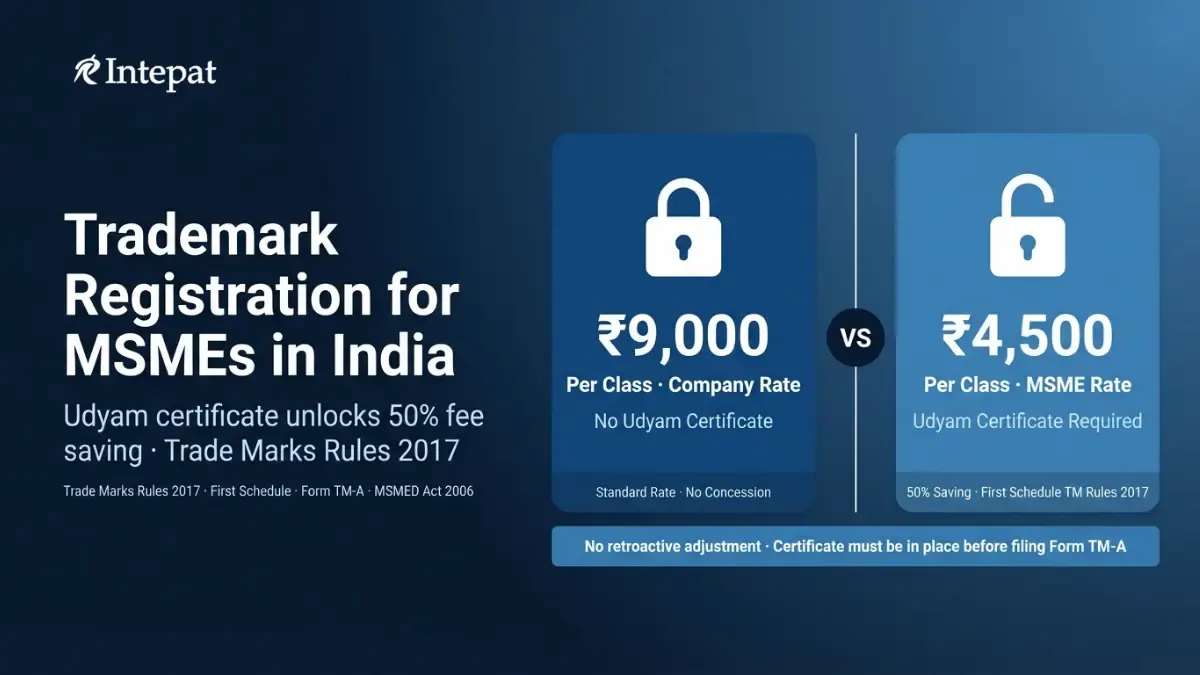
The trademark registration fee for MSME applicants is ₹4,500 per class (e-filing), half the ₹9,000 rate that applies to companies and LLPs without qualifying status. If the Udyam certificate is not in hand at the moment of filing, the fee concession is gone: there is no adjustment and no refund. The concession is set out in the First Schedule of the Trade Marks Rules 2017 and is available only when a valid Udyam Registration Certificate is in the applicant’s possession at the moment Form TM-A is submitted.
Most MSME trademark applications do not fail because the law is complex. They fail because the Udyam certificate is not yet in hand when the form is filed, or because the enterprise activity description on the certificate does not correspond to the goods or services claimed in the trademark application.Until registration is in place, a competitor who files first in your class can secure a priority advantage that is difficult to overcome in practice, regardless of how long you have been trading under the name, unless prior use is proven. Both errors that cause applications to fail are avoidable.
This guide covers the qualifying thresholds, what to check on your Udyam certificate before filing, the seven steps to register a trademark as an MSME, the class selection decisions that determine the scope of your protection, and the five filing mistakes that cost money and cannot be corrected on the existing application. For the complete statutory fee schedule across all applicant categories, see our article on trademark registration fees in India. For full eligibility rules, rights conferred by registration, and what it does not protect, see the complete guide to trademark registration in India.
Does Your MSME Qualify for the Reduced Trademark Filing Fee?
Eligibility is determined at the time of filing, not retrospectively. Two checks decide whether you qualify: (i) a valid Udyam Registration Certificate is in hand, and (ii) the business activity on that certificate corresponds to the goods or services you are protecting. If either check fails at the moment Form TM-A is submitted, the reduced fee cannot be claimed after the fact.
An enterprise qualifies for the ₹4,500 e-filing rate if it holds a valid Udyam Registration Certificate issued under the Micro, Small and Medium Enterprises Development Act 2006, and its investment and annual turnover fall within the thresholds applicable at the time of filing. The certificate is obtained free of charge from udyamregistration.gov.in using Aadhaar authentication of the proprietor, partner, managing director, or authorised signatory. Udyam replaces the earlier Udyog Aadhaar system. An Udyog Aadhaar registration does not qualify.
Under Notification S.O. 1364(E) dated 21 March 2025, which came into force on 1 April 2025, the classification thresholds under the MSMED Act 2006 are:
- Micro enterprise: Investment up to ₹2.5 crore and annual turnover up to ₹10 crore.
- Small enterprise: Investment up to ₹25 crore and annual turnover up to ₹100 crore.
- Medium enterprise: Investment up to ₹125 crore and annual turnover up to ₹500 crore.
Both investment and turnover thresholds must be satisfied concurrently. An enterprise that exceeds either limit in a financial year loses MSME classification from the date of that excess. Manufacturing enterprises are assessed on plant and machinery investment; service enterprises on equipment investment. To understand how to obtain the certificate and the full benefits it unlocks beyond trademark fees, read our article on Understanding the MSME Certificate and Registration.
Entity type alone does not determine eligibility. Proprietorships, partnerships, LLPs, and private limited companies all qualify if they meet the thresholds. The ₹4,500 rate also applies to individuals and DPIIT-recognised startups, but those are separate eligibility tracks with different supporting documents. An individual needs identity proof. A DPIIT-recognised startup needs its recognition certificate. An MSME needs its Udyam Registration Certificate. The tracks are not interchangeable. For guidance specific to startups, see trademark registration for startups in India.
How Much Does Trademark Registration Cost for an MSME in India?
The per-class government fee under the First Schedule of the Trade Marks Rules 2017 is ₹4,500 for e-filing and ₹5,000 for physical filing for MSMEs with a valid Udyam certificate. The same fee applies to individuals and DPIIT-recognised startups. Companies and LLPs without qualifying MSME status pay ₹9,000 per class (e-filing) or ₹10,000 (physical). E-filing through the IP India portal is the standard route and the lower-cost option.
| Applicant Category | E-Filing Fee (per class) | Physical Filing Fee (per class) | Qualifying Document |
| Individual / DPIIT Startup / MSME (Udyam) | ₹4,500 | ₹5,000 | Udyam Certificate / DPIIT recognition / Identity proof |
| Company / LLP / Other Entities | ₹9,000 | ₹10,000 | None — standard rate applies |
The saving is ₹4,500 per class. A garments MSME filing in Classes 24 and 25 pays ₹9,000 in government fees at the MSME rate. The same application filed as a company without Udyam registration would cost ₹18,000. The ₹9,000 saving is available only if the Udyam certificate is in place at the time Form TM-A is submitted, not when it was applied for, and not on the date it was eventually issued.
These are government fees only. Professional fees for class selection, clearance searches, filing, examination responses, and hearings are additional and depend on the complexity of the application. For multi-class filings, MSME status directly determines whether trademark protection scales cost-efficiently or doubles in cost.
What to Check on Your Udyam Certificate Before You File
Two certificate issues cause formalities failures that the Trade Marks Registry will not correct retroactively. The first is timing: the certificate must exist and be downloaded before Form TM-A is submitted. A certificate applied for but not yet issued, or issued after the filing date, does not qualify. The second is activity alignment: the enterprise activity described in your Udyam certificate must correspond to the goods or services covered in the trademark application.
Every Udyam certificate records the enterprise’s primary business activity using a National Industrial Classification (NIC) code. A textile manufacturer’s certificate carries manufacturing NIC codes. A software services firm carries services NIC codes. The mismatch we see most often is simpler than it sounds: the founder registered on Udyam years ago under a broad or slightly different business description, and no one checked whether that description still matched the goods being covered in the trademark application. When the goods or services specification on Form TM-A describes activity that does not correspond to what the Udyam certificate records, the Trade Marks Registry can raise a formalities check deficiency. A software firm’s certificate attached to a trademark application covering packaged food products is a clear example: the certificate does not support the applicant’s status for those goods, and the deficiency follows.
The correction path for a formalities deficiency is narrow and time-bound. If the deficiency is not resolved within the period prescribed by the Registrar, the application is treated as withdrawn. The government fee is not refunded. Before filing, confirm three things on your Udyam certificate: the certificate is downloaded and current, the NIC codes recorded reflect your actual business activity, and those activities cover the goods or services you intend to protect in the trademark application. The Registry evaluates whether the certificate supports the claimed goods and services, not merely whether a certificate exists.
| CHECK BEFORE YOU FILE |
| Confirm that the NIC codes and enterprise activity description on your Udyam certificate correspond to the goods or services you are protecting. A certificate that records software services NIC codes does not support a trademark application filed in food product classes. |
How to Register a Trademark as an MSME: Seven Steps
The procedural steps for trademark registration remain standard for all applicants. The MSME-specific risk lies entirely in pre-filing validation. The filing procedure follows the Trade Marks Act 1999 and Trade Marks Rules 2017. The steps specific to an MSME applicant are the certificate check before filing and the applicant category selection on Form TM-A. For full procedural detail at the examination, hearing, and opposition stages, see trademark registration process in India.
- Obtain and verify the Udyam Registration Certificate. Confirm your enterprise qualifies under the MSMED Act 2006 thresholds. Register at udyamregistration.gov.in using Aadhaar authentication. Download the certificate and check that the NIC codes recorded reflect the goods or services you plan to protect before proceeding.
- Conduct a trademark search. Search the Trade Marks Registry database for identical or similar marks in your target classes. A conflict identified before filing saves at least ₹4,500 per class in wasted government fees and avoids the cost of examination responses and hearings.
- Identify the correct trademark classes. The Nice Classification (NCL 12) applies in India. Goods fall in Classes 1 to 34; services in Classes 35 to 45. Each class requires a separate fee. Use the trademark classification tool to confirm which classes cover your goods or services before filing.
- Prepare and file Form TM-A. Select the MSME applicant category and attach the Udyam Registration Certificate. File through the IP India e-filing portal. For word marks, no device image is required. For logo or device marks, attach a JPEG representation meeting the portal’s format requirements, along with a specification of goods or services.
- Respond to the examination report, if issued. The Office of the Controller General of Patents, Designs and Trade Marks (CGPDTM) examines the application for absolute and relative grounds of refusal under Sections 9 and 11 of the Trade Marks Act 1999. If a report is issued, respond within one month of the date of receipt. Where the written response does not resolve objections, request a show cause hearing.
- Monitor the opposition window. Once accepted, the application is advertised in the Trade Marks Journal. Any person may file an opposition within four months of advertisement under Section 21 of the Trade Marks Act 1999. If no opposition is filed, or if an opposition is successfully defended, the mark proceeds to registration.
- Receive the registration certificate. Registration is effective from the date of application, not the date of certificate issuance. The mark is valid for ten years from the filing date. Renewal using Form TM-R is required every ten years under Section 25 of the Trade Marks Act 1999.
Which Trademark Classes Does Your MSME Actually Need?
Each trademark application covers one or more classes under the Nice Classification. The class you file in determines what you legally protect. Filing in the wrong class produces a registration with zero value for the goods or services you actually sell. Filing in too few classes leaves gaps that a competitor can exploit. Filing in more classes than the business needs costs ₹4,500 per unnecessary class with no protection return. For a detailed discussion on multi-class strategy and cost planning, see filing across multiple trademark classes in India.
For food product and packaged goods businesses, Classes 29 and 30 cover the primary range: processed foods, spices, condiments, and dairy fall in these two classes. Garments and textile businesses need Classes 24 and 25: fabric and textile articles in 24, clothing and footwear in 25. Engineering and industrial goods businesses typically file in Classes 7, 9, and 12 covering machinery, instruments, and vehicles. Software and IT service businesses file in Class 42.
Class 35 is the most commonly misunderstood class for manufacturing MSMEs. It covers retail and distribution services provided to others, not a manufacturer’s own sales of its branded goods. An MSME selling its own packaged food under its own brand does not need Class 35 for that activity. Class 35 becomes relevant only when the MSME operates a retail service for third-party products, runs a standalone distribution business for others, or provides business support services to third parties. Filing in Class 35 when none of those activities applies is a ₹4,500 charge with no protection value. Class selection also determines future expansion flexibility: a filing that is too narrow today creates enforcement gaps and requires fresh filings at full cost when the business grows into adjacent goods or services.
Why MSME Trademark Applications Fail -And How to Avoid It
The five mistakes below account for most avoidable losses in MSME trademark filings. None can be corrected on the existing application. Each requires a fresh filing at full cost. More consequentially, an application lost to any of these errors is a period of unprotected use during which a competitor can file in your class and acquire rights you cannot easily displace.
Filing Before the Udyam Certificate Is in Hand
What it costs: ₹4,500 per class, irrecoverable. The Registry applies the company rate and there is no refund mechanism.
The MSME fee rate requires the Udyam certificate to be present at the time of filing. If the certificate is pending, expired, or not yet downloaded, the Trade Marks Registry applies the standard company/LLP rate of ₹9,000 per class. Businesses that have applied for Udyam registration but are still waiting for the certificate to be issued should hold off before filing Form TM-A. The cost of a few days’ delay is zero. The cost of filing without the certificate is ₹4,500 per class, unrecoverable.
The Udyam Certificate That Does Not Match Your Goods
What happens: Formalities check failure. The application is treated as withdrawn and the fee is not refunded.
This is the error that receives the least attention and causes formalities check failures that applicants do not anticipate. The Udyam certificate records the enterprise’s primary business activity using NIC codes. If the goods or services description on Form TM-A covers activity not reflected in those NIC codes, the Trade Marks Registry may raise a formalities deficiency on the ground that the certificate does not support the applicant’s claim to the MSME rate for those goods or services.
The practical check is simple: open your Udyam certificate and confirm the enterprise activity section describes what your trademark application will cover. If you manufacture packaged food, the certificate should record manufacturing activity in the food sector. If the certificate records IT services activity because the Udyam registration was completed under a different business description, the mismatch creates a filing risk that an additional ₹4,500 per class cannot resolve once the deficiency notice has been issued.
Selecting the Wrong Applicant Category on Form TM-A
The cost: ₹4,500 per class overpaid with no recovery, or a declaratory deficiency raised at scrutiny.
Form TM-A requires the applicant to select the fee category. Selecting the standard company rate when the MSME rate applies costs ₹4,500 per class more than necessary, with no mechanism to claim the difference back. Conversely, selecting the MSME rate without a valid Udyam certificate creates a declaratory deficiency that may be raised as a ground of objection at the hearing stage or during scrutiny. Both directions carry a cost. The remedy is to confirm the certificate is valid and the category selection matches it before the application is submitted.
Filing in the Wrong or Incomplete Classes
The result: a paid registration that provides zero protection for the goods or services you actually sell. Only a fresh filing corrects it.
A registration in Class 30 for spices does not protect a retail business operating under the same brand in Class 35. A registration in Class 25 for garments does not cover an online retail service selling those garments. These are not theoretical edge cases. They come up regularly and the gaps are exploitable by third parties. They cannot be remedied on the existing application. For a registered trademark, the only protection is what the registration records. Identifying all commercially relevant classes before filing is the only way to avoid this outcome. See distinctiveness and trademark class selection for further guidance on building a mark that withstands examination.
Missing the Counter-Statement Deadline After Opposition
What follows: the application is deemed abandoned. Government fees paid are not refunded and no extension is available.
If an opposition is filed against your application, you have two months from the date you receive the Notice of Opposition to file a counter-statement with the Registrar. Miss that deadline and the application is deemed abandoned under Section 21(2) of the Trade Marks Act 1999: the government fees are not refunded and no extension is available. The notice does not always arrive when expected. Monitoring the Trade Marks Journal from the date of advertisement, not only after a notice arrives, is the safest way to stay inside the window. For how to monitor effectively, see trademark watch in India.
| IDENTIFY FILING RISKS BEFORE FEES ARE COMMITTED |
| Intepat’s pre-filing review checks whether your Udyam certificate supports your goods, confirms the right classes, and flags any conflicting marks already on the registry, before a rupee in government fees is committed. Turnaround: 24 hours. Cost: less than one filing fee. Request a free IP assessment. |
Post-Registration: What MSMEs Need to Keep Doing
Registration establishes rights. Active steps are needed to defend them. The Trade Marks Registry does not alert the registered owner when a conflicting application is filed. Monitoring the Trade Marks Journal and filing oppositions within the four-month window under Section 21 of the Trade Marks Act 1999 is the owner’s responsibility. An MSME that allows a conflicting mark to proceed to registration without opposition loses the opportunity to assert priority in that class. After registration, the remedy shifts to cancellation proceedings before the Registrar or the High Court, which are more complex and more expensive than opposition proceedings.
The mark must be renewed every ten years using Form TM-R under Section 25 of the Trade Marks Act 1999. The renewal window opens one year before the expiry date under Rule 57. Late renewal within six months after expiry is possible with a surcharge under Section 25(3). Renewal after that window requires restoration proceedings under Section 25(4), after which the mark is either restored or becomes available for any third party to apply for. For a full overview of what a registered trademark certificate records and what it authorises, see registered trademark certificate in India.
A registered trademark is also a business asset that can be licensed or assigned. In funding due diligence, investors and acquirers routinely check whether brand ownership is formalised. An unregistered brand at that stage creates a negotiating problem that is expensive to fix quickly. For MSMEs selling online, trademark registration also enables enrolment in programmes such as Amazon Brand Registry, which give the registered brand owner direct control over product pages and restrict counterfeit listings. This has moved from an optional benefit to a practical requirement for MSMEs distributing through e-commerce platforms. For MSME patent filing benefits and how trademark protection fits within a broader IP strategy, see patent benefits for MSMEs in India.
When to File Yourself and When to Engage a Trademark Attorney
Self-filing through the IP India e-filing portal is a reasonable option for an MSME with a clearly distinctive mark, a single unambiguous class, a clean search result, and no prior use conflicts. The portal is accessible without legal training for simple cases, and the process is fully online. The difficulty is that most founders who self-file believe their case falls in the simple category. Most examination reports are issued for applicants who believed exactly that.
Professional support becomes the better choice in four situations. First, when the mark is a common word in a crowded class: a clearance opinion before filing is cheaper than an examination response and hearing after it. Second, when an examination report raises multiple objections under Sections 9 and 11: a poorly drafted response risks refusal and the loss of the application fee. Third, when an opposition is filed against the application. Section 21 proceedings involve counter-statements, evidence rounds, and final hearings that require experienced counsel. Fourth, when the business is expanding into new product lines and needs a filing strategy that covers future classes rather than dealing with gaps as they arise.
The government filing fee is non-refundable regardless of outcome. The cost of an unresolved objection or an abandoned application consistently exceeds the cost of professional review at the clearance stage.
When the decision to file has been made, Intepat handles the full process: Form TM-A filing, examination report responses, show cause hearings, opposition proceedings, and post-registration monitoring. Cost estimates are agreed before work begins, with no surprise fees at any stage. Explore trademark registration services.
This article covers standard procedural steps under the Trade Marks Act 1999 and Trade Marks Rules 2017 as of March 2026; specific strategies depend on individual circumstances, trademark law and fee schedules are subject to change, and independent legal advice should be obtained before taking action.
Frequently Asked Questions
The government fee is ₹4,500 per class for e-filing and ₹5,000 per class for physical filing, provided the applicant holds a valid Udyam Registration Certificate at the time of filing Form TM-A. This is set out in the First Schedule of the Trade Marks Rules 2017. The fee applies per class. A two-class application costs ₹9,000 in government fees under the MSME rate.
A valid Udyam Registration Certificate issued under the MSMED Act 2006. The certificate must be in your possession at the time of filing Form TM-A. A certificate applied for but not yet issued does not qualify. Udyog Aadhaar registrations do not substitute for Udyam.
Yes, if the company holds a valid Udyam Registration Certificate and its investment and turnover fall within the MSME classification thresholds effective from 1 April 2025. Entity type alone does not determine eligibility: the Udyam certificate does. A private limited company that qualifies as a Small enterprise under the MSMED Act 2006 is entitled to the ₹4,500 e-filing rate.
Yes. Udyam Registration is the current government system for MSME registration under the MSMED Act 2006. It replaced Udyog Aadhaar from July 2020. The Udyam Registration Certificate issued through udyamregistration.gov.in is the document required to claim the reduced trademark filing fee. An Udyog Aadhaar does not qualify.
The Trade Marks Registry may raise a formalities check deficiency on the ground that the certificate does not support the applicant’s MSME status for those goods. If the deficiency is not resolved within the Registrar’s prescribed period, the application is treated as withdrawn and the fee paid is forfeit. Verify that the enterprise activity description and NIC codes on your Udyam certificate correspond to the goods or services in your trademark application before filing.
Most MSMEs file in one to three classes depending on their product and service range. A manufacturer of packaged food typically needs Classes 29 and 30. A garments business needs Classes 24 and 25. The right number depends on what the business actually sells or provides under the trademark, not on the number of products in a range. Each additional class costs ₹4,500 in government fees and should cover a commercially relevant activity. Use the trademark classification tool to confirm classes before filing.
The Trade Marks Registry applies the standard company/LLP rate of ₹9,000 per class instead of the ₹4,500 MSME rate. No refund or adjustment is made after the fact. If you have selected the MSME fee category on Form TM-A without having the certificate, a declaratory deficiency may be raised during scrutiny or at the hearing stage.
The timeline is the same as for any applicant. Once filed, the application is examined, typically within 12 to 16 months. If an examination report is issued, the applicant has one month to respond. After acceptance, the mark is advertised in the Trade Marks Journal and the four-month opposition window runs. Where no opposition is filed, registration follows. End-to-end, the process typically takes 12 to 24 months for an uncomplicated application without opposition.
Yes. A single Form TM-A can cover multiple classes. The government fee of ₹4,500 per class applies to each class selected. There is no discount for multi-class filing beyond the MSME rate itself. The advantage of filing all required classes together is a shared filing date, which means protection in all classes runs from the same date.
The renewal fee is ₹9,000 per class (e-filing) under the First Schedule of the Trade Marks Rules 2017. The reduced rate that applies at the initial filing stage does not extend to renewal. Renewal is required every ten years using Form TM-R under Section 25 of the Trade Marks Act 1999.
Self-filing is reasonable for a clearly distinctive mark in a single unambiguous class with a clean search result. Professional support is the better choice where the mark is a common word in a crowded class, the examination report raises multiple objections, an opposition is filed, or the business needs a multi-class strategy. The government fee is non-refundable regardless of outcome, so errors at the clearance and filing stage are more expensive than the cost of getting it right the first time. The harder question is whether your mark is actually as distinctive as it feels from the inside. Most examination reports arrive for applicants who were certain it was.