




A trademark search checks the Indian Trade Marks Register for earlier identical or similar marks that cover the same or related goods and services. The search is free on the public search portal. The examiner searches the same Trade Marks System database used by the public portal, but may run broader permutations, phonetic variants, class expansions, and device-code searches during examination. A careful search before filing nonetheless gives a reliable early signal of the objections a mark is likely to face under Section 11 of the Trade Marks Act, 1999.
Quick Answer
| Question | Answer |
| What is a trademark search? | A check of the Trade Marks Register for earlier marks (registered marks and earlier-filed applications) that could conflict with a proposed mark at examination or in opposition |
| Who needs to run one? | Any person proposing to file a trademark application in India: startup, SME, in-house brand team, or foreign applicant filing through a registered agent |
| Where is the free Indian search? | tmrsearch.ipindia.gov.in (no login required) |
| What are the three search modes? | Word mark search, phonetic search, and device mark search — the same three modes the examiner uses in the Trade Marks System |
| What conflict standard does the examiner apply? | Section 11(1): likelihood of confusion arising from identity or similarity of the mark and identity or similarity of the goods or services |
| When is a professional search needed? | When a search returns borderline results, the mark has device elements, or the applicant is making a significant commercial commitment on the brand |
What a Trademark Search Is, and What It Is Not
A trademark search against the Indian register tells the searcher whether any earlier registered mark, or any application pending registration, covers similar marks in the relevant class. That is its scope. It is not a written registrability opinion, it does not assess litigation risk in relation to unregistered marks, and it does not substitute for the professional judgement that weighs borderline results against the Section 11 framework and advises whether to proceed, file in a modified form, or commission further diligence.
A searcher who treats a clean register result as complete clearance is relying on an incomplete picture. What the register search answers is one question: is there a filed earlier mark that conflicts? It does not answer all the questions an applicant needs addressed before committing to a brand. The four gaps are examined in the section below.
How to use this guide: This article explains how to assess trademark search results against the Section 11 conflict standard and how to classify filing risk. For step-by-step instructions on running the search on the public portal, see the trademark public search guide. For the trademark registration process that follows a successful search, see Trademark Registration in India.
Why a Trademark Search Matters Before Filing
Three categories of risk follow from not searching before filing.
Registration risk. As part of examination practice, the examiner searches the Trade Marks System and issues an examination report containing objections under Section 11 when an earlier conflicting mark is found. If the search had been run before filing, the applicant would have known. Filing without a trademark search means absorbing that risk rather than managing it.
Enforcement risk. Securing registration does not make a mark safe to use if a prior unregistered mark exists in the same field. Under Section 27(2) of the Act, nothing in the Trade Marks Act affects the right of action against any person for passing off goods or services as those of another. A prior unregistered user may rely on that cause of action, and the same prior right may also support an opposition under Section 11(3). A trademark search that extends to prior users in trade surfaces this risk before the applicant builds a brand on an insecure foundation.
Commercial risk. Rebranding after a conflict surfaces (whether at examination, in opposition, or after a court action) is measurably more expensive than a pre-filing search. The further a brand has been rolled out across packaging, marketing materials, signage, and digital presence, the higher the switching cost. A trademark search before filing is a fraction of those consequences.
Types of Trademark Search
The table below sets out the four types of trademark search used in Indian practice, their scope, and when each is appropriate.
| Type | Scope | Output | Appropriate when |
| Preliminary check | Word mark only, one or two classes, exact and near-identical matches | List of obvious conflicts | Early-stage name shortlisting before committing to a brand |
| Public search | Word mark, phonetic, and device mark across all relevant classes on the Indian register | Full list of earlier marks and applications | Pre-filing due diligence for any application |
| Extended search | Public search plus domain registrations, company name databases, and business directories | Register conflicts and identified prior users | Consumer-facing brands, significant commercial investment, competitive markets |
| Written registrability opinion | Full search plus professional assessment against Section 11, risk classification, and recommendations | Written report with go/no-go advice | Marks with commercial value, crowded classes, borderline results, foreign applicants |
A preliminary check eliminates obvious conflicts quickly but does not replace a full public trademark search. An extended search covers the register and the market; a written registrability opinion covers the register, the market, and the law.
Unsure whether a cited mark is a real obstacle? Intepat IP can review the search results and classify the filing risk before you proceed. Request a search review
How the Examiner Searches: The Trade Marks System
Understanding what the examiner does when an application is filed is the foundation for understanding what a pre-filing trademark search should cover.
When an application is filed, it moves through data entry in the Trade Marks System (TMS). After examination, a mark that is accepted and advertised in the Trade Marks Journal, opening a four-month opposition window under Section 21 of the Act during which any person may file a notice of opposition. Where the application contains a device or figurative element, it is routed first to the Vienna Codification Section (VCS), where authorised officials classify the figurative elements using the International Classification of the Figurative Elements of Marks under the Vienna Agreement and enter the codes into the TMS. Only after Vienna codification is complete does the application move to examination.
At examination, the examiner searches for earlier marks using the Trade Marks System across three modes: word mark search, phonetic search, and device mark search. The Manual of Trade Marks describes the sequence: the Trade Marks System automatically selects the relevant class for search based on the application as filed, and the examiner may add further classes. In word mark mode, the examiner searches on the basis of selected characters as prefix or suffix. In phonetic search, the examiner specifies one or two phonetic variants, and the system returns all earlier marks with phonetic similarity. In device mark search, the examiner enters the Vienna code or codes assigned in the VCS step and the system returns all earlier device marks sharing those figurative elements.
The examiner then prepares a consolidated examination report through the Trade Marks System. Where objections are found, the examination report is communicated to the applicant and made available on the Registry website. Under Rule 33(4) of the Trade Marks Rules, 2017, if the applicant fails to respond to the examination report within one month from the date of its receipt, the Registrar may treat the application as abandoned. A pre-filing trademark search that mirrors this three-mode sequence (running all modes in the classes the brand will cover) produces results directly comparable to what the examiner will find.
The Three Search Modes: What Each Catches
The three modes are not alternatives; they surface different categories of conflict. A search that runs only one or two modes produces an incomplete result.
Word mark search identifies earlier marks that are identical or textually similar to the proposed mark. It catches conflicts based on spelling and character strings: the most direct category of conflict.
Phonetic search identifies earlier marks that sound like the proposed mark even where the spelling differs. The Trade Marks System returns marks having phonetic similarity with the proposed mark when the examiner specifies a phonetic variant. Most Section 11(1) objections in practice arise from phonetic similarity rather than spelling identity, which is why this mode is indispensable.
Device mark search identifies earlier marks that share figurative elements with the proposed logo or composite mark, using the Vienna codes assigned in the VCS step. Relevant only where the proposed mark includes a logo, symbol, or any non-textual element.
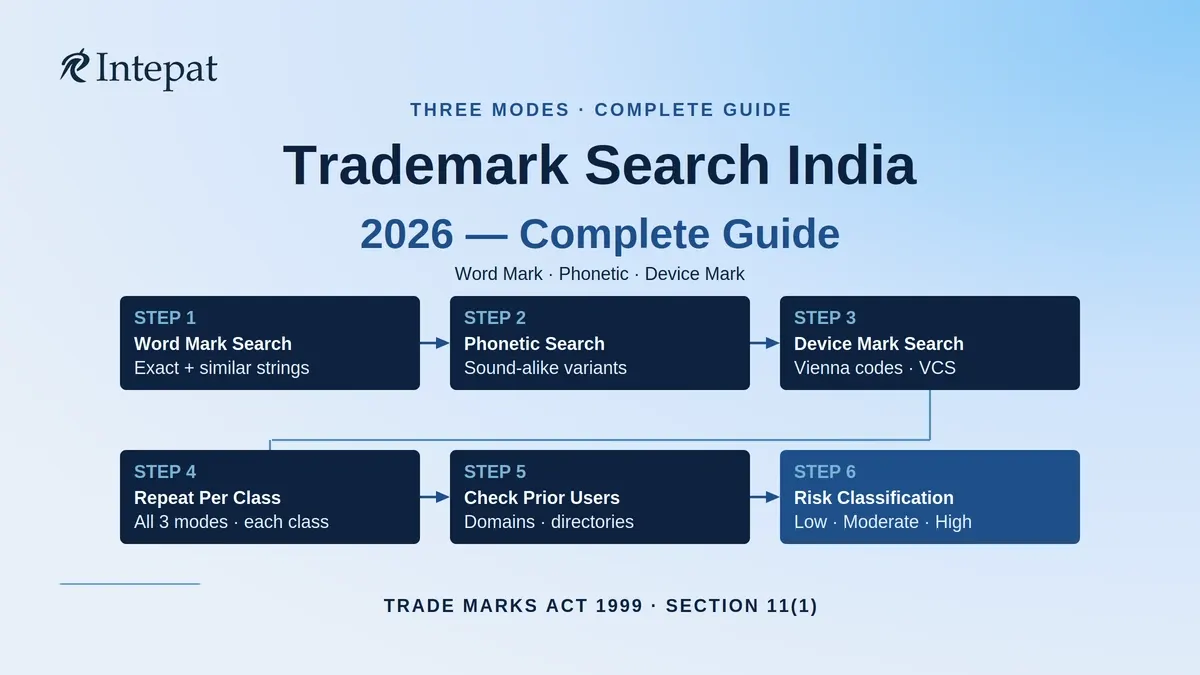
Pre-filing Trademark Search Workflow
| Step | Action | Mode |
| 1 | Search the exact proposed word or phrase | Word mark search |
| 2 | Search one or two phonetic variants | Phonetic search |
| 3 | Search Vienna codes for any logo or figurative element | Device mark search |
| 4 | Review class overlap: repeat steps 1-3 for each class the brand will cover | All modes |
| 5 | Check prior users: domain names, company name databases, market directories | Extended search |
| 6 | Assess results against Section 11 and decide whether to file, modify, or seek professional advice | Risk classification |
For step-by-step guidance on running all three modes on the public search portal, including match condition selection and result filtering, see the trademark public search guide.
What a Trademark Search Cannot Find
A clean result on the public search portal does not mean the proposed mark is free from all risk. Four categories of conflict fall outside the register entirely.
Well-known trade marks. Section 11(2) bars registration of a mark where the earlier mark is a well-known trade mark in India and use of the proposed mark without due cause would take unfair advantage of or be detrimental to the distinctive character or repute of the well-known mark, even where the goods or services are dissimilar. A well-known trade mark need not be on the Indian register for this protection to apply. As a statutory matter, refusal on this ground ordinarily requires objection by the proprietor of the earlier trade mark in opposition proceedings under Section 11(5). The register search will not surface this risk.
Unregistered marks with prior-use rights. Section 11(3) provides that a trade mark shall not be registered if its use in India is liable to be prevented by the law of passing off protecting an unregistered trade mark used in the course of trade. Separately, Section 27(2) preserves the cause of action for passing off regardless of registration status. A prior unregistered user who has built goodwill under a mark may rely on passing off, and that same prior right may support an opposition under Section 11(3). Passing-off rights depend on evidence of goodwill, reputation, and a risk of misrepresentation, not mere historical use of the mark. As a statutory matter, refusal on this ground too ordinarily requires objection by the proprietor of the earlier trade mark in opposition proceedings under Section 11(5). The register search will not surface prior unregistered users.
Absolute grounds under Section 9. Section 9(1) bars registration of marks that are devoid of distinctive character, exclusively descriptive of the goods or services, or customary in the current language or established trade practices. Section 9(2)(a) additionally bars marks that are of such nature as to deceive the public or cause confusion — covering marks that would mislead about the nature, quality, or geographical origin of the goods or services. These objections are raised against the proposed mark itself, not by reference to an earlier mark, and will not appear in any register search.
Prior use not yet indexed. Recent filings may not immediately appear in search results due to indexing delays, processing lag, or database refresh timing. Results reflect the state of the database at the moment of the search, not the state of all pending filings. This is one reason why a trademark search run close to the actual filing date produces a more current picture than one run weeks earlier.
Taken together, these four gaps explain why a clean result on the public search portal is a favourable starting point rather than complete clearance. A professional trademark search covers all four dimensions; a self-conducted public search covers the register alone.
The Section 11 Conflict Standard
Section 11(1) of the Trade Marks Act, 1999 is the provision the examiner applies when assessing whether an earlier mark conflicts with a proposed mark. A trade mark shall not be registered if, because of its identity or similarity with an earlier trade mark and the identity or similarity of the goods or services covered by the trade marks, there exists a likelihood of confusion on the part of the public, which includes the likelihood of association with the earlier trade mark.
The Explanation to Section 11 defines “earlier trade mark” as a registered trade mark or an application under Section 18 bearing an earlier date of filing. A pending application that has not yet been examined or accepted is therefore an earlier trade mark for Section 11(1) purposes and can ground a conflict objection just as a registered mark can.
The test has two components that are weighed together. The first is mark similarity: are the marks identical or similar in appearance, sound, or meaning? The second is goods and services similarity: do the goods or services of the earlier mark and those of the proposed mark overlap or are they commercially related? The Manual of Trade Marks confirms that a mark is identical with an earlier trade mark where it reproduces it without modification, or where viewed as a whole it contains differences so insignificant they may go unnoticed by an average consumer. Similarity is construed as deceptively similar, defined in Section 2(h) as so nearly resembling the other mark as to be likely to deceive or cause confusion.
A high degree of mark similarity can compensate for a lower degree of goods similarity, and a very high degree of goods similarity can sustain a likelihood of confusion even where the marks are not especially close. Both components must be assessed together; neither is assessed in isolation.
Practitioner note: Being in a different class does not make a mark safe, and being in the same class does not automatically create a conflict. Two marks in different classes may conflict where the goods or services are commercially related. Two marks in the same class may coexist where their respective goods have no commercial proximity. Class number is a starting point for the goods and services analysis, not a conclusion.
Section 11(2) extends protection to well-known marks even where the goods and services are dissimilar. Section 11(3) bars registration where use of the proposed mark would be prevented by the law of passing off or by copyright law. Under Section 11(5), a trade mark shall not be refused registration on Section 11(2) or Section 11(3) grounds unless objection on those grounds is raised in opposition proceedings by the proprietor of the earlier trade mark.
Section 11(4) recognises the consent of the proprietor of the earlier trade mark or other earlier right as a relevant factor, but registration remains subject to the Registrar’s discretion under Section 12. Obtaining consent from the proprietor of a cited mark may assist in overcoming a Section 11(1) objection; it does not guarantee registration.
Where an objection is raised under Section 11(1), the Manual sets out the form the examiner uses in the examination report: the applied mark is not registrable because identical or similar marks in respect of identical or similar goods or services are already on record and because of such identity or similarity there exists a likelihood of confusion on the part of the public. The question when reading a search result is therefore not whether the marks look or sound the same in the abstract, but whether a consumer encountering both marks in relation to the respective goods or services would be likely to be confused or to associate one with the other.
Goods and services similarity is not determined by class number alone. Two marks in different classes may still conflict where the goods or services are commercially related and consumers are likely to assume a common trade origin. A comparison of the goods and services descriptions in the search result against the proposed specification is more reliable than a class-number comparison alone. For guidance on how to respond when an examination report raises a Section 11 objection, see trademark objection reply in India.
Reading Search Results
The public search portal returns results as a list of earlier marks with their application number, class, goods or services description, proprietor name, and current status. The status of each result determines whether it is an active earlier trade mark for Section 11(1) purposes.
Status Interpretation
| Status | What it means | Section 11(1) relevance |
| Registered | Mark is on the register and in force | Active earlier trade mark; full Section 11(1) weight |
| Objected | Examination report issued; examination objections remain unresolved or final acceptance is pending | Active earlier application; Section 11(1) applies |
| Accepted and Advertised | Application accepted; published in the Trade Marks Journal; four-month opposition window open under Section 21 | Active earlier application; Section 11(1) applies; opposition risk also live |
| Opposed | Application is in opposition proceedings | Active earlier application; Section 11(1) applies; outcome uncertain |
| Abandoned / Withdrawn | Application not pursued to registration | Not an earlier trade mark for Section 11(1); prior use may still ground passing-off rights |
| Removed / Expired | Mark removed from register | Not an earlier trade mark for Section 11(1); prior use may still be relevant |
Three questions to work through for each result that appears: Is the mark similar to the proposed mark in appearance, sound, or meaning? Are the goods or services of the earlier mark the same as or commercially related to those of the proposed mark? Is the earlier mark active? A result that raises concern on all three should not be filed against without professional assessment.
Note that abandoned or removed marks are not earlier trade marks for Section 11(1) purposes, but the prior user may retain passing-off rights under Section 27(2) if they used the mark in trade before abandonment. This is one reason why an extended search covering market use matters even when the register result appears clean.
For detailed guidance on reading individual result fields, comparing multiple results, and generating a combined output from the portal, see the trademark public search guide.
Risk Classification
The results of a public trademark search can be mapped to three risk levels based on the Section 11 analysis. These are a working framework for initial assessment, not a substitute for professional opinion on specific marks.
| Risk level | What the search shows | Section 11 position | Recommended next step |
| Low | No earlier marks in the same class with similar goods or services; no phonetically similar marks in related classes; no device conflicts for the figurative element | No apparent ground for a Section 11(1) objection on the current register | Proceed, subject to a Section 9 absolute grounds assessment and a check for prior users in trade if the brand has commercial value |
| Moderate | One or more earlier marks in the same or related classes that share visual, phonetic, or conceptual similarity with the proposed mark, but the conflict is not clear-cut | Possible Section 11(1) objection at examination; outcome depends on the strength of similarity and proximity of goods | Obtain professional assessment before filing; consider whether the mark or specification can be modified |
| High | An earlier mark that is identical or near-identical in the same class, or a well-known mark in a related field | Strong ground for a Section 11(1) or Section 11(2) objection; opposition likely after acceptance and advertisement in the Trade Marks Journal | Do not file without a strategy: seek consent from the proprietor under Section 11(4), rebrand, or file in modified form |
Decision Sequence
- Does the search return any active result in the same or a related class? If no active results: low risk. Proceed to Section 9 check.
- Is any active result identical or near-identical in the same class? High risk. Stop and obtain professional advice before filing.
- Is any active result similar (visually, phonetically, or conceptually) in the same or a related class? Moderate to high risk. Obtain professional assessment before filing.
- Are the goods or services of the earlier mark commercially related to the proposed mark’s goods or services? If yes, the risk is higher even across different classes.
- Could any result be a well-known mark in the proposed mark’s field? If yes, Section 11(2) exposure exists independent of class. Professional review required.
Worked Example
A proposed mark NUTRIVA is to be filed in Class 5 (pharmaceutical preparations). A public trademark search returns two results: NUTRIVA in Class 30 (food products), registered to a different proprietor; and NUTREVA in Class 5, with status “Accepted and Advertised.”
The Class 30 result (NUTRIVA, identical word, different class) warrants closer review, specifically whether the Class 30 goods include nutritional supplements, health foods, or overlapping wellness products that could be considered commercially related to the Class 5 goods.
The Class 5 result (NUTREVA, phonetically similar, same class, accepted and advertised) is high risk on both mark similarity and goods similarity grounds; it is an active earlier application and the four-month opposition window is open. Neither result can be ignored, and the applicant should not file without professional assessment of both.
When Professional Search Input Is Needed
A public trademark search on the portal is a sound first step. Professional input is indicated in the following situations.
Where the proposed mark includes a device or figurative element, identifying the correct Vienna codes for every component requires professional judgement. Incorrect code selection produces an incomplete search result because the device mark search in the Trade Marks System operates entirely on Vienna codes assigned in the VCS step.
Where the search returns borderline results (marks that are similar but not identical, or earlier marks in related but not identical goods and services), the professional assessment applies the Section 11(1) balancing test and advises on the probability of an examination report objection and opposition risk. This requires knowledge of registry practice that is not visible from the search results alone.
Where the mark has significant commercial value and a rebrand after filing would be costly, the cost of a professional trademark search with a written registrability opinion is well below the cost of handling an examination report objection, an opposition proceeding, or an injunction after the brand has been rolled out.
Where the brand will be filed across multiple classes, each class requires its own search pass because the public search portal does not allow simultaneous searches across multiple classes. Multi-class filing is expressly permitted under Section 18(2) of the Trade Marks Act, 1999, but separate applications across classes may sometimes be operationally preferable depending on prosecution risk, use evidence, and class-specific conflict exposure. For guidance on multi-class filing strategy, see multiple trademark classes in India.
Where a search returns a high-risk result and opposition proceedings become likely, see trademark opposition in India for the opposition procedure and timelines.
The trademark search services sets out the scope, deliverables, and turnaround times for professional trademark search reports from Intepat IP.
Frequently Asked Questions
A trademark search is a check of the Indian Trade Marks Register for earlier registered marks and earlier-filed applications that are identical or similar to a proposed mark in the same or related classes of goods and services. The purpose is to identify conflicts before filing that would otherwise surface as examination report objections or opposition proceedings after acceptance and advertisement in the Trade Marks Journal.
No statutory provision requires a search before filing. However, examination is automatic after a trade mark application is filed, and the examiner will search the register using the Trade Marks System and raise Section 11 objections in the examination report if earlier conflicting marks are found. Running the search before filing identifies those conflicts in advance and allows the applicant to modify the mark, narrow the specification, or decide not to file before incurring filing fees and prosecution costs.
A word mark and phonetic search on the public search portal typically returns results within minutes. A device mark search that requires identifying the correct Vienna codes takes longer, particularly for composite logos with multiple figurative elements. A professional trademark search report with a written registrability opinion typically takes two to three working days.
A search that returns no active earlier marks in the same class covering similar goods or services indicates that, on the current state of the register, no earlier registered mark or earlier-filed application is likely to generate a Section 11(1) objection at examination. It does not mean the mark is free from all risk. A clean register result does not screen for Section 9 absolute grounds, unregistered marks whose prior-use rights may support opposition under Section 11(3), or well-known marks protected under Section 11(2) regardless of registration.
Section 11(1) bars registration where, because of the identity or similarity of the mark and the identity or similarity of the goods or services, there exists a likelihood of confusion on the part of the public, which includes the likelihood of association with the earlier trade mark. The test is applied by weighing mark similarity and goods or services similarity together. A higher degree of mark similarity can compensate for a lower degree of goods similarity, and vice versa.
No. The Trade Marks Register is updated continuously as new applications are filed and processed. A search that was clean six months ago may return a conflict today if a similar mark was filed in the intervening period. A pre-filing trademark search should be run as close to the filing date as possible.
The public search portal covers only the Indian Trade Marks Register: registered marks and pending applications. It does not cover unregistered marks. An unregistered mark with established prior use may support a passing-off action under Section 27(2) and may also ground an opposition under Section 11(3). A search intended to clear a mark for commercial use should include a check for prior users in trade, not only a register search.
Next Steps
For step-by-step guidance on running all three search modes on the public search portal (including word mark match conditions, phonetic variant entry, and Vienna code search), see the trademark public search guide.
For multi-class filing strategy, class selection risks, and when dividing a multi-class application under Section 22 of the Trade Marks Act into separate applications may be the better course, see multiple trademark classes in India.
For the trademark search services Intepat IP provides, including professional search scope and written registrability opinions, see the trademark search services.
This article provides general information on Indian trademark search procedure and is not legal advice. Statutory provisions and registry practice are verified against the Trade Marks Act, 1999, the Trade Marks Rules, 2017, and the Manual of Trade Marks as at April 2026. Readers should verify current portal URLs, fees, and procedural steps before relying on any specific detail.