




Associated trademarks in India are two or more similar or identical marks owned by the same business that the Trade Marks Registry links together on the register. The link matters most when you sell or transfer a brand: associated marks must move together as a whole, not one at a time.
This guide covers Indian law only, under the Trade Marks Act 1999 and the Trade Marks Rules 2017. It is written for founders and brand owners deciding how to build, protect, sell, or restructure a family of marks, not for litigation.
- Quick answer
- Same owner, similar or identical marks, same or related goods: the Registrar can record them as “associated” (Section 16).
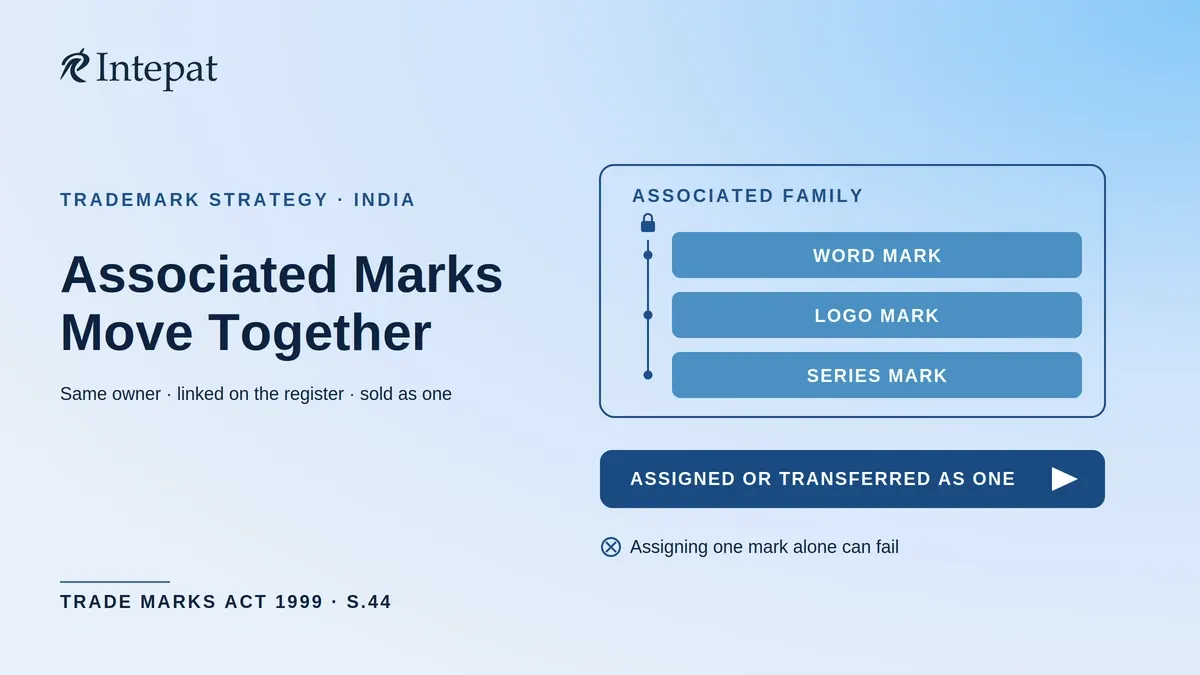
- Associated marks can only be assigned or transferred together, never separately (Section 44). Selling only part of the family can make the transfer fail.
- When you must prove use of a mark, a tribunal may accept use of an associated mark instead, for example to defend a non-use removal (Section 55). This is discretionary, not automatic.
- To unlink them, the proprietor files Form TM-P to dissolve the association (Section 16(5)). Fee Rs 1,000 physical, Rs 900 e-filing, verified as of June 2026.
- Each associated mark stays a separate registration. One lapsing does not automatically cancel the others.
When this matters for your business
Most founders never think about association during a routine filing. It starts to matter at specific moments: when you want to sell or spin off just one brand from a larger family, when you are moving marks between group companies, when you are buying a trademark portfolio and need to check that every linked mark is included, when you are defending an older registration against a non-use challenge, or when you want to separate two marks that no longer compete in the same market. If none of these is on your horizon, association rarely changes anything day to day.
What associated trademarks in India actually mean
An associated trademark is not a special kind of mark you apply for. It is an ordinary registered mark, obtained through the normal trademark registration process, that the Registry has formally linked to another mark held by the same owner. The Trade Marks Act 1999 defines associated trademarks simply as marks “deemed to be, or required to be, registered as associated trade marks” under the Act (Section 2(1)(c)).
The link applies when the same proprietor owns marks that are identical, or that so nearly resemble each other that they would deceive or cause confusion if a different person used them, for the same goods or services or for related ones. Goods and services are treated as related where they might be sold or provided by the same business (Section 2(3)).
A familiar example is a family of marks that share a common element. A cleaning-products company that registers CLEANMAX, CLEANMATE, and CLEANPLUS, all built on the same root, owns marks that resemble one another and that a customer could trace to the same source. Marks like these are natural candidates for association. The marks do not have to be word marks: a word mark and a logo can be associated, and a series registration is automatically treated as a set of associated marks (Section 16(4)). If you are weighing a series filing, our guide to series trademarks in India explains how one application can hold several closely related marks.
How marks get associated on the register
Association is usually the Registry’s decision, not something you tick on a form. Under Section 16, the Registrar “may, at any time, require” that two qualifying marks be entered on the register as associated. In day-to-day practice this surfaces during examination: the examiner reviews your application against the same owner’s earlier marks and, where they overlap, raises a condition in the examination report reading “The mark is associated with T.M. No. ___” (per the Manual of Trade Marks).
The condition is the examiner’s call, though an applicant generally accepts it where the later mark belongs to the same proprietor and overlaps with an earlier one. Our guide to replying to a trademark examination report explains how examination conditions like this one work.
Two points decide whether marks qualify: they must sit in the same ownership, and they must be identical or confusingly similar for the same or related goods or services. Whether goods are “related” turns on the kind of trade, which is why the class your goods fall into matters to the analysis. Once an association is recorded, Rule 54 requires the Registry to note the linked registration numbers against each mark, so the link becomes part of the public record.
Because association is the Registrar’s call, you do not “lose” anything by it while your application is being examined. It does not narrow your rights or change your registration date. What it changes is how the marks can be dealt with later, which is where founders need to pay attention.
The assignment trap: associated marks must move together
This is the single most important consequence for a growing business, and it is the one most owners discover too late. Section 44 says associated trademarks are “assignable and transmissible only as a whole and not separately.” You cannot assign or transmit one mark in an associated family while keeping the rest. They move together or not at all. (Licensing is different: a licence does not transfer ownership, so Section 44 does not bar licensing one mark, though any such licence should still be drafted so it does not blur who owns what.)
The reason is consumer protection. If you could hand one associated mark to a buyer and keep its near-twin, two unrelated businesses would end up using confusingly similar marks for the same goods, which is exactly the confusion association exists to prevent. So the law locks the family together.
The practical risk is concrete. If you negotiate a brand sale and the paperwork transfers only some marks in an associated set, leaving others behind, the transfer can be challenged or treated as ineffective. A complication makes this easy to miss: the public search display does not always make the full family obvious from a single mark, so a quick look at one registration may not surface every mark it is tied to. Before any brand sale, restructuring, or carve-out, run a full search of the seller’s portfolio so you know which marks are associated and must travel together. Our guide to trademark assignment in India walks through how a clean transfer is recorded.
Before signing a brand sale, transfer, merger, or group restructuring, check:
- whether the mark is associated with any earlier or later mark;
- whether those linked marks are all held by the same proprietor;
- whether every associated registration number is named in the transfer documents;
- whether a mark should first be freed through a Section 16(5) dissolution; and
- whether the register record needs correcting before the assignment is filed.
| Protect Your Brand |
| Get expert help registering and structuring your marks before they cost you a deal. |
| Register Your Mark |
Proving use of one mark to cover another
Associated marks help in one defensive situation that matters for older registrations. Indian law lets a third party apply to remove a registered mark that has not been used for a continuous period, and in that situation the owner has to prove genuine use. Section 55 gives associated marks a cushion here: where use of a registered mark must be proved for any purpose, a tribunal “may, if and so far as it shall think right” accept use of a registered associated mark, or of the mark with minor additions or alterations that do not substantially change its identity, as proof of use.
Read the qualifier carefully, because the original promise of this provision is easy to overstate. It does not mean using one mark automatically counts as using every mark in the family. The tribunal has discretion, and it weighs how close the marks are and how genuine the use is. An owner who relies on token use of one mark to keep a shelf of unused marks alive can still lose them.
The provision is a shield in a genuine dispute, not a substitute for actually using your marks. If you are facing a removal action, our guide to rectification of a registered trademark sets out the process.
One clarification worth making, because the older version of this article got it wrong: this provision is about proving use, not about renewal. Renewal of an Indian trademark does not depend on use at all. You renew each registration every ten years by paying the fee, whether or not the mark is in use, and each associated mark is renewed on its own. Non-use becomes an issue only when someone challenges the mark, not at renewal.
How to dissolve an association between your marks
If your marks have grown apart in the market and no longer risk confusing anyone, you can ask the Registry to unlink them. Under Section 16(5), the registered proprietor of associated marks can apply to dissolve the association, and the Registrar may allow it if satisfied that no deception or confusion would result from one of the marks being used by someone else.
The mechanics are straightforward. The application is filed in Form TM-P with a statement of the grounds for dissolution (Rule 54(2)). As listed on the IP India forms and fees page, the official fee is Rs 1,000 for physical filing and Rs 900 for e-filing, verified as of June 2026. Do not confuse this small fee with the cost of recording an assignment itself, which is a separate, much higher Form TM-P fee.
The usual reason to dissolve an association is a planned sale. If you want to sell one mark in a family but keep the others, you cannot do it while the marks are associated. Dissolving the association first frees the mark you want to sell, provided the Registrar agrees there is no risk of confusion. If that is your goal, plan the dissolution before you sign anything, not after.
Where association helps your brand and where it ties your hands
Association cuts both ways, and neither side is worth chasing or fearing on its own. On the helpful side, it keeps a brand family in one set of hands and stops a near-identical mark drifting to a competitor. In a genuine non-use dispute, use of one mark can support another (Section 55), and because each associated mark is still a separate registration, the family does not collapse if one mark lapses.
The constraint is the flip side. You cannot sell, split, or carve out a single mark without first dissolving the association, and a transfer that ignores the rule can fail. For a founder building toward a sale, an exit, or a brand spin-off, that is worth knowing while the portfolio is small, not in the middle of a deal. Map your marks, know which ones are linked, and decide deliberately how you want them to travel.
Frequently asked questions
An associated trademark is a registered mark that the Trade Marks Registry has linked to another mark owned by the same proprietor because the two are identical or confusingly similar for the same or related goods or services. Association is recorded on the register under Section 16 of the Trade Marks Act 1999.
No. Section 44 of the Trade Marks Act 1999 requires associated trademarks to be assigned or transferred only as a whole, never separately. To sell one mark in the family on its own, you must first apply to dissolve the association under Section 16(5); a transfer that splits associated marks can fail.
Yes. Each associated trademark is a separate registration and is renewed individually every ten years under Section 25 by paying the renewal fee. Renewal does not depend on use, and associating marks does not merge their renewal dates or let one renewal cover the whole family.
The registered proprietor files Form TM-P with the Registry, stating the grounds for dissolution under Section 16(5). The Registrar may dissolve the association if satisfied that no confusion would result. The fee is Rs 1,000 for physical filing and Rs 900 for e-filing, verified as of June 2026.
Not quite. A series is a single registration covering several marks that differ only in small, non-distinctive ways. Series marks are automatically treated as associated marks under Section 16(4), but association is the broader idea: it can also link separate registrations the Registry considers confusingly similar.
This article is general information on Indian trademark law, not legal advice, and reflects the position as at June 2026. Decisions about assigning, licensing, dissolving an association, or selling a brand turn on the specific marks and facts involved and should be confirmed with a qualified trademark attorney before you act. Registry fees and procedures can change; verify current figures on the official IP India portal.