




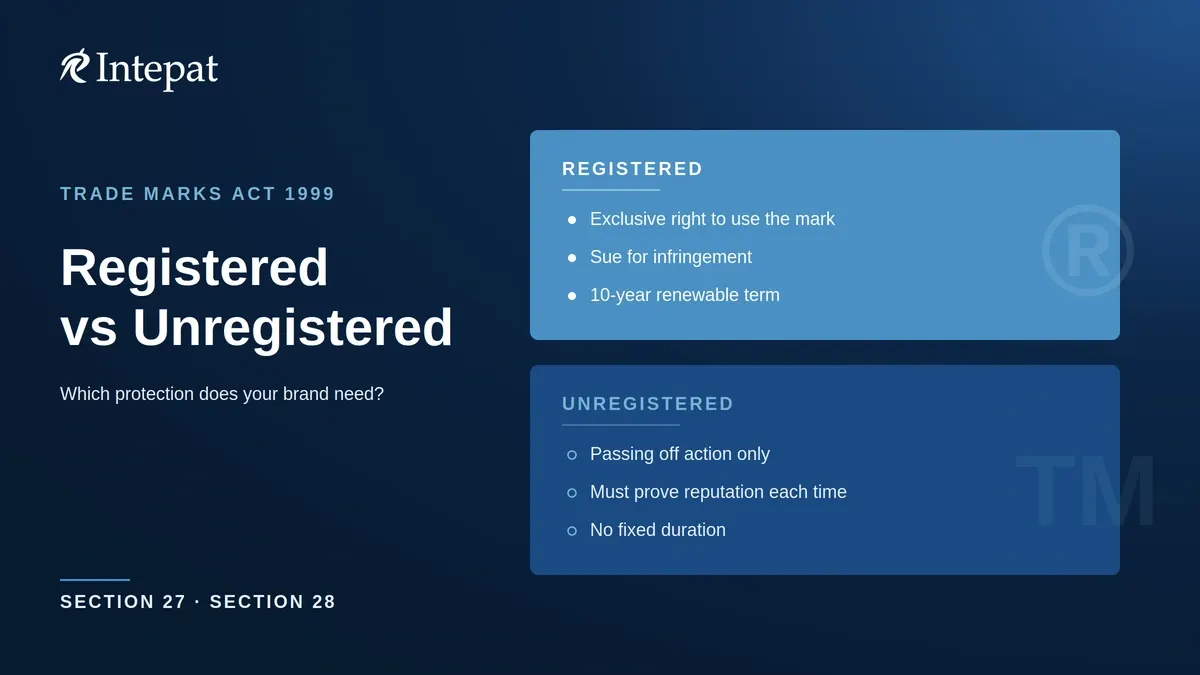
A registered trademark gives its owner the exclusive right to use the mark and to sue for infringement under the Trade Marks Act 1999. An unregistered trademark cannot support an infringement suit, but it can still be protected through a passing-off action built on reputation and prior use. Registration is optional in India, though it carries real advantages.
This guide explains the difference between registered and unregistered trademark protection in India, written for founders and business owners deciding whether to register. It covers what each one protects, where the two diverge, and how to choose. Everything here applies to India only.
The short answer
- Registration is optional in India, but it is the stronger form of protection.
- A registered trademark gives exclusive rights, the right to sue for infringement, and prima facie evidence of validity in court.
- An unregistered trademark relies on a passing-off action, where you first have to prove your reputation.
- Genuine and continuous earlier use of a mark is protected even against someone who later registers it.
- Do not use the ® symbol until your mark is actually registered.
What a registered trademark actually gives you
A registered trademark is a mark entered on the Register of Trade Marks and kept in force. Once it is on the register, the owner has the exclusive right to use that mark for the goods or services covered by the registration, subject to the provisions of the Act and any conditions or limitations on the register. The owner can also take action against infringing use of an identical or deceptively similar mark in the course of trade. Registration turns a brand name into a property right the law will enforce directly.
Three advantages matter most in practice. First, you can sue for infringement, a statutory remedy that does not ask you to prove your reputation from scratch. Second, registration is prima facie evidence of validity, which gives the registered owner a strong starting point in court and shifts much of the early burden onto the other side. Third, the right runs for ten years and can be renewed indefinitely, so the protection does not lapse as long as you keep renewing it.
Two limits are worth knowing up front. A registration covers only the goods or services you register it for, so protection is class-wise rather than a blanket monopoly over the name in every line of business. It is also territorial: an Indian registration protects you in India, not automatically in other countries. Both points shape how widely you should file, not whether you should file at all.
Registration is not automatic. You apply, the Registry examines the mark, it is published so others can object, and only then is it entered on the register. Running a trademark search before you file tells you whether the name is already taken, and the full registration process sets out each stage.
What protection an unregistered trademark still has
An unregistered trademark is a name, logo, or mark you use in trade but have never registered. You cannot sue for infringement on it. The Trade Marks Act is explicit that no infringement action lies for an unregistered mark.
What you can do is bring a passing-off action. Passing off is a common-law remedy that stops a competitor from misrepresenting their goods or services as yours, and the Act preserves this right alongside registration. The catch is what you must prove: that your mark has built up goodwill or reputation, that the competitor’s use misleads customers, and that you are likely to suffer damage. Reputation is not assumed. You establish it with evidence of use, sales, and recognition.
That is why an unregistered mark is real but harder to enforce. A registered owner walks into court with the registration as a starting point. An unregistered owner has to build the reputation case first, which takes more evidence, more time, and more cost.
A simple example shows the gap. Say you have sold cold-pressed juices under a name for three years and built a steady local following, and a new shop opens nearby using a near-identical name. Because you never registered, you cannot sue for infringement. You can still sue for passing off, but only if you can show that customers associate the name with you and are being misled. The principle is on your side; the burden of proof is the hard part.
Evidence that typically supports a passing-off claim includes invoices and sales figures, advertisements and marketing spend, website and marketplace listings, social media presence, distributor or customer recognition, press mentions, and any documented instances of actual confusion.
If you are weighing this up for a brand you are about to launch, our team can confirm availability and file for you before you commit to the name.
Unregistered vs registered trademark: a side-by-side comparison
The table sets out where the two forms of protection differ. Section references are included for readers who want them.
| Feature | Registered trademark | Unregistered trademark |
| Legal basis | Statutory right (Trade Marks Act 1999) | Common-law right (passing off) |
| Main remedy | Infringement suit (Section 28) | Passing-off action (Section 27(2)) |
| What you must prove | An identical or deceptively similar mark | Goodwill or reputation, misrepresentation, and damage |
| Evidentiary starting point | Registration is prima facie evidence of validity (Section 31) | Reputation and prior use must be proved through evidence |
| Symbol you may use | ® (only after registration) | TM, if desired |
| Duration | 10 years, renewable indefinitely (Section 25) | Lasts only as long as reputation can be shown |
| Where you can sue | District Court or above; the owner may sue where it is based (Section 134(2)) | District Court or above; generally where the defendant operates or the dispute arose |
| Effect on later filings | Cited against later identical or similar applications | Can block a later application through opposition on prior-use grounds (Section 11(3)) |
When an unregistered mark can still beat a registered one
Registration does not automatically win. Indian law protects genuine and continuous earlier use. If you or a previous owner of the business continuously used the mark for the same goods or services before the later registered owner first used or registered it, whichever date is earlier, the law saves your right to keep using it. A genuine prior user can defend its position, and often challenge the later registration, on that basis. This is also why a registered logo does not defeat a true earlier user, and why a clearance search that looks for deceptively similar marks matters before you file.
Two further situations give the unregistered side real power. A mark that has become well known is protected because of its reputation, even without registration and even against unrelated goods. An earlier unregistered owner can also oppose a later trademark application under Section 11(3), where use of the later mark could be prevented by the law of passing off, which gives an active unregistered owner a way to block a copycat filing even without a registration of its own.
Practitioner note: the courtroom is not the same for both. A registered owner can usually sue where it is based, a real convenience. That home-court option does not extend to a pure passing-off claim, so an unregistered owner generally has to sue where the other side operates or where the dispute arose. Combined with the need to prove reputation first, enforcing an unregistered mark is slower and more expensive than enforcing a registered one, which is the practical reason most growing brands register.
The ® and (TM) symbols: which one you can legally use
The two symbols are not interchangeable, and using the wrong one carries a real cost. The ® symbol means the mark is registered, and you may use it only after the Registrar enters your mark on the register. Using ® on a mark that is not registered is a contravention of Section 107 and attracts a monetary penalty, because it represents an unregistered mark as registered. Since 1 August 2024, the consequence is a monetary penalty rather than imprisonment: the lesser of 0.5% of total sales or turnover in business, or gross receipts in profession, as computed from audited accounts, or ₹5 lakh (verified as of June 2026).
The TM letters carry no such restriction. They are a marketplace signal, commonly used to show that you claim rights in a mark, and they can be used from the moment you file, or even on a mark you have not applied to register. TM gives you no extra legal right on its own; it simply puts others on notice that you treat the mark as yours. The full difference between the TM and ® symbols covers the common errors.
Do you need to register? How to decide
Registration is optional in India, but for most businesses building a brand it is the safer choice. The decision usually comes down to how much the brand is worth to you and how exposed you are to copycats. It helps to look at your own situation rather than the general rule.
- If you sell online or through marketplaces (direct-to-consumer, Amazon, and similar): registration matters most here. Most platform brand-protection and takedown tools ask for a registration number, not goodwill evidence, before they will act.
- If you export or plan to: file early in India and separately in each target country. An Indian application or registration can also support a Madrid-route or priority-based filing strategy abroad, and trademark rights are territorial, so Indian protection does not extend to other countries on its own.
- If you are early-stage or cost-sensitive: the filing fee is modest, and once granted the right dates back to your filing date, so filing early is far cheaper than fighting a passing-off case later. If you are still deciding what to protect, start with what a trademark is and the types you can register.
- If budget allows only one filing: protect the brand name as a word mark first. A word mark covers the name itself regardless of font or colour, giving broader protection than a logo filing. A logo filing can follow once the visual identity is settled.
An unregistered mark is a fallback, not a strategy. It protects you only as far as you can prove reputation, and only where that reputation reaches. A registered mark is also an asset in its own right: it is cleaner to licence, franchise, assign, or pledge as security, because the register shows exactly what is owned. Registration converts uncertainty into a clear, enforceable, nationwide right.
Practical rule: If the brand name will appear on your website, packaging, invoices, app, marketplace listings, or export material, file for registration early. Passing off should be treated as a backup remedy, not the main protection plan.
Frequently asked questions
No. Registration is optional under Indian law. A business can use an unregistered trademark and rely on common-law passing-off rights. Registration is strongly advisable, though, because it gives exclusive statutory rights, the ability to sue for infringement, and prima facie evidence of validity that an unregistered mark does not provide.
You cannot bring an infringement suit on an unregistered mark, because Section 27(1) of the Trade Marks Act 1999 bars it. You can bring a passing-off action instead. That requires you to prove your reputation, that the other party misled customers, and that you are likely to suffer damage.
The ® symbol shows a mark is registered, and may be used only after registration is granted. The TM letters signal an unregistered or pending claim and can be used from filing. Using ® on an unregistered mark is a contravention of Section 107 and now attracts a monetary penalty rather than imprisonment.
Not always. Indian law protects genuine and continuous prior use, so an earlier user who has used the mark without interruption can keep using it and even challenge a later registration. A well-known unregistered mark is also protected on reputation alone. A registered mark gives stronger, easier-to-enforce rights, but it does not override these earlier rights.
The initial ten-year term runs from the filing date of the application, because registration is deemed to take effect from that date. The term can be renewed for further ten-year periods without limit. An unregistered trademark has no fixed term; its protection lasts only while the owner can show continuing goodwill.
Passing off is a common-law remedy that stops one trader from misrepresenting goods or services as those of another. It protects unregistered trademarks. To succeed, the owner must prove goodwill or reputation in the mark, that the other party’s use is misleading, and that the misrepresentation is likely to cause damage.
Yes. The TM letters are a marketplace convention, not a statutory right, and can be used from the date you file an application or even before filing. They signal that you claim rights in the mark. No registration or approval is needed to use TM. Using the ® symbol, by contrast, requires the mark to be on the register.
Through a passing-off action. You must show that the mark has earned goodwill or reputation through use, that the other party’s conduct misleads customers into thinking its goods or services are yours, and that you are likely to suffer damage. Gathering evidence of use, sales, advertising, and customer recognition strengthens the claim.
This article explains the law on registered and unregistered trademarks in India as at June 2026 and is for general information only. It is not legal advice. Registry fees, forms, and timelines change; confirm current details with the Trade Marks Registry before you act. For advice on your specific mark, consult a trademark attorney.