




Before finalising a brand name or logo, a simple online check can prevent months of delay, unexpected objections, and avoidable legal costs. A trademark public search helps identify whether an identical or similar trademark already exists in the Indian Trademark Registry and whether that earlier mark could restrict registration or future use.
Many business owners assume that if a brand name is not visibly used in the market, registration should be straightforward. In practice, trademark examination in India focuses on registry records, phonetic similarity, visual resemblance, and the scope of goods or services claimed—not merely on market presence. This is why understanding the fundamentals of what trademarks are and how different types of trademarks function becomes important at the brand selection stage.
Conducting a trademark public search before filing allows applicants to assess potential risks early, refine brand choices if required, and proceed with greater clarity. This guide explains how trademark public search works in India, the different types of searches available, how to read and analyse search results, and what steps to take before filing a trademark application.
How Trademark Public Search Works in India
A trademark public search in India allows applicants to check whether a proposed brand name or logo conflicts with existing trademarks recorded in the Indian Trademark Registry. The search helps identify identical, visually similar, or phonetically similar marks within relevant classes and assess whether those earlier marks could restrict registration or future use.
What Is a Public Trademark Search?
A public trademark search (often referred to as a TM public search) is the process of checking India’s online trademark records to identify whether a proposed brand name or logo conflicts with existing trademarks already filed or registered.
In practical terms, a public search helps identify whether the trademark registry records contain:
- identical trademarks,
- deceptively similar trademarks (visual or structural similarity),
- phonetically similar trademarks (sound-alikes), or
- similar logos or device marks based on Vienna Classification.
A trademark public search is typically carried out before filing a trademark application to assess whether the proposed mark is likely to face objections, oppositions, or legal conflicts at a later stage.
It is important to understand a few basics at the outset. A public trademark search is free and accessible online, making it an essential first step for brand owners. However, a public search is not the same as a legal clearance opinion, and it can still miss risks if the search is limited to narrow keywords, incorrect classes, or incomplete similarity checks.
For a broader, multi-jurisdictional perspective on availability checks, see WIPO Global Brand Database: How to Check Trademark Availability Before Filing.
Why Trademark Public Search Matters Before You Register
Many trademark issues begin with a common assumption: “No one in the market is using this name, so registration should be easy.” In reality, trademark examination in India is based on registry records and legal similarity, not merely on visible market use.
A trademark public search helps reduce the risk of filing an application that later faces objections for similarity, receives opposition from an earlier trademark owner, or results in a forced rebrand after the business has already invested in marketing, packaging, domain names, and online presence.
Conducting a search also saves time. Trademark applications that attract objections or oppositions usually take longer to resolve, and responses often require careful legal drafting and evidence.
- To understand how objections can be avoided early, see 10 Steps To Prevent Trademark Objections .
- For what happens after an objection is raised, refer to 5 Things You Need To Know About Trademark Office Actions .
What Trademark Search Results Can Tell You
A trademark search result is more than a list of similar marks. Properly analysed, it helps determine whether an earlier trademark can realistically create a legal barrier to registration or use.
A public search result typically reveals key information such as the type of mark (word mark, label/logo, or device mark), the trademark class in which protection is claimed, the proprietor of the mark, and the current status—whether applied, objected, opposed, registered, abandoned, or withdrawn. It may also disclose usage details such as the declared “used since” date and the specific goods or services covered.
Understanding this information together is critical. A mark that appears similar at first glance may pose little risk if the scope of goods or services is narrow, whereas another mark with modest visual similarity can still block registration if it is phonetically close and covers overlapping goods or services.
Why “Similar Mark Found” Does Not Always Mean “Do Not File”
Finding a similar trademark in search results does not automatically mean that filing is impossible. Some similarities may be low-risk due to factors such as different classes with no practical overlap, limited goods or services descriptions, non-active application status (which still requires caution), or weak distinctiveness of the earlier mark.
However, similarity becomes high-risk when the earlier mark is registered or actively prosecuted, when the similarity is phonetic rather than visual, when goods or services overlap, or when the earlier mark appears commercially strong or widely used.
Not sure how to interpret a “similar” mark in your search results?
A focused clearance review can help assess whether the risk is low, medium, or high before you proceed.
To understand how similarity leads to refusal during examination, see Sections 9 and 11 of Trademark Act: Why Trademark Applications Are Refused.
Understanding Trademark Classes in India (Why Class Selection Matters)
Trademark protection in India is organised around a classification system that groups goods and services into specific categories. The Indian Trademark Registry follows the internationally recognised Nice Classification, which divides goods and services into 45 distinct trademark classes.
Classes 1 to 34 cover various categories of goods, while Classes 35 to 45 relate to different types of services. When a trademark application is filed, protection is granted only for the class or classes selected, not for the brand name in general.
This makes class selection a critical part of the trademark public search process. A search conducted in the wrong class can create a false sense of safety, while a correctly selected class can immediately reveal relevant conflicts.
In practice, trademark class selection answers two important questions:
- What exactly is being sold or offered under the brand?
- How would consumers perceive the source of those goods or services?
Some products or businesses may appear to fall neatly into a single class. Others may span multiple classes—for example, a brand offering physical products along with online retail services. In such cases, it becomes necessary to evaluate whether protection is required in more than one class.
A public trademark search must be conducted class by class. The Indian trademark database does not allow simultaneous searches across multiple classes. As a result, each relevant class must be searched individually to identify potential conflicts.
For a detailed explanation of how goods and services are categorised, see Trademark Classification of Goods and Services.
Why Class Selection Directly Impacts Search Result
Two trademarks may coexist peacefully if they are registered in entirely unrelated classes with no likelihood of consumer confusion. However, the same brand name may face objections if it appears in the same or closely related classes, even if the businesses operate slightly differently.
Incorrect class selection during a public search can lead to:
- missing earlier conflicting trademarks,
- underestimating the scope of an existing mark, or
- filing an application that later attracts objections under similarity grounds.
For this reason, class identification should be treated as a foundational step, not a procedural formality.
Types of Trademark Searches in India
Once the correct trademark class is identified, the next step is choosing the appropriate type of trademark search. The Indian Trademark Registry provides three primary public search options, each designed to detect a different kind of similarity.
Selecting the correct search type is essential. Many conflicts are missed not because a search was skipped, but because the wrong type of search was used.
Broadly, trademark public searches in India fall into the following categories:
- Wordmark search
- Phonetic search
- Vienna Code search (for logos and device marks)
Each serves a distinct purpose and should be used depending on the nature of the trademark.
Wordmark Search
A wordmark search is used when the trademark consists of a word, brand name, slogan, or textual element without claiming any specific visual style.
This search focuses on identifying trademarks that are visually or structurally similar to the proposed word. It is particularly useful for detecting identical spellings, minor variations, prefixes, and suffixes.
In a wordmark search, applicants can refine results using filters such as:
- trademarks that start with the searched term,
- trademarks that contain the searched term, or
- trademarks that exactly match the searched term.
Wordmark searches are the most commonly used search type and form the starting point for most trademark availability checks.
For a clearer understanding of how textual marks differ from logos, see Word Mark Vs. Logo Mark .
Phonetic Search
A phonetic search is designed to identify trademarks that may sound alike, even if they are spelled differently. This type of search is critical because trademark objections in India frequently arise from phonetic similarity rather than exact spelling.
For example, two brand names that look different on paper but sound similar when spoken may still be considered confusingly similar during examination.
The phonetic search process follows the same steps as a wordmark search, but it does not rely on prefix filters. Instead, it focuses on pronunciation-based similarity as interpreted by the registry’s search logic.
Skipping phonetic search is one of the most common mistakes made by first-time applicants, especially for invented or stylised brand names.
Vienna Code Search (Logo and Device Marks)
When a trademark includes a logo, symbol, icon, or artistic element, a Vienna Code search becomes necessary. The Vienna Classification system categorises figurative elements—such as shapes, animals, objects, or abstract designs—using a standardised numeric code.
A Vienna Code search helps identify existing trademarks that contain similar visual elements, even if the brand names themselves are different.
To conduct this search, the relevant Vienna Code corresponding to the logo’s visual elements must be entered along with the appropriate trademark class. The search results then display all trademarks containing similar device elements within that class.
Vienna Code searches are especially important for logo-heavy brands, where visual identity plays a central role in consumer recognition.
To understand why logo similarity often triggers objections, see Importance of Vienna Codes in Trademark Search .
Practical Note Before Moving Forward
In many cases, a single trademark search is not enough. A thorough public search often involves:
- a wordmark search,
- a phonetic search, and
- a Vienna Code search (if a logo is involved),
all conducted across the relevant class or classes.
How to Perform a Trademark Public Search in India (Step-by-Step)
A trademark public search in India is conducted through the online database maintained by the Indian Trademark Registry. The process is free and can be accessed without creating an account.
To ensure reliable results, the search should be performed methodically, keeping class selection and search type in mind.
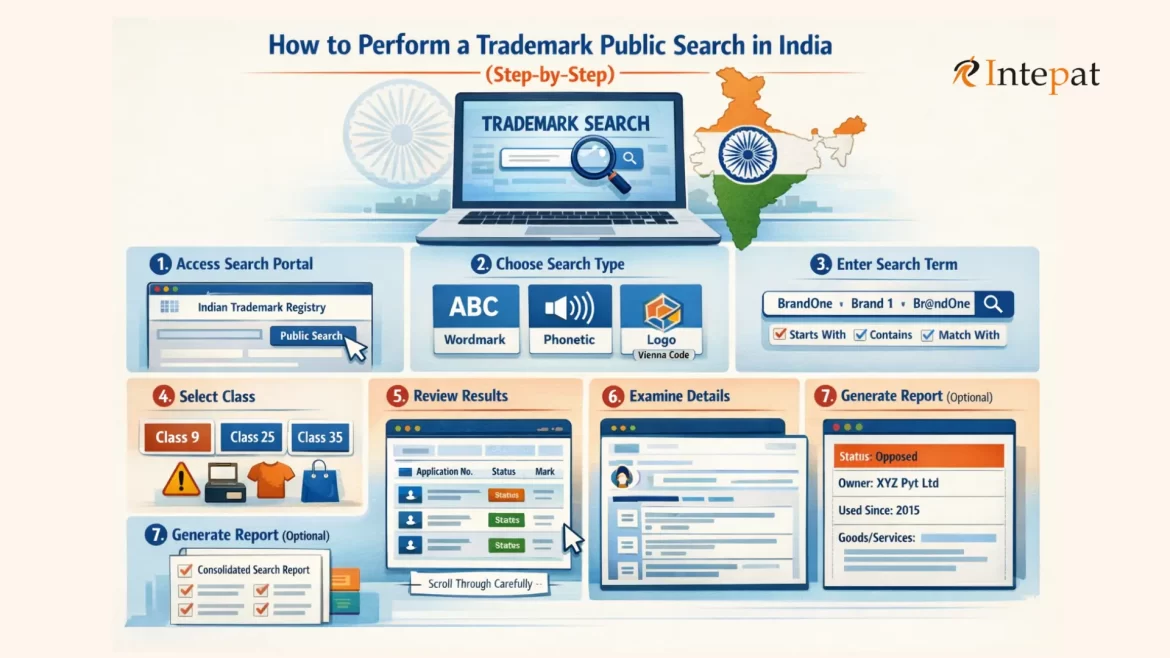
Step 1: Access the Trademark Public Search Portal
Begin by opening the public search page of the Indian Trademark Registry. The portal allows users to search trademarks based on different parameters such as wordmark, phonetic similarity, or Vienna Code.
At this stage, ensure that you clearly know:
- the brand name or keyword to be searched, and
- the trademark class or classes relevant to the goods or services.
Step 2: Select the Appropriate Search Type
From the available search options, select the search type based on the nature of the trademark:
- Wordmark for brand names, words, or slogans
- Phonetic for sound-alike checks
- Vienna Code for logos or device marks
If the trademark includes both a name and a logo, searches should ideally be performed separately for the word element and the visual element.
Step 3: Enter the Brand Name or Search Term
In the search field provided, enter the brand name or keyword exactly as intended to be used. Avoid limiting the search to a single spelling. Variations, prefixes, or shortened forms may also need to be checked in separate searches.
For wordmark searches, the portal provides filtering options such as:
- Starts With
- Contains
- Match With
Using more than one filter helps broaden the scope of the search and reduces the risk of missing relevant results.
Step 4: Select the Relevant Trademark Class
Next, enter the trademark class number corresponding to the goods or services. The Indian database allows searches only one class at a time, so each relevant class must be searched separately.
Incorrect class selection at this stage can result in misleading conclusions. A clean search result in the wrong class does not indicate that the trademark is available for registration.
If class selection is unclear, refer to Trademark Classification of Goods and Services.
Step 5: Review the Search Results List
Once the search is executed, the system displays a list of matching or similar trademarks. Each result is shown with basic details such as:
- application number,
- trademark type (word or device), and
- image (if applicable).
At this stage, it is advisable not to rely only on the first few results. Scanning the full list often reveals additional marks that may appear similar upon closer inspection.
Step 6: Use “Show Details” to Examine Individual Mark
Clicking on “Show Details” for any trademark opens a detailed view in the adjacent panel. This section provides critical information including:
- trademark status,
- proprietor name,
- application date,
- claimed “used since” date, and
- goods or services description.
These details are essential for understanding whether the earlier mark has legal strength or poses a realistic conflict.
Step 7: Generate a Consolidated Search Report (Optional)
The portal allows users to select multiple trademarks from the result list and generate a combined report. This report displays detailed information for all selected marks together, making it easier to compare similarities and assess potential risks.
Important Practical Note
A single search run is rarely sufficient. Effective trademark public search usually involves:
- multiple keyword variations,
- more than one search filter, and
- repeated searches across relevant classes.
Skipping these steps can result in an incomplete picture of trademark availability.
How to Analyse Your Trademark Search Results and Reports
Completing a trademark public search is only half the exercise. The real value lies in how the search results are analysed and whether those results indicate a genuine legal risk.
A common mistake is to look only for exact matches. In practice, trademark examination focuses on overall similarity and likelihood of confusion, not just identical spellings.
Step 1: Check the Trademark Status Carefully
Each trademark in the search results carries a trademark status such as New Application, Formalities Chk Pass, Formalities Chk Fail, Objected, Opposed, Registered, Abandoned, or Withdrawn. These labels indicate where the mark stands procedurally, but they should not be read in isolation.
A registered or opposed mark generally carries stronger legal weight. However, even an applied or objected mark can pose a risk if it has an earlier filing date or strong similarity. Abandoned or withdrawn marks require caution, as prior use or refiling may still exist.
Step 2: Review the Application Date and Priority
The application date establishes priority. When two trademarks are similar, the one with the earlier filing date usually enjoys a stronger position.
Comparing application dates helps answer a key question: Which party reached the trademark registry first for similar goods or services?
Step 3: Examine the “Used Since” Claim
Many trademarks include a declared “used since” date. This indicates when the proprietor claims first commercial use of the mark.
While this claim is not automatically accepted as proof, it can become relevant in opposition or enforcement proceedings. A mark with long-standing prior use may carry more weight than a recently adopted mark, even if registration is still pending.
Step 4: Analyse Goods and Services Description
Trademark protection is limited by the scope of goods and services claimed. Two marks may look or sound similar but still coexist if their goods or services are sufficiently different.
Careful comparison of the goods or services descriptions helps determine whether consumer confusion is likely. Broad or overlapping descriptions increase risk, while narrow or unrelated descriptions may reduce it.
Step 5: Consider the Overall Similarity, Not Individual Differences
Trademark analysis is holistic. Minor spelling differences, added words, or stylistic changes do not automatically eliminate conflict.
Similarity becomes stronger when:
- the marks look or sound alike,
- the goods or services overlap or are related, and
- the earlier mark appears distinctive or well-established.
This stage often requires judgment rather than mechanical comparison.
Practical Insight
A trademark may appear “available” after a basic search but still carry hidden risks due to phonetic similarity, related classes, or earlier priority claims. Conversely, some apparent conflicts may be manageable with informed strategy.
Not Sure How to Interpret Your Trademark Search Results?
When trademark search results appear borderline or difficult to interpret, an independent review can help assess whether filing is advisable or whether modifying the mark would reduce risk.
Benefits of Conducting a Trademark Public Search in India
Selecting a brand name often involves significant time and creative effort. Conducting a trademark public search before committing to that name helps protect this investment and reduces uncertainty at later stages of registration and use.
A well-conducted trademark search provides early visibility into whether similar or identical trademarks already exist in the registry. This allows applicants to avoid filing marks that are likely to face objections or oppositions and to make informed decisions before investing in branding, packaging, or marketing.
A trademark search also helps identify phonetic similarities and closely related marks that may not be obvious at first glance. This is particularly important in India, where trademark examination places strong emphasis on likelihood of confusion rather than exact matches.
In addition, a public search allows applicants to assess whether a proposed mark falls within restricted or sensitive categories, such as marks that are descriptive, non-distinctive, or otherwise vulnerable to refusal. Identifying such issues early can save both time and cost.
From a strategic perspective, conducting a trademark search provides flexibility. If conflicts are identified, the applicant has the opportunity to modify the mark, refine the scope of goods or services, or reconsider class selection—before filing and incurring official fees.
For common pre-filing issues that often surface during examination, see 5 Common Mistakes To Avoid Before Registering A Trademark.
What to Do After Completing a Trademark Public Search
Once a trademark public search is completed, the next step depends on what the search results reveal. There is no single outcome that applies to every case, and decisions should be guided by risk assessment rather than assumptions.
If the search does not reveal any identical or confusingly similar trademarks in the relevant class, the applicant can generally proceed with filing. However, it is still advisable to retain copies of the search results and note the date on which the search was conducted, as trademark databases are updated regularly.
When similar or potentially conflicting trademarks appear in the results, the situation requires closer evaluation. Factors such as the status of the earlier mark, overlap in goods or services, phonetic similarity, and claimed usage history become important at this stage. In some cases, a minor modification to the proposed mark may significantly reduce risk, while in others, selecting an alternative brand name may be the safer approach.
If the search indicates that the proposed mark is descriptive, weakly distinctive, or vulnerable under refusal grounds, filing without adjustment may lead to objections during examination. Understanding this early allows applicants to reconsider branding decisions before incurring filing and prosecution costs.
In situations where the search results are mixed or difficult to interpret, seeking a focused review can help clarify whether filing is commercially and legally sensible, or whether changes should be made before proceeding.
For an overview of how the filing stage works after search, see 5 Step Trademark Registration Process in India.
Frequently Asked Questions (FAQ) on Trademark Public Search in India
Trademark public search is not legally mandatory, but it is strongly recommended. Filing without a prior search increases the risk of objections, oppositions, and delays, especially where similar or phonetically close trademarks already exist in the registry.
Yes. Trademark public search can be conducted free of cost through the online database maintained by the Indian Trademark Registry. No login or payment is required to access the search portal.
No. A clean search result does not guarantee registration. Trademark examination considers legal similarity, distinctiveness, and statutory grounds of refusal. New applications filed after the search date or examiner interpretation may still result in objections.
No. Trademark search should not be limited to exact spellings. Phonetic similarity, alternate spellings, prefixes, suffixes, and visual resemblance are equally important and are commonly relied upon during examination.
Yes, in some cases. Similar trademarks can coexist if they are registered in unrelated classes with no likelihood of consumer confusion. However, class overlap, allied goods, or related services can still lead to objections despite different class numbers.
Not always. An abandoned or withdrawn trademark may still indicate prior use or future refiling. Such marks should be reviewed carefully rather than ignored outright.
A Vienna Code search is required only when the trademark includes a logo, symbol, or device element. For word-only trademarks, wordmark and phonetic searches are usually sufficient.
Trademark databases are updated regularly. If there is a significant delay between search and filing, it is advisable to repeat the search to capture newly filed applications that may affect availability.
Yes, individuals can file trademark applications themselves. However, interpreting search results, class overlap, and similarity risk often requires experience, especially in borderline cases.
The main limitation is interpretation. Public search tools display data, but they do not assess legal risk. Similarity analysis, likelihood of confusion, and filing strategy require informed evaluation beyond raw search results.