




A trademark does not have to be a word or a logo. You can protect a sound, a shape, a colour combination, or a scent, if it genuinely identifies your brand. This article maps where each of these non-traditional marks stands in India today, and what you need to know before deciding whether to file.
Quick answers
• Sound, shape, and colour-combination marks are registrable in India, with clear filing routes.
• No smell mark had been formally accepted for advertisement in India before the Sumitomo Rubber order of 21 November 2025; that application is currently opposed, not registered.
• Every unconventional mark must be precisely recordable and genuinely distinctive; shape marks face an additional bar if the shape is functional.
Where each mark stands today
| Mark type | Current Indian position | Filing difficulty | Main risk |
| Sound | Clear filing route (Rule 26) | Medium | Proving distinctiveness |
| Shape and 3D | Clear filing route (Rule 26) | Medium to high | Functional shape bar |
| Colour combination | Named in the Act | Medium | Acquired distinctiveness |
| Single colour | Contested (conflicting court rulings) | High | Legal eligibility plus evidence |
| Smell | Accepted for advertisement once (Sumitomo, 2025) | Very high | Representation plus opposition risk |
| Motion, hologram, position, texture | No codified format | Very high | Representation and distinctiveness |
What makes a trademark “unconventional”?
A trademark normally works as a word or a logo. An unconventional trademark works through something else: a sound, a shape, a colour, a scent, a position on a product, or a motion. Indian trademark law does not use this label; it is a practical grouping that covers marks that don’t fit the standard mould.
The Trade Marks Act 1999 is broad enough to admit all of these. It explicitly names shape of goods, packaging, and combinations of colours. Sounds, smells, and motions are not named, but they are not excluded either. Whether any of them qualifies as a trademark comes down to two questions: can you record it precisely enough for the Registry to know exactly what you are claiming? And does it actually identify your brand in the minds of your customers?
Three things every unconventional mark must prove
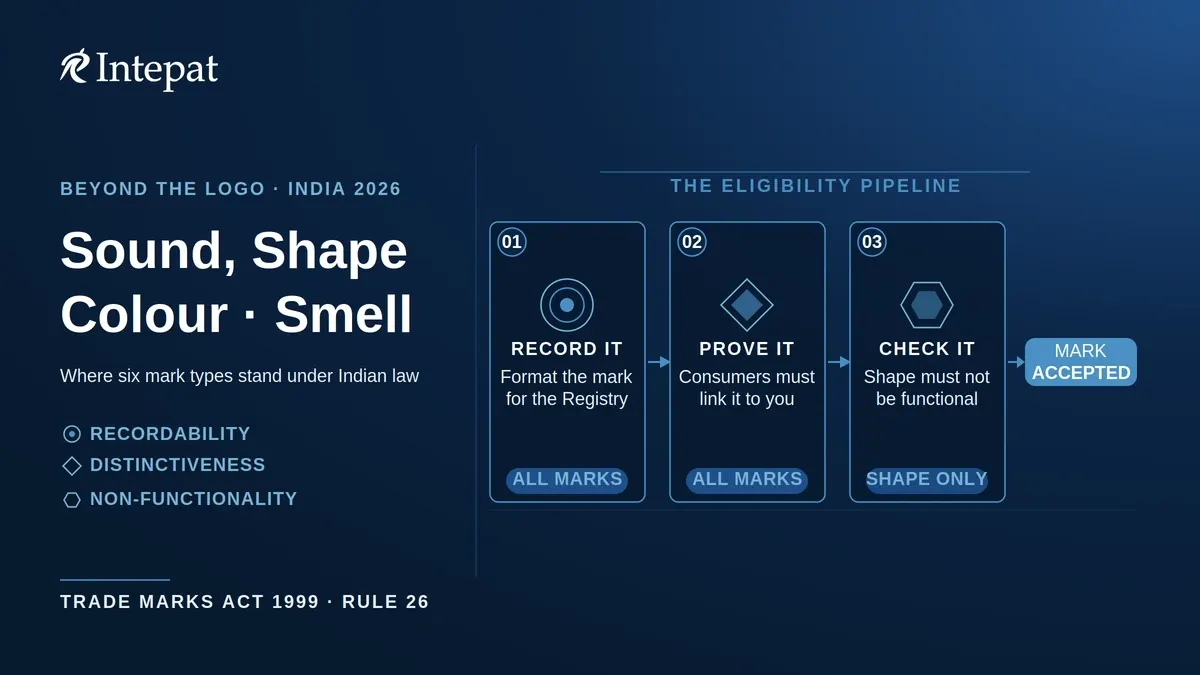
No matter what category you are filing, every unconventional mark must pass the same basic checks.
Can it be recorded? The Registry must be able to commit your mark to a precise, permanent record so that competitors and the public know what is protected. The rules set out specific formats for different categories: an MP3 file plus a musical notation for sounds; multiple photographs or drawings for shapes; and so on. If your mark cannot be captured in a format the Registry can work with, the application fails before anything else is considered.
Is it distinctive? Your mark must function as a brand signal, not a description of your product or a generic feature of your industry. A jingle everyone uses, a shape standard for the product type, a colour that is industry-wide: none of these qualify. Evidence of consistent use and consumer recognition helps, especially if you are filing a mark that does not have obvious distinctiveness on the day you file.
For shape marks: is the shape non-functional? If a shape is dictated by what the product is (a sphere for a ball), required for the product to work technically, or primarily responsible for the product’s value to the buyer, it cannot be protected as a trademark. This bar is absolute. Even a shape that every customer associates with your brand will fail if it is also the shape the product needs to be.
| Test | Applies to | What it tests |
| Recordability | All marks | Can the mark be precisely captured in a filing? |
| Distinctiveness | All marks | Does it identify a single source? |
| Non-functionality | Shape marks only | Is the shape non-functional? |
Sound marks in India: registrable since 2008
India has been registering sound marks since August 2008, when Yahoo!’s three-note yodel became the country’s first. ICICI Bank followed in 2011 as the first Indian company to protect a sound mark. The route has existed for well over a decade.
To register a sound mark today, you need two things submitted together: an MP3 recording of no more than 30 seconds, and a written musical notation showing the same tune. One without the other will not be accepted.
The harder challenge is almost always distinctiveness. A short generic melody or a sound common to your industry will not qualify. The Registry looks for evidence that customers actually associate the sound specifically with your brand, which usually means years of consistent use before filing. For the full filing procedure, see our piece on sound mark registration in India.
Shape and 3D marks: the shape must be unique, not functional
Indian law explicitly recognises the shape of goods, packaging, and three-dimensional configurations as registrable trademarks. To file, you provide multiple views of the shape: typically three to five photographs or drawings from different angles, plus a written description.
The leading Indian case is Gorbatschow Wodka K.G. v. John Distilleries Ltd., decided by Justice D.Y. Chandrachud at the Bombay High Court in May 2011. Gorbatschow made premium vodka in a distinctive bulbous bottle inspired by Russian architecture. A competitor launched a very similar bottle. The court granted an injunction, confirming that a distinctive, non-functional shape is protectable as a trademark, even while an application is still pending. The case is sometimes misread as courts being hostile to shape marks; the opposite is true.
The practical lesson: if your shape is genuinely chosen for brand reasons rather than functional ones, and customers recognise it as yours, you have a registrable mark. For the filing mechanics, see our guide on 3D trademarks in India.
Colour marks in India: single colour is contested territory
Combinations of colours are explicitly registrable under Indian trademark law, and have been for years. A single colour is a different story.
Two Delhi High Court judges reached opposite conclusions within months of each other. In December 2017, one judge recognised Christian Louboutin’s red sole as a well-known trademark and awarded damages. Five months later, in May 2018, a different judge held that a single colour does not legally qualify as a trademark, because the Act refers to “combination of colours,” not a single one.
A Division Bench of the Delhi High Court intervened in April 2019. It set aside the May 2018 dismissal, but on procedural grounds: the suit had been thrown out at the first hearing before the defendants had even appeared, which the Bench found was improper. The Bench noted the conflict with the December 2017 ruling but did not decide the substantive question of whether a single colour can be a trademark. The case was sent back for a proper hearing on the merits. The core question remains unresolved at the appellate level.
The practical result: filing a single-colour mark in India is a gamble. You may win, but you are filing into a known legal dispute where the outcome is unpredictable. A colour combination is on much firmer ground, especially if you have used it consistently long enough to build customer recognition. For how distinctiveness works for colour marks, see distinctiveness vs descriptiveness of trademarks.
Smell marks in India: one accepted case, but not yet registered
No smell had ever been formally accepted as a trademark in India before November 2025. The problem was recordability: a smell has no natural shape and cannot be drawn or photographed.
That changed with the Sumitomo Rubber Industries order of 21 November 2025. Sumitomo had applied to register the scent of roses on its tyres (Application No. 5860303, Class 12). The Registry initially refused on recordability grounds. Sumitomo’s response included a scientific method developed by researchers at IIIT Allahabad: the fragrance was mapped as a seven-dimensional vector, with each axis representing a different olfactory quality (floral, fruity, woody, and so on), plotted on a radar graph. The Registrar accepted this as a valid description and approved the application for advertisement. The logic: a rose scent on car tyres is distinctive precisely because it has nothing to do with what the tyres do.
Two important caveats. First, the application was opposed in early 2026 and remains contested. The mark is not registered. Second, the acceptance was based on a sophisticated scientific record that most applicants will not have the resources to replicate. Full details of the method are in our dedicated piece on smell trademarks in India.
Motion, hologram, position, texture: no clear rules yet
These four categories sit in a gap in Indian trademark law. There are no prescribed filing formats for any of them, unlike sound, shape, and 3D marks.
In practice, applicants file by analogy. A position mark (think of a logo always placed at the same spot on a garment) is filed as a drawing showing the mark in dotted-line context with a written description of the location. Motion marks are typically filed as a still-frame sequence with a description of the movement. The Delhi High Court has recognised Levi Strauss’s Arcuate Stitching Design as a well-known position mark, showing that long-term consistent use can still protect these marks even without a dedicated filing category.
These categories are not impossible, but they are expensive and uncertain. Think of them as sitting where smell marks were before Sumitomo: not excluded, but not mapped.
Before you file: four practical checks
Which category fits your mark? Sound, shape, and colour-combination marks have clear filing routes and track records at the Registry. Single colour, smell, motion, hologram, and texture marks require additional legal groundwork and evidence. Start by picking the strongest available category for what you want to protect.
Is your shape or feature functional? If what makes your mark distinctive is also what makes your product work, trademark law will not protect it. Ask honestly: would a competitor need to copy this feature to offer the same product? If yes, trademark protection is unavailable here.
Do you have evidence? Unconventional marks rarely come with automatic distinctiveness. Consumer surveys, years of sales records, advertising invoices, and market research all build the case before the Registry and at any subsequent opposition. Filing early, before the mark has built recognition, usually produces an objection that is hard to answer.
Do you have the right format? Sound: 30-second MP3 plus musical notation. 3D marks: three to five views plus a description. Shape of goods or packaging: five views plus description. For smell, motion, position, hologram, and texture marks, the format needs to be built with a practitioner before filing. The filing mechanics are covered in the documents-required guide and the Form TM-A walkthrough.
The full text of the Trade Marks Act 1999 is available on the India Code portal.
Frequently asked questions
What is an unconventional trademark in India?
A trademark that works through something other than a word or a logo: a sound, a shape, a colour combination, a scent, a position on a product, or a motion. Indian law allows registration of all these types. The ease of filing varies significantly by category, from straightforward for sounds to highly uncertain for smells and motions.
When did India start registering sound marks?
India’s first registered sound mark was Yahoo!’s three-note yodel, granted in August 2008. ICICI Bank followed in 2011 as the first Indian company to register one. The filing process was formalised in 2017, requiring an MP3 file and a musical notation submitted together.
Can a single colour be registered as a trademark in India?
The courts are divided and the position is still unsettled. A December 2017 Delhi High Court ruling protected Christian Louboutin’s red sole. A May 2018 ruling from the same court said a single colour cannot qualify as a trademark. A Division Bench intervened in April 2019 and set aside the dismissal on procedural grounds, but did not decide the substantive question. The core issue remains unresolved. Colour combinations are on much firmer ground.
What did the Sumitomo Rubber order of 21 November 2025 establish?
It was the first time India’s Trade Marks Registry accepted a smell (Sumitomo’s rose fragrance on tyres) for advertisement as a trademark. The acceptance relied on a scientific vector representation developed by IIIT Allahabad researchers. The mark is currently opposed and has not been finally registered.
How is a shape mark different from a three-dimensional trademark in India?
Both protect product shapes but require different numbers of views at filing: a 3D mark needs at least three views, while a shape of goods or packaging needs five. Both are subject to the same non-functionality bar: if the shape is essential to how the product works or looks valuable, it cannot be trademarked.
What is the non-functionality rule for shape marks?
A shape cannot be trademarked if it is dictated by the nature of the product (like a sphere for a ball), required for the product to work technically, or primarily responsible for the product’s value to the buyer. The rule is absolute: even if every customer recognises the shape as yours, it cannot be protected if it is functional.
Disclaimer: This article provides general information on Indian trademark law as at June 2026 and does not constitute legal advice. The Sumitomo Rubber Industries application status, the Pawan Kumar versus Abubaker doctrinal conflict, and other points discussed are subject to ongoing proceedings and may change. Brand owners considering an unconventional mark filing should obtain advice on the specific facts of their case from a Registered Trademark Attorney.