




Until 21 November 2025, no smell had ever been formally accepted as a trademark in India. The statutory definition required every mark to be “capable of being represented graphically,” and the Registry’s own Manual treated the requirement as unmet by olfactory marks. That changed when the Trade Marks Registry accepted Sumitomo Rubber Industries’ application for a rose-scented tyre, using a seven-dimensional scientific vector as its graphical representation. This article explains the statutory barrier, what Sumitomo did differently, and what the decision does and does not settle.
| Quick Answers |
| Can a smell be registered as a trademark in India? Yes, only if the applicant can clear both the graphical representation and distinctiveness tests. What made Sumitomo’s application succeed? A seven-dimensional scientific vector mapping the rose fragrance, which the Registry accepted as adequate graphical representation. Is the mark now registered? No. Notices of opposition were filed in March 2026 under Section 21. As at April 2026, the application is under opposition, with registration pending the outcome. |
The Statutory Barrier
The definition under Section 2(1)(zb)
A trademark in India is governed by the Trade Marks Act 1999. The definition of trademark sits in Section 2(1)(zb):
“‘trade mark’ means a mark capable of being represented graphically and which is capable of distinguishing the goods or services of one person from those of others and may include shape of goods, their packaging and combination of colours.”
Two requirements do the work: the mark must be capable of graphical representation, and it must distinguish the applicant’s goods. The illustrative list (shape, packaging, colours) is visual. Smells, sounds, tastes, and textures are not named. The list is not exhaustive, and olfactory signs are not expressly excluded. Their admissibility turns on whether they clear the graphical representation gate.
The graphical representation requirement
The operative meaning comes from Rule 2 of the Trade Marks Rules 2017:
“‘graphical representation’ means the representation of a trademark for goods or services represented or capable of being represented in paper form and includes representation in digitised form.”
The requirement is functional. A mark must be recordable so that the Registry, competitors, and the public know precisely what is claimed. A scent does not obviously survive that test. A verbal description is subjective; a chemical formula describes the substance, not the odour; a physical sample is neither permanent nor reproducible. For over two decades, this practical mismatch kept smell marks out of the Indian trademark register.
The Manual’s position
The Manual of Trade Marks Practice and Procedure, issued by the Controller General of Patents, Designs and Trade Marks, recorded the examination position on smell marks in its section on non-traditional marks. The Manual’s position was that, because Section 2(1)(zb) required a trade mark to be represented graphically, smell marks did not meet that requirement under the Indian trademark system.
Examiners applied this position in practice, and smell mark applications failed at the threshold. The Manual is administrative guidance, not statute. The Registry remained free to reconsider, and Section 2(1)(zb) itself did not exclude olfactory marks. What was missing was an applicant willing to defend a scientifically adequate representation.
Comparison with sound marks
Sound marks illustrate the alternative path. The Act does not address sounds expressly, but Rule 26(5) of the Trade Marks Rules 2017 requires that a sound mark application be submitted “in the MP3 format not exceeding thirty seconds’ length… accompanied with a graphical representation of its notations.” Musical notation serves as the graphical representation. Sound marks for the Yahoo yodel and the ICICI Bank jingle, among others, have been accepted on this basis. No equivalent rule existed for smells. There is no widely adopted notational system for odours comparable to sheet music, and this was the structural gap Sumitomo had to close.
The Sumitomo Rubber Industries Case
Application and timeline
On 23 March 2023, Sumitomo Rubber Industries Ltd., Japan, filed Trade Mark Application No. 5860303 for the mark “FLORAL FRAGRANCE / SMELL REMINISCENT OF ROSES AS APPLIED TO TYRES,” claimed in Class 12 (vehicles) on a proposed-to-be-used basis. Sumitomo already held the same mark on the UK register under Registration No. 00002001416, dated 1996, the first olfactory trademark registered in the United Kingdom. Because the Indian Registry’s e-filing system has no smell-mark category, the application proceeded under a conventional category (the registry has since recorded it as a device mark), with the description and supporting materials clarifying that the true claim was olfactory.
The first examination report, dated 4 August 2023, objected on two statutory grounds: Section 2(1)(zb) for lack of graphical representation, and Section 9(1)(a) for lack of distinctiveness. Sumitomo filed its written response on 27 September 2023 and appeared at multiple hearings. Because the issues were novel, the Registry appointed senior IP counsel Pravin Anand of Anand and Anand as amicus curiae, an independent advisor to the Registry.
The scientific response
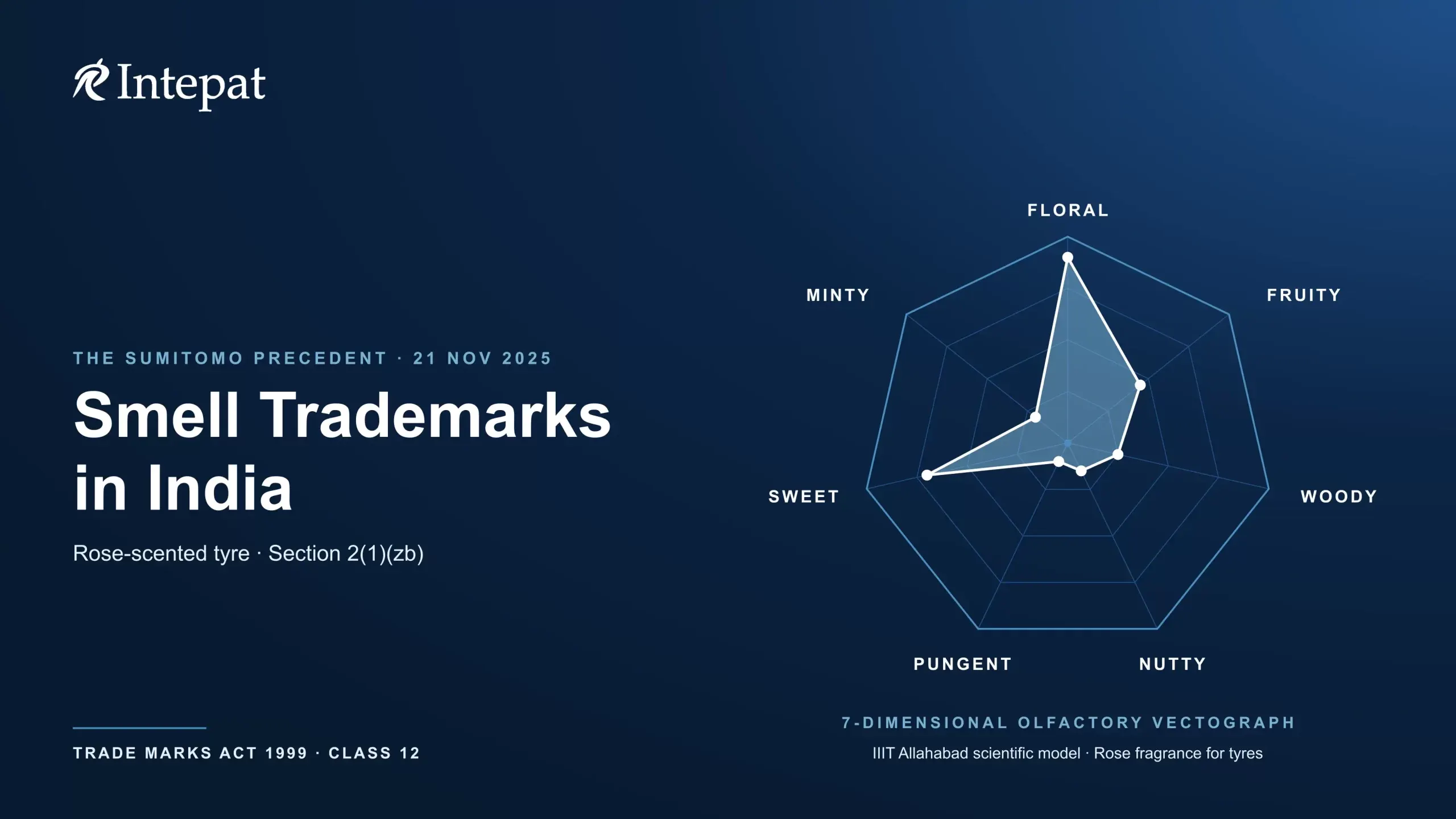
The central element of Sumitomo’s response, as recorded in the examination proceedings, was a scientific report prepared by researchers at the Indian Institute of Information Technology (IIIT) Allahabad: Prof. Pritish Varadwaj, Prof. Neetesh Purohit, and Dr. Suneet Yadav. The report represented the rose fragrance as a vector in a seven-dimensional space, with each dimension corresponding to a fundamental olfactory descriptor: floral, fruity, woody, nutty, pungent, sweet, and minty. Each descriptor was assigned an intensity value, plotted on a radar graph. The graph functioned as the proposed graphical representation, a visual object with defined coordinates that was reproducible and objectively comparable.
Sumitomo’s record went beyond the vectograph. Gas chromatography and mass spectrometry identified the molecular fingerprint of the rose fragrance. Olfactory specialists filed sworn statements attesting that the fragrance serves as a brand identifier, not a performance feature: it does not affect grip, durability, or any functional attribute of the tyre. The applicant also cited smell mark regimes in Australia, the European Union, the United Kingdom, and the United States as evidence that olfactory marks are capable of registration where the statutory tests can be met.
The Registrar’s order (21 November 2025)
The Registrar accepted the application. On graphical representation, the Registrar held that the IIIT Allahabad vectograph set out the constituent olfactory dimensions and their intensities, enabling the authorities and the public to determine the subject matter of protection. Read with the verbal description, it complied with Section 2(1)(zb).
On distinctiveness, the Registrar reasoned that the scent of roses has no natural relationship with the composition, use, or function of tyres. The fragrance is therefore arbitrary in relation to the goods. A consumer perceiving the rose scent in place of the usual rubber odour would associate it with Sumitomo as the source of origin.
The application was accepted in Class 12 on a proposed-to-be-used basis and ordered to be advertised as an “olfactory mark” in Trade Marks Journal No. 2236 dated 24 November 2025.
What the Decision Establishes
Graphical representation, recalibrated. The order does not amend Section 2(1)(zb); it interprets it. Before Sumitomo, the dominant reading was that “graphical representation” meant a visual depiction of the mark itself. The order accepts that the representation need not picture the mark; it can be a scientific model of its constituent attributes, provided it enables the authorities and the public to determine the subject matter of protection.
The Registrar did not accept a written description, a chemical formula, or a physical sample, each of which has been rejected internationally under the test in Ralf Sieckmann v Deutsches Patent- und Markenamt (CJEU, Case C-273/00, 2002). The seven-dimensional vectograph succeeded because it was clear, precise, and objective. The Sieckmann-style criteria survive; what has changed is the form in which they can be satisfied.
The vectograph does not allow a reader to perceive the scent; it defines the scent’s constituent dimensions in a form the Registry can record and adjudicate. The order treats this as sufficient for legal “representation,” even though it does not convey the sensory experience itself.
Distinctiveness applied conventionally. A scent cannot be registered if it is the natural consequence of the product (the fruity smell of orange juice, the leather smell of leather goods), because it would fail to distinguish one proprietor’s goods from another’s. Nor can it be registered if it is functional. Rose fragrance applied to tyres passes both tests: tyres do not naturally smell of roses; the scent is deliberate and has no relationship with the product’s function. It is an arbitrary mark, in the same analytical sense that a well-known trademark like “Apple” is arbitrary for computers.
What the order does not settle. Three matters remain open. First, the mark is not yet registered. Notices of opposition were filed in March 2026 under Section 21 of the Trade Marks Act 1999, on grounds available under Sections 9 and 11. As at April 2026, the application stands at “Opposed,” with the outcome of those proceedings pending. Second, the order accepts the IIIT Allahabad vectograph on its specific facts. A different applicant presenting a different representational method (a chromatogram, a spectral signature, an alternative scent model) will face the same twin tests but cannot assume the same outcome. Third, no Indian court has yet tested the enforceability of a registered smell mark.
Practical Implications
The order is a benchmark for a specific set of facts, not a procedural template. A company considering a smell mark in India should expect to satisfy four conditions: a scientific graphical representation (a verbal description is not enough); non-functionality (the scent cannot play a role in the product’s performance or purpose); distinctiveness, ideally supported by prior use in the applicant’s own market; and procedural awareness of the e-filing system’s limitations.
On the facts of Sumitomo, the order appears to accept arbitrariness, together with the applicant’s evidence and contextual record, as sufficient at the acceptance stage. Future applicants should not assume the same threshold will apply. A first-time smell mark filed on a proposed-to-be-used basis, with no prior market presence, is untested ground. Engaging an experienced trademark attorney is sensible.
Registration is the beginning of a trademark right; enforcement is the proof of it. For smell marks, the enforcement model has not been tested in India. A future trademark infringement action would face evidentiary questions that do not arise for conventional marks: how is similarity between two scents proved; will courts accept expert olfactory testimony, chemical analysis, and consumer surveys as the primary evidence; how is the scope of infringement defined. Indian courts have experience with technical evidence in patent and pharmaceutical litigation, which provides a baseline of institutional capacity. Olfactory evidence, which blends chemistry with subjective perception, raises questions that chemical-identity evidence does not. What is missing is the case law.
Taken together, these present a litigation risk profile unlike that of conventional marks. Subjectivity in scent perception introduces evidentiary uncertainty. The evidentiary standard and proof model for olfactory trademark infringement remain untested in India. The cost of enforcement may outweigh the deterrent value of registration. And the scope of a registered smell mark invites disputes over whether a similar scent on a related product infringes. Each of these risks will be clarified only through litigation that has not yet occurred.
The cost of a first-principles application is itself a meaningful barrier. Expert scientific evidence, senior counsel, amicus input, and procedural length represent a structure out of reach for most small and medium-sized applicants. Unless the Registry issues procedural guidance or a standard template, that cost will remain.
Global Context
Olfactory marks are accepted in few jurisdictions, and registrations in each remain rare.
In the European Union, the Court of Justice’s 2002 judgment in Ralf Sieckmann v Deutsches Patent- und Markenamt (Case C-273/00) set the benchmark that a graphical representation must be clear, precise, self-contained, easily accessible, intelligible, durable, and objective. EUIPO currently treats olfactory marks as not registrable, on the view that available methods do not allow olfactory signs to be represented in a manner that satisfies those criteria. The United States accepts scent marks that are non-functional and have acquired distinctiveness. The TTAB’s 1990 decision in In re Clarke, accepting a floral fragrance reminiscent of plumeria blossoms as a mark for sewing thread, remains the foundational case. The United Kingdom accepted Sumitomo’s rose fragrance mark in 1996 and a handful of other smell marks since. Australia accepts scent marks where the tests are met, with registrations few.
India has not formally adopted the Sieckmann test, but the reasoning in the Sumitomo order aligns closely with it.
Before November 2025, India aligned in practice with the EU’s restrictive position. Post-Sumitomo, India occupies a position closer to the US and UK: permissive in principle, demanding in evidentiary practice. A comparative analysis of Indian, EU, and US trademark practice situates the precedent.
The Road Ahead
The Sumitomo decision does a limited but important thing. It demonstrates that Section 2(1)(zb), read with Rule 2, can accommodate an olfactory mark where the applicant supplies a scientifically adequate graphical representation and clears the distinctiveness threshold. It does not rewrite the statute, create a general rule for future applications, or resolve how smell marks will be enforced.
Three developments would reduce the uncertainty the decision leaves behind. A formal Registry Practice Note or amendment to the Manual, addressing non-traditional marks including olfactory marks, would give examiners and applicants a shared baseline. A procedural category within the e-filing system, specific to smell marks, would remove the need to file under “word mark” as a workaround. And the first contested opposition or infringement proceeding will begin to build the evidentiary law that registration alone cannot supply.
Until then, the position is what the Registry has said it is: smell marks are not impossible in India, but they are not yet routine. The rose-scented tyre is a precedent, not a pattern.
This article reflects the position as at April 2026. Trade Mark Application No. 5860303 is currently under opposition proceedings; final registration depends on their outcome under Section 21 of the Trade Marks Act 1999. This article is general information and not legal advice on any specific application.