




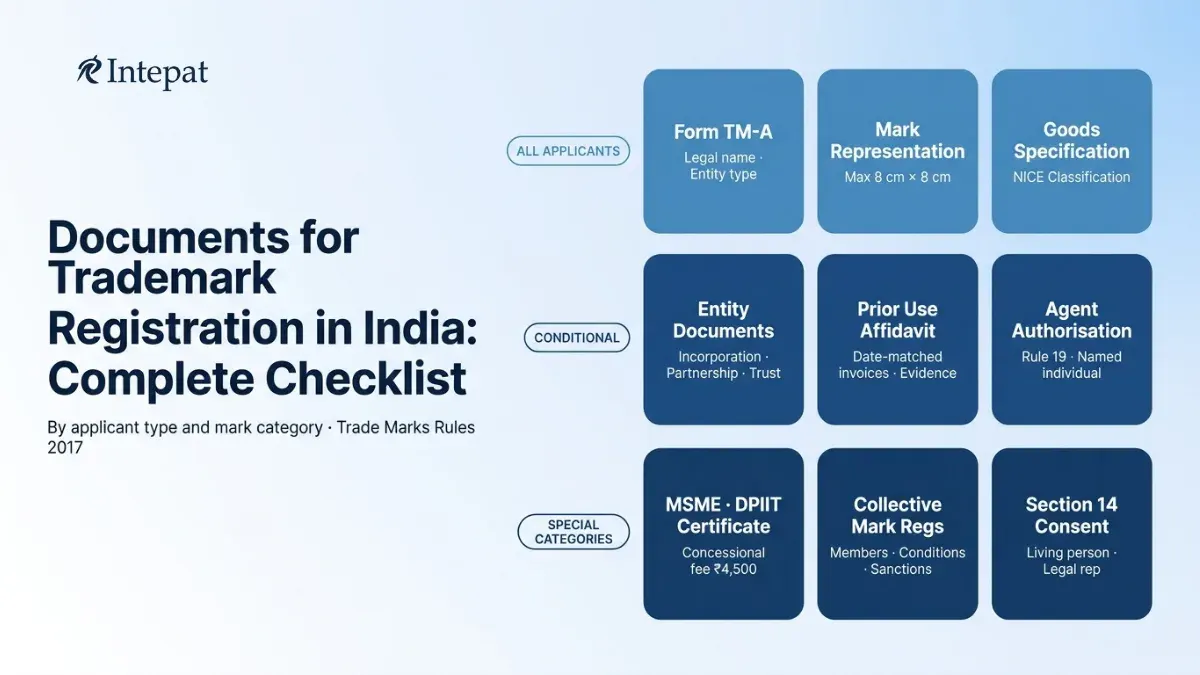
Trademark registration in India on Form TM-A needs the applicant’s legal name and entity proof, the mark representation, the goods and services specification, and the use declaration (proposed or prior). MSME and startup applicants add their Udyam or DPIIT certificate to claim the concessional fee. Additional documents apply by mark type and applicant category.
| Minimum documents for a standard trademark application in India |
| 1. Applicant legal name plus entity proof matching the name on the registration document 2. Mark representation, clear and legible, not exceeding 8 cm x 8 cm for device marks 3. Goods and services specification aligned to a NICE class 4. Use declaration: proposed to be used, or prior use with affidavit and dated supporting evidence 5. Authorisation of agent on Form TM-M, where filing through an agent or advocate 6. Udyam Registration or DPIIT Startup certificate, only if claiming the ₹4,500 per class concessional fee Additional documents apply for collective marks, certification marks, marks containing a person’s name, and convention priority claims. The full checklist is at the end of this article. |
Most trademark delays in India are not caused by examination objections. They are caused by document errors at filing.
The documents needed for trademark registration in India fall into two categories: those the Registry checks at filing, and those it calls for during examination. The filing portal accepts applications with mismatched supporting documents. The Examination Report, issued weeks or months later, surfaces the problem at a stage where fixing it requires a separate correction on Form TM-M, a fresh procedural step, and renewed examiner scrutiny. Both stages carry tight one-month clocks (Rule 31 for a notified deficiency, Rule 33(4) for an Examination Report response), and missing either is treated as abandonment. Getting the documents right before the portal session is opened is the difference between a clean application record and one that carries a correction into examination.
This article covers what a founder, in-house team, or agent needs in hand before filing. For the full picture of trademark registration in India, including timelines, costs, and the stages from search through certificate, see the complete guide to trademark registration in India. For the step-by-step of filling and submitting Form TM-A on the IP India portal, see how to file a trademark application online in India. What follows is document preparation: the inputs, before filing begins.
Documents by Applicant Type: Individual, Company, LLP, Partnership, Trust, Society
The name entered as applicant on Form TM-A becomes the statutory proprietor on registration. Under Section 18 of the Trade Marks Act 1999, any person claiming to be the proprietor of a trademark may apply. Rule 37 of the Trade Marks Rules 2017 permits correction of errors and amendment of the application before registration, but it does not permit an amendment that substantially alters the trademark or substitutes a new specification.
Changing the proprietor after filing is not a correction. For a pending application, the assignment is governed by Section 39 (unregistered marks); once registered, Section 45 governs. Both routes require a deed, stamp duty, and recordal with the Trade Marks Registry. The cost of correcting a wrong applicant name typically exceeds the original filing fee.
Form TM-A recognises ten applicant categories. The document that proves applicant identity varies.
- Individual or sole proprietor. Full legal name of the individual. A trading style or business name is not the applicant name and is recorded separately if needed.
- Partnership firm. Names of all partners. Where a minor is a partner, the guardian’s name is also stated. Partnership Deed is the reference document.
- Company (Private Limited or Limited). Certificate of Incorporation. The law under which the company is incorporated is stated on the form. A director cannot file in their own name for company-owned brands; the company files in its own corporate name.
- LLP. LLP Incorporation Certificate.
- Trust. Trust Deed together with the name of the managing trustee or chairman.
- Society. Name of the society, the authorised representative, and the statute under which it is registered.
A mismatch between the name on the application and the name on the incorporation document is a procedural objection at examination. Correcting it means filing Form TM-M, paying the associated fee, and adding weeks to the timeline. A founder filing in their personal name for a company-owned brand will hold a registered trademark that belongs personally to them, not the company. Converting that back to company ownership later is an assignment with stamp duty, not a cheap correction.
Mark Representation Documents: What to Prepare for Your Type of Mark
The representation is what the Registry publishes in the Trade Marks Journal and what goes on the certificate. It is the document most often called back for substitution at examination.
Device marks and logos. Rule 26(1) of the Trade Marks Rules 2017 requires a clear and legible representation of size not exceeding 8 cm x 8 cm. Submissions that do not show all features of the mark clearly, or are not suitable for reproduction in the Journal, will be called out. The Registrar may require a substitute representation, which delays that element of the examination.
Three-dimensional marks. Rule 26(3) requires the reproduction to consist of three different views of the mark. If the three views do not sufficiently show the particulars of the 3D mark, the Registrar may call for up to five further different views and a written description. Adequate views at filing avoid this round-trip.
Sound marks. Rule 26(5) requires reproduction in MP3 format not exceeding thirty seconds in length, accompanied by a graphical representation of the notations. Both files are submitted with the application.
Shape of goods or packaging. Rule 26(4) requires the reproduction to consist of at least five different views of the mark, with a description in words. Where the five views do not sufficiently show the shape particulars, the Registrar may call for a specimen of the goods or packaging. Shape marks are treated more strictly than device marks because the statutory bars in Section 9(3) (shape resulting from the nature of the goods, shape needed for a technical result, shape giving substantial value) are primarily assessed on the face of the representation, making adequate views at filing a document decision with registrability consequences.
Colour marks. Where the applicant claims a combination of colours as a distinctive feature of the mark, Rule 26(2) requires the application to be accompanied by reproduction of the mark in that combination.
Marks with non-Hindi, non-English words or numerals. Rule 28 requires a precise transliteration and translation of each such word and number into English or Hindi, with the language identified. This applies regardless of mark type. A mark in Tamil, Telugu, Kannada, or any script other than Devanagari or Roman that arrives without transliteration and translation will receive a procedural deficiency notice.
The mark type chosen is itself a strategic decision. A word mark protects the name across fonts and colours. A device mark protects the specific visual filed. Where a brand evolves after filing, a device-only registration may stop tracking commercial use. For which approach fits a specific situation, see wordmark vs logo mark.
Prior Use Claim: Documents If You Have Been Using the Mark Already
Rule 25 of the Trade Marks Rules 2017 creates a fork that decides what use-related documents must accompany the application. An applicant who has not yet used the mark commercially selects “proposed to be used” and files with no use-related documentation. An applicant claiming use of the mark at the date of application selects the prior use option and must file an affidavit testifying to that use, with supporting documents, under Rule 25(2).
The affidavit states the date of first use in the format required by the form. The supporting documents must include evidence from that date: invoices bearing the mark, product packaging, advertisements with dates, website or social media screenshots tied to verifiable dates, or other commercial records showing the mark in use on or before the claimed date. This is where the document error most often caught at Intepat intake happens.
| Practitioner insight: the date mismatch that forces a Form TM-M |
| The use date in the affidavit must be supported by the earliest document submitted with it. If the affidavit claims use from January 2022 but the earliest invoice is dated April 2022, the claim is unsupported for the three-month gap. Raised during examination or opposition, the applicant may need to file Form TM-M to correct the prior use date to one the evidence actually supports. That correction reopens the record, attracts examiner attention, and weakens the priority the applicant was trying to establish. Rule 37 does not expressly prohibit such amendments, but correcting a claimed use date after the examiner has begun work is avoidable. The fix before filing: review every supporting document and confirm the earliest verifiable date before the affidavit is drafted. The use date entered at filing should be the earliest date the documents actually support. |
For what evidence the Registry accepts and how to assemble it, see documents to prove use of a trademark. For why the prior use date matters in later disputes, see prior user rights in trademark law in India.
Fee Concession Documents: Udyam (MSME) and DPIIT Startup Certificates
The government fee for Form TM-A is set out in Entry 1 of the First Schedule to the Trade Marks Rules 2017. E-filing by an Individual, Small Enterprise, or Startup is ₹4,500 per class per mark. E-filing by all other applicants, including companies and LLPs not qualifying as Small Enterprise or Startup, is ₹9,000 per class per mark (verified as of April 2026).
Three document positions determine which rate applies:
- Individual. No certificate needed. The ₹4,500 rate applies automatically.
- Small Enterprise (MSME). Udyam Registration Certificate in the applicant’s name, valid at the date of filing.
- Startup. DPIIT Startup Recognition Certificate in the applicant’s name, valid at the date of filing.
Both certificates are uploaded during the filing session through the Attach Documents function. The fee category is selected at the point of payment. Once paid, the category is fixed for that application; in current practice (verified as of April 2026), there is no clear mechanism for retrospective adjustment of the fee category once payment is completed.
| Practitioner insight: certificate scope must match the Form TM-A specification |
| The goods or services described in the Udyam Registration or DPIIT certificate should bear a reasonable connection to the goods or services in the Form TM-A specification. A Udyam certificate covering food processing filed alongside a TM-A specification for software services may invite scrutiny of the fee concession claim at examination. The mismatch is common at intake and is not apparent to applicants who treat the certificate upload as a tick-box. What typically happens if scope mismatch is raised at examination: the Registry may require treatment under the higher fee category, with the applicant paying the differential to the ₹9,000 rate before the application proceeds. The application is not refused on this ground alone, but the concession claim is lost. Reviewing the certificate’s scope against the proposed specification before filing avoids this. This is a practice-based intake observation from Intepat filings; it does not come from a named Rule. |
A point that catches founders: a company filing under the Body Incorporate category pays ₹9,000 per class. A personal Udyam Registration in the founder’s name does not transfer the concessional rate to the company. To qualify at ₹4,500 per class, the Udyam Registration must be in the company’s name, and the company must meet the Small Enterprise threshold (verified as of April 2026).
For the full fee schedule across all trademark forms, see trademark registration fees in India. For founder-specific filing scenarios, see trademark registration for startups in India. For MSME-specific filing scenarios, see trademark registration for MSMEs in India.
Authorisation of Agent: Documents When Filing Through a Professional
Section 145 of the Trade Marks Act 1999 sets who may act on behalf of an applicant before the Registrar. Three categories are permitted: a legal practitioner (advocate), a person registered as a trade marks agent, or a person in the sole and regular employment of the applicant (a constituted attorney). Each is a natural person; a firm is not a Section 145 category.
Rule 19(1) of the Trade Marks Rules 2017 provides that the authorisation of an agent for the purpose of Section 145 shall be executed in Form TM-M. Form TM-M replaced Form TM-48, which had been prescribed under the Trade Marks Rules 2002 and is retired under the current Rules. References to TM-48 in older articles and, occasionally, in the Manual of Trade Marks reflect the pre-2017 position and should not be followed.
The authorisation, commonly referred to as a Power of Attorney, must be duly stamped in accordance with the Indian Stamp Act 1899, and must name the individual agent or advocate who will sign and file the application. An authorisation in favour of a firm without naming an individual is not acceptable: Section 145 permits authorisation only in favour of a legal practitioner, a registered trade marks agent, or a constituted attorney, each a natural person. An examiner encountering a firm-only authorisation will raise a procedural objection requiring a corrected Form TM-M naming the specific individual. That correction costs a filing and a few weeks.
On the IP India e-filing portal, in current practice (verified as of April 2026), the executed and stamped authorisation is uploaded via the Attach Documents function before the signing step. An agent beginning a filing session without the authorisation ready will generally not reach submission in that session.
Documents for Collective Marks, Certification Marks, and Personal-Name Marks
Three mark categories require documents beyond the standard set. Where the additional documents are missing at filing, the Registrar issues a deficiency notice and substantive examination typically does not proceed until the deficiency is cured.
Collective marks are owned by an association of persons and filed under Chapter VIII of the Trade Marks Act 1999. Form TM-A must be accompanied by draft regulations specifying the name and office addresses of the association, its object, details of members, conditions for membership and the relation of each member with the group, persons authorised to use the mark and the nature of control exercised, conditions governing use of the mark (including sanctions), and the procedure for dealing with appeals against use (Rule 131 of the Trade Marks Rules 2017). A statement of case setting out the grounds in support of the application is also required (Rule 132).
Certification marks are governed by Chapter IX of the Trade Marks Act 1999. The applicant must not carry on trade in the goods or services being certified (Section 70). Draft regulations must specify a description of the applicant, the nature of its business, infrastructure (including R&D and technical manpower), competence to administer the certification scheme, financial arrangements, an undertaking against discrimination, the characteristic the mark will indicate in certified goods or services, and the manner of monitoring use of the mark in India (Rule 137). A separate statement of case is required under Rule 138.
Marks containing a person’s name or likeness are addressed by Rule 29 and Section 14 of the Trade Marks Act 1999. Rule 29 applies where the name or representation of any person appears on a trademark: the Registrar may require written consent from the living person, or from the legal representative if the person died within twenty years before the application date, and may refuse to proceed without it. Section 14 addresses the narrower case of a mark that falsely suggests a connection with a named person; the same twenty-year window applies for deceased persons, and the Registrar may refuse to proceed until consent is furnished. Obtaining consent before filing removes a stop-point the examiner would otherwise raise.
Priority Documents for Convention Applications Under Section 154
Where the applicant is claiming a priority date based on an earlier application filed in a convention country, Section 154 of the Trade Marks Act 1999 allows the Indian filing to take the earlier date, provided the Indian application is filed within six months of the convention filing.
Rule 24 of the Trade Marks Rules 2017 sets out the documents. A certificate by the Registrar or competent authority of the convention Trade Marks Office, stating the particulars of the trademark, the country or countries, and the date or dates of filing, must be submitted with the Indian application. Where the certificate is not filed at the time of the Indian application, Rule 24(2) permits it to be filed within two months of the Indian filing. Missing both the six-month window and the two-month certificate deadline costs the priority claim; the Indian application then takes its own filing date, not the convention date.
The Paris Convention six-month window runs from the first convention filing regardless of where the Indian application sits in its own examination queue. For applicants intending to claim priority, the convention certificate is a document to secure alongside the Indian filing, not an afterthought.
Documents You Do Not Need to Submit
Applicants routinely try to attach documents the Trade Marks Rules 2017 do not require. Submitting them adds bulk without legal effect, and in one case can conflict with Registry guidance.
- PAN card or Aadhaar card. Not prescribed attachments for Form TM-A. Based on IP India’s advisory notices on portal practice (verified as of April 2026), personal identity documents of this kind should not be uploaded. The applicant’s legal name and address, not identity proof, are what the Registry records.
- GST registration certificate. Not required at filing, unless GST records are being submitted as part of the supporting evidence for a prior use claim, in which case they are exhibits to the affidavit, not standalone attachments.
- Board resolution. Not a document the Trade Marks Registry requires or requests. Internal company governance may call for one, but the Registry does not.
- Rent agreement or address proof for principal place of business. Not a prescribed attachment. The address for service in India is declared on Form TM-A (Rule 17) and is accepted on declaration; address proof is not separately called for at filing.
- Trademark search report. A pre-filing search is sound preparation and Intepat conducts one before any filing, but the search report itself is not a prescribed attachment under the Trade Marks Rules 2017 and is not filed with the Registry. In current portal practice (verified as of April 2026), the Form TM-A interface may include a declaration field asking whether a public search has been conducted on the IP India portal. This is a procedural input at the time of filing and does not require submission of any supporting document. Rule 22 of the Trade Marks Rules 2017 concerns a separate mechanism: a search certificate on Form TM-C under Section 45 of the Copyright Act 1957. That is a distinct procedure and unrelated to the TM-A filing itself.
Knowing what not to file is as useful as knowing what must be filed. Unrequired documents lengthen the filing record without legal effect; in the case of identity documents, they can conflict with Registry advisory guidance.
Complete Documents Checklist for Trademark Registration in India, in Filing Order
The table below consolidates every document category covered above, in the order preparation tends to run. Statutory basis is cited for the secondary practitioner reader; a founder using this table to prepare for filing can work from the first three columns.
| Document | Applies to | Status at filing | Statutory basis |
| Correct legal name and entity type on Form TM-A | All applicants | Mandatory | Section 18, Trade Marks Act 1999; Rule 23, TM Rules 2017 |
| Certificate of Incorporation | Company, LLP | Mandatory where applicable | Manual of Trade Marks |
| Partnership Deed with names of all partners | Partnership firm | Mandatory where applicable | Manual of Trade Marks |
| Trust Deed plus managing trustee name | Trust | Mandatory where applicable | Manual of Trade Marks |
| Mark representation, not exceeding 8 cm x 8 cm | Device / logo marks | Mandatory where applicable | Rule 26(1), TM Rules 2017 |
| Three to five views of the mark | 3D marks (minimum 3 views) | Mandatory where applicable | Rule 26(3), TM Rules 2017 |
| At least five views of the mark plus description in words | Shape-of-goods or packaging marks | Mandatory where applicable | Rule 26(4), TM Rules 2017 |
| MP3 file (max 30 sec) plus graphical notation | Sound marks | Mandatory where applicable | Rule 26(5), TM Rules 2017 |
| Colour reproduction of the mark | Colour-claim marks | Mandatory where colour is claimed | Rule 26(2), TM Rules 2017 |
| Transliteration and translation into English or Hindi | Marks with non-English, non-Hindi words or numerals | Mandatory where applicable | Rule 28, TM Rules 2017 |
| Affidavit testifying to prior use | All prior use claims | Mandatory with prior use claim | Rule 25(2), TM Rules 2017 |
| Supporting exhibits: invoices, packaging, advertisements dated on or before the claimed use date | Prior use claims | Mandatory with affidavit | Rule 25(2); Manual of Trade Marks |
| Form TM-M authorisation with stamped Power of Attorney naming the individual agent or advocate | Agent / advocate / constituted attorney filings | Mandatory where filing is through a professional | Section 145, Trade Marks Act 1999; Rule 19(1), TM Rules 2017 |
| Udyam Registration Certificate in applicant’s name | Small Enterprise (MSME) applicants claiming concessional fee | Mandatory to claim ₹4,500 rate | First Schedule Entry 1, TM Rules 2017 |
| DPIIT Startup Recognition Certificate in applicant’s name | Startup applicants claiming concessional fee | Mandatory to claim ₹4,500 rate | First Schedule Entry 1, TM Rules 2017 |
| Draft regulations (association name, members, conditions of use, sanctions, appeal procedure) plus statement of case | Collective marks | Mandatory where applicable | Section 63, Trade Marks Act 1999; Rules 131 and 132, TM Rules 2017 |
| Draft regulations (competence, infrastructure, non-discrimination, monitoring) plus statement of case | Certification marks | Mandatory where applicable | Section 71, Trade Marks Act 1999; Rules 137 and 138, TM Rules 2017 |
| Written consent of living person or legal representative (where death within 20 years of application date) | Marks containing a person’s name or likeness | May be called for by Registrar | Section 14, Trade Marks Act 1999; Rule 29, TM Rules 2017 |
| Priority certificate from convention Trade Marks Office | Convention priority claims under Section 154 | Mandatory at filing; or within 2 months under Rule 24(2) | Section 154, Trade Marks Act 1999; Rule 24, TM Rules 2017 |
Fee figures, form references, and portal-practice statements verified as of April 2026.
Frequently Asked Questions
No. PAN card, Aadhaar card, and passport are not prescribed attachments for Form TM-A under the Trade Marks Rules 2017 or the Manual of Trade Marks. IP India’s advisory notices on portal practice caution against uploading personal identity documents with trademark applications (verified as of April 2026). The Registry records the applicant’s legal name and address, not identity proof.
The ₹9,000 per class rate applies. The fee follows the applicant category on Form TM-A. A company filing under the Body Incorporate category pays ₹9,000, and a founder’s personal Udyam Registration does not transfer the concessional rate. To qualify at ₹4,500, the Udyam Registration must be in the company’s name and the company must meet the Small Enterprise threshold.
No, not safely. A prior use affidavit under Rule 25(2) requires supporting documents that corroborate the claimed date. Where the earliest evidence is three months later than the stated use date, the affidavit is unsupported for that gap, exposing the application to a challenge that may require a Form TM-M correction.
Rule 28 of the Trade Marks Rules 2017 requires a precise transliteration and translation of each Tamil word into English or Hindi, with the language identified. This must be provided in the application. An application filed without transliteration and translation will receive a procedural deficiency notice from the examiner requiring compliance before examination continues.
Rule 25(2) requires the affidavit and supporting documents at the time of filing where prior use is claimed. Filing without them is likely to draw a procedural deficiency notice, which suspends examination until cleared (Rule 31 allows one month from the notice). Preparing the affidavit and exhibits before the portal session avoids that risk.
Section 145 permits authorisation only in favour of a legal practitioner, a registered trade marks agent, or a constituted attorney, each a natural person. A firm is not a Section 145 category. An authorisation naming only the firm draws a procedural objection at examination, requiring a fresh Form TM-M naming the specific individual.
The goods or services in the Udyam Registration should bear a reasonable connection to the goods or services in the Form TM-A specification. Where the two describe unrelated activities, the fee concession claim may be questioned at examination, and the applicant may be asked to pay the differential to the ₹9,000 rate.
Section 154 of the Trade Marks Act 1999 allows an Indian application to take the filing date of an earlier convention-country application, if filed within six months. Rule 24 requires a priority certificate from the convention Trade Marks Office, submitted with the Indian application or within two months under Rule 24(2).
No. In the Trade Marks Rules 2017, Rule 19(1) is the authorisation provision: authorisation under Section 145 is executed in Form TM-M. Rule 21 concerns preliminary advice by the Registrar as to distinctiveness under Section 133. Older articles referencing Form TM-48 under Rule 21 reflect the retired 2002 Rules and are not current.
Disclaimer: This article reflects the Trade Marks Act 1999, the Trade Marks Rules 2017, and the Manual of Trade Marks as at April 2026, and applies to filings in India. Readers should seek specific legal advice based on their factual situation.