




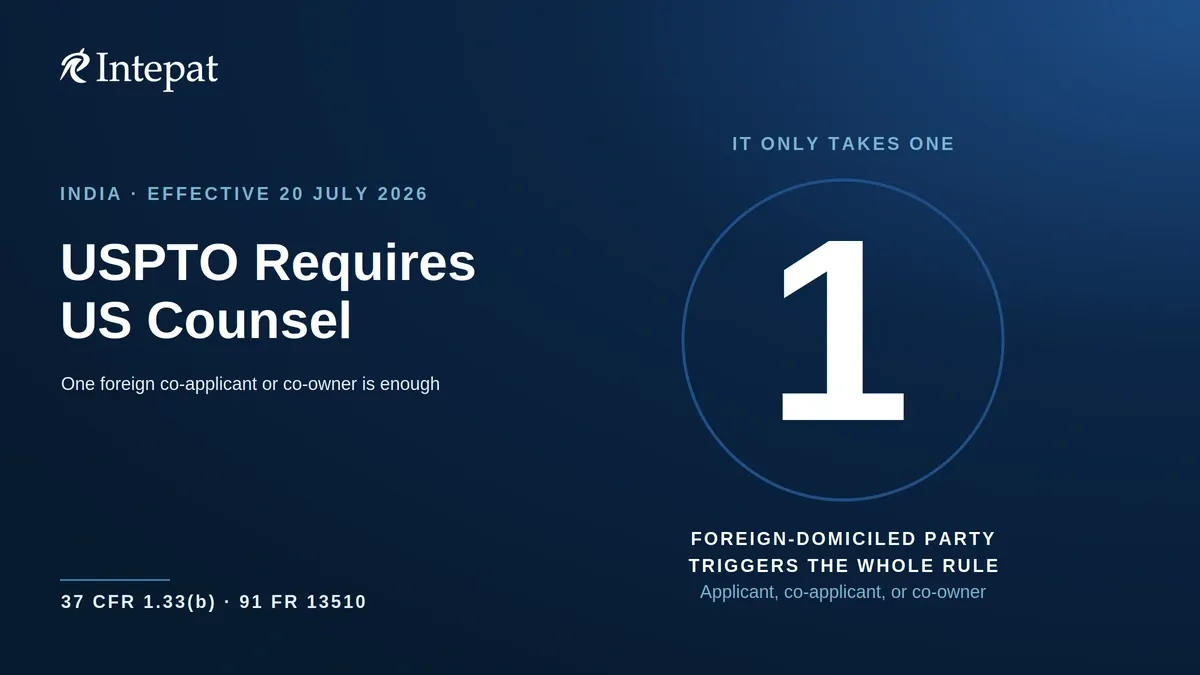
Since 20 July 2026, a foreign-domiciled patent applicant or patent owner must be represented before the USPTO by a patent practitioner. Unless another rule specifies a different signatory, papers filed on their behalf must carry the practitioner’s signature, and papers that do not are not entered.
This is the USPTO US counsel rule, published as a final rule at 91 FR 13510 on 20 March 2026 and in force from 20 July 2026. It is a United States federal regulation governing practice before the USPTO, and it changes nothing about how you file or prosecute in India. This article deals only with what the rule means for applicants and patent owners domiciled in India.
| What you need to know |
| The rule applies to papers received by the USPTO on or after 20 July 2026, whatever the filing date of your application. Papers submitted before that date are not affected. Before grant the test is the domicile of the applicant named under 37 CFR 1.42, not the residence of the inventor and not the address of a non-applicant assignee. After grant it is the current patent owner. One foreign-domiciled co-applicant or co-owner is enough to bring the whole matter within the rule. Improperly signed papers are not entered. An improperly signed Application Data Sheet does not set inventorship and does not carry a priority or benefit claim made only in that sheet. The requirement is not universal. Inventor declarations, maintenance fee payments, assignment recordation, a notice of appeal and the documents and fees required to comply with 35 U.S.C. 371(c) or (f) are among the transactions outside it. |
What the USPTO US counsel rule changes for Indian applicants
Before 20 July 2026, an individual could represent themselves before the USPTO. That option is now closed to anyone domiciled outside the United States or its territories. The amended 37 CFR 1.31 still allows an applicant to act for themselves or through a joint inventor, but carves out three groups: juristic entities (companies and other corporate applicants), applicants where at least one party is foreign-domiciled, and patent owners in the same position.
The signature requirement sits in 37 CFR 1.33(b), which provides that “all papers submitted on behalf of a juristic entity, an applicant as defined in § 1.42 in which the domicile of at least one of the parties identified as the applicant is not located within the United States or its territories, or a patent owner” in the same position “must be signed by a patent practitioner.” Note the opening words, “unless otherwise specified”, where the exceptions live.
The USPTO said the rule serves its “ongoing efforts to improve efficiency, reduce the backlog, improve quality, and deter fraud and misrepresentation in patent matters”, and brings its policies “in line with most other countries, including in Japan and before the European Patent Office”. It applies to all filings received on or after the effective date, and the USPTO declined to distinguish based on effective filing date. If you filed in 2019 and your next reply falls due in September 2026, that reply is caught.
Two things the rule does not do. It does not change the routes for US patent filing from India, and it does not deny you a filing date, since an application still receives one under 37 CFR 1.53 even where the papers are improperly signed. It creates no USPTO fee for appointing a practitioner, though correcting a defective filing can attract existing petition, surcharge or extension fees.
Whose domicile decides this, and why your inventor’s address is not the test
The rule turns on one word, now defined for the first time. The new 37 CFR 1.9(p) provides that “the term domicile as used in this chapter means the permanent legal place of residence of a natural person or the principal place of business of a juristic entity.” Where a person has more than one legal residence, the USPTO indicated that principles used under 26 U.S.C. 7701 may inform which is the domicile: a tie-breaker for the ambiguous case, not an import of the tax-residence regime.
Citizenship is not the test. The USPTO refused to create an exception for US citizens living abroad, on the ground that it does not collect citizenship information. So an Indian national whose permanent legal residence is California sits outside the rule, and a US citizen resident in Bengaluru sits inside it. What decides it is the permanent legal residence, not a passport.
The point most often misread is which party’s domicile matters. Before grant the rule pertains to the applicant, and an inventor’s or assignee’s domicile is irrelevant unless that person is itself named as the applicant. Where the inventor is the applicant, the inventor’s residence becomes the operative fact. Where an Indian company is the applicant and the inventors are its employees, the company’s principal place of business decides it and the inventors’ addresses do not. The distinction between inventor and applicant is familiar from Indian practice; it now carries a US consequence.
The USPTO reads domicile from what you filed: the residence information in the data sheet under 37 CFR 1.76 or the inventor’s declaration under 1.63, and for a non-inventor applicant, the mailing address in the Applicant Information section. Where a data sheet, a declaration or a correspondence-address designation conflict on this point, the most recent submission generally governs, and the USPTO has also said it may look to sources outside the application file. If you disagree with the finding you may personally traverse it, and such a reply “will be considered on the merits even when the applicant has not obtained representation”. That latitude covers the domicile question only: the USPTO will not necessarily address “secondary remarks regarding other outstanding requirements” if the finding is maintained. It is not a route to filing your own substantive response, and the reply period keeps running throughout.
Which Indian applicants are newly caught, and which were already covered since 2012
Indian companies named as applicants were already required to act through a patent practitioner: juristic entities have needed US counsel since September 2012, over a decade. What the 2026 amendment adds for them is the extension to juristic entity patent owners after grant.
The group that genuinely changes position is the individual. An Indian inventor named as the applicant on their own US application could, until 20 July 2026, sign their own papers. That is gone, and the same applies to an individual assignee in India made the applicant under 37 CFR 1.42, and, after grant, to a foreign-domiciled patent owner. Note the condition: before grant it is being named as the applicant that counts, not the assignment itself.
The second newly caught group is the mixed team. Where an application names two applicants, one in Pune and one in Palo Alto, the rule bites, since the trigger is that “at least one” party is foreign-domiciled; the USPTO was asked to exempt mixed-domicile groups and refused. India-US founder pairs, and Indian startups that have flipped ownership to a Delaware entity but left an Indian individual on the application, should read this provision twice.
| The mixed-team trap |
| Swapping out the foreign-domiciled applicant to sidestep the rule is not a shortcut. Any change to a named applicant must stand on the actual entitlement and the procedural requirements that govern it, not serve as a signature workaround. |
Papers that now need a US practitioner signature, and the ones that do not
The table below sets out the affected categories against the papers confirmed to be outside the requirement, drawn from the final rule and the USPTO’s U.S. Counsel Rule guidance, verified as of July 2026.
| Paper | Practitioner signature required |
| Amendments and replies to Office Actions | Yes |
| Application Data Sheet | Yes |
| Micro entity certification | Generally yes; 1.29(e) has a PCT exception |
| Information Disclosure Statement | Yes |
| Petitions, including prioritised examination and petitions to make special | Yes |
| Issue fee transmittal (PTOL-85B) | Yes |
| Inventor’s oath or declaration under 37 CFR 1.63 | No, it must be signed by the inventors |
| Written assertion of small entity status under 37 CFR 1.27(c)(2)(iii) or (c)(2)(iv) | No, expressly carved out of 1.33(b) |
| Maintenance fee payments | No new requirement imposed |
| Recordation of assignment documents | No |
| Notice of appeal under 37 CFR 41.31(b) | No, 41.31(b) disapplies the signature requirements of 1.33 |
| Documents and fees required to comply with 35 U.S.C. 371(c) and/or (f) | No, accepted as the statute requires. Optional papers filed at entry are not covered |
This is an illustrative list, not a codification. Because 1.33(b) opens with “unless otherwise specified”, the controlling question in every case is whether some other rule names a particular signatory or takes the transaction outside it, and narrower exceptions exist that are not set out here. Note also that paying a fee is not the problem: an applicant may still pay filing fees. Where micro entity status is established in a covered US application the certification needs a practitioner’s signature, but 1.29(e) lets an authorised representative sign it in an international application filed at a receiving Office other than the USPTO, the ordinary position for an Indian-origin PCT filing. The small entity assertions named in 1.33(b) stay outside the requirement.
What happens when a paper reaches the USPTO without a practitioner signature
The consequence is non-entry. Unsigned or improperly signed papers are not entered into the record of the application or patent, and the USPTO may mail a notice that representation is required, though the Office cannot aid in selecting a practitioner.
For an amendment or a reply to a US Office Action, non-entry is recoverable if time remains in the reply period, but that period does not pause while you find someone. A formal power of attorney is not the only route back: 37 CFR 1.33(b)(2) also recognises a practitioner not of record acting in a representative capacity under 37 CFR 1.34, often faster when a deadline is close. The requirement reaches the telephone too: USPTO guidance to examiners is that a practitioner must take part in an examiner interview.
For some papers, non-entry cannot be cured at all in that application. A non-publication request under 37 CFR 1.213 and a request for prioritised examination under 37 CFR 1.102(e)(1) must both be submitted with the original filing, and the USPTO gave these as its own worked example: where such a request is not accepted because it is improperly signed, it is not possible to subsequently meet the requirements for the request in that application.
On non-publication a prior question matters more in India than the signature does. Under 35 U.S.C. 122(b)(2)(B)(i) the request requires certifying that the invention “has not and will not be the subject of an application filed in another country… that requires publication of applications 18 months after filing”. India publishes at eighteen months under Section 11A of the Patents Act 1970 and Rule 24 of the Patents Rules 2003, so an applicant who has filed in India, or intends to, usually cannot make that certification, whoever signs it.
How an improperly signed data sheet puts your priority claim at risk
The Application Data Sheet is where this rule does its real financial damage, and it is the item to check first. Where the data sheet is improperly signed, it is treated as a transmittal letter in accordance with 37 CFR 1.76(e). The USPTO has spelled out the consequence: inventorship will not be set, nor will benefit or priority claims be effective.
| Check this before your next US filing |
| The fix is usually to file a compliant, practitioner-signed data sheet inside the ordinary period allowed for making the priority or benefit claim. A petition under 37 CFR 1.55 or 1.78 becomes necessary only once that ordinary period has already run out. |
Knowing the ordinary period is what stops this becoming a crisis. For an application filed under 35 U.S.C. 111(a), 37 CFR 1.55(d)(1) allows the foreign priority claim to be made within the later of four months from the actual US filing date or sixteen months from the filing date of the prior foreign application, and 37 CFR 1.78 uses the same later-of structure for the usual domestic benefit claims in a 111(a) application. The final rule says a delayed claim petition “may be necessary”, not that it always is.
Work through it on a timeline. An Indian applicant files in India in March 2026, clears Section 39 by having filed in India at least six weeks earlier with no subsisting secrecy direction under Section 35, and files in the US in August 2026 claiming Paris Convention priority. The application gets its August filing date under 1.53, but the data sheet signed by the inventor-applicant in Chennai is not entered, so the priority claim is not on file. Here the sixteen months from the March Indian filing runs past the four months from the August US filing, so the ordinary period is still open and a compliant data sheet filed inside it fixes the problem without a petition. Miss that window and what remains is a petition under 1.55(e), which carries its own requirements including a statement that the entire delay was unintentional. Relief is not automatic.
While the claim is off the file, the application cannot rely on the March date against prior art. Whether an intervening disclosure counts turns on the applicable limb of 35 U.S.C. 102 and any exception, so this is exposure rather than automatic loss. This defect does not arise the same way on national stage entry: in a US national phase case under 35 U.S.C. 371 the priority claim is carried through the international phase and 1.55(d)(2) sets the time limit by reference to the PCT, not to a US data sheet. That does not exempt an optional data sheet, or anything filed afterwards, from its own signature requirement.
Whether your Indian patent agent can sign at the USPTO
This is the question Indian applicants ask first, and the answer is no. Registration as a patent agent with the Indian Patent Office, or qualification as a patent attorney in India, confers rights before the Controller under Sections 127 and 128 of the Patents Act 1970. Neither provision has any effect at the USPTO.
Indian nationality is not by itself the barrier; the route is. Under 37 CFR 11.6(a) and (b) an alien lawfully residing in the United States may register, so Indian nationals do appear on the USPTO register. The reciprocity route in 11.6(c) needs the home patent office to “allow substantially reciprocal privileges” to US-admitted practitioners, and Section 126(1) of the Patents Act 1970 confines India’s own register to citizens of India, with no such provision for a foreign practitioner. That closes the route for an India-based agent as a matter of Indian law, not USPTO discretion. And 11.9(b) provides that “limited recognition shall not be granted or extended to a non-U.S. citizen residing outside the United States.”
The vocabulary matters: the rule does not say “registered”, it says patent practitioner, which 37 CFR 1.32(a)(1) defines as a person registered under 11.6 or given limited recognition under 11.9(a) or (b) or 11.16. For someone living in India, registration is the practical route: 11.9(b) is closed as above, 11.16 is the US law school clinic programme, and 11.9(a) is a discretionary grant tied to specified applications.
So your Indian patent agent continues to run your Indian portfolio and remains your point of contact on strategy, while a US patent practitioner takes responsibility for the papers filed at the USPTO. You can confirm any name against the USPTO’s Office of Enrollment and Discipline records before you instruct.
What to check in your US portfolio now
Split the exercise in two, because the operative party changes at grant. For each pending application, identify every party named as the applicant under 37 CFR 1.42, not the inventors; for each issued patent, identify every current patent owner. If any is foreign-domiciled, or a juristic entity, the requirement has to be considered, and a patent can be caught by assignment to a foreign owner after grant even though the applicant during prosecution was US-domiciled.
Then work through the following, in this order:
- Any reply, amendment or petition falling due in the next ninety days, since the reply period runs whether or not you have found a practitioner.
- Any US application filed on or after 20 July 2026 where the data sheet was signed by someone 1.33(b) did not permit to sign it, because inventorship and the priority claim are the exposure.
- Any application where a non-publication or prioritised examination request was filed with the original papers, since those cannot be cured later.
- Granted patents where a foreign-domiciled person or entity is now the patent owner, for anything beyond maintenance fee payments and assignment recordation.
- Mixed India and US groups, on both limbs: mixed applicant groups on pending applications and mixed owner groups on granted patents.
Where a matter needs attention, instruct a USPTO patent practitioner and refile the affected paper inside the existing period. Intepat works through US associates: we manage the file and instructions from India, and the US practitioner signs and files. Our foreign filing service and global filing practice are built around that handover.
Frequently Asked Questions
Yes. The rule applies to all papers received by the USPTO on or after 20 July 2026, regardless of the filing date of the application. The USPTO expressly declined to draw a distinction based on effective filing date. Papers submitted before 20 July 2026 are not subject to the requirement.
If the requirement applies to you, no. An application is accorded a filing date under 37 CFR 1.53 even where accompanying papers are improperly signed. What is lost is the effect of those papers: an improperly signed data sheet sets no inventorship and carries no priority claim, though a compliant one filed inside the ordinary claim period usually cures it.
No. It turns on the domicile, defined in 37 CFR 1.9(p), of each party named as the applicant under 37 CFR 1.42. Inventor and assignee domicile are not relevant unless that person is the applicant. Where the inventor is the applicant, the inventor’s domicile is the operative fact.
Yes. The USPTO stated that the rulemaking imposes no new requirement on maintenance fee payments, and assignment recordation is also outside it. Substantive papers in the granted patent do need a practitioner’s signature, and the party tested there is the current patent owner rather than the original applicant.
Domicile is defined in 37 CFR 1.9(p) as the permanent legal place of residence of a natural person, or the principal place of business of a juristic entity. Where a person has more than one residence, principles used for permanent residence under 26 U.S.C. 7701 may inform the analysis. Citizenship is not the test.
No. The requirement is triggered where at least one party identified as the applicant is domiciled outside the United States or its territories. The USPTO considered and refused a mixed-domicile exception, partly because such an exception could encourage manipulation of the applicant configuration in an application.
No. Indian registration carries no authority at the USPTO, so the person must be separately authorised there as a patent practitioner, which in practice means registration under 37 CFR 11.6. Registration under 11.6(c) requires the home patent office to allow substantially reciprocal privileges, and 37 CFR 11.9(b) bars limited recognition to a non-US citizen residing outside the United States.
No. The final rule confirms that documents and fees submitted to comply with 35 U.S.C. 371(c) and (f) will be accepted as the statute requires. The foreign priority claim in a national stage case is made under the PCT, per 37 CFR 1.55(d)(2). Optional papers filed at entry, and everything filed afterwards, remain subject to their own signature requirements.
Not necessarily. A power of attorney puts the practitioner on record, but 37 CFR 1.33(b)(2) also recognises a practitioner who is not of record acting in a representative capacity under 37 CFR 1.34. Which route suits a given matter is a question for the practitioner you instruct.
This article states the position under 37 CFR Parts 1, 11 and 41 as amended by the final rule at 91 FR 13510, under 35 U.S.C. 122, and under the Patents Act 1970 and Patents Rules 2003, verified as of July 2026. It is general information on a United States procedural requirement and is not legal advice on any specific application or patent. Domicile determinations, priority recovery petitions and the treatment of individual papers depend on the facts of each matter and on the USPTO’s assessment of them. Applicants with a live US filing or reply deadline should take advice on their own file before acting.