




US patent law settles that only a natural person can be named inventor, even where AI tools assisted the work. India’s Patent Office reached the same conclusion administratively, refusing a patent application naming the AI system DABUS as inventor on 15 April 2026. The USPTO’s November 2025 guidance changed how a human’s own AI-assisted contribution is tested, returning to ordinary conception analysis.
India-and-United-States comparative scope. This article addresses inventorship of AI-assisted inventions under the US Patent Act and the Indian Patents Act, 1970, as the law and administrative guidance stood on 6 August 2026. The two proceedings are not a like-for-like comparison: the USPTO guidance concerns a human inventor’s own contribution where AI assisted as a tool (AI-assisted), while the Indian DABUS application named the AI system itself as inventor (AI-generated), so the DABUS refusal should not be read as a direct Indian answer to every AI-assisted R&D situation. India’s refusal is also not final in the way Thaler v. Vidal settled the US position: Dr. Thaler has appealed it to the Delhi High Court under Section 117A of the Patents Act, 1970, in Dr. Stephen L. Thaler v. Assistant Controller of Patents and Designs, C.A.(COMM.IPD-PAT) 36/2026. As of the Court’s order of 30 July 2026, notice has been issued and the Respondent has six weeks to file a reply, with the matter next listed on 18 September 2026, so the appeal remains pending and undecided.
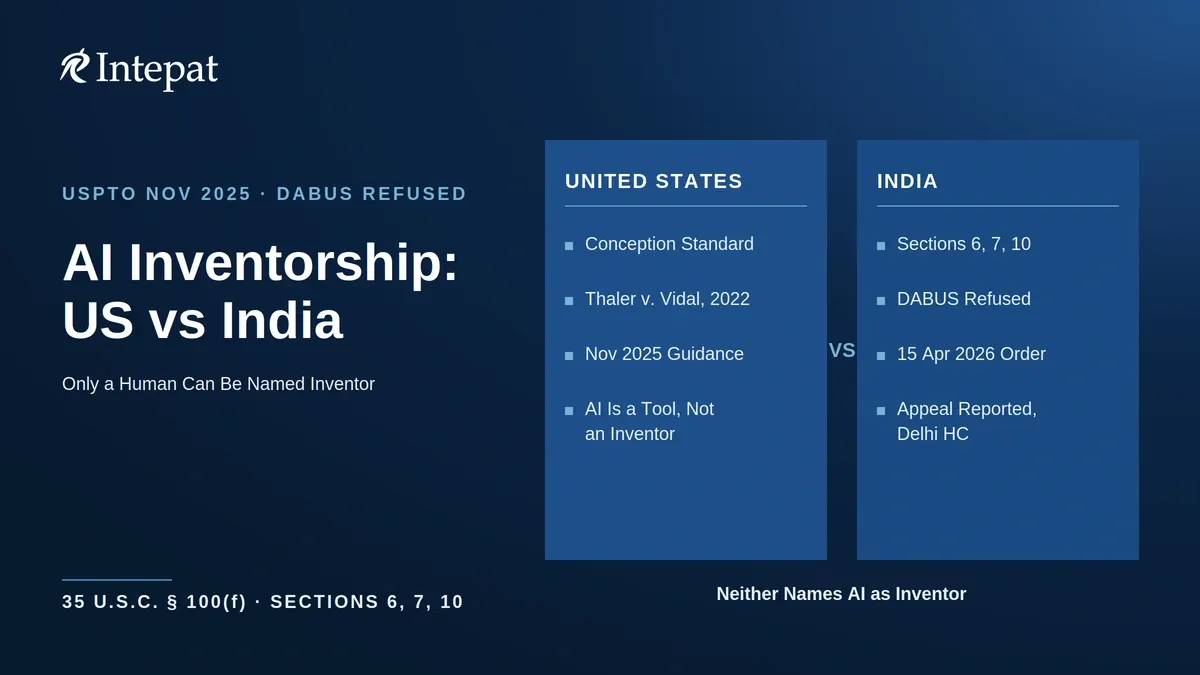
Practitioner takeaway box
- The USPTO’s November 2025 guidance (90 Fed. Reg. 54636) rescinds its February 2024 guidance (89 Fed. Reg. 10043) and removes the AI-specific Pannu-factors test. A single conception standard now applies to every invention, AI-assisted or not.
- Pannu v. Iolab Corp., 155 F.3d 1344 (Fed. Cir. 1998) still governs joint inventorship, but only among natural persons. It was never, and is not now, a test for whether an AI system contributed enough to be named inventor.
- The Indian Patent Office refused Application No. 202017019068 (the DABUS application) on 15 April 2026, holding that DABUS lacks the legal status needed to hold entitlement or make the declarations Sections 6, 7 and 10 require of a “true and first inventor.” A separate order the same day held that this entitlement objection did not fall within Section 25(1)(f), the pre-grant opposition ground concerning whether the claimed subject matter is an invention or is patentable.
- That refusal is not final law. Dr. Thaler has appealed it to the Delhi High Court under Section 117A of the Patents Act, 1970 (C.A.(COMM.IPD-PAT) 36/2026); as of the Court’s 30 July 2026 order, notice has issued and the appeal is pending, with the Respondent’s reply due within six weeks and the next listing on 18 September 2026.
- Neither authority treats a detailed prompt or AI ownership alone as sufficient. Under US doctrine this is tested claim by claim against conception; the Indian sources reviewed do not set out an equivalent published test, so claim-mapped documentation there is prudent practice, not an established statutory requirement.
What the USPTO changed in November 2025
On 28 November 2025, the USPTO published its Revised Inventorship Guidance for AI-Assisted Inventions in the Federal Register (90 Fed. Reg. 54636). The notice states that the USPTO “rescinds the previously published Inventorship Guidance for AI-Assisted Inventions” of 13 February 2024 (89 Fed. Reg. 10043) and replaces it in full.
Why the 2024 guidance and its Pannu-based approach were withdrawn
The February 2024 guidance had asked examiners and applicants to test a human’s inventorship of an AI-assisted invention against the three Pannu factors: whether the person contributed significantly to conception or reduction to practice, whether that contribution was more than insignificant measured against the whole invention, and whether the person did more than explain well-known concepts to others. Pannu itself has nothing to do with AI; it is a 1998 Federal Circuit decision on joint inventorship disputes between human co-inventors. The 2024 guidance repurposed it as a human-versus-AI contribution test.
The November 2025 guidance withdraws that repurposing. It states that “Pannu is inapplicable when only one natural person is involved in developing an invention with AI assistance because AI systems are not persons and therefore cannot be ‘joint inventors.’” The factors remain fully applicable, unchanged, wherever two or more human contributors are assessed for joint inventorship, whether or not that assessment arises from an active dispute. What the revised guidance removes is the idea that a separate, AI-specific significant-contribution test is needed at all.
The return to the traditional conception standard
In place of the AI-specific test, the November 2025 guidance applies the ordinary Federal Circuit conception standard to every invention, regardless of whether AI was used. Conception is “the formation in the mind of the inventor of a definite and permanent idea of the complete and operative invention” (see Hybritech Inc. v. Monoclonal Antibodies, Inc., 802 F.2d 1367, 1376 (Fed. Cir. 1986)), not a general research goal or an instruction to a tool. The guidance frames AI systems as instruments in that inquiry, “analogous to laboratory equipment, computer software, research databases, or any other tool that assists in the inventive process.” This tracks Thaler v. Vidal, 43 F.4th 1207 (Fed. Cir. 2022), which held that “inventor” under 35 U.S.C. § 100(f) means a natural person and that AI systems cannot be named inventors regardless of their role in generating a result.
The guidance also addresses foreign and PCT filings: a US priority claim to a foreign application naming an AI system as sole inventor “will not be accepted,” and applicants must list only natural persons on the US application data sheet. This point is unchanged from the 2024 guidance; the November 2025 revision altered the domestic contribution test, not the foreign-priority rule.
What India’s DABUS refusal actually established
On 15 April 2026, the Indian Patent Office refused Application No. 202017019068, in which Stephen Thaler named DABUS as inventor, under Section 15 of the Patents Act, 1970. A separate order the same day disposed of a pre-grant opposition to the same application under Section 25(1) and Rule 55.
Human inventorship, entitlement and proof of right
The Section 15 refusal rested on two distinct grounds. First, the Controller found the claims lacking inventive step under Section 2(1)(ja), a patentability objection independent of who was named inventor. Second, and separately, the Controller found defects in inventorship, entitlement and proof of right under Sections 2(1)(y), 6, 7 and 10. This article concentrates on the second ground because it is the one that raises AI-specific questions, but the inventive-step finding is an independent part of the refusal and should not be read out of the order’s result.
On the entitlement ground: Section 6 permits an application only from a person claiming to be the true and first inventor, an assignee of that person’s right to apply, or a legal representative of a deceased applicant. Section 7(3) requires the application to name the person claiming to be the true and first inventor and, where the applicant is not that person, to declare a belief that the named person is the true and first inventor. Section 10(6) requires a declaration as to inventorship in Form 5. The central problem the Controller identified was not a signature mechanic on any one form; it was that DABUS has no legal status capable of holding the entitlement, making the declarations, or having rights assigned from it that Sections 6, 7 and 10 assume of a “true and first inventor.” The Controller reportedly rejected Thaler’s argument that ownership of the DABUS hardware and code alone conferred entitlement to what it produced.
On the PCT point, Section 138(4) gives an international application designating India the effect of a filing under Section 7, treating its title, description, claims and abstract as the complete specification; by its terms Section 138(4) references Section 7, not Section 10, so it is the Section 7 declaration requirement that this deeming effect carries into national phase. The Controller held that a PCT Rule 4.17(ii) declaration naming a non-human inventor does not displace that compliance requirement.
The Guidelines for Examination of Computer Related Inventions, 2025, address a related but distinct question on the patentability side: an AI-assisted invention, where a human uses AI as a tool, is not categorically excluded from patentability, while an invention an AI system produces autonomously with minimal human direction does not have a human inventor to satisfy Section 6 in the first place.
Limits of the Controller’s ruling
The Section 15 order is a Patent Office decision on one application’s facts. It is a Controller’s order, not a High Court or Supreme Court judgment. It does not, by its own terms, establish that every AI-assisted invention is unpatentable, that AI use must always be disclosed to the Patent Office, that operating or funding an AI system makes a person an inventor, or a general Indian threshold for how much human contribution an AI-assisted invention needs. It answers the narrower question actually before the Controller: whether an AI system alone can satisfy Sections 6, 7 and 10. It does not answer what a human must show when a person, not an AI, is named and the question is the adequacy of that person’s contribution.
The separate Section 25(1) opposition order narrowed the ruling further on process: it held that the objection to DABUS’s status as inventor did not fall within Section 25(1)(f), the ground concerning whether the claimed subject matter is an invention or is patentable. The Controller treated the Section 2(1)(y)/6/7 entitlement question as a matter for examination rather than an independent pre-grant opposition ground under Section 25(1)(f). Wrongful obtaining is a distinct ground under Section 25(1)(a) and was not the basis of this holding.
Most importantly for filing strategy, the refusal is not final. Dr. Thaler has appealed it to the Delhi High Court under Section 117A of the Patents Act, 1970, in Dr. Stephen L. Thaler v. Assistant Controller of Patents and Designs, C.A.(COMM.IPD-PAT) 36/2026, before Justice Jyoti Singh. The Court’s order of 30 July 2026 records that notice has been issued, that the Respondent’s counsel has accepted notice and been granted six weeks to file a reply, that any rejoinder is to be filed before the next date, and that the matter is next listed on 18 September 2026. At that stage the Court had disposed of preliminary applications (an exemption application and permission to file a detailed synopsis and list of dates) but had not addressed the merits of the Section 15 refusal. Readers should treat the Section 15 reasoning as the current administrative position, not as settled law, and should check the case’s subsequent listing history before relying on its status.
US and India compared
| Issue | United States | India | Practical consequence |
| Who may be named inventor | Only a natural person (35 U.S.C. § 100(f); Thaler v. Vidal) | Only a person capable of the Section 6/7/10 declarations; DABUS refused on this basis, with the refusal under a pending Section 117A appeal | AI is never named as inventor in either jurisdiction |
| Test for a human’s AI-assisted contribution | Ordinary conception standard; no separate AI test since Nov 2025 guidance | No equivalent test found in the Indian sources reviewed; assessed only indirectly, through the Section 6/7/10 declaration and entitlement framework | Document human conception the same way for both filings; do not assume India requires (or lacks) a US-equivalent test |
| Role of Pannu-style factors | Governs joint inventorship among natural persons | Not part of the Indian statutory framework | Do not import Pannu language into Indian filings |
| Status of the key ruling | Published Federal Register guidance; operative USPTO examination policy | Single Controller’s order, under a pending Delhi High Court appeal (C.A.(COMM.IPD-PAT) 36/2026; notice issued 30 July 2026) | Treat the Indian position as current administrative practice, not settled law |
| AI-generated (autonomous) inventions | Cannot claim priority naming AI as sole inventor | CRI Guidelines 2025 indicate Section 6 bars AI-generated inventions without a human inventor | Identify a human’s specific claim contribution before filing in either country |
| Foreign priority naming an AI inventor | Priority claim to such an application “will not be accepted” | Narrower holding: a PCT Rule 4.17(ii) declaration naming an AI does not cure Section 7/10 non-compliance at national phase; no general Indian priority-rejection rule has been formulated | Never let the earliest-filed application in the family name only an AI system |
Who is the inventor when AI contributes to the technical solution?
Prompting alone is not a universal inventorship test
Neither the USPTO guidance nor the Indian DABUS order treats writing a detailed prompt as automatically sufficient for inventorship. Under US conception doctrine, the significance of a prompt depends on whether it evidences a definite and permanent idea of the complete, operative invention, rather than merely stating a research objective, not merely on who typed the instruction that produced an output. The examples below applying this to specific prompt scenarios are this article’s practitioner application of that doctrine, not text drawn from the USPTO guidance itself: a prompt that specifies only a general goal, “find a stable formulation for this compound,” is closer to a research plan than to conception; a prompt that embodies the specific structure or arrangement later claimed is closer to conception, but this is a claim-by-claim, fact-by-fact inquiry under US doctrine specifically. The Indian sources reviewed for this article do not set out an equivalent prompt-specific inventorship test; the DABUS order addressed whether an AI system could be named inventor at all, not how much a human’s prompt must contain.
Ownership or operation of the AI system is insufficient
The Indian Controller’s rejection of the accession argument, that owning DABUS’s hardware and code entitled Thaler to what it produced, establishes that ownership of an AI system does not, by itself, confer entitlement under Indian law. Some commercial arrangement or employment relationship may still transfer rights from an actual human inventor, but that is a question of assignment, not of who invented.
Inventorship follows the claimed human contribution, where the test exists
Under US law, inventorship is assessed through conception of the claimed invention, with ordinary joint-inventorship principles applying where multiple natural persons contributed; that inquiry cannot be answered without reading the claims. The Indian sources reviewed for this article do not set out a comparably developed administrative or judicial test specifying how much human contribution is sufficient when AI assists the inventive process. Sections 6, 7 and 10 regulate who may apply, identification of the true and first inventor, proof of right and the inventorship declaration; Section 2(1)(ja) inventive step is a separate patentability inquiry, not a test for identifying the inventor, and should not be conflated with it. Mapping each contributor’s role to specific claim limitations remains prudent filing and evidentiary practice in India, as it is in the US, but it should not be described as an established Indian statutory test.
Practical examples of AI-assisted R&D
These illustrations are this article’s practitioner application of US conception doctrine to common R&D scenarios; they are not text drawn from the USPTO guidance itself. They are not categorical outcomes under Indian law, for which the sources reviewed do not set out a published equivalent test; they are included because they are useful for internal invention-harvesting interviews and inventor questionnaires in either jurisdiction.
- Broad problem, first AI output accepted. A researcher describes a general problem and accepts the AI system’s first proposed solution without modification. Under the USPTO standard, this looks closer to a research plan than a definite and permanent idea of the complete invention; conception may not be established until the researcher settles on the specific claimed solution.
- Human architecture, AI parameter optimisation. A researcher defines the technical architecture and uses AI only to optimise parameters within it. This more plausibly supports conception of the architecture itself, though optimised parameters that themselves become claim limitations need separate analysis.
- AI identifies an unexpected result, human verifies it. Where AI flags an unexpected compound or configuration and a human then verifies and characterises it, the analysis depends on what is actually claimed and whether verification involved inventive selection or routine confirmation.
- Iterative team modification. A team selects training data, constraints and evaluation criteria, then iteratively modifies AI-generated proposals. Joint inventorship among the team members is then assessed under Pannu in the US; as a matter of general Indian practice, the inventorship declaration on the application should identify only those team members who actually contributed to the claimed invention, though the sources reviewed do not spell out a claim-by-claim mapping requirement.
- Funding or operating the platform only. A person who merely funds or operates the AI platform, without contributing to conception of the claimed solution, is unlikely to qualify as inventor in either jurisdiction on that basis alone.
- Different humans, different claim limitations. Where different people contributed to different claim limitations, ordinary joint inventorship principles apply in the US. Indian filings should similarly name only those contributors who actually invented, but the sources reviewed do not establish a specific claim-limitation-mapping rule for the inventorship declaration.
Filing the same AI-assisted invention in the US and India
Consistency across the priority application, PCT filing and national phase entries matters more than in a purely human-inventor case. On the US side, the USPTO expressly states that a US priority claim to a foreign application naming an AI system as sole inventor will not be accepted, so an AI-named inventor anywhere in the priority chain risks the US filing specifically. The Indian position is narrower on the published record: the Controller has held that a PCT Rule 4.17(ii) declaration does not override the Sections 6, 7 and 10 requirements at Indian national-phase entry; no general Indian rule rejecting priority merely because the earliest filing named an AI has been formulated as such. Applicants should still treat both rules as pointing the same direction in practice and identify, claim by claim, the human inventive contribution before the earliest filing is made.
Keep assignments and proof-of-right documentation current across the family. Where an inventorship error is discovered after filing, the available Indian route depends on whether the change concerns a clerical mistake (Section 78, which is confined to clerical errors), mention of a person as inventor (Section 28), or a substantive amendment implicating Sections 57 and 59 and the applicable Rules; it is stage- and defect-specific, not a single general correction procedure. Whether the Indian position on AI-assisted inventorship will develop further administrative guidance beyond the CRI Guidelines 2025 is, at present, an open question that the pending Delhi High Court appeal (C.A.(COMM.IPD-PAT) 36/2026) may bear on once it reaches the merits.
Evidence and recordkeeping for inventorship
In the US, contemporaneous records do not automatically establish inventorship; they are evidence relevant to the fact-intensive conception inquiry, which still turns on the claims. India’s sources reviewed do not set out a comparable evidentiary framework for inventorship disputes, but similar records support the Section 6/7/10 declarations and any later entitlement or ownership dispute, so keeping them is prudent practice in both jurisdictions even though the underlying legal tests differ. Useful records include: the problem each human contributor formulated, in their own words, before AI involvement; the technical constraints they selected; which claimed features each person conceived, as distinct from features the AI proposed and a human merely accepted; AI-generated alternatives that were rejected or substantially modified, and why; experiments or validation a human carried out; the point at which the complete claimed solution became definite, not merely directional; and each team member’s contribution to specific claim limitations, tied to assignment and employment records. None of this substitutes for the legal analysis of who conceived what; it supports that analysis when inventorship is later questioned.
What Indian applicants should do now
Given that the DABUS refusal is under appeal and the CRI Guidelines 2025 address patentability rather than a detailed inventorship test, Indian applicants filing AI-assisted inventions should name a human inventor whose contribution can be tied to specific claims, retain the records described above, and treat any claim that AI use must be disclosed to the Patent Office, or that a threshold percentage of human contribution is required, as an unsettled question rather than an established rule, unless a specific Guideline or Rule provision says otherwise for the invention type involved. For inventions with a US counterpart, align inventorship documentation across both filings from the outset rather than reconciling it after an office action or opposition raises the question. Readers assessing an existing DABUS-related filing, or the general framework the Controller applied, can review Intepat’s account of the DABUS refusal for the underlying prosecution history this article does not repeat.
Where parallel US-India filings stand today
The USPTO’s November 2025 guidance and India’s April 2026 DABUS refusal reach the same conclusion, that only a natural person can be named inventor, by different statutory routes: US law through the conception doctrine developed under 35 U.S.C. §§ 100(f), 101, 115 and 116, and Indian law through the declaration and entitlement structure of Sections 6, 7, 10 and 15. Neither authority has issued a detailed, tested standard for how much human contribution an AI-assisted invention needs beyond the bare requirement of a human inventor, and the Indian position is not yet final. Applicants filing in both countries should document human inventive contribution claim by claim, keep inventor declarations consistent across the priority chain, and watch the Delhi High Court appeal, Dr. Stephen L. Thaler v. Assistant Controller of Patents and Designs, C.A.(COMM.IPD-PAT) 36/2026 (notice issued 30 July 2026, next listed 18 September 2026), for whether it narrows or widens the Controller’s reasoning once it reaches the merits.
Comparable positions exist elsewhere: the UK Supreme Court held in Thaler v Comptroller-General of Patents, Designs and Trade Marks [2023] UKSC 49 (20 December 2023) that the Patents Act 1977 requires a named human inventor and that an AI system cannot be so designated, and the EPO Legal Board of Appeal reached a similar conclusion in J 8/20 and J 9/20 (decided 21 December 2021, written reasons published July 2022), holding that a designated inventor must be a natural person. Intepat’s earlier analysis of the UK Thaler ruling discusses that decision at greater length, and a broader primer on AI as a prospective inventor covers the EPO’s DABUS rejection alongside it. Together these positions reinforce that the human-inventor requirement is presently a point of convergence across major patent systems rather than a uniquely American or Indian rule. Readers who want the earlier procedural history of USPTO’s 2020 DABUS rejection can find that background in Intepat’s earlier coverage.
Frequently asked questions
No. The USPTO’s November 2025 guidance treats AI systems as tools, not inventors, consistent with Thaler v. Vidal, 43 F.4th 1207 (Fed. Cir. 2022), which held that “inventor” under 35 U.S.C. § 100(f) means a natural person. India’s Patent Office has reached the same administrative conclusion for its own filings.
The November 2025 guidance rescinded the February 2024 guidance and removed its AI-specific use of the Pannu factors as a test for a human’s contribution. A single conception standard now applies to all inventions, whether or not AI was used.
No. The 15 April 2026 refusal named DABUS itself as inventor and also found the claims lacking inventive step under Section 2(1)(ja), a separate patentability ground. The CRI Guidelines 2025 distinguish this from AI-assisted inventions where a human directs the process and is named inventor, which remain assessed under ordinary patentability criteria on their own facts.
No. It is a Controller’s order under Section 15, not a High Court or Supreme Court judgment. Dr. Thaler has appealed it to the Delhi High Court under Section 117A of the Patents Act (C.A.(COMM.IPD-PAT) 36/2026), where notice issued on 30 July 2026 and the appeal is pending; the reasoning should be treated as the current administrative position rather than settled law.
Not automatically. Under US conception doctrine, significance depends on whether the prompt evidences a definite and permanent idea of the claimed invention, not on its detail alone. The Indian sources reviewed for this article do not set out an equivalent prompt-specific inventorship test, so this US framework should not be assumed to apply there in the same form.
The USPTO will not accept such a priority claim, and applicants must list only natural persons on the US application data sheet. In India, the Controller has held only the narrower point that a PCT Rule 4.17(ii) declaration naming an AI does not cure Section 6, 7 and 10 non-compliance at national phase; no broader Indian priority rule has been formulated on the public record.
The sources reviewed do not identify a general rule requiring disclosure of AI use in every application. The CRI Guidelines 2025 impose disclosure expectations tied to sufficiency of description for certain AI-related inventions in India; confirm whether a given invention falls within that scope rather than assuming a blanket duty applies, and do not treat this as confirmation that no such duty could ever apply.
This article explains the law on AI-assisted inventorship in the United States and India as at August 2026 and is for general information only. It is not legal advice. The Indian Patent Office’s DABUS refusal of 15 April 2026 is currently under challenge before the Delhi High Court in C.A.(COMM.IPD-PAT) 36/2026, pending as of the Court’s order of 30 July 2026, and should not be treated as settled or final law. USPTO guidance, Patent Office guidelines, and the outcome of the pending Delhi High Court appeal may change; confirm the current position before relying on this article for a specific filing. For advice on your specific invention, consult a registered patent agent or US patent counsel.