




A trademark application can fail, or end up weaker than expected, for reasons that have nothing to do with the brand name itself. Five errors show up again and again before filing: skipping a proper search, choosing a descriptive name, picking the wrong class, over-filing without genuine use intent, and skipping professional review.
Fixing any one of these before you file costs a few hours. Fixing it after a refusal or opposition can cost months and a second application fee. This guide is written for founders filing in India for the first time; the same issues apply if you’re adding a new mark to an existing portfolio. Every rule cited below is current under the Trade Marks Act, 1999 and the Trade Marks Rules, 2017, as amended; Registry practice is flagged separately where it differs from a binding rule.
Three Pre-Filing Checks That Prevent Common Problems
Before filing, check three things. First, is the mark registrable at all: distinctive, and free of Section 9’s other absolute objections, including deceptive marks, matter that offends religious sensitivities, scandalous content, and a few shape-based exclusions. Second, does it conflict with an earlier mark. Third, are your goods or services identified and classified accurately. None of these guarantee approval, but each is checkable before you spend a rupee on the official fee.
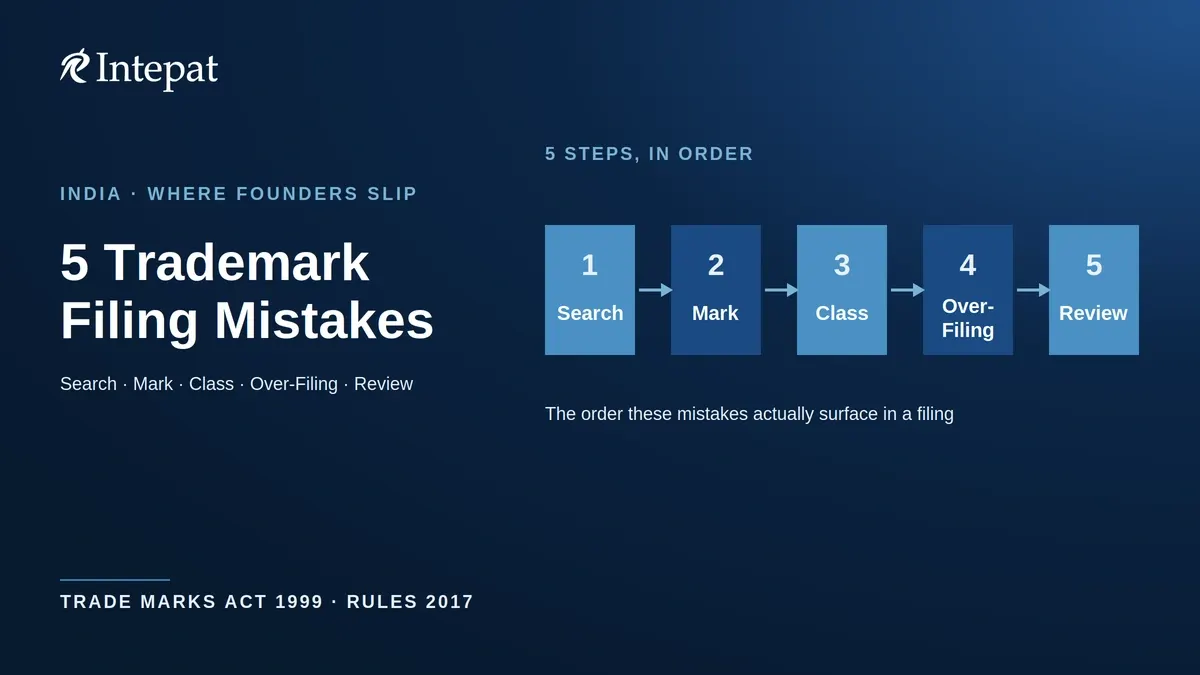
The five mistakes below are ordered the way they actually surface in a filing timeline: search, mark selection, classification, filing strategy, and execution.
Mistake #1: Skipping a Proper Trademark Search Before Filing
The Registry itself runs a mandatory search once you file. Under Rule 33, the examiner searches the register for marks identical with or deceptively similar to yours, across the same or similar goods and services. A hit doesn’t automatically sink the application, since the examiner still has to judge whether it’s legally relevant, but if an objection is raised, you get an examination report and one month to respond before the application risks abandonment.
The mistake founders make is assuming this Registry search is the only search that matters, or skipping search altogether and treating the application fee as a lottery ticket. Rule 33’s search covers earlier trademarks that are registered or already applied for, so it does reach pending filings. What it does not reach is unregistered use: a business trading under a confusingly similar name that never filed anything, or common-law rights, protection built up through actual use and reputation, not registration, and not simply time in the market. A mark can pass examination cleanly and still face opposition during the four-month window after advertisement, or, after launch, a passing-off claim, a court action based on unregistered goodwill, from someone who never filed at all. A self-search won’t catch every unregistered user, but it surfaces some of these risks while a launch, a domain, and packaging are still cheap to walk away from.
A basic pre-filing search should cover the WIPO Global Brand Database, which aggregates Madrid System and participating-office records but isn’t a substitute for India’s own register, plus the Indian Trade Marks Registry’s public search and a plain web search for anyone already trading under a similar name. None of this replaces a professional clearance opinion. This preliminary screening might take an afternoon; a proper clearance search usually takes longer.
Mistake #2: Choosing a Descriptive or Generic Mark
Section 9 of the Trade Marks Act, 1999 refuses registration to marks devoid of distinctive character, marks that merely describe the goods or services, and marks that have become customary in the trade. A skincare brand called “SMOOTH” for a moisturiser, a bakery called “FRESH BAKES,” or “FAST CLOUD” for cloud-computing services all describe the product rather than distinguish it, and examiners are trained to catch this pattern. A descriptive mark can still be registered if the evidence shows it had acquired distinctive character before the filing date, but that’s a harder, slower path than choosing a stronger mark to begin with. More in our detailed breakdown of absolute and relative grounds for refusal.
There’s a second, slower-moving risk: a mark used so loosely that it comes to mean the product category itself, rather than one trader’s brand, gets harder to enforce over time, a pattern often called genericide. Section 36 treats this cautiously: a registration isn’t invalidated merely because the mark is later used generically; specific conditions have to be proved first. The safer habit is to use your mark as a brand name alongside the generic term, “XYZ photocopier” rather than “an XYZ.” More in our dedicated article on genericide.
The practical fix: choose a coined, arbitrary, or suggestive mark rather than a descriptive one. A distinctive logo can make a composite mark (words, artwork, or other elements combined) registrable even with descriptive wording in it, but Section 17 is explicit that this doesn’t give exclusive rights over a part that’s common to the trade or non-distinctive on its own. A stylised “FAST CLOUD” logo can be enforced against an identical or deceptively similar overall mark; it won’t stop a competitor using “fast cloud” descriptively, rather than as a trademark, for their own service. For real protection, the name itself should be the distinctive element, not just the artwork around it.
Mistake #3: Filing Under the Wrong NICE Class
India classifies goods and services under the current edition of the NICE Classification, published by the World Intellectual Property Organization and adopted by reference in the Trade Marks Rules, 2017. There are 45 classes in total: 1 to 34 cover goods, 35 to 45 cover services. A single application can cover multiple classes, but the fee is charged per class.
The class itself is mainly an administrative filing category. The direct scope of your registration is principally identified by the specification, the precise list of goods or services you file against: conflict analysis under Sections 11 and 29 of the Trade Marks Act looks at the similarity of those goods or services, not simply whether two marks share a class number. A wrong class designation can still delay or complicate prosecution, the examination and response process before the Registry, but the more serious problem is an incorrect or incomplete specification, because goods or services left out of the original application generally cannot be added later.
The available fix depends on exactly what went wrong. Rule 23(6) lets the Registrar move goods or services you already listed into an additional class, on a formal request in Form TM-M and the additional class fee, if they turn out to belong there. It does not let you add goods or services that were never in the original application: Rule 37 blocks amendments that substitute a new specification. So a correct specification placed in the wrong class can usually be fixed; goods or services left out of the original filing generally require a fresh application, with its own fee and examination timeline. Our guide to Indian trademark classification works through how to map your actual goods and services to the correct class before you file, rather than after an examiner flags the mismatch.
Mistake #4: Over-Filing Classes Without Genuine Use Intent
The opposite mistake is filing across far more classes than the business actually operates in, on the theory that broader coverage means broader protection. It doesn’t work that way, and it isn’t free: the official fee is charged per class, so a fifteen-class filing costs roughly fifteen times a single-class one before any professional fees are added.
There are two separate problems with this strategy beyond the upfront cost. First, Rule 23(5) lets the Registrar refuse an application covering “all goods or services” in a class, or an unrealistically wide specification, unless the applicant can show the specification is justified by actual or intended use. Second, Section 47 lets a person aggrieved, someone whose legal or commercial interests are affected, apply to remove a registration for the specific goods or services concerned, on two separate grounds. The first applies immediately, no fixed waiting period: no genuine intention to use the mark at registration, combined with no actual use since. The second is the five-year ground: a continuous five years of non-use from the date the mark was actually entered on the register, measured to three months before the removal application. Speculative filings with no genuine intent to use are exposed under the first ground from day one, not only once five years have passed.
The fix is to file for goods and services you use or genuinely intend to offer under a credible business plan, not an aspirational catalogue of everything you might sell someday, and to add more through a fresh, properly justified application as the business genuinely expands.
Mistake #5: Filing Without Professional Review
None of the first four mistakes are hard to avoid on paper, but Indian trademark procedure has enough sequencing traps, around evidence of use, specification wording, and response deadlines, that a founder filing for the first time can do everything “by the book” and still stumble. Section 145 of the Trade Marks Act lets most steps before the Registrar, except making an affidavit, be handled through a legal practitioner, a registered trademark agent, or a person in the applicant’s own regular employment. A legal practitioner or agent typically adds the most value: having sat through examination reports, hearings, and oppositions is different from simply completing the filing form.
Two areas matter most. Documentation: where use before the filing date is claimed, Rule 25(2) requires a statement of use backed by an affidavit and supporting documents. Invoices, packaging, and public records are examples of that evidence, not an exhaustive list, but a claimed first-use date that contradicts what’s actually available weakens the claim during examination, opposition, or litigation. Our checklist of documents required for trademark registration in India goes through this. Fee category: the reduced rate applies to an individual, startup, or small enterprise as specifically defined in the Rules, not MSME status generally. The applicant itself must qualify; in practice, the Registry expects the DPIIT (the department that grants Startup India recognition) or Udyam documentation to identify that same applicant, not just a form declaration. Strategy is the third piece: whether to file a series mark, a set of closely resembling marks that differ only in non-distinctive details such as colour or wording, registered together under Section 15; whether the evidence supports the claimed first-use date; and how to respond to a Section 9 or Section 11 objection without conceding more than necessary. None of these are questions a filing portal answers for you.
Hiring a specialist doesn’t remove the founder’s job of getting the first four mistakes right. It reduces the odds that a correctly chosen, correctly classified mark still gets tripped up by an avoidable procedural error.
Pre-Filing Checklist: What to Do Instead
Before you submit Form TM-A, work through this in order.
- Search first. Check the WIPO Global Brand Database, the Indian Trade Marks Registry’s public search, and the open market for anyone already using a similar name.
- Choose a defensible mark. Favour coined, arbitrary, or suggestive names over descriptive ones. A distinctive composite logo can help a descriptive name register, but it won’t ordinarily give you exclusive rights over the descriptive wording itself.
- Classify accurately. Match your actual goods and services to the correct class or classes under the current NICE Classification before filing, not after an objection.
- File for what you’ll use. Cover goods and services your business already uses or has a genuine plan to offer, and expand later through a proper additional filing as the business grows.
- Get the paperwork and strategy checked. Have a legal practitioner or registered trademark agent review your specification, affidavits, and prior-use claims before submission, especially if you’re claiming the startup or small-enterprise fee category.
If you’d rather have this handled end to end, our trademark registration service covers clearance search, filing, and prosecution support, including responses to examination objections.
FAQ
It depends on what went wrong. If goods or services you already listed belong in an additional class, Rule 23(6) may permit adding it on request and fee, subject to the Registrar’s determination. If the goods or services were never in the original application, Rule 37 blocks adding them by amendment, so a fresh application is usually needed.
No. A preliminary search is just a screening step; the Registry’s own examination under Rule 33 is what applies the actual legal objections. Neither eliminates the risk from unregistered users with protectable goodwill.
Under the Trade Marks Rules, 2017, e-filing Form TM-A costs ₹4,500 per class for an individual, startup, or small enterprise, and ₹9,000 per class for other applicants (₹5,000 and ₹10,000 respectively for physical filing), charged for each mark and each class. This is the official government fee only; professional fees for search, drafting, and prosecution are separate.
Not as a default strategy. Fees are charged per class, and an unrealistically broad specification can itself draw an objection under Rule 23(5). Goods or services can also become vulnerable under Section 47, either where there was no genuine intention to use them and no actual use, which doesn’t require waiting, or where the separate five-year non-use ground is later satisfied. File for what you use or genuinely intend to offer, and add more through a fresh application as the business expands.
This article is intended as general information on Indian trademark procedure and does not constitute legal advice. Fee figures and procedural timelines are current as of July 2026 and may change through amendments, notifications, or updated Registry procedures; verify current figures before filing, and consult a legal practitioner or registered trademark agent for advice on your specific mark and business.