




Filing a logo as a trademark in India uses Form TM-A with the Trade Marks Registry under the Trade Marks Act 1999 and the Trade Marks Rules 2017. The application covers device marks and composite marks, and passes through examination, advertisement, and a four-month opposition window before registration under Section 23. Filing a logo rather than a word mark changes what is protected: the registration covers the specific graphical representation filed, not the brand name in plain text. For the complete context on trademark rights, costs, and class strategy, see the complete guide to trademark registration in India; for the step-by-step filing procedure common to all applications, see how to file a trademark application online in India.
| At a glance |
| Form: TM-A | Governing law: Trade Marks Act 1999 and Trade Marks Rules 2017 Fee per class, per mark (e-filing): Rs 4,500 (individual, startup, or small enterprise); Rs 9,000 (others) Logo representation size: not exceeding 8 cm × 8 cm (Rule 26(1)) Colour claim: optional; if claimed, reproduction in those colours is required (Rule 26(2)) Examination response window: one month (Rule 33(4)) Opposition window: four months from Journal advertisement (Rule 42(1)) Term: ten years, renewable (Section 25(1)) Appeal route post-2021: High Court (specialised IP Divisions at Delhi, Madras, Himachal Pradesh, and Calcutta) |
What qualifies as a logo for trademark purposes in India
A logo can be registered as a trademark in India if it meets two statutory tests under Section 2(1)(zb) of the Trade Marks Act 1999. The mark must be capable of being graphically represented, and it must be capable of distinguishing the applicant’s goods or services from those of others. These two tests flow through every later stage of the filing and into the scope of protection the registration gives.
Logos fall into three working categories that the Registry treats differently during data entry and examination. A device mark is a purely figurative logo with no word element, such as an abstract symbol or a geometric figure. A composite mark (or “word-and-device mark”) combines stylised text with a graphic element, producing the logos most businesses recognise as their brand. A word mark, by contrast, claims only the text itself in plain form and is not treated as a logo mark for Vienna Classification purposes. For a fuller comparison of these categories, see our article on the word mark versus logo mark distinction.
The category matters for two practical reasons. First, device marks and composite marks are subject to Vienna codification during examination (Chapter II of the Manual of Trade Marks) that word marks are not. Second, Section 17 limits the exclusive right to the mark “taken as a whole,” and the allocation of distinctiveness between the word and device elements changes the practical enforcement scope, discussed in the section on post-registration rights below.
For brands with a distinctive word element, a word mark and a logo mark are often complementary filings rather than substitutes: the word mark protects the name in any font or styling, while the logo mark protects the specific visual identity. The section on post-registration rights returns to this point in the context of Section 17(1)’s “as a whole” rule.
Pre-filing: search, class selection, and design decisions
Two things happen before Form TM-A is lodged: a public register search, and a set of design-level decisions that are difficult to reverse after filing.
Search the public register first. The Trade Marks Registry publishes a free public search on its portal, and the same database can be queried on a fee-paying basis under Rule 22 of the 2017 Rules (Form TM-C). For a logo, the search has two axes: a wordmark search on any text in the mark, and a figurative search using Vienna codes. The Vienna Classification, administered by WIPO, divides figurative elements into 29 categories and is currently in its 10th edition, in force from 1 January 2026. A pre-filing search that uses the likely Vienna codes surfaces earlier device marks that the examiner is likely to identify during search.
Select the Nice class carefully. Form TM-A accepts a single application across one or more classes under the Nice Classification, which has 45 classes (34 for goods, 11 for services). The fee is payable per class, per mark (First Schedule Entry 1). A wrongly chosen class limits protection to a market the business may not actually occupy, and an over-inclusive class list multiplies cost without adding enforcement value. Where the logo will be used across distinct lines of business, multi-class filing on a single Form TM-A is permitted under Rule 23(4) with the fee counted per class.
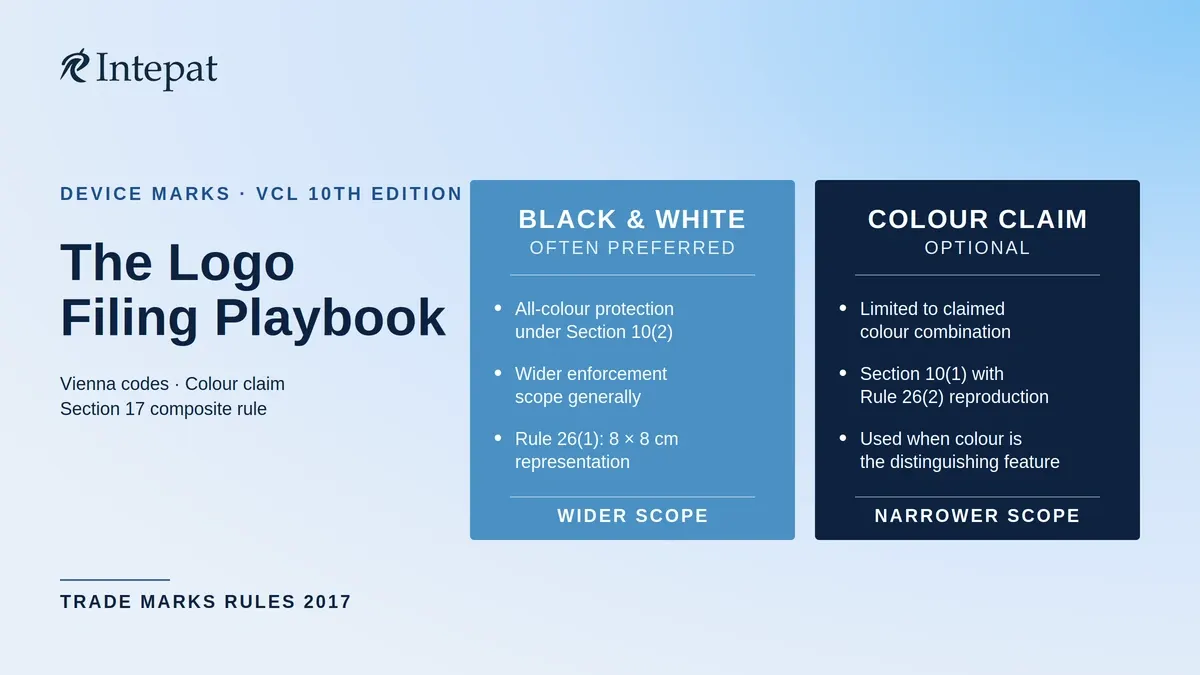
Decide colour or black-and-white. Section 10 of the Act, read with Rule 26(2), permits an applicant to claim a combination of colours as a distinctive feature of the mark. The practical trade-off is this: a mark registered without a colour limitation is deemed to be registered for all colours (Section 10(2)), which generally yields wider protection. A mark with a colour claim is limited to that combination, which may be tactically useful where the colour itself carries source-indicating value, but it narrows the infringement scope for the same logo in other colours. In practice, applicants often opt for a black-and-white representation unless colour is essential to brand recognition.
Filing Form TM-A: what the Registry needs
The filing form is prescribed under Rule 23 of the Trade Marks Rules 2017. Form TM-A accepts a single trademark across one or more classes (Rule 23(4)), and Rule 23(2) sets out what the application must do: give a precise description, depict a graphical representation, and expressly state any three-dimensional or colour-combination claim.
Representation of the logo. Rule 26(1) requires a clear and legible representation of the mark of size not exceeding 8 cm × 8 cm. On e-filing, the representation is uploaded electronically in the format accepted by the IP India portal. If the application claims a combination of colours, Rule 26(2) requires the reproduction to be in those colours and the application to state the claim. If the Registrar is not satisfied with any representation, Rule 26(6) allows a replacement to be called for before the application proceeds.
Statement of user. Under Rule 25(1), the application must state the period of use and the person by whom the mark has been used, unless the mark is proposed to be used. Where prior use is claimed from a date before the application, Rule 25(2) requires an affidavit testifying to the use along with supporting documents such as invoices, advertisements, or dated marketing material.
Fees. First Schedule Entry 1 prescribes the filing fee per class, per mark. An applicant filing as an individual, a startup recognised under the Startup India initiative, or a small enterprise pays Rs 4,500 per class on e-filing (Rs 5,000 for physical filing). All other applicants, including private limited companies, LLPs, partnerships, and trusts, pay Rs 9,000 per class on e-filing (Rs 10,000 for physical filing). The fee categories are distinct, and applying the startup rate without the underlying recognition triggers a deficiency notice. All fees verified as of April 2026 against the First Schedule to the Trade Marks Rules 2017; confirm current figures on ipindia.gov.in before filing.
Examination and the Vienna Classification step
Once filed, the application moves through data entry and, for device and composite marks, through the Vienna Classification Section, where officials codify the figurative elements of the logo using WIPO’s Vienna codes. Chapter II of the Manual of Trade Marks describes this step: every mark containing a figurative element receives one or more Vienna codes that drive how the examiner searches for conflicting earlier device marks. A logo depicting a lion, for instance, is codified under Category 3 (animals), and the code pulls up every earlier mark bearing a similar figurative element in the examiner’s comparison.
Examination under Sections 9 and 11. The examiner checks the logo against two sets of grounds. Section 9 (absolute grounds) covers distinctiveness: a logo devoid of distinctive character, or one that describes the goods or services, or one that has become customary in the trade, cannot be registered, subject to the proviso that a mark which has acquired distinctiveness through use can still be registered. Section 11 (relative grounds) covers similarity to earlier marks where there is a likelihood of confusion, including likelihood of association with the earlier mark.
Responding to an examination report. If the examiner raises objections, Rule 33(2) requires them to be communicated in writing as an examination report. The applicant has one month from the date of receipt to respond (Rule 33(4)); failure to respond within that window may result in the Registrar treating the application as abandoned. A response that is not satisfactory, or where the applicant has requested a hearing, triggers the hearing right under Rule 33(6), conducted per Rule 115. Section 18(5) requires the Registrar to record the grounds of any refusal or conditional acceptance in writing.
Founders commonly read an “OBJECTED” status as a refusal. It is not. An objection is a communication of the examiner’s concerns and an invitation to respond. A reasoned response, supported by evidence of use or a narrowed specification where relevant, resolves many Section 9 and Section 11 objections without proceeding to a hearing.
Advertisement, opposition, and registration
If the examination report is cleared, or the application is accepted absolutely, the Registrar causes the application to be advertised in the Trade Marks Journal under Section 20. The advertisement opens a four-month window under Rule 42(1) during which any person may file a notice of opposition on Form TM-O. Section 21(1) sets out the grounds, which largely track Sections 9 and 11 with additional grounds around bad faith and earlier rights.
If opposition is filed. The Registrar serves a copy of the notice on the applicant, who has two months under Rule 44 to file a counter-statement on Form TM-O. Failure to file the counter-statement within the prescribed period results in the application being treated as abandoned under Section 21(2). Where the counter-statement is filed, the opposition proceeds through evidence stages under Rules 45 to 48 (opponent’s evidence, applicant’s evidence, evidence in reply, further evidence), followed by a hearing under Rule 50. Appeals from the Registrar’s final decision lie to the High Court, covered in the next section.
If no opposition, or if opposition fails. The Registrar enters the mark on the register under Section 23. Under Section 23(1), the date of the application is deemed to be the date of registration for the purposes of the Act. The certificate of registration issues shortly afterwards, and the proprietor may use the ® symbol, subject to the limits discussed below.
What the registration actually protects. Section 17 is the provision logo owners most often misread. Section 17(1) confers the exclusive right to the use of the trademark “taken as a whole.” Section 17(2) carves out that where a composite mark contains any part that is not separately registered, or any matter which is common to the trade or otherwise of a non-distinctive character, no exclusive right attaches to that part alone. Practical effect: where a composite logo contains a descriptive or common element, Section 17(2) prevents the proprietor from claiming exclusive right in that element alone, although the composite mark as a whole remains protected. Separate word-mark and device-mark filings give the proprietor more enforcement flexibility where the business wants to protect each element independently.
After registration: what your logo actually protects
Registration confers the exclusive right to use the logo in relation to the goods or services for which it is registered (Section 28(1)), and a right to sue for infringement under Section 29. The certificate is prima facie evidence of validity under Section 31 in any legal proceeding. The term is ten years from the deemed date of registration, renewable for further ten-year periods on payment of the prescribed fee (Section 25(1), read with Rule 57). See our article on the general trademark registration procedure for the renewal mechanics.
What counts as infringement. Section 29 sets out the test in layers. Section 29(1) covers use of an identical mark for identical goods or services. Section 29(2) covers use of a mark identical with, or deceptively similar to, the registered mark where there is a likelihood of confusion. Section 29(4) extends protection for well-known marks to dissimilar goods or services where unfair advantage or detriment to reputation is shown. For a composite logo, the Section 29 analysis is read against the Section 17(1) “as a whole” rule: the court compares the marks as wholes, and the allocation of dominance between the word and device elements is a matter of judicial assessment on the facts.
The ™ and ® symbols. The ™ symbol is commonly used to signal a claim of trademark rights even before registration; it is a marketplace convention rather than a statutory entitlement under Section 23. The ® symbol may be used only after the mark is entered on the register under Section 23. Section 107 makes it a criminal offence to represent a mark as registered when it is not, or to represent a part of a registered mark as separately registered when it is not. The offence is punishable with imprisonment of up to three years, a fine, or both. Using ® before the registration certificate issues is a frequent compliance issue.
Prior user defence. Section 34 preserves the rights of a person who has continuously used an identical or nearly resembling mark from a date earlier than the registered proprietor’s first use, or the date of the registered proprietor’s registration, whichever is earlier. A registered logo does not automatically defeat a genuine prior user, and a competent trademark search before filing reduces the risk of a Section 34 challenge later. Common-law passing-off rights also remain available to unregistered users under Section 27(2).
Appeals. Appeals from the Registrar’s decisions on registration, examination, opposition, and rectification now lie to the High Court, following the abolition of the Intellectual Property Appellate Board under the Tribunals Reforms Act, 2021. Specialised Intellectual Property Divisions have been constituted at several High Courts, including Delhi, Madras, Himachal Pradesh, and Calcutta, with rules at additional High Courts under preparation.
Taking your logo beyond India: the Madrid Protocol in brief
India acceded to the Madrid Protocol on 8 July 2013. Sections 36A to 36G of the Act and Chapter IV of the 2017 Rules (Rules 62 to 74) govern international applications where India is the Office of origin.
Pre-requisite. An international application under the Madrid Protocol must be based on an Indian application or registration, called the “basic mark.” A logo applicant planning cross-border protection typically files Form TM-A in India first, then files Form MM2(E) with the Indian Registry for transmission to WIPO. The Indian Registry handling fee is Rs 5,000 (e-filing only; First Schedule Entry 23).
WIPO fees. The basic international filing fee is CHF 653 for a black-and-white mark and CHF 903 for a mark in colour, verified as of April 2026 against WIPO’s schedule of fees. Additional complementary fees of CHF 100 per designated Madrid member (or individual fees where a member has notified them) and supplementary fees of CHF 100 per Nice class beyond three apply.
Cross-border search implications. Figurative elements in Madrid filings are classified using the Vienna Classification framework, which assists search and examination across jurisdictions. However, protection and examination in each designated member remain governed by that member’s domestic law and practice; some offices use modified versions of the Vienna system or their own classification schemes. Refusal by one designated office does not affect protection granted by another.
Frequently asked questions
Registration ordinarily takes 12 to 24 months where no objection or opposition is filed, and longer where either arises. The timeline depends on Registry workload, whether the examination report raises objections under Sections 9 or 11, and whether a third party opposes the advertisement within the four-month window under Rule 42(1).
A word mark claims text in plain characters. A logo mark, known in Indian practice as a device mark, claims a purely figurative element with no text. A composite mark combines stylised text with a device element. All three are filed on Form TM-A, but the Registry’s Vienna codification step applies only to device and composite marks.
A logo filed without a colour limitation is deemed to be registered for all colours under Section 10(2) of the Trade Marks Act 1999, which generally yields wider protection. A colour claim under Section 10(1) and Rule 26(2) narrows protection to that combination of colours but may be appropriate where colour itself is the distinguishing feature.
The ™ symbol may be used from the date the application is filed; it signals a claim of unregistered trademark rights. The ® symbol may be used only after the Registrar enters the mark on the register under Section 23. Using ® before registration is an offence under Section 107, punishable with imprisonment up to three years, a fine, or both.
No. An “OBJECTED” status means the examiner has raised concerns in an examination report under Rule 33(2), commonly citing Section 9 (distinctiveness) or Section 11 (similarity to earlier marks). The applicant has one month from the date of receipt to respond under Rule 33(4). A reasoned response, with evidence of use or a narrower specification where appropriate, resolves many objections without a hearing.
A registered mark cannot be materially altered. Under Section 59, only changes that do not substantially affect the identity of the registered mark may be permitted. The request is made in Form TM-P under Rule 102 of the Trade Marks Rules 2017. For any material redesign such as a new device, changed font, or a different colour scheme where colour was claimed, the proprietor must file a fresh Form TM-A for the new logo. Continuous non-use of the old logo for five years from the date of entry in the register, plus the three-month window under Section 47(1)(b), exposes it to rectification.
Yes, through the Madrid Protocol. India acceded on 8 July 2013. A registered or pending Indian mark serves as the basic mark for an international application on Form MM2(E), filed through the Indian Registry with a handling fee of Rs 5,000 (First Schedule Entry 23). The WIPO basic fee is CHF 653 for a black-and-white logo and CHF 903 for a logo in colour, plus per-member and per-class fees.
DisclaimerThis article is for general information on the registration of logos as trademarks in India and does not constitute legal advice. The Trade Marks Act 1999, the Trade Marks Rules 2017, and the fees, deadlines, and procedural steps discussed are verified as of April 2026 against primary sources. Registry fee schedules, portal practice, and WIPO fees may change; confirm the current position on ipindia.gov.in and wipo.int, or consult a registered trademark agent, before