




The International Patent Classification (IPC), established under the Strasbourg Agreement of 1971, is WIPO’s system for classifying patents and utility models by technology area. WIPO’s IPCCAT tool predicts likely IPC symbols from patent text; it is now powered by PATCAT, a deep-learning engine trained on patent titles and abstracts. IPCCAT is a classification assistant, not a binding classification decision.
QUICK ANSWER
- The IPC organises all patent technology into 8 sections, more than 650 subclasses, and over 74,000 classification codes. A new edition enters into force every January.
- WIPO’s IPCCAT tool accepts patent text (title, abstract, or a technical summary of up to 200 words) and returns the most likely IPC symbols, ranked by confidence, at class, subclass, main-group, or subgroup level.
- As of October 2025, IPCCAT is powered by PATCAT, a deep-learning sequence model. The tool primarily supports English and offers cross-lingual support for nine additional languages through WIPO Translate (verified as of June 2026).
- IPCCAT is a classification assistant, not a binding classification decision. The official IPC classification of a patent application is assigned by the patent office examiner.
What Is IPC Automatic Text Categorization?
Patent classification is the process of assigning standardised codes to a patent document to indicate the area of technology it covers. The IPC, administered by WIPO and established under the Strasbourg Agreement of 1971, is the internationally agreed system for doing this across patent offices worldwide. A new edition enters into force every year on January 1, with IPC 2026.01 being the current edition.
The IPC hierarchy runs from broad to specific:
| Level | Description | Example |
| Section | Highest level; 8 sections (A to H) | A = Human Necessities |
| Class | Subdivision of a section | A01 = Agriculture; Forestry |
| Subclass | Subdivision of a class; over 650 subclasses | A01B = Soil working in agriculture |
| Main Group | Subdivision of a subclass | A01B 1/00 = Hand tools |
| Subgroup | Most specific; over 74,000 codes total | A01B 1/02 = Hoes |
Because IPC symbols are language-independent, the same code applies to a Japanese patent, a German patent, and an Indian patent covering the same technology. This makes cross-jurisdictional prior art searches consistent regardless of the filing language.
Automatic text categorization means using software to predict the correct IPC code from the text of a patent application, rather than relying entirely on a human examiner to select it manually. WIPO’s IPCCAT tool is the main publicly available implementation of this for the IPC.
What Is IPCCAT?
IPCCAT (IPC Computer-Assisted Categorization) is WIPO’s AI-based tool for classifying patent text within the IPC. According to WIPO’s AI-based Classification for IP Data page, “IPCCAT helps patent filers and examiners in IP offices to automatically categorize patent applications into technical units according to their International Patent Classification (IPC) class, subclass, main group or sub-group.” (verified June 2026)
WIPO’s IPCPUB Help documentation (version 9.10, verified June 2026) states: “IPCCAT is powered by PATCAT, a deep learning powered classification engine that predicts IPC codes out of patent titles and abstracts.” The same document confirms that the previous machine-learning engine was replaced by PATCAT as of October 2025.
The tool is publicly accessible through IPCPUB, WIPO’s IPC Publication Platform, either through the Search tab or as a web service. On entering patent text, IPCCAT returns predicted IPC symbols most likely to match the technical field, together with a confidence ranking for each prediction.
How to Use IPCCAT in Practice
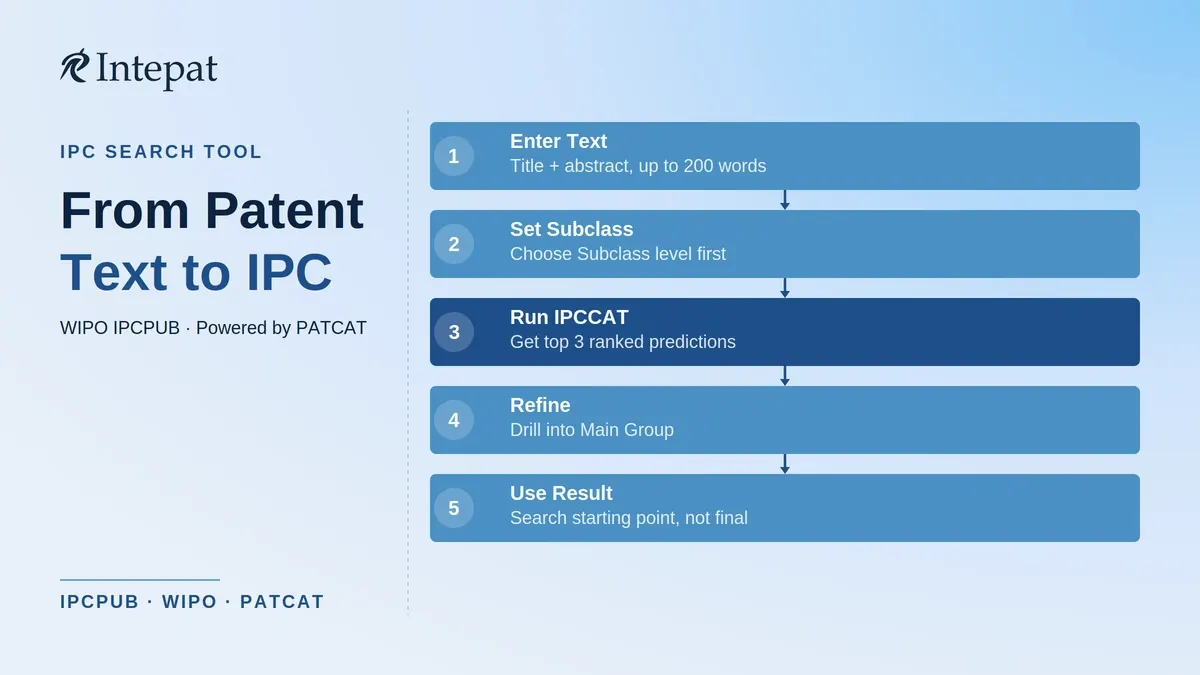
WIPO’s IPCPUB Help recommends a cascaded approach for best results. The following steps reflect that guidance (source: WIPO IPCPUB Help v9.10, verified June 2026).
- Go to WIPO’s IPC Publication Platform at ipcpub.wipo.int.
- Open the Search tab and select the IPCCAT option from the left menu.
- Enter the invention title and abstract, or a compact technical summary. The text is limited to 200 words; entering only a few isolated keywords will not produce a relevant result.
- Set the classification level to Subclass and run the prediction first.
- Review the predicted subclasses and select the most relevant one.
- Use the Refine function within that subclass to narrow the prediction to main group or subgroup level.
- Treat the result as a search and drafting starting point, not as the final classification.
For patent applicants and agents, IPCCAT is most useful as a search-scoping tool: the predicted subclass or main group tells you where to focus a prior art search in PATENTSCOPE or Espacenet, not which symbol to claim as the official classification.
WHAT IPCCAT CANNOT DO
IPCCAT cannot assess patentability, replace a prior art search, bind the Indian Patent Office or any other patent office, or guarantee a prediction for all IPC categories. Per WIPO’s IPCPUB Help, some PATCAT predictions are less reliable than others because training examples are not evenly distributed across all IPC categories.
How PATCAT Predicts IPC Symbols
PATCAT is a deep-learning sequence model trained on the WIPO-DELTA dataset: a collection of patent documents classified by human IPC experts, reclassified under IPC 2024.01 as the training baseline. PATCAT learns to map input text to IPC symbols by processing millions of classified patent titles and abstracts.
WIPO’s IPCPUB Help explains the training basis: “The training of PATCAT… was initially performed using the patent’s title and abstract.” This means PATCAT’s predictions are most reliable when the input text resembles a patent title and abstract, not a keyword list or a free-form description of an idea.
Because the training corpus contains human-assigned legacy classifications, and because those classifications are not distributed evenly across all IPC subgroups, PATCAT’s reliability varies by technical field. Well-documented technology areas with large training corpora tend to produce more reliable predictions than newer or niche fields where fewer classified examples exist.
WIPO also notes that PATCAT is periodically retrained with controlled data to incorporate new IPC vocabulary and the latest reclassification practices, so prediction quality may improve over time.
Supported Languages
WIPO’s IPCPUB Help (v9.10, verified June 2026) states that PATCAT is natively trained on English and primarily supports English input. Cross-lingual categorization is available through WIPO Translate for the following languages:
- Arabic (ar)
- German (de)
- Spanish (es)
- French (fr) — an authentic language of the IPC, alongside English
- Korean (ko)
- Japanese (ja)
- Portuguese (pt)
- Russian (ru)
- Chinese (zh)
For cross-lingual input, the tool translates the text into English internally and then applies the English-trained PATCAT model. Precision in non-English inputs is influenced by translation quality.
WIPO’s November 2023 IPC Roundtable presentation reported that IPCCAT-neural at that time was cross-lingual in 12 languages. That figure predates the October 2025 transition to PATCAT. The current WIPO public pages should be followed for the live tool’s language support; check the IPCPUB interface directly before relying on any language list.
Accuracy and Limitations
WIPO’s November 2023 IPC Roundtable presentation reported the following figures for IPCCAT-neural at subgroup level:
- Automatic prediction in 99% of IPC places (subgroup level)
- Top-three prediction precision above 82%
These figures should be read as WIPO’s 2023 benchmark for IPCCAT-neural: they describe the system as it stood before the October 2025 transition to PATCAT. WIPO’s current IPCPUB Help does not publish a comparable precision figure for PATCAT. Until WIPO publishes an updated benchmark, the 82% figure should not be presented as a confirmed current PATCAT accuracy metric.
What the 99% coverage figure means. The IPC contains a small number of subgroups with insufficient training data. Coverage of 99% means IPCCAT can return a prediction for virtually all IPC places, though confidence scores will be lower for sparse subgroups.
What the 82% top-three figure meant. In more than 82 out of 100 cases for IPCCAT-neural 2023, the correct IPC symbol appeared among the first three suggestions returned. The current PATCAT system may differ.
Practical limitations confirmed in WIPO’s Help. WIPO states that some PATCAT predictions are less reliable because training examples are uneven across IPC categories, and that inconsistencies in legacy classifications used to train PATCAT are also present. For certain main group or subgroup areas, PATCAT predictions may not be as accurate as a human classification decision.
How IPCCAT Helps Indian Patent Searches
For an Indian applicant or patent agent, IPCCAT is useful at two stages of the filing process.
Before filing: Entering the invention title and abstract into IPCCAT gives a preliminary indication of the IPC class or subclass the application is likely to cover. This helps focus a prior art search on the right part of the IPC hierarchy in databases such as
Before filing: Entering the invention title and abstract into IPCCAT gives a preliminary indication of the IPC class or subclass the application is likely to cover. This helps focus a prior art search on the right part of the IPC hierarchy in databases such as PATENTSCOPE or Espacenet. A preliminary IPCCAT prediction is not a substitute for a thorough patent search; it narrows the starting point.
Understanding a search report: When an examiner issues a First Examination Report, the cited prior art documents carry IPC symbols. Understanding those symbols helps an applicant and their agent assess whether cited references are in the same technology area as the claimed invention.
In India, IPC classification is assigned by Indian Patent Office examiners during examination. IPCCAT is a search and drafting-support tool; it does not dictate the official classification assigned by the Patent Office. For advice on how to structure an application for the most appropriate classification, consult a registered patent agent.
The IPC and AI or Machine-Learning Patent Codes
Patent offices, including the Indian Patent Office, have expanded IPC coverage for AI and machine-learning technologies in recent years. IPC version 2019.01 introduced the G06N hierarchy for machine learning, and IPC 2023.01 further developed the G06N codes for artificial intelligence. Applicants seeking to protect AI or machine-learning inventions in India should check the current IPC 2026.01 codes for the appropriate subgroup, as this area of the classification has been actively revised in successive editions.
IPC and Related WIPO Classification Schemes
WIPO administers several classification systems for different types of IP rights. The IPC covers patents and utility models only. The main systems are:
| System | Covers | Governing Agreement |
| IPC | Patents and utility models | Strasbourg Agreement (1971) |
| Nice Classification | Goods and services for trademark registration | Nice Agreement (1957) |
| Vienna Classification | Figurative elements of trademark images | Vienna Agreement (1973) |
| Locarno Classification | Industrial designs | Locarno Agreement (1968) |
The Cooperative Patent Classification (CPC) is a separate scheme, jointly administered by the EPO and USPTO, with more than 250,000 classification entries compared with the IPC’s 74,000-plus. Indian patent filings and journals display IPC codes; European and US patent documents typically carry CPC codes alongside IPC codes.
These systems are distinct and administered under separate agreements. Nice Classification applies to Indian trademark applications; the IPC applies only to patent and utility model filings.
Frequently Asked Questions
What is IPCCAT?
IPCCAT (IPC Computer-Assisted Categorization) is WIPO’s AI-based tool for classifying patent text within the International Patent Classification. As of October 2025, it is powered by PATCAT, a deep-learning engine trained on patent titles and abstracts. A user enters patent text and the tool returns ranked IPC symbol predictions at class, subclass, main-group, or subgroup level. It is available at ipcpub.wipo.int.
What is the International Patent Classification?
The IPC is a hierarchical system of language-independent symbols, administered by WIPO under the Strasbourg Agreement of 1971, for classifying patents and utility models by technology area. It is organised into 8 sections (A to H), over 650 subclasses, and more than 74,000 codes at subgroup level. A new edition enters into force on January 1 each year.
How accurate is IPCCAT?
WIPO’s November 2023 presentation reported that IPCCAT-neural achieved top-three precision above 82% at subgroup level. That benchmark applied to the previous engine; as of October 2025 IPCCAT uses PATCAT and WIPO has not published an updated precision figure. Precision varies by technical field; entering a full title and abstract rather than keywords generally improves results.
What languages does IPCCAT support?
As of June 2026, WIPO’s IPCPUB Help lists PATCAT as natively supporting English, with cross-lingual categorization available through WIPO Translate for Arabic, German, Spanish, French, Korean, Japanese, Portuguese, Russian, and Chinese. Check the current IPCPUB interface before relying on this list, as WIPO may add languages as the Translate service expands.
Can IPCCAT be used for Indian patent searches?
Yes. IPCCAT is publicly available and language-independent. Indian applicants and patent agents can enter an invention title and abstract to obtain a preliminary IPC classification that helps focus a prior art search on the right part of the hierarchy. The tool does not replace a thorough patent search or the Indian Patent Office examiner’s official classification.
Does IPCCAT give a definitive IPC classification?
No. WIPO’s own documentation describes IPCCAT as a classification assistant. The tool returns ranked predictions with confidence scores, not a binding classification. The official classification of an Indian patent application is assigned by the Patent Office examiner during examination. IPCCAT’s output is a starting point for search and drafting support.
What is the difference between the IPC and CPC?
The IPC is a universal classification administered by WIPO under the Strasbourg Agreement, used by patent offices worldwide including the Indian Patent Office. The Cooperative Patent Classification (CPC) is a finer-grained scheme jointly managed by the EPO and USPTO, with more than 250,000 entries. Indian filings display IPC; European and US documents typically carry both CPC and IPC codes.
This article explains WIPO’s IPC classification system and the IPCCAT tool as at June 2026 and is for general information only. It is not legal advice. For advice on patent classification or filing strategy for your specific invention, consult a registered patent