




AI and machine learning inventions are patentable in India only when the claims demonstrate a concrete technical effect rather than an algorithmic improvement alone. Section 3(k) of the Patents Act, 1970 excludes algorithms and computer programs per se. As a result, many AI applications fail during examination not because the technology lacks novelty, but because the claims are framed around abstract data processing instead of a technical contribution.
The CRI Guidelines 2025 (effective 29 July 2025) introduce a structured examination framework for determining whether a computer-related invention satisfies this requirement. For a detailed explanation of the new framework and how Section 3(k) is applied in practice, see our guide on the CRI Guidelines 2025 for Computer Related Inventions in India.
In practical terms, the rule applied by the Indian Patent Office is straightforward. An invention that improves the functioning of a technical system can qualify for patent protection. An invention that produces only a better informational output generally does not.
India has emerged as one of the fastest-growing jurisdictions globally for AI-related patent filings. Yet a large proportion of AI applications stall during examination because the specification and claims fail to demonstrate a measurable technical effect. The key question under Indian patent practice is therefore not whether artificial intelligence technology is sophisticated, but whether the invention is framed as a technical solution to a technical problem.
This guide explains how AI and machine learning inventions are evaluated under the CRI Guidelines 2025, how Section 3(k) is applied during examination, and how claim drafting strategy determines whether an AI patent application in India proceeds to grant or fails at the subject-matter stage. The article also compares the Indian position with the USPTO and EPO approaches, helping applicants structure AI patent filings that can withstand examination across jurisdictions.
The Core Legal Problem: Why AI Inventions Get Rejected
At every major patent office, the same structural issue arises. An AI or ML invention, at its core, involves a mathematical model, namely a neural network, a classification algorithm, or a gradient-descent optimisation, and mathematical methods, taken alone, are excluded from patent protection everywhere. The disagreement between jurisdictions is not whether to exclude pure algorithms, but how much technical context is needed to lift a claim out of the excluded category. Getting that balance right in the specification, before filing, is the single most impactful decision in AI patent prosecution.
Three practical consequences follow. First, a specification drafted purely around model architecture, training procedure, and accuracy metrics will face rejection in all three jurisdictions. Second, the same underlying invention, such as an ML model that reduces diagnostic error in medical imaging, can be claimed in a way that passes or fails subject-matter examination depending on how it is presented. Third, because specification quality at the time of filing determines the scope of protection available in India, investment in drafting precision before filing is more effective than attempting to broaden claims during prosecution.
India: Section 3(k) and the Technical Effect Doctrine
Under Section 3(k) of the Patents Act, 1970, mathematical methods, algorithms, business methods, and computer programs per se are excluded from patentability. The word “per se” is the operative qualifier. Courts and the Indian Patent Office (IPO) have consistently held that an invention is not excluded merely because it involves a computer program or algorithm; the exclusion applies where the claim is directed to nothing more than the algorithm itself.
The “Technical Effect” Test: How It Works
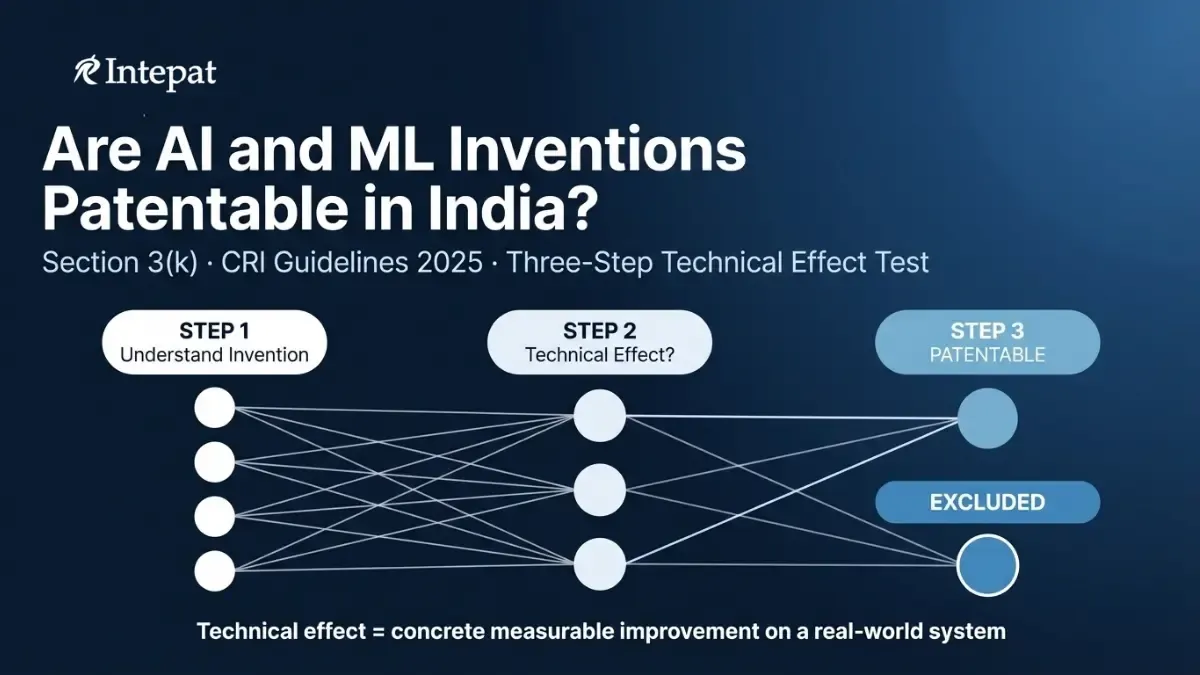
The judicial doctrine of technical effect , developed through a line of Delhi High Court decisions, has now been codified in the CRI Guidelines 2025 (effective 29 July 2025). The guidelines establish a structured three-step analysis for AI and ML claims:
- Understand the invention as a whole. Do not assess individual components in isolation. Read the claim, specification, and drawings together.
- Determine whether a technical effect is present. A technical effect is a concrete, reproducible improvement in a technical system, such as reduced computational load, improved signal fidelity, faster processing, measurably higher diagnostic accuracy, or lower memory consumption. Abstract improvements in information content alone do not qualify.
- Rule on patentability accordingly. If a genuine technical effect is present, Section 3(k) does not apply, and examination proceeds on novelty and inventive step.
The CRI Guidelines 2025 explicitly state that AI-generated inventions, those created autonomously by AI with minimal human contribution, remain non-patentable because the inventorship requirement under Section 6 of the Patents Act cannot be satisfied. Only human inventors, or human inventors assisted by AI tools, can file.
Example: Medical Imaging Diagnostic System
Practical scenario: An AI system uses a convolutional neural network (CNN) to detect early-stage pulmonary nodules in CT scans, reducing radiologist review time by 40% and false-negative rates by 18%.
Claim framed around the algorithm (excluded): “A method comprising: receiving a CT image dataset; applying a convolutional neural network trained on labelled nodule data; classifying regions of interest as nodule-present or nodule-absent.”
This claim describes the algorithm and its output classification. It produces an informational result, a diagnosis, and not a technical effect on a technical system. Under the CRI Guidelines 2025 three-step test, Step 2 fails. The IPO would issue a Section 3(k) rejection.
Claim reframed around technical contribution (patentable pathway): “A computer-implemented system for processing CT image data comprising: a processor configured to execute a CNN architecture optimised to reduce false-negative detection of pulmonary nodules having a diameter below 6 mm, wherein execution of the CNN reduces GPU memory allocation by at least 30% relative to a standard ResNet-50 baseline by applying a multi-scale feature pyramid with shared weight initialisation, the system producing a spatial heat map overlaid on the reconstructed CT volume for direct radiologist interface.”
This version anchors the claim in measurable technical effects: GPU memory reduction, specific architectural choices, and a technical output (spatial heat map integrated into the imaging system). In practice, quantitative benchmarking in the specification strengthens technical-effect arguments at examination and provides a defensible basis for distinguishing prior art during prosecution.
Key Judicial Developments
Several Delhi High Court decisions from 2023–2024 have shaped the current examination standard under CRI Guidelines 2025:
- Ferid Allani v. Union of India (2019, DHC) : Established that software-implemented inventions providing a technical effect are not excluded under Section 3(k). Remains the foundational authority.
- Microsoft Technology Licensing v. Assistant Controller (2023, DHC) : Reinforced that the IPO must evaluate claims as a whole and cannot reject on the sole basis that the claimed invention includes a computer program.
- Comviva Technologies v. Assistant Controller (2024, DHC) : Held that a business method authentication system incorporating technical security features was not automatically excluded; the court directed re-examination on technical merits. Signals the IPO must look beyond surface categorisation.
- Google v. Controller of Patents (2024, DHC, decided 2 April 2024) : The court set aside an IPO rejection and directed grant, finding that the invention demonstrated technical advancement over prior art. Reinforces that demonstrated technical advancement, not algorithmic novelty alone, is the operative test.
For the full CRI examination framework that underpins these judicial decisions, see CRI Guidelines for Computer Related Inventions in India. On the separate question of whether AI can be named as an inventor, see Can an AI be Recognised as an Inventor?.
How India Compares: USPTO and EPO at a Glance
India’s Section 3(k) framework is not unique in excluding bare algorithms, but it differs from the USPTO and EPO in how it measures the threshold for eligibility. At the USPTO, AI patent eligibility is governed by 35 U.S.C. Section 101 and the two-step Alice/Mayo test. The operative question is whether the claim integrates an abstract idea into a practical application, typically by improving a technological process or the functioning of a computer system. The USPTO’s August 2025 AI Subject Matter Eligibility Memorandum reinforces that claims referencing neural network training do not automatically recite an abstract idea, but claims that name specific algorithms such as backpropagation or gradient descent do, and require further analysis.
At the EPO, patentability is governed by Articles 52 to 57 of the European Patent Convention. The EPO’s updated Guidelines G-II, 3.3.1 (effective 1 April 2025) confirm that an AI or ML claim directed to a method using technical means, such as a computer, has technical character as a whole and is not excluded under Article 52(2) or (3). The real challenge at the EPO is inventive step: under the COMVIK approach, only technically characterised features count toward the inventive step assessment, which means an ML algorithm that merely classifies information contributes nothing inventive beyond running on a computer. The comparison table below summarises the key differences practitioners should account for when coordinating India filings with US or European prosecution.
For a deeper comparative analysis of Indian and European patent law, see Comparative Study of European and Indian Patent Laws.
Jurisdiction Comparison Table
The table below summarises the key patentability framework, exclusion basis, and claim-drafting priority for each jurisdiction covered in this guide.
| Factor | India (IPO) | USA (USPTO) | EPO | Key Difference |
| Legal basis | Section 3(k), Patents Act 1970 | 35 U.S.C. § 101; Alice/Mayo | Art. 52(2)(3) EPC; COMVIK | India: statutory exclusion. US/EPO: case-law doctrine |
| What is excluded | Algorithms, math methods, computer programs per se | Abstract ideas, laws of nature, natural phenomena | Math methods, computer programs as such | Functionally similar but India uses “per se” qualifier |
| Core test | Technical effect / technical contribution (CRI Guidelines 2025) | Integration into practical application (Step 2A Prong Two) | Technical character + COMVIK inventive step | EPO has two hurdles; India/US effectively one decisive test |
| Key 2025 update | CRI Guidelines 2025 (29 Jul 2025): codifies technical effect; explicit AI/ML examples | Aug 2025 Memo: narrows “mental process”; clarifies neural-network claim analysis | Guidelines G-II 3.3.1 (1 Apr 2025): confirms AI/ML technical character if computer-implemented | India and USPTO updates are substantive; EPO update clarificatory |
| Claim drafting priority | Embed quantitative technical effects; compare to prior-art system baselines | Describe post-inference technical action on a system; avoid reciting specific algorithms by name | Disclose architecture, training data, and reproducible technical effect across claim scope | EPO requires broadest enablement; India rewards quantification |
| AI-generated inventions | Non-patentable; human inventorship required (Section 6) | Non-patentable; human inventorship required; AI-assisted ✓ | Non-patentable; human inventorship required | Uniform across all three jurisdictions |
Filing Strategy: PCT and Multi-Jurisdictional Considerations
For applicants seeking protection in India alongside the US and EPO, the PCT route provides a practical framework. The Indian Patent Office functions as a Receiving Office, ISA, and IPEA, giving applicants flexibility in ISA selection. Under the Patents (Amendment) Rules 2024, effective 15 March 2024, the Request for Examination (Form 18) deadline for PCT national phase applications in India coincides with the 31-month national phase entry deadline. Both must be met simultaneously. Restoration is generally unavailable under current practice, making deadline compliance non-negotiable.
From a specification standpoint, a PCT application that quantifies technical effects for India, describes post-inference technical action for the USPTO, and discloses training data and architecture in sufficient detail for the EPO will support prosecution at all three offices without requiring supplemental disclosure after filing. The claim drafting principles set out in Sections 2 and 3 above apply equally whether the route is direct national filing or PCT national phase entry.
6. Common Pitfalls and How to Avoid Them
The following patterns consistently cause rejection or narrowing across all three jurisdictions.
| Pitfall | What Goes Wrong | Fix |
| Claiming the algorithm alone | Fails Section 3(k) in India; ineligible at Step 2A Prong One at USPTO; excluded “as such” at EPO | Add post-inference technical action on a system; embed quantitative technical-effect claim language |
| Novelty of domain as substitute for technical contribution | Applying ML to a new business domain does not create a patentable claim (Recentive, 2025) | Focus on how the invention improves a technological system, not what new domain it addresses |
| Vague specification: no architecture or training data details | EPO Article 83 sufficiency objection; USPTO §112 enablement rejection; India examiner finds no technical contribution | Disclose architecture, training dataset characteristics, and reproducible performance benchmarks in the specification |
| Missing the 31-month deadline for India national phase | Application treated as withdrawn; restoration is generally unavailable under current practice | Diarise 31-month deadline from earliest priority date; file Form 18 simultaneously (post March 2024 rules) |
| Claiming AI-generated inventions without human inventorship | Non-patentable in India (Section 6), US, and EPO; uniformly rejected at all three offices | Identify and document human inventive contributions; AI tools may assist but humans must conceive the invention |
Conclusion: AI and Software Patentability Under Section 3(k)
AI and machine learning inventions can be patented in India only when the claims demonstrate a measurable technical effect rather than algorithmic improvement alone. In practice, AI patent examination operates within the broader framework governing computer-related inventions and software patents under Section 3(k). For a deeper explanation of this framework, see our guide on software patents in India.
The CRI Guidelines 2025 now provide a clearer structure for evaluating AI claims, focusing on whether the invention produces a concrete technical contribution. Similar principles apply internationally. At the USPTO, eligibility depends on integration into a practical technical application, while the EPO evaluates AI inventions through technical character and the COMVIK inventive-step analysis.
For applicants filing AI inventions internationally, the most decisive factor is the quality of the specification at the drafting stage. Specifications that disclose system architecture, training methodology, and measurable technical improvements are far more likely to survive examination in India, the US, and Europe. Practitioners who structure claims around technical effect from the outset will face significantly fewer Section 3(k) objections during Indian prosecution.
Ready to Evaluate the Patentability of Your AI Invention in India?
Before filing, have your AI invention reviewed for Section 3(k) compliance, technical contribution, and claim structure under Indian patent practice. Share your application number, draft specification, or invention summary for a preliminary India-specific assessment.
Legal Disclaimer
This post is for informational purposes only and does not constitute legal advice. Statutory references reflect publicly available information as of the date noted above. For advice specific to your patent filing situation, consult a registered patent agent or attorney qualified in the relevant jurisdiction.
Frequently Asked Questions
Not in isolation. A claim directed solely to a neural network architecture, without specifying a technical problem it solves or a measurable technical effect it achieves, will be excluded under Section 3(k) as a mathematical method or algorithm per se. To achieve grant, the neural network must be claimed as part of a technical system that produces a concrete, reproducible technical effect, such as reduced memory consumption, improved signal fidelity, or measurably higher diagnostic accuracy compared to a prior-art baseline.
Yes. Under Section 6 of the Patents Act, 1970, only a human inventor, or their legal representative, can file a patent application. Inventions created entirely by AI without meaningful human inventive contribution cannot be patented in India. Inventions where a human uses AI as a tool, while retaining inventive control over the conception, remain patentable, provided all other requirements are met.
The 2017 CRI Guidelines applied a relatively mechanical test that often led to rejections based on the presence of a computer program, without adequate analysis of technical contribution. The CRI Guidelines 2025, effective 29 July 2025, introduce a structured three-step test, expressly address AI, ML, blockchain, IoT, and quantum computing as potentially patentable domains, provide illustrative examples drawn from recent judicial decisions, and codify the technical-effect doctrine that courts had developed since Ferid Allani (2019). Examination is now required to assess the invention as a whole, not to identify algorithmic elements in isolation.
Yes, if drafted to the highest common denominator. A specification that discloses architecture and training data in sufficient detail for EPO sufficiency purposes, quantifies technical effects for India’s technical-contribution test, and describes post-inference technical action for USPTO practical-application analysis will generally support examination at all three offices. Claim sets will typically need jurisdiction-specific adaptation during national phase prosecution, but a well-drafted PCT specification avoids having to supplement disclosure after filing.
Under the Patents (Amendment) Rules 2024, effective 15 March 2024, the national phase entry deadline and the Request for Examination (Form 18) deadline both fall at 31 months from the PCT priority date, and both must be filed simultaneously. There is no option to enter the national phase and defer examination. Missing the 31-month deadline causes the application to be treated as withdrawn; restoration is generally unavailable under current practice. Practitioners should diarise the deadline immediately upon international filing and confirm entity classification before entry, as fees differ between large entity, startup, and small entity applicants.
The EPO applies two sequential tests: technical character (first hurdle, usually cleared for computer-implemented AI claims) and inventive step using the COMVIK problem-solution approach (second hurdle, where most applications face objection). India’s CRI Guidelines 2025 apply a single structured test centred on technical effect. In practice, the EPO’s inventive-step analysis is the most technically demanding of the three jurisdictions because the COMVIK approach systematically strips non-technical features from the inventive step assessment. The USPTO’s Alice/Mayo test sits between the two: less demanding than the EPO on inventive step, but requiring clear integration of the abstract idea into a practical technical application.