




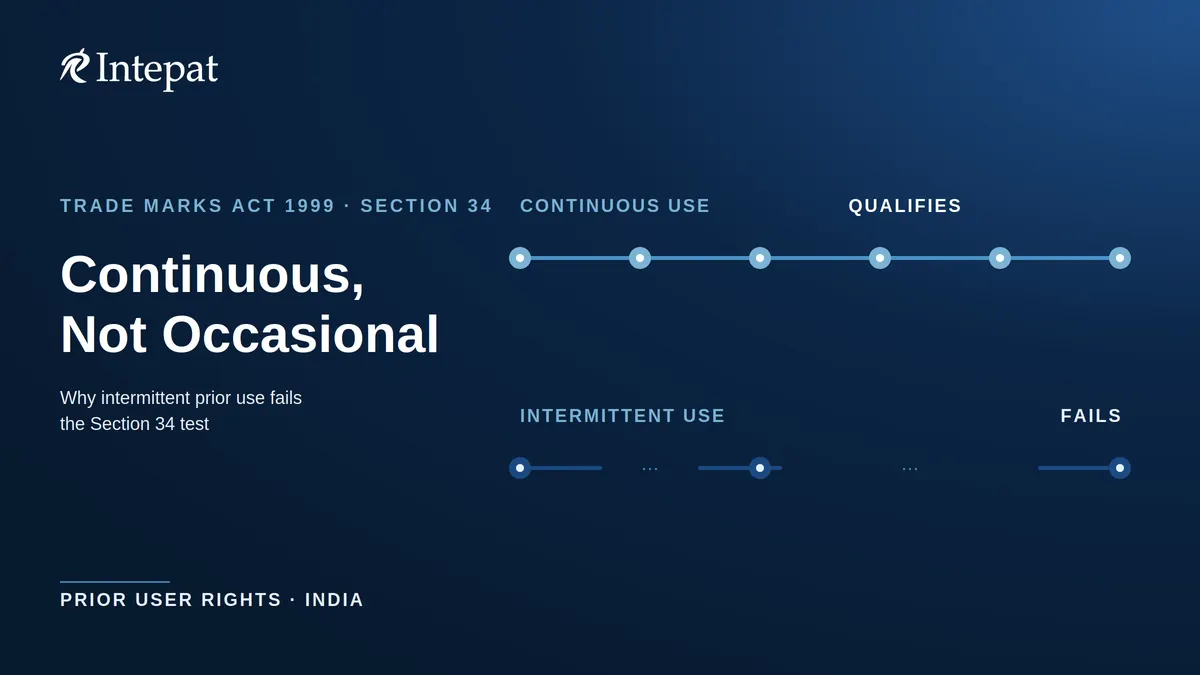
Under Section 34 of the Trade Marks Act 1999, a prior user of a trademark can prevent a registered proprietor from interfering with their use, but only if that use has been commercially continuous. Whether prior use qualifies depends on the nature of the business and trading pattern, not a fixed annual-invoice test. Stray, isolated, or disjointed use is unlikely to satisfy the section.
| What you need to know |
| • Section 34 protects a prior user only if their use has been commercially continuous from a date before the registered proprietor’s first use or their registration date, whichever is earlier • Stray, isolated, or disjointed acts of use are unlikely to qualify; whether a gap is fatal depends on the commercial context, not a fixed annual rule • Courts look for invoices and year-on-year sales records, supported by other commercial documents; continuity is assessed against the nature of the business • Use should be connected to the Indian market; prior use abroad does not ordinarily satisfy a Section 34 defence in Indian proceedings • If Section 34 is unavailable, passing off (Section 27(2)) and non-use cancellation (Section 47(1)(b)) are separate options, each with independent proof requirements |
The Protection Section 34 Offers
If you have been using a trademark in India before another business registered it or started using it (whichever happened first), Section 34 of the Trade Marks Act 1999 protects your right to continue. The section operates as a saving: a registered proprietor cannot stop you from using a mark identical or nearly resembling theirs if you or your predecessor in title continuously used that mark from a date before their first use or their registration date.
The protection applies to goods or services in relation to which you have been using the mark. The section also works in your favour at the Registry: the Registrar cannot refuse to register your mark simply because a registered proprietor holds a similar earlier mark, provided you prove continuous prior use.
The word “continuously” carries most of the legal weight. For a broader introduction to how prior user rights operate in India, see our article on prior user rights of trademarks in India.
What “Continuously Used” Means in the Statute
Section 34 does not protect prior use in the abstract. It protects prior continuous use. A plain reading of the provision makes this clear: “has continuously used that trade mark from a date prior” is the operative phrase. Being first in time is necessary but not sufficient; you must also show a genuine, commercially sustained course of use across the full period you claim.
What the statute does not do is define continuity by a fixed calendar rule. It does not require a transaction in every year, set a minimum volume, or specify a minimum duration of uninterrupted trading. Whether a particular pattern of use qualifies depends on the commercial context: the nature of the goods or services, the type of sales, the relevant territory, and the scale of the business. A seasonal product sold actively across multiple seasons may show continuity even without invoices in every month. A specialised industrial good may change hands infrequently but still demonstrate a genuine course of trade. Courts examine the evidence as a whole.
What the standard clearly excludes is use that is stray, isolated, or disjointed: a scattered handful of transactions with no coherent commercial pattern. That kind of use does not build the consumer association that trademark law protects, and courts have consistently refused to treat it as sufficient.
“Use” under the Act has a defined meaning. Section 2(2)(b) provides that a reference to use of a mark means use of its printed or other visual representation. Section 2(2)(c)(i) provides that in relation to goods, this means use upon or in any physical or other relation to those goods. Section 2(2)(c)(ii) provides that in relation to services, this means use as or as part of any statement about the availability, provision, or performance of those services. The use must be market-facing. Internal documents, unused draft labels, or a third party’s references to your business in a publication do not constitute your use of the mark.
What Courts Have Decided
Peps Industries Pvt. Ltd. v. Kurlon Ltd.: Two Orders, One Case
This dispute generated two separate orders, each relevant to the Section 34 analysis, and the two must be read together.
Single Judge (CS(COMM) 174/2019, 16 March 2020, Delhi HC, Justice Mukta Gupta)
Kurlon claimed it had used “NO TURN” on mattresses since 2007, one year before Peps Industries began using the same mark from 15 January 2008. The Single Judge examined Kurlon’s invoices and found that sales appeared only in certain years across the period since 2007. The court held that the invoices did not indicate continuous and voluminous use and rejected Kurlon’s Section 34 defence. However, the Single Judge then denied Peps the interim injunction it sought, treating “NO TURN” as a descriptive mark, an issue Kurlon had not raised in its defence.
Division Bench (FAO(OS)(COMM) 94/2020, 7 October 2022, Delhi HC, Justices Vibhu Bakhru and Amit Mahajan; 295 (2022) DLT 527)
Peps appealed. The Division Bench reversed the order on the injunction question. It held that Kurlon was estopped from raising descriptiveness because it had never pleaded it; the Single Judge should not have decided an issue the parties had not put in issue. The Division Bench expressly stated: “We refrain from expressing any view on whether the mark ‘NO TURN’ is descriptive.” Having affirmed that Kurlon’s Section 34 defence had no merit, the Division Bench restrained Kurlon from using “NO TURN” or any deceptively similar mark until disposal of the suit.
The procedural sequence:
| Date | Forum | Outcome |
| 16 March 2020 | Single Judge, CS(COMM) 174/2019 | Kurlon’s Section 34 defence rejected (intermittent, not voluminous); Peps denied interim injunction (descriptiveness raised suo motu) |
| 7 October 2022 | Division Bench, FAO(OS)(COMM) 94/2020; 295 (2022) DLT 527 | Reversed; descriptiveness question undecided; Kurlon restrained pending disposal of suit |
The core finding on Section 34 was affirmed at both stages: invoices showing sales only in selected years, without a coherent pattern of sustained commercial activity, do not establish the continuously used requirement of Section 34.
Kamat Hotels (India) Ltd. v. Royal Orchid Hotels Ltd. (Notice of Motion 2552/2008, Bombay HC, 5 April 2011)
The Bombay High Court set out four requirements for Section 34 to apply:
- (1) The mark must be identical or nearly resembling the registered mark and used for the same goods or services
- (2) The use must be continuous: not stray, isolated, or disjointed
- (3) The person claiming protection must be the actual user, or a predecessor in title
- (4) The use must predate the earlier of the registered proprietor’s first use and the date of registration
The court held that a commercially continuous course of trading is required. It also confirmed that evidence must be assessed in context, taking into account the nature of the product, type of sales, territory, and scale of manufacture. Disclosure of sales figures was held to be the cogent material courts look for. Isolated advertising, without contemporaneous evidence of actual supply, was found insufficient on the facts of that case.
Supreme Court Judgments Delivered in 2015, Reported in (2016) 2 SCC
In Neon Laboratories Ltd. v. Medical Technologies Ltd. ((2016) 2 SCC 672, decided 5 October 2015) and S. Syed Mohideen v. P. Sulochana Bai ((2016) 2 SCC 683, decided 17 March 2015), the Supreme Court confirmed the underlying principle: the scheme of the Trade Marks Act places the rights of a prior user above those of a registered proprietor. Both judgments addressed situations of established, sustained prior use and confirm that the protection is real where continuity is proved. Neither judgment addressed whether intermittent or low-volume use can qualify.
What Continuous Use Requires: The Evidence Tests
The statute imposes no fixed evidence checklist. Courts assess the complete record in context. The following types of evidence carry the most weight.
Invoices and sales records. Year-on-year invoices showing actual sales under the mark are usually the most direct evidence of a continuous course of trade. Gaps across significant periods, or invoices confined to one or two years out of many, will attract scrutiny, particularly where the nature of the business does not explain those gaps. In Peps v. Kurlon, the Single Judge found invoices for only certain years were insufficient on those facts.
Sales volume. Volume is relevant to whether use reflects genuine commercial activity rather than token transactions. In Peps v. Kurlon, the court noted the sales were “not voluminous.” There is no fixed figure in the statute; the sufficiency of volume depends on the nature of the goods, the market, and the scale of the business. Low volume is a factor to weigh, not an automatic disqualifier.
Other contemporaneous commercial documents. Audited accounts, GST or tax filings under the mark, packaging applied to goods actually supplied, distributor or dealership records, purchase orders, transport and delivery records, and regulatory approvals or product licences connected to the relevant goods or services are all relevant evidence of a genuine commercial course of use.
Advertising and promotional material. Advertisements are relevant supporting evidence where they accompanied actual supply. Isolated promotional activity without contemporaneous evidence of actual commercial supply is ordinarily insufficient on its own, as confirmed on the facts in Kamat Hotels. The Act does recognise advertising as one form of use in relation to services under Section 2(2)(c)(ii), but promotional activity alone generally does not establish a continuous course of trade.
Predecessor-in-title records. If you acquired the brand or business, Section 34 covers use by a predecessor in title. You need to document the acquisition and show that continuous use passed to you without a break in the chain.
In summary:
| Evidence type | Likely effect on the claim |
| Year-on-year invoices with consistent volumes | Strong evidence of continuous use |
| Invoices across multiple seasons for seasonal goods | Context-dependent; may demonstrate continuity |
| Invoices only in isolated years out of a long period | Weak; unexplained gaps will be scrutinised |
| Other commercial documents (GST, accounts, delivery records) | Relevant supporting evidence when combined with sales records |
| Advertising linked to actual supply | Relevant supporting evidence |
| Isolated advertising without evidence of supply | Usually insufficient on its own |
| Internal adoption documents or unused label drafts | Proves adoption intention, not commercial use |
| Predecessor-in-title records with a gap | Chain of continuity will be examined closely |
The practical point: complete and dated commercial records are the backbone of any prior-use claim. This is one of the strongest practical reasons to register your mark rather than rely on use alone. For context on how registration affects your rights, see our article on registered vs unregistered trademarks.
The Territorial Limit: Use Must Be Connected to India
A Section 34 defence in Indian infringement proceedings requires that the prior use be connected to the Indian market. Section 34 does not itself use the words “within India,” but this follows from the Act’s territorial operation: a party relying on Section 34 in an Indian court must establish prior commercial use that is relevant to the Indian market.
As a practical matter, prior use in another country (say, the UAE, UK, or USA) does not ordinarily establish the defence in Indian proceedings. If an Indian party registered the mark here first and has been using it here, earlier foreign use will not displace that registration. Early Indian trademark registration, or documented Indian market activity, is the more reliable route to protecting a brand that originated elsewhere. Foreign prior use can support a well-known mark argument in limited circumstances, but that is a different and more demanding doctrine with its own statutory requirements.
When Section 34 Is Unavailable: What Else You Can Do
If a Section 34 defence is unavailable, two further options are worth examining with a trademark attorney. Neither is an automatic fallback; each has its own independent proof requirements.
Passing off under Section 27(2) of the Trade Marks Act 1999. The Act preserves the common law right of action for passing off, including for unregistered marks. The elements are: goodwill in India connected to your mark, misrepresentation by the other party likely to deceive, and damage or a likelihood of damage. Passing off does not require the same statutory continuity test as Section 34. However, the same evidential reality applies: intermittent or limited use that cannot establish Section 34 may also make it difficult to prove protectable goodwill in India. A Section 34 failure does not supply the elements of passing off; both claims must be proved independently. For more on unregistered mark rights, see our article on registered vs unregistered trademarks.
Non-use cancellation under Section 47(1)(b). An aggrieved person may apply to remove a registered mark where, up to three months before the removal application is filed, a continuous period of five years or longer from the date of actual entry in the register has elapsed without bona fide use of the mark for the relevant goods or services by any proprietor for the time being. This turns the position around: instead of defending your own use, you challenge the validity of their registration. Note that the section contains a proviso: a tribunal may decline to remove the mark if bona fide use is shown in goods or services of the same description or associated goods or services. See our article on revocation for non-use of a trademark for the full framework.
Concurrent registration under Section 12. In an appropriate case, Section 12 permits the Registrar to register identical or similar marks for more than one proprietor in cases of honest concurrent use or other special circumstances, subject to such conditions as the Registrar thinks fit. This is a discretionary registration mechanism operating at the Registry level, not a defence in infringement litigation. See our article on honest concurrent use of a trademark for when this route may apply.
Frequently Asked Questions
“Continuously used” under Section 34 requires a genuine, commercially sustained course of use of the mark across the full period claimed. Courts assess this contextually, looking at the nature of the business, trading pattern, and evidence as a whole. Stray, isolated, or disjointed acts of use are unlikely to satisfy the requirement, but Section 34 does not impose a fixed annual-invoice test.
It depends on the commercial context. Stray, isolated, or disjointed use is unlikely to qualify. In Peps Industries Pvt. Ltd. v. Kurlon Ltd. (FAO(OS)(COMM) 94/2020; 295 (2022) DLT 527), the Delhi High Court Division Bench affirmed that invoices showing sales only in certain years were insufficient. However, Section 34 does not impose a fixed annual checklist; courts assess whether the use amounts to a genuine, commercially continuous course of trade in the context of the business.
Courts look primarily for invoices and year-on-year sales records, supplemented by audited accounts, GST or tax filings under the mark, packaging applied to goods actually supplied, distributor records, purchase orders, and transport records. Advertising is relevant but ordinarily insufficient without evidence of actual supply. The Bombay High Court in Kamat Hotels (India) Ltd. v. Royal Orchid Hotels Ltd. (Notice of Motion 2552/2008) confirmed that disclosure of sales figures is the cogent material courts require.
Not ordinarily. A Section 34 defence in Indian proceedings requires prior use connected to the Indian market, derived from the Act’s territorial operation rather than an express provision of Section 34 itself. Prior use abroad, including in markets where you built the brand before entering India, does not ordinarily satisfy the requirement. Businesses entering India after trading elsewhere should treat prior foreign use as no substitute for Indian trademark registration or documented Indian market activity.
Two independent options remain. First, passing off under Section 27(2) of the Trade Marks Act 1999, where you must prove goodwill in India, misrepresentation, and damage or a likelihood of damage. Second, non-use cancellation under Section 47(1)(b), available where the registered mark has had no bona fide use for a continuous five-year period from actual entry in the register, up to three months before the removal application. Both require independent proof on their own facts.
Section 34 protects a continuous prior user against interference by a registered proprietor. Section 33 applies to an earlier-mark proprietor who, while aware of the use of a later registered trademark, acquiesces in that use for five continuous years. That person then loses the right to apply for invalidity of the later registration or to oppose its use. The trigger in Section 33 is acquiescence in the use of the later mark, not mere failure to challenge its registration. The bad-faith exception applies.
This article explains the law on prior use of trademarks in India as at July 2026 and is for general information only. It is not legal advice. Registry timelines and procedures change; confirm current details with the Trade Marks Registry before you act. For advice on your specific mark or dispute, consult a registered trademark attorney.