




A trademark agent in India (the statute uses “trade marks agent”) is registered with the Trade Marks Registry under the Trade Marks Rules 2017 to represent clients before the Registrar. The graduate route requires Indian citizenship, age 21 or above, a university degree, and passing the Registrar’s examination. Advocates and ICSI members qualify on a separate statutory route.
The CGPDTM has opened registration for the Trade Marks Agent Examination 2027. The online application window runs from 1 July 2026 to 30 September 2026, with the examination tentatively scheduled for 9 January 2027 (CGPDTM public notices dated 27 March 2026 and 23 June 2026; dates subject to change).
At a glance
– Three categories of persons may represent a client before the Registrar: a legal practitioner, a registered trade marks agent, or an employee in the sole and regular employment of the client.
– For the ordinary applicant route, a person must be an Indian citizen, at least 21 years old, hold a university degree or equivalent qualification, and pass the Registrar’s examination in trade marks law and practice.
– Advocates and members of the Institute of Company Secretaries of India (ICSI) are separate eligible categories under Rule 144, subject to the citizenship, age, and fit-and-proper requirements.
– Application is made in Form TM-G to the Trade Marks Registry office linked to the applicant’s principal place of business (main work or business address in India).
– Registration fee: Rs 5,000 (physical filing) or Rs 4,500 (e-filing). A continuance fee is payable every five years.
Who May Represent a Client Before the Trade Marks Registry
The Trade Marks Act 1999 sets out who may act on behalf of a person in trademark matters before the Registrar. Under Section 145 of the Trade Marks Act 1999, any act required to be done before the Registrar (other than the making of an affidavit) may be performed by a duly authorised person who falls into one of three categories:
- (a) a legal practitioner,
- (b) a person registered as a trade marks agent under the Trade Marks Rules 2017, or
- (c) a person in the sole and regular employment of the principal.
The authorisation itself is executed in Form TM-M under Rule 19 of the Trade Marks Rules 2017.
Under Section 146 of the Act, if an agent or representative of the proprietor of a registered trade mark, without authority, uses, attempts to register, or registers the mark in their own name, the registered proprietor may oppose the application or seek cancellation or rectification of the register so as to have the mark transferred back by assignment in their favour, provided that action is taken within three years of the registered proprietor becoming aware of the conduct.
Registered trademark agents also benefit from a specific protection: under Section 142(3) of the Act, a registered trade marks agent is not liable under the groundless-threats provision for acts done in their professional capacity on behalf of a client.
What a Trademark Agent Does
A registered trademark agent handles dealings with the Trade Marks Registry on behalf of clients, from pre-registration searches through to post-registration management. The scope of work typically includes:
- Advising on the registrability of a proposed mark and conducting trademark searches.
- Drafting and filing trademark applications (Form TM-A) across one or more classes of goods and services.
- Corresponding with the Registry, responding to examination reports, and attending show-cause hearings.
- Filing notices of opposition (Form TM-O) and defending against oppositions filed by third parties.
- Managing renewal, assignment, and licensing recordals.
- Advising on enforcement and responding to infringement complaints.
A trademark agent’s statutory authority under Section 145 covers acts before the Registrar. Court litigation, infringement suits, and legal representation before courts are handled by an Advocate or by a practitioner who is also qualified as a legal practitioner; trademark agent registration alone does not confer those rights.
A trademark agent specialises in trademark law and Registry procedure. In practice in India, the term “trademark attorney” is commonly used for a legal practitioner who also advises on enforcement and court proceedings; the two terms are often used together.
If you are looking to protect your brand in India or internationally, Intepat’s trademark team handles the full range of filings and Registry proceedings.
How to Become a Trademark Agent in India
Eligibility
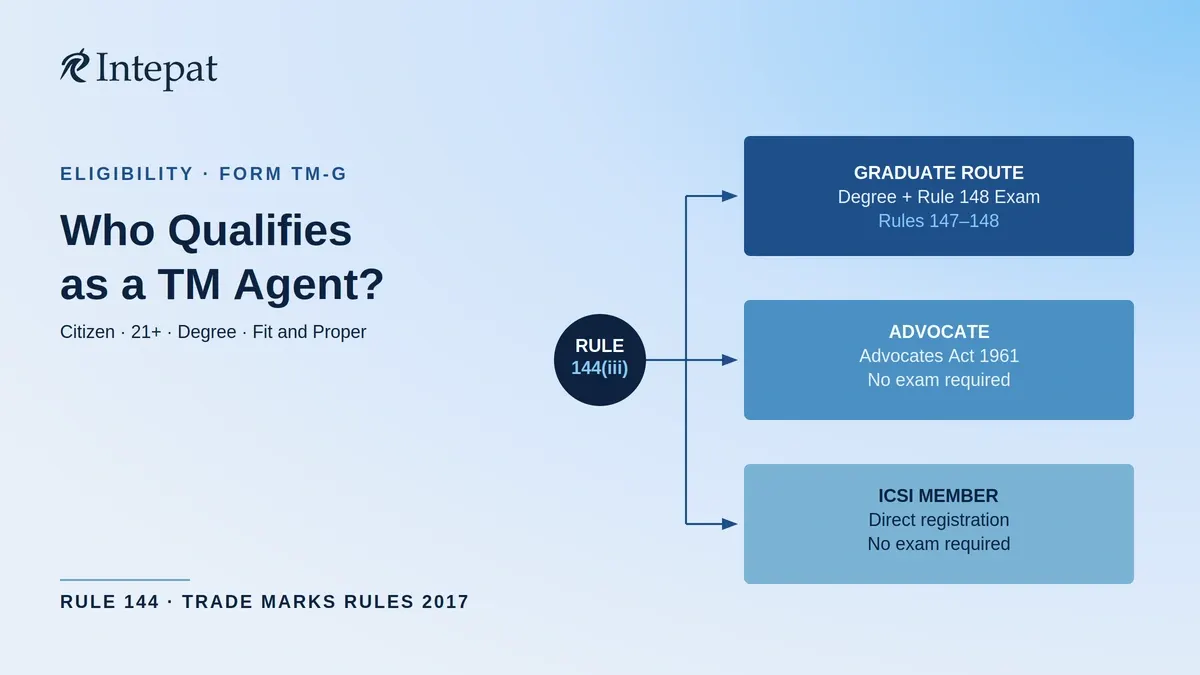
Under Rule 144 of the Trade Marks Rules 2017, a person qualifies for registration as a trademark agent if all four of the following conditions are met.
Citizenship. The applicant must be a citizen of India.
Age. The applicant must be at least 21 years old.
Qualification limb. Rule 144(iii) provides three alternative paths, each of which satisfies this limb:
- A graduate of any university in India (or a person with an equivalent qualification) who has passed the examination prescribed in Rule 148, or
- an Advocate within the meaning of the Advocates Act 1961 (25 of 1961), or
- a member of the Institute of Company Secretaries of India.
Advocates and ICSI members satisfy the qualification limb by virtue of their existing professional status and do not need to pass the Rule 148 examination, though they must still meet the citizenship, age, and fit-and-proper requirements.
Fit and proper. The Registrar must consider the applicant a person whom the Registrar regards as suitable in terms of integrity and professional conduct (the statutory phrase is “a fit and proper person”).
Persons Not Eligible for Registration
These disqualifications primarily address insolvency, serious criminal conviction, and professional misconduct. Under Rule 145, a person may not be registered as a trademark agent if they:
- have been adjudged by a competent court to be of unsound mind;
- are an undischarged insolvent;
- being a discharged insolvent, have not obtained a court certificate that their insolvency was caused by misfortune without any misconduct on their part;
- have been convicted by a competent court (whether within or outside India) of an offence punishable with transportation or imprisonment (the Rules retain the older statutory expression “transportation”); unless the offence has been pardoned or the Central Government has removed the disability on application;
- being a legal practitioner, have been held guilty of professional misconduct by any High Court in India;
- being a chartered accountant, have been held guilty of negligence or misconduct by a High Court; or
- being a registered trademark agent, have been held guilty of professional misconduct by the Registrar.
The Registration Process
Step 1: File the Application
An applicant files Form TM-G at the office of the Trade Marks Registry linked to their principal place of business (main work or business address) in India. The application is submitted in duplicate. Note: Form TM-G is the current form for agent registration under the Trade Marks Rules 2017. Form TM-A, which is used for trademark applications, is a separate document and is not used for agent registration.
The prescribed fees under the First Schedule to the Trade Marks Rules 2017 (verified June 2026) are:
| Purpose | Physical Filing | E-Filing | Form |
| Registration as trademark agent (Rules 147 and 149) | Rs 5,000 | Rs 4,500 | TM-G |
| Continuance on register, per five years (Rule 150) | Rs 10,000 | Rs 9,000 | TM-G |
| Restoration within 3 years of removal (Rule 153) | Rs 5,000 + continuance fee | Rs 4,500 + continuance fee | TM-G |
| Alteration of register entry (Rule 154) | Rs 1,000 | Rs 900 | TM-G |
Verified as of June 2026. Source: First Schedule, Trade Marks Rules 2017.
Step 2: Examination
On receipt of the application, the Registrar, if satisfied that the applicant meets the prescribed qualifications, will appoint a date for the examination in trade marks law and practice. Advocates and ICSI members are not required to sit the examination.
The Trade Marks Rules 2017 do not prescribe fixed passing marks; qualifying marks are as advertised by the Registrar for each sitting. The examination format may also vary by sitting; recent Registrar notices have described written papers followed by a viva-voce (oral examination) component for candidates who qualify. Check the current Registrar notice for the format and qualifying requirements applicable to the sitting you are attending.
| Trade Marks Agent Examination 2027: current registration window CGPDTM public notices dated 27 March 2026 and 23 June 2026. All dates are tentative and subject to change. Verify the current notice at ipindia.gov.in before acting. Online registration window 1 July 2026 to 30 September 2026 Admit card (online) 15 December 2026 onwards Trade Marks Agent Examination 2027 9 January 2027 (tentative) Written results Second week of February 2027 Viva voce (physical mode only) Last week of February 2027 Final results Third week of March 2027 |
Documents typically required for the examination (per recent official notices; verify against the current Registrar notice before attending):
- Proof of date of birth
- Proof of degree or equivalent qualification (for the graduate route)
- Proof of citizenship
- Character certificate
- Address proof
- Admit card issued by the Registrar
- Passport-size photographs
Step 3: Registration and Certificate
If the Registrar is satisfied that the applicant is eligible and qualified under Rule 144, the applicant is enrolled as a registered trademark agent after payment of the prescribed fee. The Registrar issues a certificate in Form RG-4. The registration is valid until the end of the financial year in which it is granted.
Step 4: Keeping the Registration Active
To remain on the Register, a registered trademark agent must pay the continuance fee prescribed in the First Schedule every five years, on or before the first day of the succeeding financial year. If the fee is not received within three months of the due date, the name is removed from the Register under Rule 151(1)(b). A name removed for non-payment may be restored within three years of removal, on payment of the restoration fee plus the continuance fee.
Practical Requirements for Registered Agents
A registered trademark agent must maintain an address for service in India comprising a postal address and a valid email address, and must also furnish an India-registered mobile number (Rule 17 of the Trade Marks Rules 2017). The Registrar shall refuse to recognise a person as an agent if that person neither resides nor has a place of business in India (Rule 152(2)).
If a registered agent fails to maintain a valid address for service, the Registrar is under no obligation to send notices required by the Act or the Rules, and any subsequent order or decision in proceedings cannot be challenged on grounds of non-service (Rule 17(3)).
The Register of Trademark Agents
Under Rule 142, the Registrar of Trade Marks maintains a Register of Trademark Agents. The Register records each agent’s name, address of residence, principal place of business address, nationality, qualifications, and date of registration. The Registrar publishes the list of agents from time to time, and at least once in two years.
Under Rule 143(2), the Registrar may publish in the Trade Marks Journal a code of conduct for registered trademark agents. Agents registered under earlier rules are deemed to be registered under the 2017 Rules.
Removal from the Register
The Registrar removes an agent’s name from the Register in the following circumstances:
- On the agent’s own request.
- For non-payment of the continuance fee, where three months have elapsed from the due date.
- Where the agent has become subject to any disqualification under Rule 145.
- Where the Registrar declares the agent not to be a fit and proper person to remain on the Register by reason of negligence, misconduct, or dishonesty in their professional capacity.
- Where the name was entered on the Register by error, or on the basis of misrepresentation or suppression of a material fact.
- On the agent’s death.
Removal on the misconduct and error/misrepresentation grounds requires the Registrar to call upon the person to show cause before making the declaration. Every removal is notified in the Trade Marks Journal and, where possible, communicated to the person concerned.
How Trademark Agent Registration Differs from Patent Agent Registration
The two registrations are entirely separate. Patent agents are registered under the Patents Act 1970 and the Patents Rules 2003, following an examination administered by the Patent Office. Trademark agents are registered under the Trade Marks Act 1999 and the Trade Marks Rules 2017, following an examination administered by the Trade Marks Registry.
Holding one registration does not confer the other. A practitioner advising on both patent and trademark matters holds both registrations independently. For a detailed account of patent agent eligibility and the patent agent examination, see How to Become a Patent Agent in India.
Working with a Registered Trademark Agent
For businesses and individuals filing trademark applications in India, a registered trademark agent handles all correspondence with the Registry, signs documents on the client’s behalf under a Form TM-M authorisation, and manages timelines from filing through registration. For an overview of what happens at each stage, see Trademark Registration Process in India. If you are comparing agent-assisted filing against self-filing, understanding what the trademark registration fees in India cover is a useful starting point for that decision.
Frequently Asked Questions
A trademark agent in India is a person registered with the Trade Marks Registry under the Trade Marks Rules 2017, authorised to represent clients in trademark matters before the Registrar. The graduate route requires Indian citizenship, age 21 or above, a university degree, and passing the Registrar’s examination. Advocates and ICSI members are separate eligible categories under Rule 144.
File Form TM-G in duplicate at the Trade Marks Registry office for your business address in India. The registration fee is Rs 5,000 (physical) or Rs 4,500 (e-filing) per the First Schedule to the Trade Marks Rules 2017. The Registrar schedules an examination in trade marks law and practice, unless you qualify as an Advocate or ICSI member. For the 2027 cycle, the online registration window runs from 1 July 2026 to 30 September 2026 (CGPDTM notice, 23 June 2026; dates tentative).
No. Under Rule 144(iii) of the Trade Marks Rules 2017, Advocates within the meaning of the Advocates Act 1961 and members of the ICSI are separate eligible categories who satisfy the qualification limb by virtue of their professional status and do not need to pass the Rule 148 examination. They must still meet the other eligibility requirements under Rule 144.
The Trade Marks Act 1999 uses the term “registered trade marks agent.” The term “trademark attorney” is used in professional practice to describe a legal practitioner advising on trademark law. Both a registered trademark agent and an Advocate are authorised under Section 145 of the Act to represent clients before the Registrar. However, trademark agent registration alone does not confer rights of audience before courts; court litigation requires the person to be qualified as a legal practitioner.
Registration is valid until the end of the financial year when first made. Keeping the registration active requires payment of a continuance fee every five years. Failure to pay within three months of the due date results in removal. A name removed for non-payment may be restored within three years on paying the restoration fee and continuance fee.
Yes. The Registrar removes a name from the Register on the agent’s own request, for non-payment of the continuance fee, on becoming subject to any disqualification under Rule 145, or on the basis of error or misrepresentation in the original application. Removal on grounds of misconduct or error requires a show-cause process before the Registrar.
A client authorises a trademark agent to act in a proceeding or matter by executing Form TM-M under Rule 19 of the Trade Marks Rules 2017. Once executed, service of any document on the agent is deemed to be service on the client.
This article explains the law on trademark agent registration in India as at June 2026 and is for general information only. It is not legal advice. Registry fees, forms, and timelines change; confirm current details with the Trade Marks Registry before you act. For advice on your specific matter, consult a trademark attorney.