




Competition law and patent law in India now point to different forums, and the line between them is still unsettled. If a patent owner licenses its patents on terms that a licensee considers unfair, the first question may no longer be whether those terms are lawful. The more immediate question is which authority has the power to examine them. That issue is once again before the Supreme Court.
Two Indian laws are relevant. The Competition Act, 2002 gives the Competition Commission of India (CCI) power to examine anti-competitive agreements under Section 3 and abuse of a dominant position under Section 4. The Patents Act, 1970 gives the Controller powers under Chapter XVI to grant compulsory licences and determine licence terms.
Quick answer: Under the Delhi High Court’s current position, the CCI cannot investigate complaints relating to a patentee’s exercise of patent rights. Such remedies must instead be pursued under the Patents Act. Where the conditions under Section 84 are satisfied, a person interested may apply to the Controller for a compulsory licence. Separately, certain restrictive licence conditions may be void under Section 140 and can be raised as a defence in a patent infringement suit.
This position comes from a Division Bench judgment of the Delhi High Court. The Supreme Court earlier declined to interfere with that judgment, but did not approve its reasoning on the merits. The wider question of which authority has jurisdiction is now pending before the Supreme Court in a separate appeal.
Where Competition law and patents in India collide
The Competition Act contains one express intellectual property carve-out, and it appears in Section 3. Section 3(5) allows an IP rights holder “to impose reasonable conditions, as may be necessary for protecting” rights recognised under heads (a) to (g). Heads (a) to (f) identify seven IP statutes, including the Patents Act, 1970 at head (b).
Two parts of this wording are important, particularly in a patent licensing negotiation. First, the protection is limited to reasonable conditions that are necessary to protect the IP right. It does not protect every condition that a patent owner may choose to include in a licence. Second, Section 3(5) begins with the words “this section”. Since it forms part of Section 3, the carve-out applies to Section 3. On its wording, it does not extend to Section 4.
Section 4 contains no similar IPR carve-out or proviso. It does contain another qualification, but not one specific to intellectual property. The Explanation to Section 4(2)(a) excludes a “condition or price which may be adopted to meet the competition”. In other words, a dominant enterprise may defend a condition or price if it was adopted to meet competition. This defence is available generally and is not an IPR-specific protection.
The Competition (Amendment) Act, 2023 made one relevant change to Section 4, and that change widened this Explanation. Before the amendment, only a “discriminatory condition or price” could be justified as meeting competition. The amendment replaced those words with “condition or price”. As a result, the defence can now extend to unfair conditions as well as discriminatory ones. Parliament did not add any specific intellectual property defence to Section 4 in 2023, and none has been added since.
The 2023 amendment also widened Section 3(5). A new head (g) was added, covering “any other law for the time being in force relating to the protection of other intellectual property rights”. The statutory list is therefore no longer limited to the IP laws specifically identified in the original provision. For patents, however, this amendment makes no practical difference because the Patents Act was already expressly included at head (b).
| Section 3 (agreements) | Section 4 (abuse of dominance) | |
|---|---|---|
| Express IPR carve-out | Yes, Section 3(5) | None |
| What it protects | Reasonable conditions necessary to protect the right | Not applicable |
| Other qualifier | Joint-venture proviso to Section 3(3) | Meeting competition, Explanation to Section 4(2)(a) |
| Settlement or commitment (Sections 48A and 48B) | Only where the inquiry is under Section 3(4) | Yes, but only if the CCI route reopens |
Two other provisions explain how the Competition Act is intended to operate alongside other laws, and they point in different directions. Section 60 says that the Competition Act “shall have effect notwithstanding anything inconsistent therewith contained in any other law for the time being in force”. This gives the Competition Act overriding effect where there is an inconsistency.
Section 62, however, says that the Act “shall be in addition to, and not in derogation of, the provisions of any other law for the time being in force”. That wording suggests that the Competition Act is meant to operate alongside other statutory remedies rather than replace them. The Patents Act does not contain an equivalent provision giving it overriding effect over other laws.
Why the Delhi High Court closed CCI jurisdiction over patents
On 13 July 2023, a Division Bench of the Delhi High Court decided five connected matters involving Ericsson, Monsanto Holdings and the CCI. At paragraph 1, the Court framed the central question: once a patent has been granted in India and the patentee exercises its patent rights, can the CCI investigate that conduct?
The Court held that it cannot. Two of the matters were Ericsson appeals arising from complaints by handset manufacturers about licensing terms for standard essential patents (SEPs). Another was a Monsanto appeal involving allegations of excessive royalty demands. At paragraph 52, the Court held that “Chapter XVI of the Patents Act is a complete code in itself on all issues pertaining to unreasonable conditions in agreements of licensing of patents, abuse of status as a patentee, inquiry in respect thereof and relief that is to be granted therefor”.
At paragraph 54, the Court concluded that when the dispute concerns the exercise of patent rights, “the Patents Act is the special statute, and not the Competition Act”. At paragraph 55, it held that the Patents Act must prevail under the principles of generalia specialibus non derogant and lex posterior derogat priori. The second principle, that the later law prevails over the earlier one, was based on the Court’s finding at paragraph 21 that Chapter XVI of the Patents Act “was introduced by way of an amendment in 2003 after the Competition Act was enacted”.
Section 4 cannot simply be dealt with through the Section 3(5) IPR carve-out, and that distinction remains important. The Court recorded the CCI’s argument that Sections 3(5)(i)(b) and 4 together make the Commission the proper authority to decide whether a patent licence condition is unreasonable or amounts to an abuse of dominance. The Court answered, “We disagree.”
Its reasoning was that the factors considered by the CCI under Sections 19(3) and 19(4) while examining possible violations of Sections 3 and 4 are not materially different from the factors considered by the Controller under Sections 84(6) and 84(7) of the Patents Act, particularly when those provisions are read with Sections 83 and 89.
For Section 4, therefore, the Court relied on what it saw as an overlap between the Competition Act inquiry and the compulsory-licensing framework under the Patents Act. It also treated Section 3(5)(i)(b) as an indication of Parliament’s intention regarding patent licensing conditions. That reasoning remains open to challenge. Section 3(5), by its own opening words, applies only to Section 3 and does not expressly extend to Section 4.
At paragraph 56, the Court allowed all five matters. It set aside the 2016 and 2020 Single Judge judgments that had upheld the CCI’s jurisdiction and quashed the CCI proceedings. Paragraph 57 made one point clear: the Court was not deciding whether Ericsson or Monsanto had actually imposed anti-competitive licence conditions or abused a dominant position.
The Court also dealt with some of the reasoning in the judgments it was overturning, and two passages remain particularly important for anyone arguing the jurisdiction issue today.
At paragraph 61, it considered Sections 21 and 21A of the Competition Act, which allow references between the CCI and other statutory authorities. The Court held that these provisions “are intended to deal with situations where the powers of the Commission are not excluded by other statutes”. The reference mechanism therefore remains available where the CCI otherwise has jurisdiction, but it cannot be used to restore jurisdiction where, according to the Court, another statute has already excluded it.
At paragraph 62, the Court considered the Additional Solicitor General’s argument that CCI decisions operate in rem, while decisions of the Controller operate in personam. The Court rejected that distinction, stating: “We find ourselves unable to concur.”
One important issue, however, was left less clearly resolved. The judgment does not give a separate substantive answer to Section 60 of the Competition Act, which gives the Act overriding effect in cases of inconsistency. Its treatment of Section 62 appears only within the discussion at paragraph 61. That leaves an important opening for challenging the jurisdictional reasoning on appeal.
What the Supreme Court did in 2025, and what it did not
The CCI took the matter to the Supreme Court. On 2 September 2025, a Bench of Pardiwala and Sandeep Mehta JJ disposed of five special leave petitions. The order is only eight short paragraphs long and is a Record of Proceedings. It is not a reasoned judgment deciding the relationship between the Competition Act and the Patents Act.
The captioned matter is SLP(C) 25026/2023, arising from the Monsanto appeal, while the Court treated SLP(C) 12209/2024 as the lead matter. The reason given for not interfering was tied closely to the facts of those cases. Paragraph 5 states that, “In the peculiar facts and circumstances of the case, more particularly, keeping in mind what has been observed by the High Court in Paragraph 58 of its impugned judgment”, and considering that “the original complainants/informants have nothing further to say in the matter, we should not interfere”.
Paragraph 58 of the Delhi High Court judgment dealt with settlement. It recorded the view that once the informant had settled the dispute, the basis for continuing the CCI proceeding no longer remained. That was the specific part of the High Court judgment on which the Supreme Court relied.
Paragraph 6 is equally important. It states: “If there are any questions of law involved in this litigation, the same are kept open to be agitated in some other appropriate case.”
Three points therefore matter when relying on the 2025 order. First, the petitions were “disposed of”; the order does not use the word “dismissed”. Second, the order does not discuss the Patents Act, Chapter XVI, Sections 3, 4, 60 or 62 of the Competition Act, or the broader question of whether the Patents Act is a special statute that excludes CCI jurisdiction.
Third, the Supreme Court reproduced paragraph 58 of the Delhi High Court judgment and no other part of it. It did not reproduce or discuss the paragraphs containing the High Court’s main jurisdictional reasoning.
The 2025 order therefore cannot fairly be read as the Supreme Court approving the Delhi High Court’s conclusion that the Patents Act prevails over the Competition Act. The Court chose not to interfere on the facts before it and expressly left any questions of law open for consideration in another appropriate case.
The question is back before the Supreme Court
The jurisdiction issue returned to the Supreme Court within two months. On 30 October 2025, the National Company Law Appellate Tribunal decided Competition Appeal (AT) No. 5 of 2023. The appeal had been filed by an informant whose complaint concerning the anaemia drug Ferric Carboxymaltose had earlier been closed by the CCI. The Tribunal dismissed the appeal and held that the Patents Act governs the dispute.
The informant had argued that the drug was neither sufficiently accessible nor affordable because production was limited. The complaint had been brought under both Sections 3 and 4 of the Competition Act. Two parts of the Tribunal’s reasoning deserve close attention.
Paragraph 8 states that “The Competition Act, in Section 3(5) has laid down that the Competition Act will not restrict the right of any person in protecting his rights under the Patent Act”. The difficulty is that the case involved Section 4 as well as Section 3, while Section 3(5), by its opening words, applies only to Section 3. That distinction becomes important when the Tribunal’s reasoning is compared with the statutory text discussed earlier.
Paragraph 10 presents another issue. It records that the September 2025 special leave petition “has been dismissed by the Hon’ble Supreme Court”. As noted above, however, the Supreme Court’s order itself says that the petitions were “disposed of” and expressly left questions of law open.
The CCI then appealed to the Supreme Court, even though the Tribunal’s final outcome had been in its favour. On 2 February 2026, in Competition Commission of India v. Swapan Dey, Civil Appeal No. 519/2026, a Bench of Pardiwala and Vijay Bishnoi JJ issued notice returnable on 23 February 2026. It also directed that “The observations made in paragraphs 8-10 of the impugned order shall remain stayed from its operation”. The Court further stated that it would hear the matter “only on the issue of jurisdiction”.
The scope of that stay matters. The Supreme Court expressly stayed paragraphs 8 to 10 of the NCLAT order. Those paragraphs contain the Tribunal’s Section 3(5) reasoning, its reproduction of the Delhi High Court’s approach, and its description of the 2025 Supreme Court order as having “dismissed” the earlier petitions.
Paragraph 11, however, was not expressly included in the stay. That is the paragraph in which the Tribunal states its final conclusion on jurisdiction. The distinction should therefore be kept in mind when citing the NCLAT decision.
The Supreme Court appeal is registered as Diary No. 124 of 2026 and can be searched using that number on the Court’s case-status portal. As at August 2026, no later order appears to have been publicly reported based on searches of Supreme Court orders, cause lists and practitioner reporting. That should be treated as a search result rather than a formal docket confirmation, so the latest case status should be checked on the Supreme Court portal before the position is relied upon.
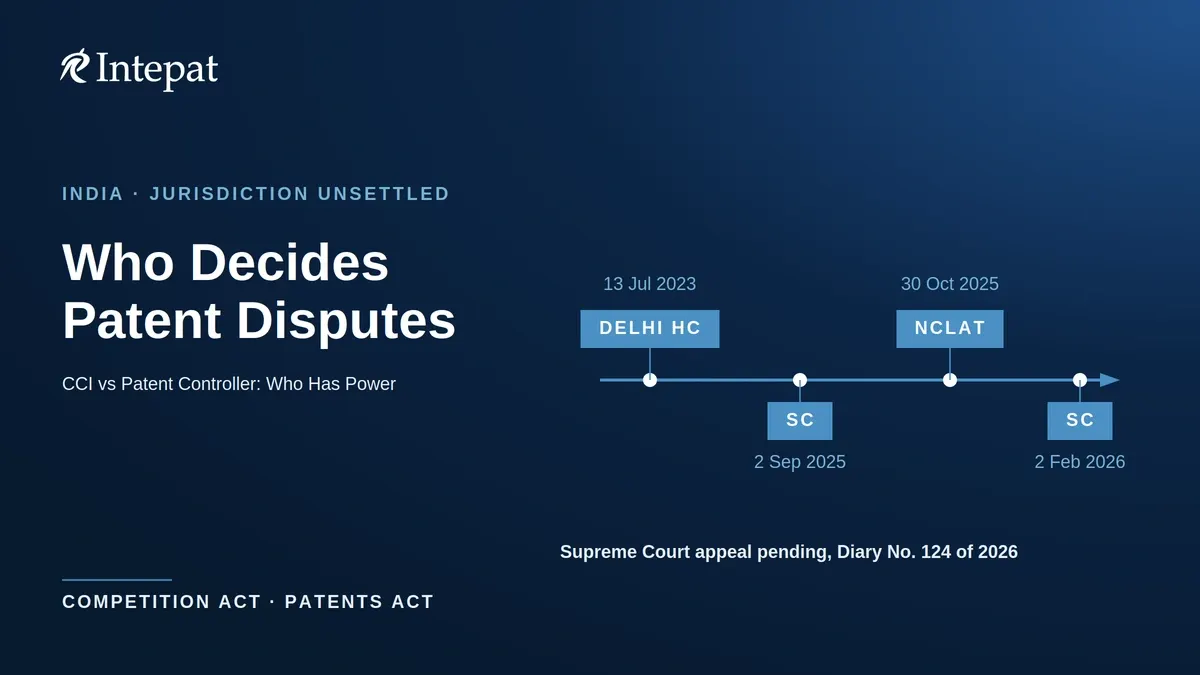
| Date | Event | Effect on the forum question |
|---|---|---|
| 13 July 2023 | Delhi High Court Division Bench, LPA 247/2016 and connected | CCI route closed for conduct involving exercise of patent rights |
| 2 September 2025 | Supreme Court disposes of five special leave petitions | High Court judgment left standing, but questions of law kept open |
| 30 October 2025 | NCLAT, Competition Appeal (AT) No. 5 of 2023 | Delhi High Court reasoning extended to a patented pharmaceutical |
| 2 February 2026 | Supreme Court, Civil Appeal No. 519/2026 | Paragraphs 8 to 10 stayed; Court to hear jurisdiction issue |
What a patentee and an implementer each do now
Both sides can act under rules that remain available whichever way the Supreme Court appeal is decided. The Patents Act route exists in either scenario. What may change is whether the CCI route reopens alongside it, bringing remedies that the Controller of Patents cannot grant.
For a patentee, the Delhi High Court judgment remains the operative authority and carries substantial weight. But it is not a Supreme Court decision on the merits, and paragraph 6 of the September 2025 Supreme Court order expressly keeps the legal question open.
One provision that remains important regardless of the appeal is Section 140 of the Patents Act. It makes four categories of licence conditions unlawful: requiring a licensee to acquire non-patented articles from the licensor; restricting the licensee’s use of non-patented articles not supplied by the licensor; restricting the use of processes other than the patented process; and conditions providing for “exclusive grant back, prevention to challenges to validity of patent and coercive package licensing”. The last category is particularly relevant to SEP licensing and patent pools. If a licence condition falls within Section 140, it is void without the licensee first having to obtain an order from the Controller or the CCI.
For an implementer or licensee, the principal route currently runs through the Patents Act. Section 84 allows any person interested to apply for a compulsory licence after three years have expired from the date of grant of the patent. The application may be based on any of three grounds: the reasonable requirements of the public have not been satisfied; the patented invention is not available to the public at a reasonably affordable price; or the invention is not worked in India. The application is filed in Form 17 under Rule 96 of the Patents Rules, 2003.
A complaint about unreasonable licensing terms can enter through the first of those grounds. Section 84(7) treats the reasonable requirements of the public as not satisfied in specified situations. These include cases where, because the patentee refuses to grant a licence on reasonable terms, demand for the patented article “has not been met to an adequate extent or on reasonable terms”. The provision also refers to conditions involving “exclusive grant back, prevention to challenges to the validity of patent or coercive package licensing”.
The language of tie-ins, no-challenge clauses and package licensing is therefore already built into the compulsory-licensing framework of the Patents Act. If a compulsory licence is granted, Section 90 governs its terms, including the requirement that the royalty and other remuneration be reasonable.
Chapter XVI also gives an allegation of anti-competitive conduct a specific procedural effect. Section 84(6)(iv) normally requires an applicant to show that it first tried to obtain a licence from the patentee on reasonable terms and that those efforts were unsuccessful within a reasonable period. The Explanation says that this period should not ordinarily exceed six months.
That negotiation requirement does not apply, however, where a ground of anti-competitive practices by the patentee is established. An implementer able to establish such conduct can therefore approach the Controller without first completing the usual negotiation period. Separately, the three-year waiting period under Section 84 can be bypassed under Section 92 where the Central Government makes the required notification in circumstances of national emergency, extreme urgency or public non-commercial use.
There is also a third forum, and in practice it may already be dealing with the dispute. Section 140(3) provides that where a contract containing a condition declared unlawful under Section 140 is in force at the time of the infringement, the existence of that contract can operate as a defence in a patent infringement action. An exception applies where the plaintiff was not a party to the contract and proves that the unlawful condition was inserted without its knowledge and consent. Questions such as patent essentiality and FRAND compliance may also be litigated before the same court.
| Patents Act, Chapter XVI | Competition Act | Civil court | |
|---|---|---|---|
| Forum | Controller of Patents | CCI | District Court or High Court |
| Currently available | Yes | No, under the 2023 Delhi High Court authority | Yes |
| Trigger | Form 17 application under Section 84 | Information under Section 19 | Section 140(3) defence, or the infringement action itself |
| Remedy | Compulsory licence on terms set under Section 90; no penalty on the patentee | Cease-and-desist directions, modification of agreement and turnover-based penalty under Section 27; no licence | Specified restrictive condition void; Section 140(3) defence in infringement proceedings |
The remedies are therefore materially different. The Controller can grant a compulsory licence and determine its terms, including royalty. The CCI, if its jurisdiction is ultimately restored, can impose competition-law remedies such as directions, modification of agreements and penalties, but it does not itself grant a patent licence.
That difference is one reason the pending appeal matters. However, the Delhi High Court Division Bench has already rejected the argument that differences in available remedies are, by themselves, enough to justify allowing both statutory forums to operate over the same patent-related conduct. That argument therefore faces the existing Division Bench authority.
One further issue sits outside all three routes. Paragraph 58 of the Delhi High Court judgment, and the Supreme Court’s later reliance on that paragraph, suggest that settlement between an informant and the patentee can remove the factual basis for continuing a CCI proceeding.
The Supreme Court, however, acted expressly “in the peculiar facts and circumstances of the case”. It did not decide whether settlement must terminate a CCI inquiry as a general rule. That wider question remains open, particularly because a CCI inquiry, once commenced, is not simply a private proceeding belonging to the informant that can automatically be withdrawn.
What to watch as the appeal proceeds
The Supreme Court’s decision will affect more than the choice of forum. Sections 48A and 48B of the Competition Act, in force since March 2024, allow an enterprise to offer commitments or seek settlement. But both provisions begin with the same limitation: they apply only where an inquiry has been initiated for a contravention of Section 3(4) or Section 4.
Cartels under Section 3(3) are therefore outside both mechanisms. A patent-licensing complaint against a single patentee, however, will often be framed under Section 4 or Section 3(4), which is exactly the type of case for which the settlement and commitment framework can operate.
If the Supreme Court restores CCI jurisdiction over patent-related conduct, a patentee will face renewed competition-law exposure, but will also gain access to a negotiated exit that was not available before 2024. If the Court confirms that CCI jurisdiction is excluded, those provisions will have little relevance to patent licensing disputes. The Patents Act route would remain central, through Chapter XVI before the Controller and Section 140 in infringement proceedings.
Collective licensing arrangements may require a different analysis. A patent pool can involve coordination among several patentees, rather than the conduct of one patentee exercising its rights under the Patents Act. The Delhi High Court’s 2023 reasoning is framed mainly around the exercise of patent rights by a patentee, so its application to broader horizontal arrangements may not be straightforward.
Competition-law risk has also not simply disappeared. Some of the scrutiny has shifted into patent litigation itself. The Delhi High Court has been requiring SEP owners to establish essentiality and compliance with fair, reasonable and non-discriminatory licensing obligations with greater care. The Division Bench decision in Bansal v. Philips on 18 May 2026 is one recent example.
The practical position is therefore limited but clear. Treat the jurisdiction issue as still open. Draft and review licence terms so that they can be defended on their substance and reasonableness, not merely on an argument that the CCI has no jurisdiction. Existing patent licences should also be checked against the four categories of prohibited conditions in Section 140.
And before advising a patentee, implementer or licensee on forum strategy, check the latest status of Diary No. 124 of 2026 on the Supreme Court portal. The jurisdictional position may change with the next substantive order.
Frequently asked questions
On the current authority, no. The Delhi High Court quashed CCI proceedings against two patentees on 13 July 2023, holding that Chapter XVI of the Patents Act is a complete code covering unreasonable licence conditions and abuse of patentee status. The Supreme Court declined to interfere in September 2025 but expressly kept the questions of law open.
Not on its wording. Section 3(5) opens with “Nothing contained in this section”, and the section it sits in is Section 3. Section 4 carries no intellectual property carve-out. The 2023 amendment widened Section 3(5) with a residual head but added no such defence to Section 4, so the asymmetry remains.
It did not decide that question. The order of 2 September 2025 disposed of the petitions on the basis that the informants had settled and had nothing further to say, and paragraph 6 keeps any questions of law open for another case. The order does not mention the Patents Act or the special-statute argument at all.
Under the Patents Act, not the Competition Act, on the current authority. Where the requirements of Section 84 are met, a person interested may seek a compulsory licence from the Controller on Form 17, and Section 84(7) treats the reasonable requirements of the public as unsatisfied where the patentee refuses to license on reasonable terms.
The Delhi High Court quashed the proceedings before it for want of power, so a patentee facing an existing inquiry has a jurisdictional objection available rather than only a merits answer. That objection depends entirely on the 2023 judgment surviving, which is what the Supreme Court is now hearing. Take advice on your specific matter.
No. The Controller grants a licence on terms and sets a royalty going forward under Section 90; there is no penalty on the patentee and no compensation for the past. A CCI order under Section 27 can direct discontinuance, modify the agreement and impose a turnover-based penalty, but it cannot grant anyone a licence.
It arose from SEP complaints. Two of the five matters were Ericsson appeals against CCI proceedings begun on complaints from handset makers about licensing terms for telecommunications SEPs. The reasoning is not confined to SEPs, though, and the tribunal applied it in 2025 to an availability and pricing complaint about a patented pharmaceutical.
Both routes would run in parallel, and a patentee would face inquiry under Section 4 with no intellectual property defence, only the meeting-competition Explanation available to any dominant enterprise. Settlement and commitment under Sections 48A and 48B would become available, since those provisions reach Section 4 and Section 3(4) matters.
This article explains the position in India as at August 2026 and is for general information only. It is not legal advice. Laws, fees, and procedures change; verify the current position before you act. For advice on your specific matter, consult a qualified IP professional.