




WIPO is the United Nations agency that administers the treaties, including the Paris Convention, the PCT, and the Madrid Protocol, that shape how you protect intellectual property abroad. TRIPS is the WTO agreement that sets minimum protection standards, including minimum patent and trademark terms, and enforcement obligations, that every WTO member must give effect to in its own legal system.
Both form part of the international IP framework, but WIPO is an organization and TRIPS is a WTO agreement. This article looks at both from an Indian applicant’s position: what each one controls, and what changes for a founder filing a patent, trademark, or design outside India.
| Quick answer |
| WIPO administers a mix of treaties. Some are centralized filing or registration systems, the PCT for patents, the Madrid Protocol for trademarks. Others, like the Paris and Berne Conventions, set priority, national-treatment, or automatic-protection rules without a filing system of their own.TRIPS requires WTO members to give minimum IP standards effect in their own law, covering the availability, acquisition, scope, maintenance, and enforcement of rights, not just what happens after grant. It does not itself decide whether your application is granted; that stays with each country’s domestic law and its own IP office.TRIPS floor: patents at least 20 years from the filing date (Article 33); trademarks at least 7 years per term, renewable indefinitely (Article 18).India carries both sets of obligations, WIPO membership since 1 May 1975, the WTO and TRIPS since 1 January 1995. An Indian resident must also comply with Section 39 of the Patents Act before filing a patent abroad, though prior permission isn’t always required. |
What Is WIPO and What Does It Administer?
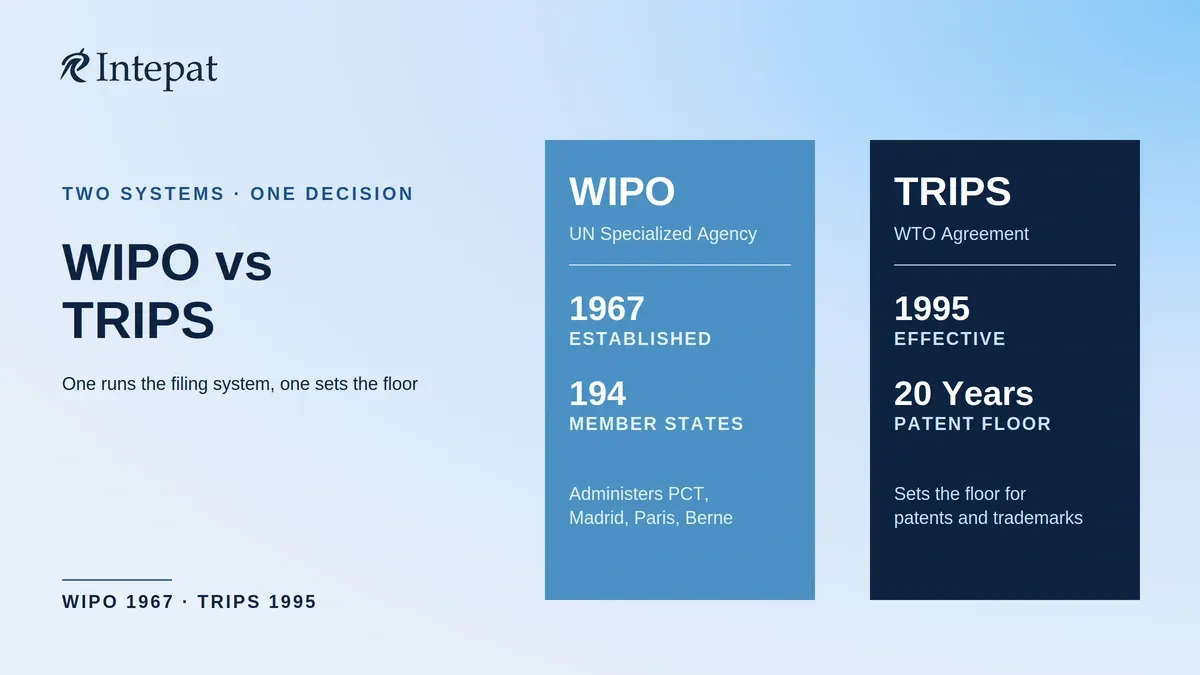
WIPO, the World Intellectual Property Organization, was created by the Convention Establishing WIPO, signed at Stockholm on 14 July 1967 and in force from 1970. It became one of the 15 specialized agencies of the United Nations in 1974, and it currently has 194 member states. India acceded on 31 January 1975, with effect from 1 May 1975.
Under Article 3 of the WIPO Convention, the organization has two objectives: to promote the protection of intellectual property worldwide, and to ensure administrative cooperation among the intellectual property Unions that WIPO administers. Those Unions, and the treaties behind them, do different jobs. Some create centralized filing or registration systems: the Patent Cooperation Treaty lets an applicant file a single international patent application, and the Madrid Protocol lets an applicant file a single international trademark application through an Office of origin. Others do something different: the Paris Convention gives an applicant a priority period, 12 months for patents, 6 months for trademarks and industrial designs, within which to make later national or regional filings in other Paris Convention countries while claiming priority from the first application; it is not itself a filing system. The Berne Convention goes further still: it bars member countries from making copyright protection conditional on registration or any other formality, though national law may still require a work to be fixed in a material form before it qualifies.
WIPO also runs services that sit outside any treaty obligation. PATENTSCOPE lets an applicant search published international and national patent documents, and WIPO’s Arbitration and Mediation Center administers UDRP domain name disputes as an ICANN-approved provider; a panel decides each case, not WIPO itself.
WIPO also administers the Hague System for registering designs internationally, but India is not a Contracting Party to it. An applicant relying only on Indian nationality, domicile, or habitual residence cannot use Hague; an Indian company with a separate qualifying connection, such as a real and effective industrial or commercial establishment in a Hague Contracting Party, may still be eligible. Absent that, protection abroad needs national or regional design filings in each country wanted, claiming Paris Convention priority within six months of the Indian filing date where that country allows it.
None of these treaties, on their own, come with a WTO-style trade-dispute and retaliation mechanism if a member country falls short. Paris and Berne do carry their own dispute clauses referring unresolved disputes between member countries to the International Court of Justice, though in practice no IP dispute has ever gone that route, and India has opted out of Berne’s version. Either way, none of it gives an individual applicant a remedy. That’s where TRIPS sits.
What Is TRIPS and What Does It Require?
TRIPS, the Agreement on Trade-Related Aspects of Intellectual Property Rights, is Annex 1C to the Marrakesh Agreement that established the WTO. It was signed at Marrakesh on 15 April 1994 and took effect on 1 January 1995. TRIPS is a WTO agreement, not a WIPO one: it is administered through the WTO’s Council for TRIPS, and it is one of the agreements every country accepts as a condition of WTO membership, there is no separate opt-in.
TRIPS binds governments, not applications. Article 1.1 requires members to give effect to the Agreement’s provisions, while leaving each member free to determine the appropriate method within its own legal system and practice. Its standards reach beyond duration and enforcement alone: TRIPS also governs the availability, acquisition, scope, maintenance, and use of IP rights, including, under Article 62, a requirement that a member’s own grant or registration procedures not unreasonably curtail the period of protection. What TRIPS does not do is grant a patent, trademark, or design itself, convert a PCT application into a granted patent, or validate a Madrid designation; whether you obtain and can enforce protection in a given country still depends on that country’s own law and its own IP office.
TRIPS sets minimum standards across seven categories in its Part II: copyright and related rights, trademarks, geographical indications, industrial designs, patents, layout-designs of integrated circuits, and undisclosed information. India does not presently have a single, dedicated central trade secrets statute; the Law Commission’s Report No. 289 (March 2024) recommended one and appended a draft Bill, which had still not been enacted as of early 2026. The Commission’s own view is that TRIPS does not require a dedicated statute, and that India’s existing mix of contractual, common-law and equitable remedies, together with applicable criminal and sector-specific statutory provisions, meets the Agreement’s minimum standard.
Two figures a founder is likely to run into directly. A patent’s term of protection cannot end before 20 years from the filing date (Article 33). A trademark’s initial registration and each renewal must run for at least 7 years, and the registration itself must be renewable without a treaty-imposed limit on the number of renewals (Article 18), though TRIPS separately lets a member cancel a registration for at least three years’ continuous non-use, absent valid reasons (Article 19). TRIPS also incorporates the substantive obligations of the Paris Convention (Articles 1 through 12 and 19) and most of the Berne Convention, excluding its moral rights provisions, by reference. A WTO member cannot join and then ignore those two conventions’ substantive terms, even if it has never separately signed either one.
TRIPS places specified IP obligations within the WTO framework and makes WTO dispute settlement available between member governments, and it goes further than Paris or Berne on one point in particular: enforcement. Enforcement procedures must permit effective action against infringement (Article 41), and criminal procedures and penalties are required at least for wilful trademark counterfeiting and copyright piracy on a commercial scale, with available remedies that must include imprisonment and/or deterrent monetary fines (Article 61). Disputes between member governments over TRIPS compliance go through the WTO’s dispute settlement system under Part V, the same mechanism used for trade disputes generally, but that route is government-to-government only. A founder cannot file a TRIPS complaint at the WTO directly; enforcing an individual patent, trademark, or design still means using the courts or administrative process of the country where you hold the right.
TRIPS also built in transition periods for developing countries: a general five-year delay to 1 January 2000 (Article 65.2), plus a further five years, to 1 January 2005, specifically for extending product-patent protection to technology areas that weren’t protectable before (Article 65.4). That extra window came with conditions attached. India still had to accept the filing of pharmaceutical and agrochemical product-patent applications from 1995 onward, the “mailbox” obligation under Article 70.8, and, in some circumstances, grant exclusive marketing rights pending examination under Article 70.9. India’s first mailbox, run by administrative instruction rather than statute, was challenged at the WTO and found inadequate in the 1998 India Patents (US) dispute, which is why the Patents (Amendment) Act, 1999 put the mailbox and exclusive-marketing-rights mechanism onto a statutory footing. Only the Patents (Amendment) Act, 2005 then completed the transition, extending product-patent protection to pharmaceuticals and agrochemicals; before that, only process patents were grantable in those fields, with product-patent applications held in the mailbox for later examination.
WIPO vs TRIPS: The Core Difference
WIPO administers many of the systems you can use to file and register intellectual property abroad; TRIPS sets the minimum standards a WTO member’s own IP system has to meet, covering availability, acquisition, scope, maintenance, and enforcement, though the member’s own office and courts still apply that country’s law to your individual application.
| WIPO | TRIPS | |
| What it is | UN specialized agency, established 1967, in force 1970 | WTO agreement, Annex 1C to the Marrakesh Agreement, effective 1995 |
| What it does | Administers a mix of filing/registration systems (PCT, Madrid), priority and protection treaties (Paris, Berne), and IP services (PATENTSCOPE, UDRP) | Requires WTO members to give minimum standards effect in domestic law, covering availability, acquisition, scope, maintenance, and enforcement; does not itself grant or guarantee any right |
| Membership basis | 194 member states; each joins individual treaties separately | Automatic for every WTO member (166 members, verified as of August 2026); no separate opt-in |
| India’s status | Member since 1 May 1975 | Bound since 1 January 1995, a founding WTO member |
| Enforcement if a member falls short | No built-in trade-based mechanism in the WIPO Convention itself | WTO dispute settlement (Part V), government-to-government only; Part III also requires domestic civil, administrative, border, and criminal enforcement |
| What a founder mainly uses it for | An optional centralized route for some rights, the PCT (patents) or Madrid (trademarks); direct national or regional filing remains available, and is usually the route for designs, since India itself is not a Hague member | The minimum standards, including grant procedure, term, and enforcement, a WTO member’s own IP system must meet |
How WIPO and TRIPS Work Together
Despite sitting in different institutions, the two are formally linked. The Council for TRIPS is directed to establish cooperation arrangements with WIPO bodies (Article 68), and a separate WIPO-WTO cooperation agreement, concluded in Geneva on 22 December 1995, took effect on 1 January 1996. Under it, WIPO and the WTO Secretariat exchange information and coordinate legal-technical assistance to developing countries implementing TRIPS.
Practically, this means the two obligations can, in principle, diverge. A country can be a WIPO member without being a WTO member, in which case it is bound only by whichever WIPO-administered treaties it has separately joined, not by TRIPS’s minimum standards. A WTO member, on the other hand, is bound by TRIPS, subject to any transition period, waiver, or WTO decision that applies to it, regardless of which individual WIPO treaties it has signed, because TRIPS pulls in the Paris and Berne Conventions’ substantive terms by reference. In a country outside the WTO, TRIPS simply does not apply; that does not necessarily block a foreign applicant from filing there, since a direct national filing under that country’s own domestic law can still be available even where no relevant WIPO-administered treaty covers it. India carries both sets of obligations, so for a founder here the distinction is less about which one applies and more about what each one is for: use an appropriate WIPO-administered system, or a direct national or regional filing, to file, and rely on TRIPS to know the floor domestic protection cannot go below.
What This Means When You File IP From India
For a founder filing outside India, this split has five practical consequences.
First, WIPO administers optional centralized routes for certain rights, not the only way to file. An Indian applicant may use the PCT for patent applications, which has the effect of a national or regional application in the contracting states designated and lets the applicant postpone most national-phase decisions, commonly until 30 or 31 months from the priority date, though the exact deadline must be checked separately for each designated Office, or the Madrid Protocol for trademarks, filed through an Indian basic application or registration. Direct national or regional filings remain available for both, and are usually the route for designs too, since India itself is not a Hague member, with a narrow exception for a company that separately qualifies through an establishment abroad: protection abroad generally needs national or regional design filings, claiming Paris Convention priority within six months where available.
Second, one step comes before any of that, though. Before making or causing any patent application outside India, an Indian resident must comply with Section 39 of the Patents Act, 1970. Prior permission on Form 25 is not required where the same invention was filed in India at least six weeks earlier and no secrecy direction is in force, subject to the exception in Section 39(3) for inventions first filed abroad by a person resident outside India. For defence or atomic-energy inventions, the Controller cannot grant permission without the Central Government’s prior consent, and Rule 71’s 21-day disposal period runs from receipt of that consent. Contravention causes the corresponding Indian application to be deemed abandoned under Section 40, and any patent already granted on it is liable to revocation; Section 118 also carries penal exposure of up to two years’ imprisonment, a fine, or both.
Third, neither PCT nor Madrid is a one-shot exercise. National-phase fees, translations, and local representation still follow in each PCT country you enter, and each patent office examines under its own law regardless of the international search or examination result. A Madrid registration stays dependent on its Indian basic application or registration for five years. If that basic mark is refused, restricted, or cancelled within that window, or a challenge to it is filed within the window even if decided later, the international registration can be cancelled to the same extent, in whole or just for the affected goods and services, the “central attack” risk. Each designated country’s office can also still issue its own provisional refusal regardless.
Fourth, TRIPS sets the floor a WTO member’s own IP system has to meet: it constrains certain acquisition and maintenance procedures, for instance requiring that grant or registration not be unreasonably delayed, and it sets minimum terms and enforcement standards. It does not prescribe a complete examination code, though; the detailed examination process itself stays a matter for each Office. If a member’s grant-procedure timing, patent term, trademark renewal period, or enforcement standard falls short of the Article 62, 33, 18, or Part III minimums, that is a TRIPS compliance question, but only a government can raise it against another government through the WTO’s dispute settlement system. A founder cannot bring that complaint directly and still has to use the designated country’s own administrative or judicial process to enforce an individual right.
Fifth, the two obligations do not automatically travel together in every country. India carries both, so in practice an Indian applicant rarely has to separate them, but the distinction matters when assessing protection in a country whose WIPO and WTO memberships do not match, a small but real category.
FAQs
WIPO is a United Nations agency that administers a mix of IP treaties: some, like the PCT and Madrid Protocol, are filing systems; others, like the Paris and Berne Conventions, set priority or protection rules with no filing system. TRIPS is a WTO agreement requiring every WTO member to give minimum protection standards effect in domestic law.
No. WIPO is a separate United Nations specialized agency, and TRIPS is administered through the WTO’s Council for TRIPS. The two bodies cooperate under a 1996 WIPO-WTO agreement, and TRIPS incorporates the Paris and Berne Conventions’ substantive terms by reference, but WIPO does not administer TRIPS itself.
Yes. India has been a WTO member since 1 January 1995 and has been bound by TRIPS from that date. India used the Article 65.4 transition period for pharmaceutical and agrochemical product patents, extending product-patent protection to those fields by 1 January 2005 through the Patents (Amendment) Act, 2005, after an earlier 1999 amendment fixed India’s mailbox and exclusive-marketing-rights mechanism.
A patent’s term of protection cannot end before 20 years from the filing date (TRIPS Article 33). This is a floor, not a ceiling: WTO members cannot legislate shorter, though the Agreement leaves each member free to decide how it gives that floor effect in its own law.
Not always, but compliance is mandatory. Section 39 requires an Indian resident to either have filed in India at least six weeks earlier with no secrecy direction pending, or obtain the Controller’s written permission on Form 25, subject to the Section 39(3) exception for inventions first filed abroad by non-residents. This comes before any WIPO or TRIPS question.
Not through a single WIPO filing based on Indian nationality alone. India is not a party to the Hague Agreement, WIPO’s design system, though a company with a qualifying establishment elsewhere may still be eligible. Otherwise, protecting a design abroad needs a separate national or regional filing in each country, claiming Paris Convention priority within six months where available.
No. A treaty does not automatically displace contrary Indian legislation just because India has accepted it; its domestic effect depends on India’s constitutional and legislative framework, operating through statutes like the Patents Act 1970 and Trade Marks Act 1999 rather than replacing them. Where the statutory text allows it, courts may still interpret domestic law consistently with India’s treaty obligations.
This article explains WIPO and TRIPS as they apply to Indian applicants as at August 2026 and is for general information only. It is not legal advice. Treaty memberships, agreement texts, and their domestic implementation change over time. For advice on a specific filing or a specific country’s compliance position, consult a qualified IP practitioner.