




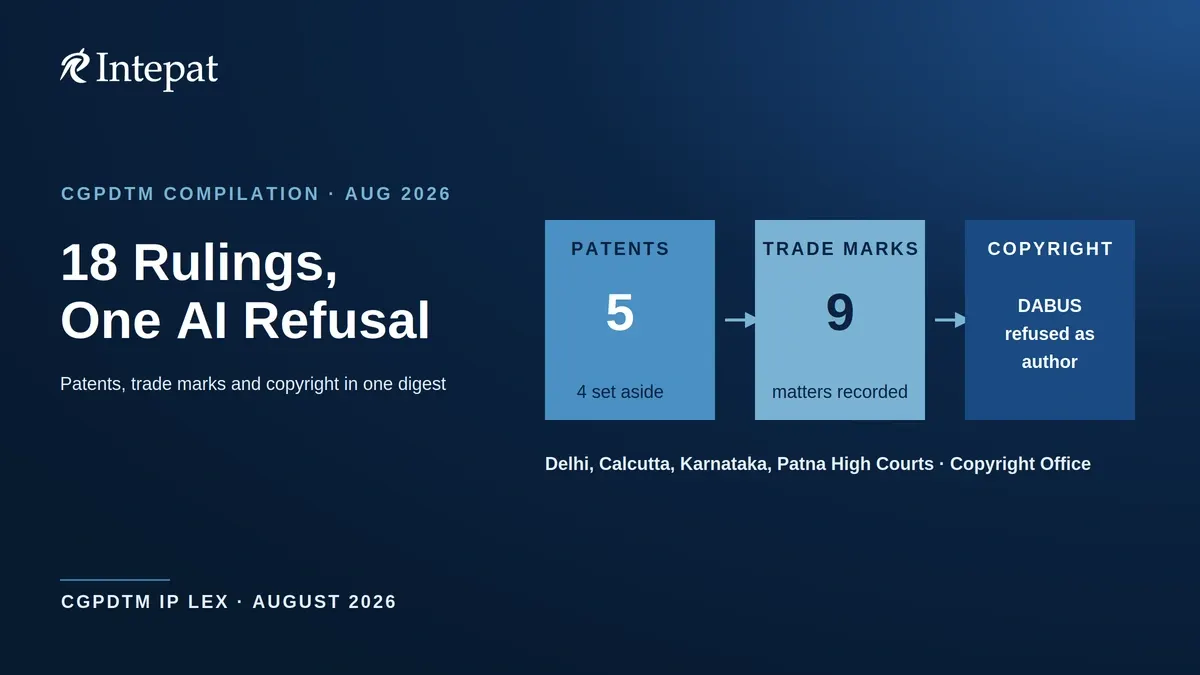
IP Lex August 2026 is the CGPDTM’s monthly compilation of intellectual property judgments, covering eighteen matters across patents, trade marks and copyright. Its headline entry is the Registrar of Copyrights’ order of 31 August 2026 refusing to enter an autonomous AI system as author of an artistic work.
The CGPDTM IP Lex series is issued in India by the Legal and Litigation Cell of the Office of the Controller General of Patents, Designs and Trade Marks. This edition draws on decisions of the Delhi, Calcutta, Karnataka and Patna High Courts together with one order of the Copyright Office. This article reports what that document records, and does not restate the underlying judgments, for the reason set out immediately below.
Quick answer: The August 2026 edition records eighteen matters. Four of the five patent entries end with the Office’s order set aside, in three of them on the reasoning or the applicant’s opportunity to respond. The copyright section carries the Registrar’s refusal to name DABUS as author, a refusal the Registrar himself confined to that application.
What IP Lex is, and what its own disclaimer rules out
IP Lex is a monthly digest of Indian IP judgments, organised by statutory provision so a reader can trace decisions on a given section. Its disclaimer states that the summaries are not verbatim, that the original judgment prevails on any inconsistency, and that the content is not to be cited or relied on in any proceeding.
That last clause matters more than it looks. A digest published by the office whose orders are under review is a reliable signal of what the Office itself considers significant. It is not a source you plead from. Anything here that describes a decision describes what the compilation records about it, and any file turning on one of these matters needs the judgment pulled from the court record.
The foreword names five subject areas; the August edition carries three: patents at pages 1 to 12, trade marks at 13 to 37, copyright at 38 to 50.
The DABUS order: an AI system refused entry as author
The compilation presents the Thaler application as a matter of particular significance, describing it as the first reasoned determination by the Registrar of Copyrights on AI authorship under Section 2(d)(vi) of the Copyright Act, 1957, where an autonomous system is named as author. The compilation records the DABUS copyright application as rejected by order dated 31 August 2026.
Dr. Stephen L. Thaler applied on 29 March 2022 to register the artistic work “A Recent Entrance to Paradise”, naming as author DABUS, the Device for the Autonomous Bootstrapping of Unified Sentience, and claiming ownership for himself. A discrepancy letter issued in July 2023, and a hearing fixed for March 2024 was adjourned. Thaler moved the Delhi High Court under Article 226 in W.P.(C)-IPD 15/2026; by order of 9 April 2026 Justice Tushar Rao Gedela disposed of the petition on being told a fresh hearing notice had issued, directing that the hearing conclude within eight weeks and expressing no view on the merits. The Registrar appointed Ms. Rajeshwari Hariharan, Senior Advocate, as Amicus Curiae.
Two findings sit at the centre of the recorded order, and they point in different directions. The work is recorded as satisfying the minimal threshold of originality under Section 13, the compilation recording the reasoning that originality is independent of authorship and that a computer generated output is not disqualified merely because algorithmic processes produced it. But DABUS could not be entered as author, because Section 2(d)(vi) is recorded as a rule of legal attribution rather than a factual inquiry into which mechanism executed the final output: the phrase “the person who causes the work to be created” identifies the mastermind or effective cause behind the work as a whole, not the instrument that performed the last computational step.
On the applicant’s own facts, the compilation records, Dr. Thaler conceived, configured, trained and supplied inputs to the system, and was therefore the person capable of being named statutory author. He declined to amend the particulars. The application continued to name DABUS as author and Thaler merely as owner, a combination the Registrar found inconsistent with Sections 2(d)(vi) and 17 to 19. Because DABUS has no juristic personality and no capacity to own, assign or enforce rights, the order is recorded as holding that naming it as author while claiming ownership elsewhere leaves the chain of title incomplete, and that a Register serving a public function of traceable ownership cannot record it.
The order is also recorded as saying that extending legal personhood or authorship to autonomous AI is a matter of legislative policy for Parliament, not something to be introduced by administrative reinterpretation.
What the Registrar expressly left undecided
Four limits are recorded in the compilation’s account of the order, and they are why this is not the sweeping ruling the headline invites: the decision is confined to this application, an amendment route is left open, a fresh application is not precluded, and the parliamentary reply cited is read narrowly.
The first limit is scope. The compilation records the Registrar as clarifying that the decision did not purport to rule on every form of AI assisted creation, since the degree of human involvement varies across systems and works. A work made with AI assistance and a work whose applicant insists the AI is the author are different applications, and only the second was before him.
The second is the amendment that was not made. Thaler’s alternative request, to name himself as author with a remark noting DABUS as generator, was not accepted, but the recorded reason is procedural rather than substantive: it was not presented as an unconditional, properly formulated amendment. That option is recorded as left open for a future, separately framed request.
The third is that the rejection is recorded as not precluding Dr. Thaler from pursuing registration afresh with corrected particulars. The fourth is a point of hygiene about secondary material: the order is recorded as referring to a PIB reply to a Rajya Sabha question of 9 February 2024 only to confirm that the existing framework can protect AI assisted works, and not for any proposition that AI systems themselves qualify as authors. Read together, what the compilation records is a refusal of a particular set of particulars, not a closed door on AI assisted authorship. Our note on DABUS refused as inventor in India covers how the same applicant fared on the patent side, and our overview of IP law for artificial intelligence sets out the wider framework.
Five patent matters, one recurring defect in the order below
The patent section records five appeals. Four end with the Office’s order set aside; one refusal is upheld. In three of the four the recorded ratio concerns how the order was written or how the applicant was heard; in the fourth it concerns the order in which two connected applications were decided, though notice and hearing feature there too.
The recurring defect is the unreasoned or non-speaking order. In 9449710 Canada Inc., the compilation records that the Controller did not identify the person skilled in the art and merely tabulated extracts from the cited documents without reasoning on motivation to combine, contrary to the five-step approach in F. Hoffmann-La Roche v. Cipla. In Enviro Ambient, the novelty objection is recorded as having been sustained on a bald reference to a single prior art document. In UPL, a novelty objection dropped at the second hearing notice is recorded as having resurfaced in the final order, alongside seven documents not previously put to the applicant. All three were decided by Justice Jyoti Singh, so this is one judge returning to the same complaint rather than three benches converging on it.
Two entries carry separate points. In 9449710 Canada Inc., the compilation records the Court as distinguishing process claims from product and substance claims under Section 3(d), so a process claim cannot be refused for want of improved efficacy data. In Green Energy Resources, before the Calcutta High Court, the recorded holding is one of sequencing: a pending restoration application under a subsisting High Court direction should be decided before a post-grant revocation concerning the same patent, and a party who consented to an adjournment pending restoration cannot later press for revocation first.
The exception is Esteve Pharmaceuticals, the single refusal recorded as upheld. The compilation records one document as teaching the therapeutic combination of tramadol and celecoxib and another as disclosing pharmaceutical co-crystals listing both as suitable ingredients, so a skilled person would have been motivated to prepare the claimed 1:1 co-crystal. Having found the inventive step objection sufficient, the Court is recorded as declining to examine the Section 3(d) and 3(e) objections. See our note on disclosure in the patent specification for the drafting side of this.
Trade marks: the quality of a cited mark, and the limits of appellate interference
The trade mark section runs to nine matters. Four turn on the Registry’s own conduct or on the evidence needed to support a claim; the remaining five turn on party conduct before the court or on how the court below dealt with the matter, though Prakash Industries also records a finding against the Registry.
In Ayu Lifescience, the compilation records the refusal as set aside because two of the three cited marks were themselves compromised, one unprosecuted since 2020 after an objection and one under pending opposition, and the Registrar had not recorded why they were nonetheless relied on. The third mark, validly registered, is recorded as having been compared on the wrong footing, the refusal resting on a shared word rather than on the overall impression of each mark as a composite whole. The practical reading is that a citation list is not self-proving, and the status of each cited mark is a line of attack in itself. Our guide to trade mark objections covers the response mechanics.
RITES is the procedural counterpart. The compilation records an application treated as abandoned under Section 132 where no notice of default had issued, the Court holding such notice to be a sine qua non and an abandonment order passed without it arbitrary. The documents had in fact been uploaded the next day, against a related application, by clerical error.
Dr. Reddy’s and Hahnemann both turn on evidence. In Dr. Reddy’s, the registration of DAPLOGIN was cancelled, and the recorded reasoning separates two defences that are often run together: a “common to trade” defence needs proof of substantial third-party use, and citing four registrations bearing the same prefix is not that. Where rival goods share an active ingredient for the same disease, the compilation records that exacting scrutiny applies and the prescription-only character of both drugs does not dispel confusion.
Hahnemann points the other way. The compilation records the appeal as dismissed both on a 76-day delay and on the merits, a claimed date of first use being an assertion rather than proof, and an appellate court interfering with a discretionary interlocutory order only where the discretion was exercised arbitrarily, capriciously, perversely or in disregard of settled legal principles. Our deceptively similar trade marks case study sits alongside these.
Trade marks: suppression, settlement and a contempt that ended in an apology
The second group records outcomes turning on conduct before the court and on how the court below proceeded. One ex parte injunction was set aside in its entirety with costs, two suits were decreed on consent, two connected contempt petitions were disposed of on an unconditional apology, and one refusal of interim relief was remitted for fresh consideration.
Nugenesys is the sharpest of them. The compilation records that the plaintiff had issued a cease and desist notice and filed an opposition some seven months before the date on which it told the court it first learned of the defendant’s mark, and that neither appeared in the plaint. The recorded consequence went further than vacating the order: a plaintiff seeking an ex parte injunction owes a duty of uberrima fides, and unclean hands bar discretionary relief, so the interim application itself failed. Costs of Rs 2,00,000 were directed.
Two settlements are recorded for what they permit rather than what they restrain. In Bait Al Tamur, a consent decree under Order XXIII Rule 3 of the Code of Civil Procedure carried an undertaking to abandon a pending trade mark application, the terms were directed to form part of the decree, and the plaintiff recovered the entire court fee. In Unicorn Snacks, the settlement carved out the descriptive words in the packaging for continued use, on the footing that words merely descriptive of the goods cannot be monopolised by one trader even inside a consent restraining a composite trade dress.
Prakash Industries records a registration renewed and then transferred after a tribunal had ordered its cancellation pursuant to a settlement, the transfer being held contemptuous and void. Samriddhi, from the Patna High Court, records an interim injunction refused on a ground neither party had pleaded, and the principle that a company’s trade marks and goodwill are not the property of its shareholders.
Copyright beyond DABUS: hotel rooms, disparagement and bare recitals
The other three copyright entries are conventional but load-bearing. One turns on who needs a licence, one on what counts as a commercial dispute, and one repeats the reasoned-order point that dominates the patent section.
IPRS v. Hotel Appolo is the commercially significant one. The compilation’s ratio records the Calcutta High Court as holding that a hotel distributing cable content to television sets in individual guest rooms does not fit the definition of subscriber under the Cable Television Networks (Regulation) Act, 1995, because a subscriber does not further transmit the signal.
The compilation is internally inconsistent on that point: its judgment paragraph treats the guests as the non-subscribers and describes the cable operator’s licence as limited to its own subscriber, the hotel, and its ratio repeats that licence proposition before putting the hotel outside the subscriber definition. Check that point against the original judgment before relying on it. The activity is recorded as falling within communication to the public under Section 2(ff) of the Copyright Act, whose Explanation deems communication to residential rooms of a hotel to be communication to the public, and the exemption at Section 52(1)(k) is recorded as expressly excluding hotels. Paying cable subscription charges is recorded as not equivalent to paying a licence fee to the copyright society. Our overview of copyright law in India sets out the underlying rights.
Sun Pharmaceutical v. Emami records a disparagement suit held not to be a commercial dispute, the recorded reasoning being that a tortious disparagement claim does not become one because the plaintiff mentions its IP registrations to show goodwill. On the merits the injunction fell because the advertisement showed no brand or distinctive container, and Section 29(8) of the Trade Marks Act is recorded as applying only where the registered mark itself appears in the advertisement.
Lahari Films closes the loop. The compilation records an ex parte order restraining the creation of third-party rights in a film as set aside because the trial court recited prima facie case, balance of convenience and hardship without explaining why each was satisfied. The compilation records that a bare recital of the three phrases is not a reasoned order.
IP Lex August 2026 matters at a glance
Identity, forum, citation and disposition for all eighteen matters, exactly as recorded in the compilation and not beyond it. Two entries share the numeral 167/2026 but are different appeals, one FAO(OS)(COMM) and one FAO(COMM). Verified as of September 2026.
| Matter | Forum | Citation | As recorded |
| Green Energy Resources v. Joint Controller | Calcutta HC | IPDPTA/9/2026 | Revocation order set aside; restoration to be decided first |
| Esteve Pharmaceuticals v. Controller | Delhi HC | C.A.(COMM.IPD-PAT) 118/2022 | Appeal dismissed; refusal upheld on inventive step |
| 9449710 Canada Inc. v. Deputy Controller | Delhi HC | C.A.(COMM.IPD-PAT) 69/2024 | Refusal set aside; remanded for de novo consideration |
| Enviro Ambient Corporation v. Assistant Controller | Delhi HC | C.A.(COMM.IPD-PAT) 74/2024 | Order set aside; remanded for fresh consideration |
| UPL Corporation v. Assistant Controller | Delhi HC | C.A.(COMM.IPD-PAT) 6/2025 | Rejection set aside; remanded after hearing |
| Ayu Lifescience Industries v. Controller General | Delhi HC | C.A.(COMM.IPD-TM) 74/2025 | Refusal set aside; fresh decision within three months |
| Hahnemann Scientific Laboratory v. Meera Rastogi | Delhi HC | FAO (COMM) 182/2026 | Appeal dismissed on limitation and merits |
| Bait Al Tamur Co v. Insiya Global | Delhi HC | CS(COMM) 1145/2024 | Suit decreed on settlement; full court fee refunded |
| RITES Limited v. Registrar of Trade Marks | Delhi HC | C.A.(COMM.IPD-TM) 19/2026 | Abandonment order set aside for want of notice |
| Prakash Industries v. Registrar of Trade Mark | Delhi HC | CONT.CAS(C) 1437/2022 and 16/2023 | Transfer held contemptuous and void; apology accepted |
| Dr. Reddy’s Laboratories v. Razenta Pharmaceuticals | Delhi HC | C.O.(COMM.IPD-TM) 122/2025 | Registration cancelled; Register to be rectified |
| Nugenesys Pharmaceuticals v. Celagenex Research | Delhi HC | FAO(OS)(COMM) 167/2026 | Ex parte injunction set aside; costs of Rs 2,00,000 |
| Unicorn Snacks v. Ishan Snacks and Namkin | Delhi HC | FAO (COMM) 167/2026 | Settlement recorded; suit decreed |
| Samriddhi Rice Mill v. Samriddhi Agro Foods | Patna HC | Commercial Appeal No. 11 of 2026 | Order set aside; injunction application remitted |
| Lahari Films LLP v. L Manohar Krishna | Karnataka HC | MFA No. 5130 of 2026 (CPC) | Ex parte order set aside; fresh decision in fifteen days |
| Sun Pharmaceutical Industries v. Emami Limited | Calcutta HC | F.M.A.T. No. 56 of 2026 | Injunction set aside; suit not a commercial dispute |
| Indian Performing Right Society v. Hotel Appolo | Calcutta HC | FMA 322 of 2025 | Appeal allowed; injunction granted |
| “A Recent Entrance to Paradise” (Thaler) | Registrar of Copyrights | Diary No. 9356/2022-CO/A | Application rejected; DABUS not entered as author |
What to carry into your own files
One theme runs through the patent section and into Lahari Films: an order stating a conclusion without working through the material is being set aside, and the appeal succeeds on the shape of the reasoning rather than on the invention or the mark.
The compilation records the same complaint in two settings: a prior-art tabulation with no identified skilled person, and a bare recital of the injunction triad in an order passed without notice. Whether either reading travels to a different order is a question for the judgment.
Three narrower points are worth a file note. The status of each mark cited against your application is contestable, and an unprosecuted or opposed citation needs the Registrar to justify relying on it. On the patent side, the compilation records that a Controller cannot revive an objection dropped at a hearing notice, or rely on documents not previously put to the applicant, without giving an opportunity to respond. And on the copyright side, the DABUS order is a refusal of particular particulars: it records the human who configured and trained the system as the person capable of being named author, and it records a future, separately framed request as left open.
Each of these is what the compilation records, at the level of generality the compilation states it. Before any of it goes into a submission, pull the judgment.
This article reports the contents of an official publication and is not legal advice. IP Lex states that its summaries are not verbatim reproductions of the judgments and are not to be cited or relied on for interpretation in any judicial, quasi-judicial or administrative proceeding; the original judgment or order prevails on any inconsistency. Positions described here are those recorded in the compilation as at September 2026 and may have changed. For advice on a specific matter, consult a qualified practitioner.
Sources
- “बौद्धिक न्यायवृत्त” (IP LEX), Monthly Compilation of Judgements on Intellectual Property Rights, August 2026. Office of the Controller General of Patents, Designs and Trade Marks, Government of India, prepared by the Legal & Litigation Cell (LLC), O/o CGPDTM. Cover, foreword, the unnumbered introductory “IP LEX” page, disclaimer, Tables 1 and 2, pages 2 to 50, and the unnumbered “Prepared by” page in the back matter. ipindia.gov.in