




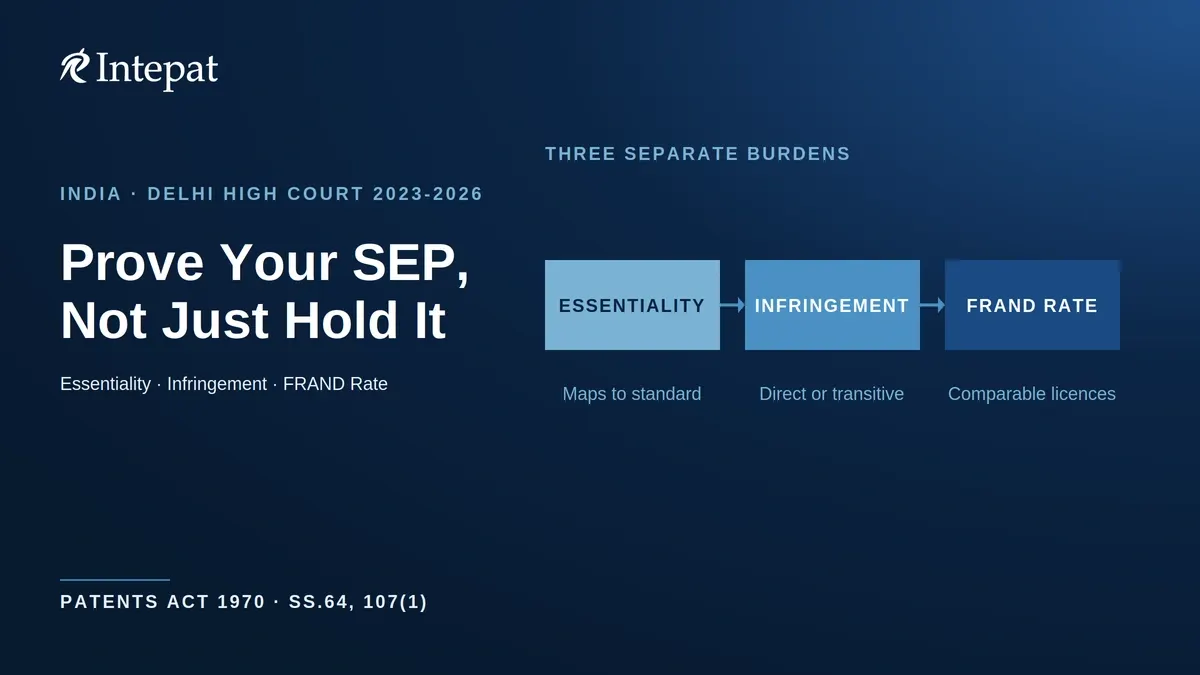
Standard essential patents are patents that cannot be avoided, on technical grounds, by anyone implementing a technical standard. In India, holding one is no longer enough to enforce it: Delhi High Court rulings between 2023 and 2026 have made essentiality, infringement and the fairness of the royalty three separate things a patentee must prove in evidence.
SEP litigation in India is concentrated in the Delhi High Court, and the position on FRAND licensing in India has moved a long way since 2023. One Division Bench, a two-judge appellate bench of the same court, has held that the Patents Act 1970 rather than the Competition Act 2002 governs how a patentee exercises its rights. Another has set aside a royalty decree standing since 2018. Between them sits a full-trial judgment that fixed a FRAND rate from comparable licences. The demands land on manufacturers, importers and assemblers of devices implementing cellular, Wi-Fi, audio and video standards.
Quick answer: An SEP holder suing in India must prove essentiality and infringement to establish liability, and the onus of showing that the rate it offers is fair, reasonable and non-discriminatory rests squarely on it. Clearing that hurdle does not guarantee the rate it asked for, because the Court may instead fix other FRAND terms. A declaration to a standard setting organisation proves none of this, and implementers can face deposit orders long before any of it is decided, on a sum measured partly against their own negotiating conduct.
What standard essential patents are, and what FRAND commits a holder to
A patent is standard essential when a technical standard cannot be implemented without infringing it. The ETSI IPR Policy puts the test on technical grounds alone: essentiality exists where it is not possible, on technical but not commercial grounds, to build compliant equipment without the patented invention.
The policy defines ESSENTIAL as meaning “that it is not possible on technical (but not commercial) grounds, taking into account normal technical practice and the state of the art generally available at the time of standardization, to make, sell, lease, otherwise dispose of, repair, use or operate EQUIPMENT or METHODS which comply with a STANDARD without infringing that IPR” (clause 15(6)). A cheaper or more popular route to compliance does not make a patent essential where a technically viable alternative exists. The clause adds one exception: where a standard can only be implemented by solutions all of which infringe IPRs, all of them are considered essential.
Membership carries a disclosure duty. Members must use reasonable endeavours to inform ETSI of essential IPR “in a timely fashion” (clause 4.1), a duty that expressly does not oblige them to conduct IPR searches (clause 4.2). The FRAND commitment works differently: where essential IPR is brought to ETSI’s attention, the Director-General must request the owner to give, within three months, “an irrevocable undertaking in writing that it is prepared to grant irrevocable licences on fair, reasonable and non-discriminatory (‘FRAND’) terms and conditions”, which may be made conditional on reciprocity (clause 6.1). That undertaking is what an implementer relies on.
So the declaration is not essentiality: a member self-assesses, with no duty to search, and nobody at ETSI adjudicates. As the Delhi High Court put it in 2026, “Standard Essential Patents are strange and complex creatures”, and establishing that a patent is an SEP “merely establishes that the plaintiff’s patent is an SEP. The aspect of infringement still remains.”
Essentiality has to be proved, not declared
Essentiality is a question of evidence, decided claim by claim against the text of the standard. The Delhi High Court requires complete mapping between the elements of the standard set by the standard setting organisation and the features of the patent as claimed. A self-declaration does not discharge that burden.
This is what defeated Philips in the DVD litigation, decided on appeal as Bansal v Philips. Philips had relied on essentiality certificates prepared by outside law firms for the corresponding US and European patents, and the Single Judge treated them as shifting the onus onto the defendants. The Division Bench worked through the chain Philips had to establish instead: that the DVD Forum was a standard setting organisation, what standards it had set, that the Indian patent was equivalent to its foreign counterparts, and that those counterparts were essential to those standards. The certificates were unsupported by the testimony of their authors, and no claim charts were on record. The decree was set aside on 18 May 2026.
Claim charts are the element-by-element tables that set each claim limitation beside the passage of the standard and the feature of the product said to meet it, and in an SEP case they belong in the plaint. Rule 3.A(ix) of the High Court of Delhi Rules Governing Patent Suits, 2022 provides that a plaint shall, to the extent possible, include “Precise claims versus product (or process) chart mapping or in the case of SEPs, claim chart mapping through standards”. Our note on claim mapping sets out how they are built.
Infringement: the direct test and the transitivity test
Proving essentiality does not prove infringement. Indian courts recognise two routes. The direct route compares the defendant’s product against the claims. The indirect route, available because the product complies with a standard, maps the patent onto the standard and the product onto the standard, and infers infringement.
The Division Bench in Intex Technologies v Ericsson described the indirect method as requiring proof of two steps: “[m]apping patentee’s patent to the standard to show that the patent is a Standard Essential Patent” and “[s]howing that the implementer’s device also maps to the standard” (paragraph 93). The Court called this “akin to the Law of Transitivity, i.e., if A=B and B=C, then A=C, where A= Patent ; B = Standard ; C = Defendant’s device” (paragraph 94).
The indirect route spares the patentee from reverse-engineering every accused handset, but collapses if either limb is unproved, as happened to Philips. The direct route has its own demands. In Ericsson v Lava the patentee produced test reports showing the accused devices met the standard, including optional portions of it, and the burden moved to Lava to show it used something else. It did not, and infringement was found. See our guide to patent infringement in India.
Validity is a fourth front, and it pays. Section 107(1) makes every ground of revocation under Section 64 available as a defence, and courts form a prima facie view on validity at the deposit stage, so the prior-art work has to be funded early. In Lava the revocation of one of the eight patents in suit cut the royalty by one eighth. Our note on patent revocation in India covers the grounds.
The FRAND rate is the patentee’s burden to prove
Fairness is not presumed from the fact of a FRAND undertaking. The Delhi High Court has stated the position plainly: “The onus to prove that the rate is FRAND is squarely on the plaintiff, and it is open to the defendant to contend otherwise.” That means producing the comparable licences relied on, in a form the defendant can test.
Philips failed on exactly this. The Division Bench’s own section heading records the finding: no evidence that rates offered were FRAND. The judgment holds that the Single Judge’s finding “is not supported by any evidence whatsoever”, and that “[n]ot a single agreement, with any third party, has been placed on record, even though PW-2 … deposed that he was in possession of such licences/agreements.” The same Bench was candid about the difficulty, observing that “[t]he entire exercise is so intimidating that it is doubtful whether any Court can arrive at a precise and accurate determination of FRAND rates”. Discharging the onus is not the same as securing the rate demanded: a court may compel a licence on the plaintiff’s terms “or at other FRAND terms as may be fixed by the Court”.
Ericsson v Lava shows the other outcome. Ericsson filed 54 third-party licence agreements in sealed cover (paragraph 27), which the Court held comparable because they were made with entities similarly placed to Lava. Eight patents were in suit and the Court revoked one, so it discounted Ericsson’s November 2015 offer by one eighth and arrived at 1.05 per cent of the net selling price of the device for 1 November 2011 to 8 May 2020. The decree was Rs 244,07,63,990 with interest at 5 per cent per annum from judgment, plus actual costs. Lava appealed, no stay was granted, and an interim arrangement was recorded on the basis of the licence fee Micromax had paid under an earlier settlement.
The royalty base: the whole device, or the part that practises the patent
The two judgments point in different directions on royalty base, and the difference is not a conflict. In Lava the Court declined to confine damages to a smallest saleable patent practising unit and calculated on the net selling price of the handset. In Bansal it held that royalty could not be worked out on the entire DVD player.
Lava concerned a portfolio of telecommunication SEPs, and one reason given for using the end device was evidential: in none of Ericsson’s comparable agreements did the counterparties pay on chipset value, so a chipset base had no support in the licences relied on. Damages also ran across the portfolio rather than only the asserted patents, on the footing that patent-by-patent licensing departs from how the industry contracts.
Bansal concerned one patent covering a decoding device inside a DVD player, and the Division Bench held that “[t]here is no question of Philips having been entitled to any royalty, for any item, other than, or in excess of, the decoding device.” Neither judgment lays down a single Indian rule on royalty base. The working rule is about proof rather than a preferred formula. A patentee who wants the end-product base needs comparable licences that use it; one asserting a single component patent with no licensing record should expect the base confined to the component that practises the invention. Our note on patent valuation methods covers the approaches.
Exhaustion under Section 107A(b) turns on who authorised the seller
Where an implementer imports a patented component from a seller authorised under the law to produce and sell or distribute it, that importation is not an infringement, and the patentee’s rights in the article imported may be exhausted. The provision is narrow: it reaches importation, and turns on the seller’s authority.
The wording matters, and it has changed. Section 107A(b) of the Patents Act 1970 now provides that “importation of patented products by any person from a person who is duly authorised under the law to produce and sell or distribute the product, shall not be considered as an infringement of patent rights.” As originally inserted with effect from 20 May 2003 it read “duly authorised by the patentee”. Section 58 of the Patents (Amendment) Act 2005 substituted the present words with effect from 1 January 2005, so the question is whether the seller is authorised under the law, not whether authority traces back to the patentee.
Bansal, a Division Bench decision, is the governing construction of the clause, and it decided the second issue in that appeal: the defence succeeded. The appellants had bought MediaTek chips through authorised distributors and assembled DVD players around them, and every player produced in court contained a MediaTek chip. Because those sales were authorised under the law of the country of export, the Division Bench held that Philips’ exclusivity in the suit patent stood extinguished by exhaustion in terms of Section 107A(b). Our analysis of the Bansal v Philips judgment takes that reasoning further.
For an implementer, the defence is only as good as the paper trail: purchase records, distributor authorisations and, where relevant, the licence position of the chipset supplier. Lava’s defence failed partly for want of that and partly because the Court held the suit patents read on the end device rather than the chipset alone.
Pro tem security: what an implementer may pay before trial
An implementer’s near-term exposure in India is often not the decree but the deposit ordered while the suit is pending. The Delhi High Court treats pro tem security as a temporary arrangement made without a detailed exploration of merits, and distinguishes it from an injunction because it does not stop manufacture or sale.
Applications are made under Order XXXIX of the Code of Civil Procedure or the Court’s inherent power under Section 151. The power is discretionary and the sums have been substantial. Verified as of August 2026.
| Case | Date | Anchor | Amount |
| Intex v Ericsson | 29 March 2023 | The royalty found due below | The entire royalty amount, not quantified in the order, within four weeks |
| Nokia v Oppo | 3 July 2023 | The last paid amount under an expired 2018 licence | 23 per cent of that amount, within four weeks (redacted in the official published text; the unredacted text of paragraph 103 gives it as USD 230,000,000) |
| Dolby v Lava | 10 July 2025 | Past sales, 2019 to 2024, at Dolby’s own offered rates | Rs 20,08,06,293.92 within eight weeks, then half-yearly deposits on continuing sales |
| Malikie v Xiaomi | 30 April 2026 | The mean of the parties’ second offer and counter-offer, at a 19.12 per cent Indian market share | Rs 272 crore |
| InterDigital v Transsion | 1 July 2026 | The defendants’ own last counter-offer | One fifth of it, within eight weeks |
A bank guarantee has been accepted in place of cash in several of these orders. Non-payment is no soft option: in Dolby the Court recorded that failure to deposit “would entitle Dolby to move an application before the Court for seeking an interim injunction/restraint order against Lava from selling any further devices in India which implement the suit patents”. Market access, not only cash, is in issue.
The merits are not set aside, but the threshold is lower. In InterDigital v Transsion the Court held that at this stage “only a prima facie understanding of whether the patents are essential and valid are to be considered”, below the threshold applied on an interim injunction application, and it took into account the Nokia v Oppo ratio that a deposit should ordinarily follow a prima facie finding on essentiality and validity, save where the challenge appears “merely an after thought”. Conduct does the rest of the work. In Nokia v Oppo the Court weighed the implementer’s status as an ex-licensee, its admission that its phones used the patents, its willingness to renew and to make interim payments, its resort to a foreign court for a FRAND determination, and its financial condition, and it rejected a four-fold merits test as the gateway to relief.
Two of those factors repay attention. Financial condition cuts both ways, though the Court says little about why. In Nokia v Oppo it listed “the financial condition of Oppo” among its reasons without elaborating; what was before it was Nokia’s submission, quoting Oppo’s own notes to accounts, that Oppo’s liabilities were significantly higher than its total assets. In InterDigital the defendants’ own claim of robust finances was turned around on them, the Court presuming they would have no qualms about depositing. And going abroad for a rate is not neutral. The Court held that Oppo’s Chinese FRAND suit was “a prima facie admission that Nokia does own Standard Essential Patents and that Oppo must necessarily license it against FRAND royalty payment”.
Negotiation conduct is therefore evidence. Hold-out, in the Delhi High Court’s words, “occurs if an implementer is able to implement a technical solution covered by a Standard Essential Patent without paying the reasonable market value for a licence”. Ericsson v Lava characterised the implementer as an unwilling licensee after four years of delayed responses and absent counter-offers, and the finding led the Court to take the upper end of the offered range and award actual costs. Intex records that the assessment is normally fact sensitive, and that FRAND imposes “mutual reciprocal obligations on both the Essential Patent holder and the implementer”.
Where the Competition Commission now stands
The route that produced India’s earliest SEP rulings is closed at the High Court level, for now. The Competition Commission of India ordered investigations into Ericsson’s royalty practices in November 2013 on Micromax’s information and in January 2014 on Intex’s, and a Division Bench quashed those proceedings on 13 July 2023.
The reasoning is that “Chapter XVI of the Patents Act is a complete code in itself on all issues pertaining to unreasonable conditions in agreements of licensing of patents, abuse of status as a patentee, inquiry in respect thereof and relief that is to be granted therefor” (paragraph 52), so that “the Patents Act must prevail over the Competition Act on the issue of exercise of rights by a patentee under the Patents Act” (paragraph 55). Section 21A, whether read alone or with Section 62, under which the Competition Act is “in addition to, and not in derogation of, the provisions of any other law”, was held not necessarily to empower the Commission to exercise powers the Controller would otherwise exercise under Chapter XVI.
The Supreme Court disposed of the Commission’s petitions in that matter on 2 September 2025 without deciding the question, recording that “[i]f there are any questions of law involved in this litigation, the same are kept open to be agitated in some other appropriate case.” That case has since arrived. On 2 February 2026 the Court issued notice in Competition Commission of India v Swapan Dey, Civil Appeal 519/2026, recording that “[w]e will be hearing the parties only on the issue of jurisdiction”. Treat the competition route as shut in Delhi but the question as live. The substance of the 2013 concern survives the change of forum: royalty pegged to handset price rather than to the patented component, illustrated by the Commission with the same chip in a Rs 100 phone and a Rs 1,000 phone, is now argued inside the patent suit as a challenge to the royalty base. Read our note on competition law and the patent pendulum alongside this.
What this means if you are on the receiving end of an SEP claim
Four questions decide an Indian SEP dispute. Three test the patentee’s case: has it produced claim charts mapping the patent onto the standard and the product onto the standard, can it produce comparable licences supporting its rate and base, and will its patents survive a revocation counterclaim? The fourth tests your record: can you evidence your authorisation chain?
The answers set the strategy. Where the mapping is thin, the defence is evidentiary and the case is worth contesting, as Bansal shows, though the Bansals waited seventeen years for that outcome. Where the mapping is sound and the portfolio is broadly licensed, as in Lava, the exposure is the rate and the base, and holding out is expensive.
Either way, the deposit question arrives first, well before final adjudication. It can be ordered on a prima facie view of essentiality and validity and before infringement is decided, and quantum has been measured against the implementer’s licence history, conduct and counter-offers rather than the strength of its defence. A counter-offer made early, in writing, with a rate, a base, a term and a scope, is among the conduct signals a court weighs most heavily. See our overview of patent licensing and, where pooled licensing is in issue, our note on patent pools in India.
Frequently Asked Questions
No. A declaration records the holder’s own assessment and its FRAND commitment; it does not adjudicate essentiality, and members are under no duty to search for essential IPR. Indian courts require complete mapping between the elements of the standard and the claimed features of the patent before treating it as standard essential.
Not on their own. In Bansal v Philips the certificates related to the corresponding US and European patents, their authors did not testify, and no claim charts mapping the patents onto the DVD standards were filed. The Division Bench set aside the decree that had rested on them, seventeen years after the suits began.
Injunctive relief remains available in principle, and the Delhi High Court’s patent suit rules allow monetary directions instead, in exceptional situations, once infringement is prima facie established. Failing to pay a deposit is itself a route to an injunction: in Dolby v Lava non-payment was made a ground for seeking a restraint on further sales.
Pro tem security is an interim deposit ordered mid-suit. It is not an injunction and does not stop manufacture or sale. Anchors have included a previous licence (23 per cent of the last paid amount in Nokia v Oppo), the implementer’s own counter-offer (one fifth in InterDigital), past sales (Dolby) and the entire royalty claimed (Intex).
It depends on what the evidence supports. In Ericsson v Lava the Court used the net selling price of the device, that is the sale price of the finished handset, because none of the comparable licences used chipset value. In Bansal, where a single patent covered a decoding device, the Court held no royalty was payable beyond that device.
Not on the Delhi High Court’s current view. A Division Bench quashed the Commission’s proceedings against Ericsson on 13 July 2023, holding that the Patents Act prevails on the exercise of a patentee’s rights. The Supreme Court is now hearing that jurisdictional question in a separate appeal, Civil Appeal 519/2026.
Acknowledge in writing, ask for claim charts mapping each asserted patent onto the standard and onto your product, and ask for the comparable licences behind the rate. Then make a counter-offer setting out a rate, a base, a term and a scope. Silence and delay can materially support a finding of unwillingness and the case for security.
It can, where the chips are imported and the supplier is duly authorised under the law to produce and sell or distribute them. Since 1 January 2005 Section 107A(b) asks whether the seller is authorised under the law, not whether the patentee authorised the sale. The defence still has to be proved on documents.
This article explains the position in India as at August 2026 and is for general information only. It is not legal advice. Laws, fees, and procedures change; verify the current position before you act. For advice on your specific matter, consult a qualified IP professional.