




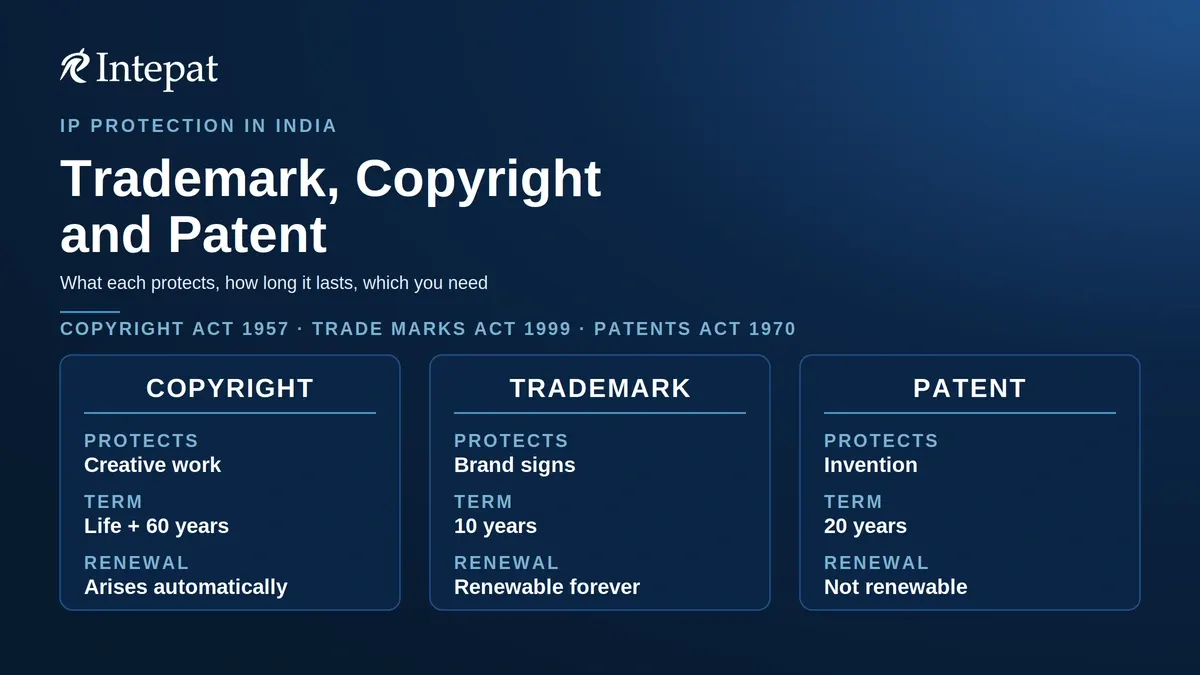
The difference between trademark, copyright and patent is what each one protects. Copyright covers original creative work such as writing, music, art and software. A trademark protects the brand signs that identify your goods or services, like a name or logo. A patent protects a new invention. Each is governed by a separate Act and lasts for a different period.
This article explains the three main intellectual property rights in India, sets them side by side, and helps you work out which one your work or product needs. It is limited to India: the Copyright Act 1957, the Trade Marks Act 1999 and the Patents Act 1970, with their respective Rules. The quick guide below points you to the usual right for what you are protecting.
| If you want to protect… | Usually consider… |
| A brand name, logo or tagline | Trademark |
| A book, content, photo, music or code | Copyright |
| A technical product or process | Patent |
| A product’s shape or visual appearance | Design registration |
What is copyright, and what does it protect?
Copyright protects the original expression of an idea, not the idea itself. Under the Copyright Act 1957, it subsists in original literary, dramatic, musical and artistic works, and in cinematograph films and sound recordings. Software code is treated as a literary work. What copyright does not protect is the underlying idea, method or factual information; two people can write about the same subject, and each owns the copyright in their own words.
Section 14 of the Act defines copyright as the exclusive right to do, or authorise others to do, certain acts: reproducing the work, issuing copies to the public, performing or communicating it to the public, making a film or sound recording of it, and translating or adapting it. These are the economic rights an owner can license or assign for value.
Separately, Section 57 gives the author moral rights that stay with the author even after the economic rights are sold. These are the right to claim authorship and the right to restrain distortion, mutilation or modification of the work that would harm the author’s honour or reputation. You can read more on moral rights under Indian copyright law in our dedicated guide.
Copyright in India arises automatically the moment a work is created in a fixed form. Registration is not mandatory. It is, however, useful: under Section 48 the entry in the Register of Copyrights is prima facie evidence of the particulars recorded, which helps in a dispute. The process is set out in our guide to copyright law in India, and the practical steps are covered in copyright registration procedure.
The term depends on the type of work. For literary, dramatic, musical and artistic works published in the author’s lifetime, copyright lasts for the author’s life plus sixty years, counted from the start of the year after the author dies (Section 22). For cinematograph films and sound recordings, the term is sixty years from publication (Sections 26 and 27). Photographs, once dealt with separately, were brought in line with artistic works by the 2012 amendment and now follow the life-plus-sixty rule.
What is a trademark, and what does it protect?
A trademark protects the signs that tell customers who is behind a product or service. It can be a name, a logo, a tagline, a shape, a colour combination or a sound, used to distinguish your goods or services from someone else’s. The protection attaches to the mark in connection with the specific goods or services it is registered for, not to the words or image in the abstract.
Trademarks are registered class by class. Under Rule 20 of the Trade Marks Rules 2017, goods and services are grouped into classes under the NICE Classification published by WIPO, and you register the mark for the classes that cover what you actually sell. Before filing, a trademark search checks whether an identical or similar mark already exists for those goods or services.
Registration matters because of what it unlocks. Under Section 28 of the Trade Marks Act 1999, registration gives the proprietor the exclusive right to use the mark for the registered goods or services and to sue for infringement. You are not obliged to register before using a mark, but Section 27 bars an infringement action for an unregistered mark; it preserves the separate remedy of passing off, which protects goodwill built through use. Prior continuous use can also count against a later registration: Section 34 saves the vested rights of someone who used the mark first.
Under Section 25 of the Act, registration lasts ten years and can be renewed every ten years without limit. This is the one feature that sets a trademark apart from the other two rights: kept renewed, it can last indefinitely, because a brand’s value does not expire the way a creative work or an invention eventually enters the public domain.
What is a patent, and what does it protect?
A patent protects a new invention: a product or a process. Section 2(1)(j) of the Patents Act 1970 defines an invention as a new product or process involving an inventive step and capable of industrial application. In plain terms, it must be new, it must be more than an obvious step for someone skilled in the field, and it must be capable of being made or used in industry. A patent does not protect an idea on its own, a discovery of something that already exists, or an artistic creation.
Section 48 sets out what a patent grants: the right to prevent others, without the patentee’s consent, from making, using, offering for sale, selling or importing the patented product, or from using a patented process. It is a right to exclude others, not a positive right to work the invention yourself, which may still depend on other approvals. Our guide to patent law in India covers the grant process in full.
A patent term is twenty years from the date of filing the application (Section 53), and it cannot be extended beyond that. For an application that enters the Indian national phase through the Patent Cooperation Treaty, the twenty years run from the international filing date. Annual renewal fees must be paid to keep a granted patent in force; if they lapse, the patent ceases. A patent is also territorial: an Indian patent protects the invention only in India, so protection in other countries needs separate filings there.
Two timing points matter at the start. First, file before you disclose: a public disclosure before filing can defeat novelty. Second, if you are not ready to file the full technical detail, a provisional application secures an early date and gives you up to twelve months to file the complete specification (Section 9), and you can run a patent search in India before you commit. Miss the twelve-month window and the application is treated as abandoned.
Trademark vs copyright vs patent: side by side
The table below sets out the core differences. The figures are statutory and current as of May 2026.
| Criteria | Copyright | Trademark | Patent |
| Governing law | Copyright Act 1957 | Trade Marks Act 1999 | Patents Act 1970 |
| What it protects | Original creative work: writing, music, art, films, sound recordings, software | Brand signs: name, logo, tagline, shape, colour, sound | A new invention: product or process |
| Registration | Optional; copyright arises automatically on creation | Not mandatory to use a mark, but a statutory infringement action needs registration | Required; granted only after examination |
| Unregistered protection | Yes, arises automatically | Passing off may be available; an infringement action needs registration | No patent rights unless granted |
| Term | Authored works: life plus 60 years. Films and sound recordings: 60 years from publication | 10 years | 20 years from filing (from the international filing date for PCT national-phase applications) |
| Renewal | Not renewable; enters the public domain after the term | Renewable every 10 years, indefinitely | Annual renewal fees during the term; not extendable beyond 20 years |
| Scope | Protects expression, not the idea | Protects the mark for the registered goods or services | Right to exclude others from the invention in India |
Can the same logo, product or software have more than one?
Yes, and this is the point a simple comparison can hide. The three rights protect different things, so a single asset often attracts more than one of them at the same time. The practical question is rarely which one to choose; it is which combination your asset needs.
A logo is the clearest example. The artwork in a logo is an original artistic work, so copyright arises in it automatically. The same logo, used to identify your goods or services, is also a trademark. Protecting it as a registered trademark gives you brand rights that copyright alone does not, while the underlying artwork keeps its copyright.
One caution on logos and other commissioned artwork: where the work is made by an employee, a freelancer or an agency, who owns the copyright depends on the contract and the first-ownership rules in Section 17, so the assignment should be checked before you rely on owning it.
Software shows the same overlap from a different angle. The source code is protected by copyright as a literary work the moment it is written. A genuinely technical method the software performs may be patentable, but only if it satisfies the Patents Act and is not merely a computer program per se, an algorithm, a business method or a presentation of information, which Sections 3(k) and 3(n) exclude. The product name and app icon are trademark territory. The shape or visual design of a physical product is a separate matter again, protected by industrial design registration rather than by any of these three.
So the right way to read the differences is not as a menu of alternatives. Map your asset to the rights it can hold, and protect each layer that has value to you.
Which protection does your work or product need?
Start from what you have made, then ask where its value sits. Four questions usually settle it.
Is the value in a brand identifier? A name, logo or tagline customers recognise is trademark territory. A direct-to-consumer brand name, for example, is a trademark.
Is the value in creative expression? Writing, website text, product photographs, music or software code are protected by copyright from the moment they are created, and registration adds evidence if you expect a dispute.
Is the value in a technical solution? A machine, device, chemical composition or manufacturing process is patent territory, and the inventive detail should stay confidential until you have filed.
Is the value in the visual appearance of an article? The shape or look of a product or its packaging is protected by design registration, not by any of the three rights above.
Many businesses answer yes to more than one. A startup might register its brand as a trademark, hold copyright in its marketing material and code, and file a patent on its core technology. The differences matter precisely so that you protect each part of what you own under the right one, rather than assuming a single registration covers everything.
Common mistakes when choosing between these rights
- Assuming copyright protects a brand name. A name used to identify goods or services is a trademark, not a copyright work.
- Assuming a trademark protects the technology in a product. Technical function is the job of a patent.
- Disclosing an invention publicly before filing a patent, which can defeat novelty.
- Registering copyright in a logo but never filing it as a trademark, leaving the brand identifier unprotected.
- Overlooking design registration for a product’s shape or appearance.
- Assuming an Indian registration protects the asset worldwide; each right is territorial and needs separate protection abroad.
| Not sure which you need? Speak to an IP attorney about protecting your brand, content, software or invention. |
| Get advice |
Frequently asked questions
What is the difference between trademark, copyright and patent?
A trademark protects brand signs like names and logos under the Trade Marks Act 1999. Copyright protects original creative work such as writing, music and art under the Copyright Act 1957. A patent protects a new invention under the Patents Act 1970. Each covers a different subject and lasts a different period.
Do I need to register copyright in India?
No. Copyright arises automatically when an original work is created in a fixed form, so registration is not mandatory under the Copyright Act 1957. Registration is still useful because, under Section 48, the entry in the Register of Copyrights is prima facie evidence of ownership in a dispute.
How long does each right last?
Copyright in authored works lasts the author’s life plus sixty years; for films and sound recordings it is sixty years from publication. A trademark lasts ten years and is renewable indefinitely. A patent lasts twenty years from the date of filing and cannot be extended.
Can copyright protect a brand name?
No. A brand name that identifies goods or services is protected as a trademark under the Trade Marks Act 1999, not by copyright. Copyright protects creative expression such as text, art, music or code, not a name used as a commercial identifier of source.
Can a trademark protect an invention?
No. A trademark protects the brand signs that identify goods or services. A new product or process is protected by a patent under the Patents Act 1970, provided it meets the novelty, inventive step and industrial-application tests in Section 2(1)(j).
Can I protect an app’s name, icon and code separately?
Yes. The app name and icon can be registered as trademarks, the source code is protected by copyright as a literary work, and a genuinely technical method may be patentable, subject to the exclusions in Sections 3(k) and 3(n) of the Patents Act 1970.
When should I file a patent before disclosing my invention?
Before any public disclosure. A disclosure before filing can defeat novelty, so the application, at least a provisional one under Section 9 of the Patents Act 1970, should be filed before you pitch, publish or display the invention.
Can the same thing be protected by more than one IP right?
Yes. A logo is both an artistic work protected by copyright and a trademark when used to identify goods or services. Software code is copyright, while a technical method may be patentable subject to statutory limits. The rights protect different aspects, so they can apply together.
Is a patent valid in other countries?
No. A patent is territorial, so an Indian patent protects the invention only in India under Section 48 of the Patents Act 1970. Protection in other countries requires separate applications filed in each of them, within the timelines those systems allow.
Disclaimer: This article is general information on Indian intellectual property law and is not legal advice. The position of any specific work, brand or invention depends on its facts. For advice on protecting yours, consult a qualified IP practitioner.