




The First Examination Report (FER) is the Indian Patent Office’s formal examination output issued under Section 14 of the Patents Act, 1970, setting out every objection to grant, the prior art cited, and the statutory deadline for the applicant’s response.
Receiving the First Examination Report is the most consequential stage of Indian patent prosecution after filing. The report identifies the objections raised by the Patent Office and starts a strict statutory clock for the applicant to respond.
Many applicants misinterpret the examination report as a rejection. It is not. The FER is an opportunity to respond, amend claims where necessary, and place the application in condition for grant. A properly structured FER response filed under Rule 24B can resolve all objections without the need for a hearing. However, leaving objections unaddressed, introducing new matter, or missing the statutory response deadline can result in the application being treated as abandoned.
This guide explains the First Examination Report in India, the objections typically raised by the Patent Office, the statutory response timelines, and how applicants should structure an effective FER response. For the examination lifecycle leading up to report issuance, see: Patent Examination in India: Procedure, Timelines and Key Deadlines (2025).
FER Deadlines and Key Milestones: India 2024–2025
| Milestone / Deadline | Ordinary Examination | Expedited Examination |
| FER issuance from RFE (current practice) | 12–24 months or more | 1–3 months |
| Initial FER response deadline | 6 months from FER issue date | 6 months from FER issue date |
| Maximum response window (with extension) | 9 months from FER issue date | 9 months from FER issue date |
| Form 4 extension request window (Rule 24B(6)) | Any time between month 6 and month 9 | Any time between month 6 and month 9 |
| Form 3 FER-triggered deadline | 3 months from FER date (extendable 3 months under Rule 12(5)) | 3 months from FER date (extendable 3 months under Rule 12(5)) |
| SER (if objections remain) | Issued after FER response; respond within original 9-month window | Same |
| Hearing notice period | Minimum 10 days (Rule 129) | Minimum 10 days (Rule 129) |
| Written submissions after hearing | Within 15 days of hearing date | Within 15 days of hearing date |
Practical timelines reflect current IPO conditions and may vary. Statutory deadlines are fixed.
What Triggers the First Examination Report in India
The examination report does not issue automatically. Under Section 14 of the Patents Act, 1970 (Indian Patent Office official portal), the Controller issues it only after four conditions are met. First, a valid Request for Examination (RFE) has been filed on Form 18 or Form 18A. Second, the Controller has assigned the application to an examiner under Section 12. Third, the examiner has completed the prior art investigation under Section 13. Fourth, the Controller has reviewed that examiner’s report.
Under the Patents (Amendment) Rules, 2024, the report must issue within 1 month of the Controller receiving the examiner’s findings (Rule 24B(3)). The practical gap between RFE and report issuance is substantially longer: 12 to 24 months or more on the ordinary route; 1 to 3 months on the expedited route under Rule 24C. For expedited examination eligibility, see: Expedited Patent Examination in India (Rule 24C).
Practical Note A successful response and grant do not close the door to challenge. The patent can still be the subject of patent opposition proceedings in India before grant (Section 25(1)), after grant (Section 25(2)), or revocation proceedings. Build the strongest possible prosecution record from the first response onwards.
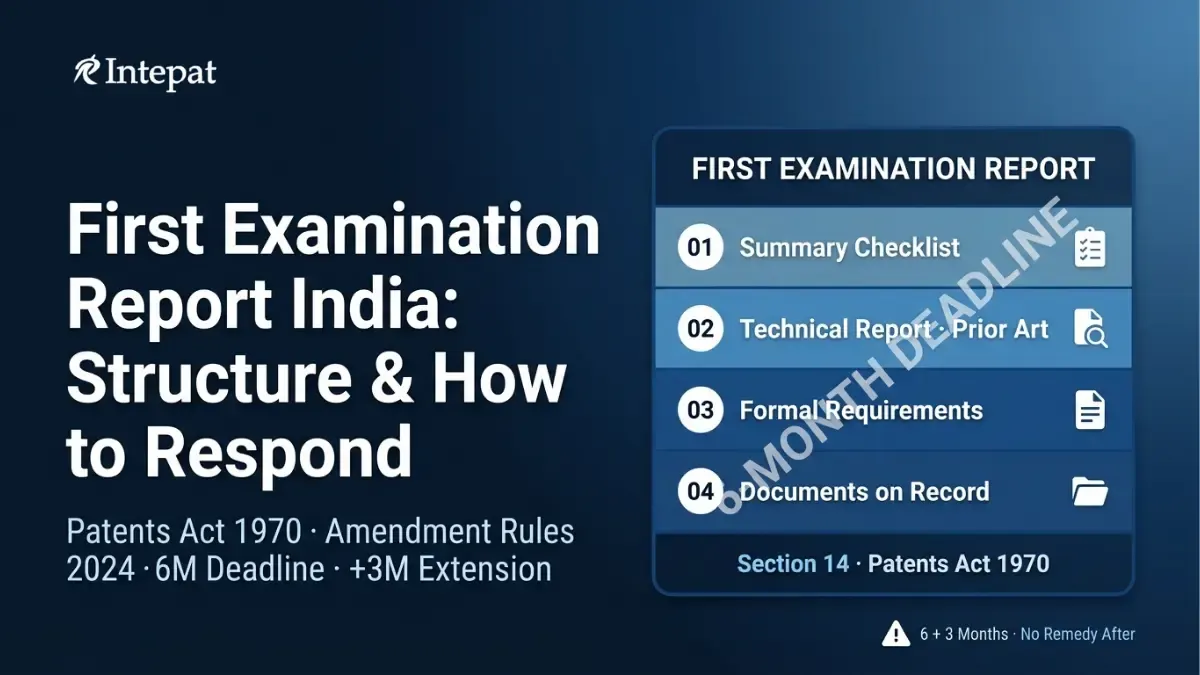
The Four-Part Structure of the FER
| # | Part | What It Contains | What to Do With It |
| 1 | Summary Checklist | Pass/fail on all nine patentability and compliance criteria | List every adverse criterion. These define your response scope |
| 2 | Detailed Technical Report | Cited prior art (D1, D2…); reasons for each adverse finding; Section 13 search results | Read each citation in full; map each document to the claim(s) it is cited against |
| 3 | Formal Requirements | Outstanding forms, fee deficiencies, specification/drawing corrections | Comply in full. No argument available on formal objections |
| 4 | Documents on Record | All documents on file; FER issue date; last date for response | Record the FER issue date; calculate 6-month and 9-month deadlines immediately |
Part 1: Summary Checklist
Nine criteria must be satisfied for grant. Every criterion marked adverse must be addressed in the response. One unanswered finding is enough to prevent grant. The nine criteria are: novelty (Section 2(1)(l)); inventive step (Section 2(1)(ja)); industrial applicability (Section 2(1)(ac)); non-patentability under Section 3; non-patentability under Section 4; unity of invention (Section 10(5)); sufficiency of disclosure (Section 10(4)(a)(b)); clarity and support of claims (Section 10(4)(c)); and reference to foreign applications (Section 8).
Part 2: Detailed Technical Report
Part 2 contains the list of cited prior art (D1, D2, D3…) and the examiner’s detailed observations on each adverse finding. Every citation is linked by code to the claims it is cited against. The response must engage each citation by its code. Do not rely on the examiner’s characterisation: retrieve and read the full text of every cited document before drafting any argument or amendment.
Parts 3 and 4: Formal Requirements and Documents on Record
Part 3 lists formal compliance issues (pending forms, fee shortfalls, specification and drawing corrections). No argument is available; every item requires full compliance. Part 4 lists all documents on file and states the last date for filing the response. Record the issue date from Part 4 immediately and calculate both the 6-month and 9-month deadlines from that date.
Types of Patent Objections in the Indian FER
Indian patent objections in the examination report fall across seven categories. The response approach differs significantly between each: novelty and inventive step require distinct arguments; Section 3 objections require specialist handling; formal objections require compliance, not argument.
| Objection Type | Statutory Basis | What Triggers It | Response Approach |
| Lack of novelty | Section 2(1)(l) | Single prior art document discloses every element of a claim | Argue distinguishing features; amend claims where specification supports |
| Lack of inventive step | Section 2(1)(ja) | Claimed invention obvious over cited prior art (alone or combined) | Argue technical advance or economic significance; combine with claim amendments |
| Lack of industrial applicability | Section 2(1)(ac) | Invention not shown usable in any industry | Provide working examples; direct examiner to existing specification disclosure |
| Non-patentable subject matter | Section 3 (3(b), 3(d), 3(e), 3(k)) | Claimed subject matter falls within Section 3 exclusions | Specialist handling required; see Section 3(k) and 3(d) guides |
| Insufficiency / lack of clarity | Section 10(4)(a)(b)(c) | Specification incomplete, claims unclear, or unsupported by description | Amend under Section 59 (see Section 5.3); must not introduce new matter |
| Unity of invention | Section 10(5) / Rule 13 | Application claims more than one invention without technical link | Elect invention to prosecute; file divisional under Section 16 |
| Formal / procedural | Various Rules | Missing forms, fee deficiency, drawings non-compliant | Comply in full; no argument available |
Novelty Objections (Section 2(1)(l))
A combination of documents cannot ground a novelty objection. The examiner must identify a single document disclosing each and every feature of the claim. The response requires either a technical argument that the cited document does not disclose one or more claim features, or an amendment narrowing the claim to include a feature absent from that document. Any such amendment must be supported by the original specification. For the novelty standard under Indian patent law, see: Novelty under Indian Patent Law: Section 2(1)(l) and Prior Art Standards.
Inventive Step Objections (Section 2(1)(ja))
Under Section 2(1)(ja), the examiner may combine multiple prior art documents to argue obviousness. The response must establish that the technical advance is non-obvious, that the proposed combination would not have been made by a person skilled in the art, or that the combination still does not arrive at the claimed invention. For inventive step analysis under Indian patent law, see: Inventive Step in Indian Patents.
Section 3 Non-Patentability Objections
Section 3 objections require a fundamentally different approach from prior art responses. The sub-clauses most commonly raised are 3(b), 3(d), 3(e), and 3(k). Dedicated response guides for Section 3(d) and Section 3(k) are in preparation. For the complete list of exclusions, see: What Cannot Be Patented in India: Section 3 Exclusions Explained.
How to Read an Indian FER: Triage Before You Draft
Work through these steps before drafting a single argument. A structured triage is the foundation of every successful FER response India practitioners file.
- Record the issue date and calculate all deadlines: 6-month initial, 9-month outer, and 3-month Form 3 deadline. Diarise all three immediately.
- Read the Summary Checklist: List every adverse criterion. Every one must be resolved.
- Separate formal from substantive: Part 3 requires compliance; Part 2 requires technical argument and possibly amendments. Handle each independently.
- Retrieve and read all cited prior art in full: Do not rely on the examiner’s summary. Build a citation-to-claim map before writing a single argument.
- Assess amendment options under Section 59: For each claim under objection, identify whether a limiting amendment exists in the original specification. Flag complex objections for hearing consideration now, not after an unsuccessful response.
Drafting the FER Response: Structure and Requirements
The response is a formal legal document filed on the InPASS portal. It must cover every objection and put the application in order for grant within the 9-month window. Track the application and confirm filing dates on InPASS: How to Check Indian Patent Application Status on InPASS.
Structure of the Response
A complete response contains three components. First, written arguments addressing each substantive objection by citation code (D1, D2…). Second, amended claims filed on Form 13 with a claim amendment chart showing the specification basis for each change, where amendments are required. Third, full compliance with every Part 3 formal objection.
Written Arguments
Arguments must engage directly with the examiner’s reasoning in Part 2. For novelty: identify the specific claim feature absent from the cited document and reference the relevant passage. For inventive step: establish that the technical advance is non-obvious, that the combination would not have been made by a person skilled in the art, or that the combination does not arrive at the claimed invention. In practice, economic significance arguments under Section 2(1)(ja) are most effective when combined with technical advance arguments. Arguments and amendments combined are typically more persuasive than either alone.
Claim Amendments Under Section 59
Section 59 permits amendments only by way of disclaimer, correction, or explanation. Every proposed amendment must be traceable to specific language in the original specification. The key constraints:
| Permitted Under Section 59 | Barred Under Section 59 |
| Narrowing claim scope by adding limitations disclosed in original specification | Adding subject matter not present in original specification as filed |
| Correcting obvious errors or inconsistencies within original disclosure | Broadening claim scope beyond original claims |
| Clarifying language where original meaning is supported by specification | Introducing new examples, embodiments, or features not originally filed |
| Deleting claims or dependent claim references | Combining features from description and drawings unless explicitly disclosed as a combination |
Practical Note In practice, the Controller applies the new matter bar under Section 59 strictly at both examination and opposition stages. Pre-grant amendments are assessed more flexibly than post-grant, but any amendment introducing a feature without clear textual support in the original specification will be refused. Every proposed amendment must survive the question: is there verbatim or clearly equivalent support in the original specification text?
Formal Objections and the Form 3 FER Trigger
Every Part 3 formal objection requires full compliance. No argument is available. The most critical recurring issue is the Form 3 obligation triggered by examination: under Section 8(1) read with Rule 12(2) as amended 2024, an updated Form 3 is due within 3 months of the report date. This is extendable by 3 months under Rule 12(5) on a Form 4 request. This deadline runs independently of the response deadline and must be diarised separately. For the Section 8 disclosure framework, see: Statement and Undertaking Under Section 8 of the Patents Act.
The FER Response Window: Deadlines and Extensions
- Initial deadline: 6 months from the report issue date (Rule 24B(5)). This is the target, not the fallback. Every FER deadline India applicants face under Rule 24B(5) is calculated from this date.
- Maximum outer deadline: 9 months from the issue date. A 3-month extension is available by filing Form 4 under Rule 24B(6) at any time before expiry of the 3-month extension period itself. These deadlines apply under the Patents (Amendment) Rules, 2024, effective 15 March 2024.
WARNING: No remedy after 9 months Rules 24B(5) and (6) are expressly excluded from Rule 137(2) condonation under the Patents (Amendment) Rules, 2024. If no complete response is filed within 9 months of the report date, the application is at risk of abandonment with no retrospective remedy. Verify current rule text at the Indian Patent Office official portal. The Form 4 extension under Rule 24B(6) is a prospective power. It must be requested before the 3-month extension period itself expires. Once the 9-month window closes, no remedy exists. File within the 6-month initial window. Use the extension period only where complex objections require it, not as default practice.
The Subsequent Examination Report (SER)
An SER may issue if outstanding objections remain after the written response. It is not a separate examination. It continues the same 9-month cycle from the original report date. The SER does not reset the response clock. A late examination response may leave only days before the outer deadline closes. File within the 6-month initial window as default practice.
Practical Note In practice, an SER is more common where the initial response makes substantive amendments without full written arguments, or where arguments address only some of the cited prior art. Address every citation in the first response.
Requesting a Hearing on Your Indian FER
A hearing under Section 14 is most useful where substantive objections involve complex technical or legal arguments, Section 3 objections have been raised, or an SER indicates key objections remain unresolved after the written response. A hearing is not automatic. The applicant must request it within the response window. The Controller must give at least 10 days’ notice (Rule 129). Written submissions must be filed within 15 days of the hearing date. Hearings may be conducted by video conference on request, which is particularly relevant for foreign applicants.
WARNING: Non-attendance Non-attendance at a scheduled hearing without advance notice of postponement can result in refusal under Section 15 without the applicant having been heard.
Common Pitfalls in Responding to an Indian Patent Examination Report
Pitfall 1: Treating the Examination Report as a Final Rejection
The examination report is not a rejection. An applicant who allows the 9-month response window to expire without filing loses the application permanently. Rules 24B(5) and (6) are excluded from Rule 137 condonation. The only recourse is a new application with a later priority date and no guarantee against intervening prior art.
Pitfall 2: Introducing New Matter in Claim Amendments
The most common substantive error is an amendment incorporating a feature from drawings or description without verifying explicit textual support in the specification. Where the Controller refuses an amendment on new matter grounds and the applicant does not correct it within the 9-month window, the application may be refused.
Pitfall 3: Missing the Form 3 Trigger and the Divisional Window
Two independent deadlines are frequently missed. First, the Form 3 obligation under Rule 12(2) is due within 3 months of the report date (extendable under Rule 12(5)) and must be diarised separately from the response deadline. The Section 8 disclosure framework is covered in the Statement and Undertaking guide on intepat.com. Second, where a unity objection is raised, divisional applications under Section 16 must be filed before the parent is granted or refused. There is no mechanism to extend this window after the fact.
Pitfall 4: Filing Late and Leaving No Room for an SER
Filing the response late in the 9-month window leaves no time to address an SER if one issues. File within the 6-month initial window as default practice, not the exception.
FER Response Checklist
| # | Action Item | Governing Provision |
| 1 | Record the FER issue date; calculate the 6-month and 9-month deadlines | Rule 24B(5) |
| 2 | Diarise the Form 3 deadline separately. 3 months from FER date | Section 8(1); Rule 12(2) as amended 2024 |
| 3 | Read the Summary Checklist. List every adverse finding | Section 14; FER Part 1 |
| 4 | Retrieve and read every cited prior art document in full | Section 13 |
| 5 | Separate formal objections (Part 3) from substantive objections (Part 2) | Various Rules |
| 6 | Verify each proposed amendment is traceable to specific language in the original specification | Section 59 |
| 7 | Draft written arguments for each substantive objection separately | Sections 2(1)(l), 2(1)(ja), 3 |
| 8 | Address every formal objection in full. No partial compliance | Patents Rules (various) |
| 9 | File updated Form 3 within 3 months of FER date (or request extension under Rule 12(5)) | Rule 12(2) triggering; Rule 12(5) extension |
| 10 | If extension needed: file Form 4 under Rule 24B(6) before expiry of the 3-month extension period. Do not wait until month 9. | Rule 24B(6) |
| 11 | If unity objection raised: decide on divisional strategy before parent is granted or refused | Section 16 |
| 12 | If complex objections remain: request a hearing within the response window | Section 14; Rule 129 |
| 13 | File complete response well within the 9-month outer deadline | Rule 24B(5)/(6) |
Full FER Response Timeline: India
| Stage | Event | Statutory Trigger / Deadline | Form(s) |
| 1 | FER issued by Controller | Within 1 month of receiving examiner’s report (Rule 24B(3)) | N/A |
| 2 | Form 3: FER-triggered update | Within 3 months of FER date; extendable 3 months under Rule 12(5) | Form 3 |
| 3 | FER response: initial deadline | 6 months from FER date (Rule 24B(5)) | Form 13 (if amendments) |
| 4 | Form 4 extension request (if needed) | Any time between month 6 and month 9 from FER date (Rule 24B(6)) | Form 4 under Rule 24B(6) |
| 5 | FER response: maximum outer deadline | 9 months from FER date (Rule 24B(5)/(6)) | N/A |
| 6 | SER issued (if objections remain) | After reviewing FER response; within 9-month window | N/A |
| 7 | SER response | Within remaining time in 9-month window from original FER date | Form 13 (if amendments) |
| 8 | Hearing (if requested) | Minimum 10 days’ notice (Rule 129); written submissions within 15 days | Form 13; written submissions |
| 9 | Grant or refusal under Section 15 | After all requirements met or after hearing | Letters Patent issued |
Responding to an Indian FER: What Determines the Outcome
The First Examination Report is the central document in Indian patent prosecution. The key disciplines are these: read every cited prior art document in full before drafting; cover every objection in a single complete response; verify every claim amendment against the original specification; and file within the 6-month initial window, treating the 9-month outer deadline as a safety margin, not a target.
The Patents (Amendment) Rules, 2024 tightened every FER deadline India applicants face. A structured FER response India practitioners build on the disciplines above resolves most objections in the first round. Once the patent is granted, annual renewal fees are payable from the third year; estimate them using the Patent Renewal Fees Calculator. For prosecution support, see our Patent Prosecution Services. For official fee estimates, use our Patent Fee Calculator.
Get Help With Your FER Response
Share your examination report, application number, and technology area for a preliminary response strategy review. Our team responds within 24 hours
All consultations remain 100% confidential.
LEGAL DISCLAIMER This post is for informational purposes only and does not constitute legal advice. For advice specific to your situation, consult a registered patent agent. Laws and procedures may change: verify current requirements with the Indian Patent Office (ipindia.gov.in) before acting. The content reflects the Patents Act, 1970 and Patents Rules, 2003 as amended by the Patents (Amendment) Rules, 2024.
FER India: Frequently Asked Questions
6 months from the report issue date under Rule 24B(5). A 3-month extension is available by filing Form 4 under Rule 24B(6) before expiry of that 3-month extension period itself, giving a maximum of 9 months. Rules 24B(5) and (6) are excluded from Rule 137 condonation. No retrospective remedy exists after 9 months.
The application is at risk of abandonment under Section 21 of the Patents Act. The Form 4 extension under Rule 24B(6) is a prospective remedy only. It must be requested before the extension period itself expires and cannot be invoked retrospectively. The only recourse is to file a new application with a later priority date, which loses the commercial window the original priority date protected.
No. Section 59 of the Patents Act expressly prohibits any amendment that broadens claim scope beyond the original application as filed. Pre-grant amendments are restricted to disclaimers, corrections, and explanations that narrow or clarify.
A Subsequent Examination Report (SER) may issue. The SER must be responded to within whatever time remains in the 9-month window from the original report date. It does not create a new deadline. Request a hearing under Section 14 where the written response alone is unlikely to resolve the objections. For the full examination lifecycle, see: Patent Examination in India: Procedure, Timelines and Key Deadlines (2025).
The Controller issues an SER after reviewing the response where outstanding objections remain. It follows the same four-part structure as the examination report and must be addressed within the remaining time in the original 9-month window. SERs are relatively uncommon but must be treated with urgency, as remaining response time may be short.
3 months from the report issue date under Section 8(1) read with Rule 12(2) as amended 2024. Extension of up to 3 months is available under Rule 12(5) on Form 4 request. This deadline runs independently of the response deadline and must be diarised separately. Missing it can impede prosecution and provide grounds for pre-grant opposition.
The applicant must elect one invention to prosecute in the current application. Non-elected inventions can only be protected through divisional applications under Section 16, filed before the parent is granted or refused. There is no mechanism to extend this window. A unity objection should immediately trigger a divisional strategy assessment in parallel with the examination response.
Yes. Hearings under Section 14 may be conducted by video conference on request. This is particularly useful for foreign applicants where attendance at the relevant branch (Delhi, Mumbai, Chennai, or Kolkata) is impractical. Request video conference at the time of requesting the hearing or in the written response.
The applicant may cite additional prior art to support arguments. However, applicant-cited prior art can cut both ways. It may reveal further objections or complicate the examiner’s analysis. Only cite additional prior art where it unambiguously supports the response.