




Your patent claim must draw a clear line around what you protect, so anyone in your field can see where the monopoly ends. A claim too vague or broader than what your specification describes can be refused by the Indian Patent Office, opposed by competitors, or revoked under Section 10(5) of the Patents Act 1970.
What this actually means for you
Think of your patent claim as a fence around your invention. The fence has to be tall enough to keep competitors out of the space you have actually built, and it has to be planted on ground your specification clearly shows you own. If the fence sags into the public space (too broad) or runs across ground you never described (no support), it will not hold up.
That single picture explains why the law asks three things of every patent claim.
Clear. Someone working in your industry, reading the claim with your specification next to it, should be able to point at any product or process and say whether it falls inside the claim or outside. If the answer is “it depends on what you mean by ‘strong’”, the claim is not clear enough.
Brief and well organised. A claim that is padded with sub-clauses, optional features, and overlapping alternatives forces the examiner (and a future judge) to hunt for what you actually invented. Tight claims survive examination; sprawling claims invite objections.
Backed by your specification. Whatever you claim has to trace back to something the specification actually shows. If your description gives one working example of one method, you cannot then write a claim that covers ten methods you never showed. This is the rule that catches the broadest applications.
Here is the most common version of the problem in practice:
| What you wrote | What survives examination |
| “A strong polymer layer disposed on the substrate.” | “A polymer layer having a tensile strength of 50 to 80 MPa disposed on the substrate.” |
The first leaves “strong” for the reader to interpret. The second sets a number the specification can support. If you swap one for the other early enough, the fix is straightforward; if you wait, your options narrow. The drafting craft side, where you train yourself to spot these patterns before the examiner does, is covered in our companion piece on clarity and conciseness of patent claims.
Where this comes up: from drafting to revocation
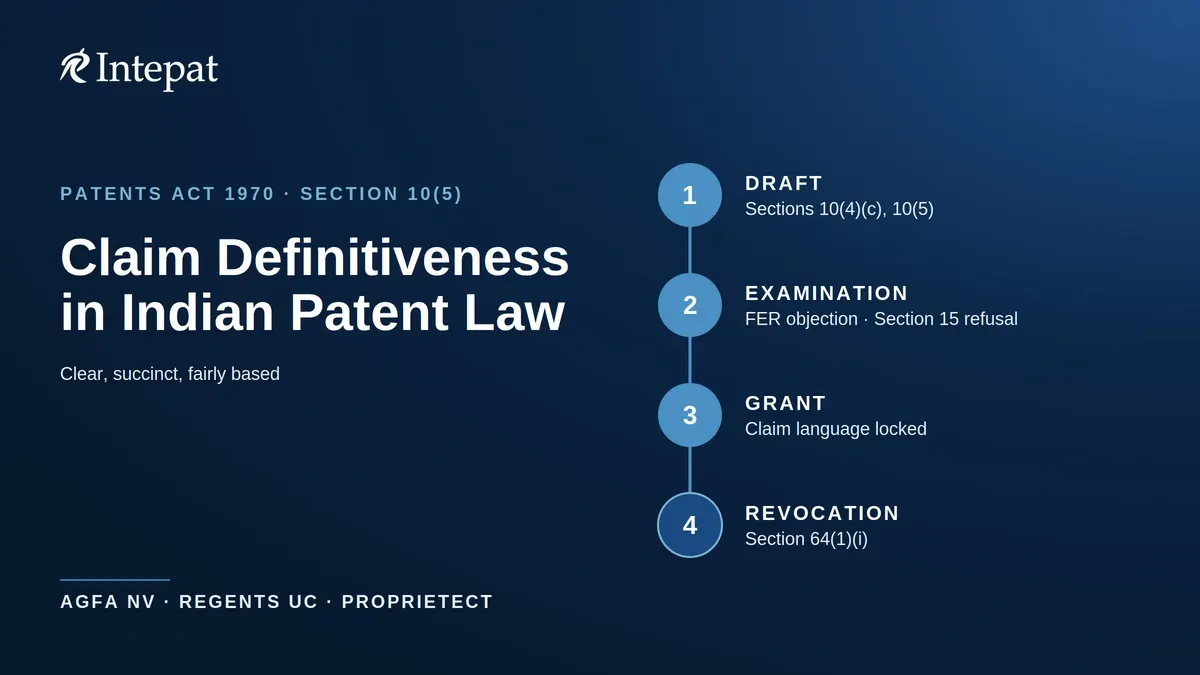
The same standard you write to in your specification is the standard a Controller, an opponent, or a revocation petitioner will use to test your patent later. The table below shows the four places it bites and what happens if your claim fails the test.
| Stage | Statutory provision | What can happen |
| Drafting and examination | Sections 10(4)(c) and 10(5) | Objection in your First Examination Report; refusal under Section 15 if you cannot fix it. |
| Pre-grant or post-grant opposition | Section 25(1)(g); Section 25(2)(g) | Used by a competitor in opposition proceedings; usually pleaded alongside other grounds. |
| Revocation: claim too vague or too broad | Section 64(1)(i) | Standalone ground for revoking your granted patent; this is the main post-grant attack. |
| Revocation: specification too thin | Section 64(1)(h) | Description-focused ground; commonly pleaded with the one above. |
The simple takeaway: the test does not stop at examination. The same clarity and fair-basis standard will resurface for years after grant, and once you are in revocation proceedings the cost of fixing a sloppy claim climbs sharply.
What recent court rulings mean for you
Most of the recent guidance on indefinite claims comes from the Delhi High Court’s Commercial Patents bench. Three rulings change how the Indian Patent Office and applicants should behave.
In AGFA NV v. Assistant Controller, the Delhi High Court reversed a refusal that called terms like “thermosetting resin” vague. Those words are routine to a person working in the laminate industry, the Court said, and the claim is read for that audience. If you receive an examination objection that just says your claim “lacks clarity” without naming the vague term and explaining why it is vague to a person in your field, you have a strong reply.
In The Regents of the University of California v. Controller of Patents, the Court did the opposite: it upheld a refusal where the applicant claimed combinations of mutations across multiple Salmonella strains but had given working examples for only one combination in one strain. The lesson is straightforward. The breadth of your claim has to match the breadth of what your specification actually shows. If it does not, you cannot rescue the claim later by argument alone.
In Proprietect L.P. v. Controller of Patents, the Court set aside a refusal because the examiner raised a clarity objection for the first time in the final refusal order, without flagging it in the examination report or the hearing notice. If a fresh objection appears at the eleventh hour, you can challenge it on procedure before arguing the merits.
The older Bombay High Court case Press Metal Corporation v. Noshir Sorabji Pochkhanawalla remains good law on its core point: a patentee owes a duty to state the claim clearly. The newer Delhi rulings build the modern framework around that older principle.
Four things that get flagged at the Patent Office
The Manual of Patent Office Practice and Procedure, together with what examiners do in practice, throws up the same four patterns again and again.
Speculative words. Words like “thin,” “strong,” “a major part,” “such as,” “when required,” and “any” leave the reader guessing. They can sometimes stand if your industry treats them as definite in context, but the burden is on you to show that. Best to avoid them.
Omnibus claims. A claim that reads “the apparatus substantially as herein described and illustrated in the drawings” has no legal basis in India. The Indian Patent Office treats omnibus claims as non-definitive and they are deleted at examination.
Too many alternatives. A claim packed with Markush groups, ranges, and optional features can look clean on the page but defeat both a proper search and the boundary the claim is supposed to draw. If your claim has dozens of permutations that you have not all shown in the specification, expect an objection.
Dependent claim drift. Dependent claims that change or substitute a feature of the independent claim break the logical chain. A reader should be able to compute the scope of every claim by reading claim 1 first; if your dependent claims pull in a different direction, the structure of your claim set is broken.
How to fix it: amendments and limits
A clarity or fair-basis objection during examination is often, but not always, fixable. The route is Section 59 of the Patents Act, which lets you amend your specification by disclaimer, correction, or explanation. Two limits matter: you cannot add subject matter that was not in substance disclosed in the original specification, and the amended claim cannot fall outside the scope of an original claim. Inside that corridor, the usual fixes are routine. You can swap a speculative adjective for a numerical range that your specification already gives, delete an omnibus claim, or re-anchor a stray dependent claim to claim 1.
Where the claim genuinely outruns the specification, the cure runs out. If your specification supports only deletion mutations in one strain but your claim covers insertions, deletions, and substitutions across six strains, no permitted amendment will save you. That is the lesson Regents drives home.
After grant, the picture changes. A competitor can attack your patent in revocation proceedings, and the burden then falls on you to defend both the claim language and any narrowing amendment you offer as a fix. The same claim that breezed through examination because nobody pushed back can fall years later when an opponent reads it carefully through the lens of claim construction and a person skilled in the art.
The cheapest place to fix a definitiveness problem is your draftsman’s chair, before you file. The next cheapest is your first response to the examination report. Everything after that costs more, in time, in fees, and in litigation risk.
FAQ
What does Section 10(5) of the Patents Act 1970 require?
Section 10(5) says the claims of a complete specification must relate to a single invention, must be clear and succinct, and must be fairly based on what the specification actually discloses. In practice, it is the test the examiner uses to check that your claim draws a workable boundary around your invention.
Is “definitiveness” a term used in the Patents Act 1970?
No. The Patents Act 1970 does not use the word “definitiveness.” It is the everyday shorthand practitioners (and the Manual of Patent Office Practice and Procedure at paragraph 05.03.17(v)) use for the same idea: your claim must let a reader in the field see where the monopoly ends.
Can the examiner raise a new clarity objection for the first time in the refusal order?
No. In Proprietect L.P. v. Controller of Patents, the Delhi High Court set aside a refusal where the Section 10(5) objection appeared for the first time in the final order. The examiner must put you on notice in the examination report or hearing notice so you have a chance to address it.
Can I amend an indefinite claim in India?
Yes, within limits. Section 59 of the Patents Act 1970 allows amendment by disclaimer, correction, or explanation, and only for the purpose of incorporating actual fact. You cannot add subject matter that was not in substance disclosed in the original specification, and your amended claim cannot fall outside the scope of an original claim. Most routine fixes (swapping a speculative adjective for a disclosed range, for example) fit easily inside this corridor.
What is the revocation risk under Section 64(1)(i) after grant?
Section 64(1)(i) of the Patents Act 1970 gives any person interested a standalone ground for revocation where a claim’s scope is not sufficiently and clearly defined, or where the claim is not fairly based on the disclosure. The case is heard by the High Court, and once you are in revocation you carry the burden of defending both the claim and any narrowing amendment you propose.
What is an omnibus claim and why is it not allowed in India?
An omnibus claim is one that references the description and drawings instead of specifying the technical features, typically reading “the apparatus substantially as herein described.” The Manual of Patent Office Practice and Procedure at paragraph 05.03.17(v) records that such claims have no legal basis under the Patents Act and cannot be allowed under Section 10(4)(c) because they fail to define the scope of the invention.
Strengthen your patent claims
Have a registered Indian Patent Agent review claim language before you file or before you respond to a clarity objection.