




| Quick answer |
| A negative PCT written opinion is not binding on the Indian Patent Office, but in practice ISR prior art citations often reappear in the First Examination Report (FER). IPO examiners also draw on the corresponding US or EP prosecution file and conduct their own independent search. An Article 19 amendment narrowing the claims before national phase entry often reduces the likelihood of the same ISR objection being re-argued in identical form, though the examiner may still raise fresh objections or rely on additional prior art. However, a written opinion that is silent on patentability does not protect against Section 3(d) or Section 3(k) objections in the FER, which are field-dependent and triggered by Indian domestic law, not PCT standards. |
This article reflects Indian patent law and PCT procedure as at April 2026, including the Patents (Amendment) Rules, 2024 (effective 15 March 2024). It is for general informational purposes only. Readers should seek specific legal advice based on their factual situation.
What a Negative PCT Written Opinion Actually Means for Your India Filing
The written opinion of the International Searching Authority (WO/ISA) carries a formal status that practitioners sometimes misread in both directions. It is non-binding on the Indian Patent Office as a designated office under the PCT. The Indian Patent Office conducts its own examination under Section 12 of the Patents Act, 1970, and the examiner is not required to adopt, defer to, or even acknowledge the ISA’s conclusions on novelty or inventive step.
That is the formal position. The practical position is different. The ISR and written opinion represent the first rigorous prior art assessment of the claims as filed. The IPO examiner assigned to the application when the First Examination Report (FER) is being prepared will have access to the published international application file, which includes the ISR and written opinion as part of the public record. In our experience, the same prior art documents cited in the ISR often reappear in the FER.
What a negative written opinion signals, therefore, is not that India prosecution will be difficult, but that the FER objections are largely predictable. Reading the ISR and written opinion before national phase entry allows the FER response strategy to be prepared in advance rather than constructed under the six-month deadline.
How IPO Examiners Use ISR Findings When Drafting the FER
Understanding how the examiner approaches the prior art question is the starting point for any PCT national phase prosecution plan for India. The examiner’s prior art sources are not limited to the ISR. In practice, three distinct sources appear in Indian FERs on PCT national phase applications.
First, the examiner draws on the ISR citations directly. X and Y category citations are most likely to reappear in the FER, applied against the claims under Section 2(1)(j) and Section 2(1)(ja) of the Patents Act, rather than the Article 33 PCT standards applied by the ISA.
Second, the examiner draws on the corresponding priority application’s prosecution file. Where the same application was examined before the USPTO or the European Patent Office before the PCT application was filed, the examiner may in some cases cite prior art that was raised in those proceedings, even if that prior art did not appear in the ISR. Corresponding prosecution records are publicly accessible.
Third, the examiner conducts independent research. The FER may therefore cite documents that appear in neither the ISR nor any corresponding application file. A clean ISR does not guarantee a clean FER.
| Practitioner note |
| Pre-entry planning for India should therefore cover not only the ISR but also the prosecution records of any corresponding US, EP, or other priority applications, as citations overcome elsewhere may resurface under Indian patentability standards. |
Once the FER is issued, the applicant has six months from the date of issuance to file a response under Rule 24B(5) of the Patents Rules, 2003. This period is extendable by three months under Rule 24B(6) on a Form 4 request with the prescribed fee. The FER response deadline cannot be extended retrospectively once missed, and under the Patents (Amendment) Rules, 2024, the Form 3 statement under Section 8 of the Patents Act must be updated within three months from the date of the FER.
Practitioners advising on FER response strategy for PCT applications should understand the full Indian examination lifecycle before layering in the PCT-specific variables. The examination procedure in detail, including subsequent examination reports and the hearing stage, is set out in Intepat’s guide to patent examination procedure in India.
Why Your ISA Choice Changes India Prosecution Risk
Practitioners advising on Indian national phase prosecution should factor ISA identity into their strategy, as the authority that conducted the international search affects how the FER reads.
Where the European Patent Office acted as ISA, the written opinion will typically be detailed and technically substantive. EPO examiners identify close prior art and explain their reasoning in depth. The result, from an India prosecution standpoint, is that the prior art the IPO examiner sees in the ISR is likely to be genuinely close to the claims. An EPO-negative written opinion is a credible signal of what the FER will contain, and the response strategy needs to be substantive from the outset.
Where the Indian Patent Office itself acted as ISA, the search framework and prior art coverage will differ from those applied by the EPO or USPTO. The FER may cite documents that were not identified in the ISR, including art sourced from the examiner’s independent research, regardless of which ISA conducted the international search. A positive written opinion from any ISA does not eliminate the need to review the prior art landscape independently before national phase entry in India.
There is a separate procedural consequence to ISA designation that matters for prosecution speed rather than prosecution difficulty. Applicants whose corresponding PCT application indicated India as the competent International Searching Authority or elected India as the International Preliminary Examining Authority qualify for expedited examination under Rule 24C of the Patents Rules, 2003. Under current IPO conditions, the expedited queue typically delivers an FER significantly faster than the ordinary route in most cases, though timelines vary depending on workload and subject matter. The eligibility criteria and filing requirements are covered in Intepat’s guide to expedited patent examination in India. If the ISA designation has this consequence, it should be factored into the national phase entry plan at the time of filing Form 18A, not discovered after the examination request has been filed.
Section 3 Objections: What the Written Opinion Cannot Warn You About
The most significant gap between the written opinion and the FER in Indian prosecution is not prior art. It is the application of Section 3 of the Patents Act, 1970.
The ISA applies Article 33 of the PCT, which covers novelty, inventive step, and industrial applicability but has no equivalent for the subject matter exclusions under Section 3 of the Indian Patents Act. A written opinion that finds the claims patentable under Article 33 has said nothing about Section 3.
Section 3(d) is the most frequently encountered of these exclusions for pharmaceutical applicants. It excludes the mere discovery of a new form of a known substance that does not result in enhancement of the known efficacy of that substance, along with salts, esters, polymorphs, metabolites, and other specified derivatives. An application covering a pharmaceutical formulation or a new salt form may receive a written opinion with no patentability objection and then receive an FER raising a Section 3(d) objection that requires a substantive efficacy argument. The written opinion provides no warning because the ISA is not applying Indian domestic law.
Section 3(k) poses a comparable challenge for software and computer-implemented inventions. The provision excludes a mathematical or business method, a computer programme per se, or algorithms. Where the claims are directed to a technical method implemented in software, the FER may raise a Section 3(k) objection regardless of whether the written opinion found the claims inventive. The examiner applies the Controller General’s Guidelines for Examination of Computer Related Inventions and the relevant High Court case law, not the EPO’s technical effect doctrine or the USPTO’s subject matter eligibility analysis.
The practical consequence is field-specific rather than universal. Pharmaceutical applicants with formulation or derivative claims, and software applicants with method or system claims, should assess Section 3 as a real procedural risk in the India FER, independent of what the written opinion said. Where the technology and claim type make a Section 3 objection plausible, preparing the response before the FER arrives is more efficient than addressing it reactively.
Pre-Entry Options When the PCT Written Opinion Is Negative
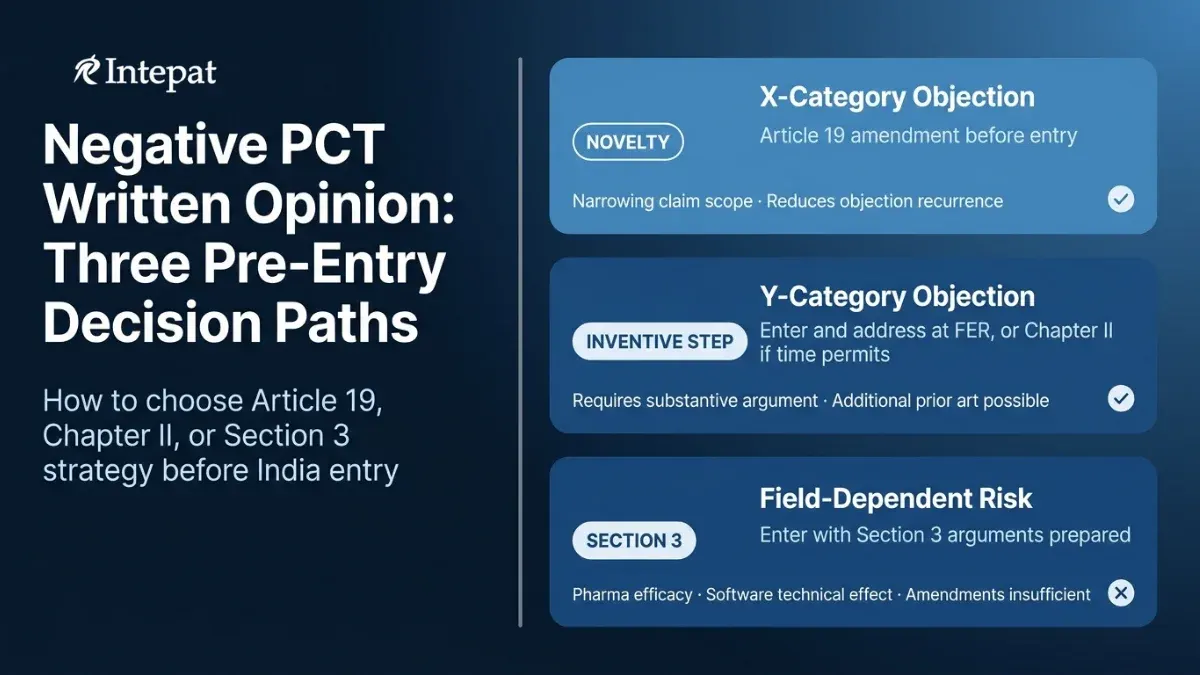
Three courses of action are available after a negative written opinion and before national phase entry in India. The decision between them depends on the type of objection raised, the available prior art room, and the timeline.
| Objection type | Pre-entry option | India-specific consideration |
| Novelty (X category citation, beatable by narrowing) | Article 19 amendment before national phase entry | In our experience, narrowing often reduces the likelihood of the same objection being re-argued in identical form; no binding examination affecting the Indian national phase occurs at the international stage |
| Inventive step (Y citations in combination, requires argument and possible amendment) | Enter and address at FER, or file Chapter II demand if deadline not yet passed | Chapter II demand generates an IPRP that the IPO examiner can see; upstream strategy covered separately |
| Section 3(d) or 3(k) risk (not in WO, field-dependent) | Enter with Section 3-specific arguments prepared | pre-entry amendments alone do not eliminate a Section 3 objection; India-specific argumentation at the FER response stage remains necessary |
Any narrowing strategy must remain within the scope of the original disclosure, as post-entry amendments are constrained by Section 59 of the Patents Act, 1970 in the same way. Article 19 amendments, covering claims only, can be filed with the International Bureau within the later of two months from transmittal of the ISR and written opinion or sixteen months from the priority date. The mechanics, deadlines, and scope of Article 19 and Article 34 amendments are set out in Intepat’s article on PCT amendments. The India-specific point is that where claims are narrowed by an Article 19 amendment, Section 138(6) of the Patents Act, 1970 provides that such amendments, if the applicant so desires, shall be taken as amendments made before the patent office. The narrowed claims therefore enter the Indian national phase file as the operative claim set.
Applicants who filed a Chapter II demand before the later of three months from transmittal of the ISR and written opinion or 22 months from the priority date have already engaged with the written opinion at the international stage and enter India with an International Preliminary Report on Patentability rather than a bare WO. The strategy for those applicants is addressed in Intepat’s PCT Chapter II demand strategy guide. Where the Chapter II deadline has passed and the prior art objection is substantive, the remaining option is to address it at the FER stage in India, without the benefit of a pre-entry international examination round. Where the written opinion identifies an X-category reference that destroys the core inventive concept and no fallback embodiment is disclosed, national phase entry in India may not be commercially rational. That assessment is best made before entry costs are incurred, not after the FER repeats the same objection.
Building the FER Response for a Negative-WO Application
National phase entry in India for a PCT application follows the procedure set out in the PCT Applicant’s Guide (India, valid from January 1, 2026) and the relevant provisions of the Patents Act and the Patents Rules, 2003 as amended. The national phase requirements including Form 1, the claims fee, Form 5 (declaration of inventorship), and the Section 8 undertaking on Form 3 are covered in detail in Intepat’s PCT national phase entry guide for India.
For an application arriving in the Indian national phase with a negative written opinion, two prosecution decisions compound the entry formalities and need to be made before the FER arrives.
First, any claim amendments made during the international phase, whether under Article 19 or Article 34, need to be confirmed at national phase entry as the operative claim set. The claims fee under Rule 7 of the Patents Rules is calculated on the claim count as filed at entry, including Article 19 amendments, under Section 142(3) of the Patents Act. An incorrect claim count at entry creates a fee deficiency that can obstruct prosecution.
Second, the Form 3 obligation under Section 8 of the Patents Act requires the applicant to disclose corresponding applications filed outside India. Under the Patents (Amendment) Rules, 2024, the second Form 3 update is now due within three months from the date of issuance of the FER, not on a rolling basis. This change is frequently missed by foreign applicants. Where amendments were made during foreign prosecution after the PCT filing date, or where prior art arguments in a corresponding application differ materially from positions taken in India, the Section 8 exposure is heightened and the Form 3 update becomes a substantive rather than a purely formal obligation. Missing this deadline exposes the application to a Section 8 compliance challenge.
Claim amendments after national phase entry but before grant are governed by Section 59 of the Patents Act, which permits amendments that narrow the scope of the claims or correct the disclosure but prohibits any amendment that broadens scope or introduces new matter. The full scope of permissible amendments at the national phase stage is addressed in Intepat’s article on PCT national phase amendments in India.
For a negative-WO application where the prior art objection has been narrowed by an Article 19 amendment before entry, the FER response covers three points: confirm that the amendment resolves the ISR citation, provide claim support from the original specification, and address any new citations the examiner has sourced independently.
Where the prior art objection was not resolved before entry, the FER response requires substantive arguments on novelty or inventive step, or claim amendments within the scope permitted by Section 59. For pharmaceutical and software applicants who anticipate a Section 3 objection, the FER response needs to be built in parallel: the Section 3 argument, whether directed to technical effect for a software claim or to enhanced efficacy for a pharmaceutical claim, requires different materials and a different argument structure from the prior art response.
Frequently Asked Questions
Not automatically. A positive written opinion is not binding on the IPO examiner, who conducts an independent examination under Section 12 of the Patents Act, 1970. The examiner may cite prior art not identified in the ISR, including documents sourced from corresponding priority applications or from independent research. A positive WO is a useful data point and may support prosecution arguments at the FER stage, but it does not substitute for substantive examination in India.
Yes. An applicant may amend the claims, specification, or drawings at any time before grant under Section 57 read with Section 59 of the Patents Act, provided the amendment does not exceed the scope of the application as filed. A formal amendment request is made on Form 13 with the prescribed fee under Rule 81 of the Patents Rules. Amendments submitted before the FER is issued may reduce the scope of examination. However, proactive amendment before the FER is less common in Indian practice than responding to the FER once issued.
If the X-category citation is directly anticipatory and the narrowing move is available within the original disclosure, filing an Article 19 amendment before national phase entry is generally the more efficient path. In our observation, narrowing often reduces the likelihood of the same objection being re-argued in identical form, which can reduce one examination round from the India prosecution timeline, though the examiner may still raise fresh objections or additional prior art. Whether the narrowed claim set is acceptable across other designated offices needs to be assessed separately, as Article 19 amendments apply globally once filed.
No. The ISA applies Article 33 of the PCT, which has no equivalent for Section 3(d) of the Indian Patents Act. A written opinion that does not raise a patentability objection under Article 33 has not assessed the claims against the Section 3(d) exclusion, which is a domestic Indian law standard. For pharmaceutical formulations, new salt forms, polymorphs, and derivative compounds, a Section 3(d) objection in the FER is a real procedural risk regardless of what the written opinion said. Efficacy evidence and technical arguments supporting enhanced efficacy should be identified and prepared before the FER arrives.
Once the Chapter II demand deadline has passed (the later of three months from transmittal of the ISR and written opinion or 22 months from the priority date), international preliminary examination is no longer available. The full range of national phase prosecution options remains open: Article 19 amendments filed before 16 months from priority are still available if that deadline has not passed; claim amendments at national phase entry and at the FER response stage under Section 59 are available; and substantive arguments on novelty, inventive step, and Section 3 can be made in the FER response. The available options in the national phase after a Chapter II deadline has been missed are addressed in Intepat’s PCT national phase entry guide for India.
This article reflects the Patents Act, 1970, the Patents Rules, 2003, and the Patents (Amendment) Rules, 2024 as at April 2026. PCT procedure references the WIPO PCT Applicant’s Guide (India), valid from January 1, 2026. Readers should seek specific legal advice based on their factual situation.