




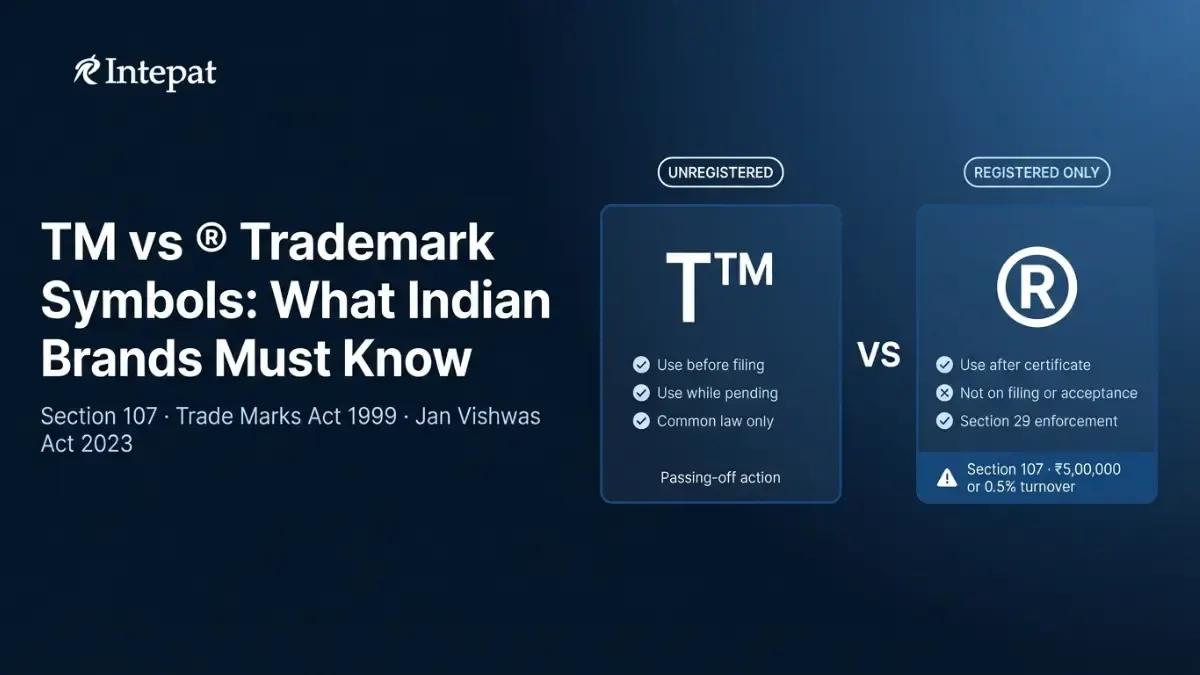
The primary difference between TM and R symbol in India is registration status, which determines the nature and enforceability of rights. ™ can be used by any brand owner at any stage (before filing, after filing, or while the application is pending) and does not confer statutory rights under the Trade Marks Act, 1999. ® can only be used after the CGPDTM issues a registration certificate. Using ® before that point makes the person liable to a civil monetary penalty under Section 107.
| Quick Answer |
| ™ (TM): Any brand owner can use this symbol at any stage: before filing, after filing, or while the application is pending. It does not confer statutory rights under the Trade Marks Act, 1999; protection arises only through passing-off under common law. |
| ® (Registered): This symbol can only be used after the Office of the Controller General of Patents, Designs and Trade Marks (CGPDTM) has issued a registration certificate and the mark is entered in the Register of Trade Marks. Using it before that point makes the business liable to a civil monetary penalty. |
| The legal rule: Misusing ® attracts a civil monetary penalty under Section 107, Trade Marks Act, 1999 (as amended by the Jan Vishwas (Amendment of Provisions) Act, 2023, effective 1 August 2024). The penalty is 0.5% of total annual turnover or gross receipts, as computed in audited accounts, or ₹5,00,000, whichever is less. |
Walk through any Indian marketplace, physical or digital, and you will see ™ and ® attached to brand names, logos, and product packaging. Most people treat them as interchangeable decoration. They are not. Each symbol carries a specific legal meaning under the Trade Marks Act, 1999, and using the wrong one at the wrong time carries consequences that range from weakened enforcement rights to a civil monetary penalty. This article explains what each trademark symbol means in India, when you can legally use each one, and exactly what Section 107 says about misuse, including the penalty figure often misstated in secondary sources, which changed from a criminal provision carrying imprisonment of up to three years to a civil monetary penalty when the Jan Vishwas (Amendment of Provisions) Act, 2023 came into force on 1 August 2024.
What Are Trademark Symbols — and Why Do They Carry Legal Weight in India?
Trademark symbols are superscript characters placed alongside a brand name, logo, or slogan to signal the legal status of that mark. In India, two symbols matter for trademark purposes: ™, which indicates an unregistered trademark claim, and ®, which indicates a mark that has been officially registered under the Trade Marks Act, 1999. A third symbol, ℠ (service mark), exists in US practice but has no formal standing under Indian law; in India, both goods and services use ™ before registration.
The Trade Marks Act, 1999 is entirely silent on ™. The Act does not define it, does not require its use, and attaches no statutory consequence to it. This means using ™ is a matter of commercial practice and common law positioning, not statutory obligation. The ® symbol is a different matter entirely. Section 107 of the Act treats any representation (through a symbol, word, or sign) that implies a mark is registered in India as a legally significant act. If that representation is false, the person may be liable to a civil monetary penalty. The distinction between the two symbols is therefore not cosmetic. ™ represents a public claim; ® indicates registered statutory status.
Indian businesses and startups frequently discover this distinction only after a dispute arises: either when they find they cannot enforce their ™-marked brand against a copycat, or when they realise they have been using ® on packaging before their registration certificate arrived. Both situations are avoidable, and both follow from the same root misunderstanding of what each symbol actually permits.
TM Symbol Meaning — What It Signals and When You Can Use It
Standing for “trademark,” ™ placed next to a brand name, logo, or slogan is a public declaration that the owner considers that mark to be their intellectual property and intends to assert rights over it. Under Indian law, no registration is required before using ™. No application needs to be pending. The symbol can be used from the moment a brand is adopted for commercial use, and it can continue to be used after registration, though replacing it with ® after the certificate arrives is commercially and legally advisable.
The ™ symbol serves three practical purposes. First, it puts the market on notice that the owner is asserting rights over the mark, and this can support an argument of awareness or prior assertion of rights if a passing-off dispute arises later. Second, it can help establish the date from which commercial use of the mark began, which matters in disputes over prior use. Third, it signals to potential copycats that the owner is paying attention to the mark and is likely to defend it.
What ™ does not do is equally important. It does not confer statutory rights under the Trade Marks Act, 1999; protection arises only through passing-off under common law. In plain terms, this means that if a third party copies your ™-marked brand, you cannot sue them for trademark infringement; that right exists only for registered marks. Your remedy is a passing-off action, which requires proving three things independently: that your mark has acquired goodwill and reputation in the relevant market, that the third party’s use constitutes a misrepresentation, and that you have suffered or are likely to suffer damage. Passing-off actions are slower, more expensive, and harder to win than infringement suits. The ™ symbol helps set up the groundwork for such an action, but it is not a substitute for the protection that the ® symbol represents.
A practical note on timing: the moment a trademark application is filed with the CGPDTM, using ™ if it has not already been adopted signals not just commercial use but pending registration. Many founders delay this and lose the deterrent value of the notice during what is often the most commercially active early period of a brand’s life. Several Indian startups in their early growth stages used ™ alongside their brand names before their marks were formally registered; the symbol placed the market on notice while registration was in progress. If you are still weighing whether to file, understanding what types of trademarks qualify for registration in India is a useful starting point.
Registered Trademark Symbol ® — What It Means and When It Becomes Available
Placed alongside a brand name, ® signals that a trademark has been officially registered with the Office of the Controller General of Patents, Designs and Trade Marks (CGPDTM) and entered in the Register of Trade Marks maintained under the Trade Marks Act, 1999. It is the highest-grade trademark signal available in India. When a consumer, competitor, or court sees ® alongside a brand name, the legal implication is that the owner holds a registered mark and has the full suite of statutory enforcement rights that registration confers.
The trigger for using ® is precise and non-negotiable: the trademark registration certificate must have been issued by the CGPDTM. Filing or acceptance does not confer registration status. The registration process in India moves through several stages: filing (day one), examination and issuance of the Examination Report if objections arise (indicative timeframe: 3 to 6 months, though actual timelines vary depending on Registry workload and objections), response and acceptance (a further 3 to 6 months), advertisement in the Trade Marks Journal, a four-month opposition window, and finally registration and certificate issuance. End to end, the process typically ranges between 12 and 36 months. The ® symbol cannot be used at any earlier stage. The certificate is the trigger. Nothing before it qualifies.
Where no opposition is filed during the four-month window, or where opposition has been filed and resolved in your favour, the CGPDTM issues the trademark registration certificate electronically through the IP India portal. You can check your current application stage at any point; the trademark application status guide for India explains what each status means and what happens next. When the status changes to ‘Registered’ and the certificate is available for download, ® becomes available to use. Not before.
Once ® is legitimately available, the legal advantages are substantial. Registration creates prima facie evidence of ownership and validity across India; you do not need to prove goodwill or prior use in every jurisdiction where the mark is used. An infringement action under Section 29 of the Trade Marks Act, 1999 is available without proving the extensive factual record that a passing-off action demands. The registered proprietor can also record the trademark with Customs under the Intellectual Property Rights (Imported Goods) Enforcement Rules, 2007 to enable border enforcement against infringing imports, license the mark with greater legal certainty, and use the registration as a foundation for international filings under the Madrid Protocol; the full filing-to-certificate journey is covered in the trademark registration process guide for India.
Well-known Indian registered marks such as Amul, Tata and Infosys carry ® precisely because registration gives their owners nationwide statutory enforcement rights that ™ cannot provide. Using ™ after registration is not illegal, but it signals a weaker position than you actually hold; replacing it with ® is commercially and legally advisable the moment the certificate arrives. Starting that process early, ideally before your brand enters the market, gives you the strongest position for using ® once registration is granted; Intepat’s trademark registration service covers the full process from availability search through to that certificate.
Difference Between TM and R Symbol — Legal Rights Compared
Choosing between TM and R symbol in India is not just a question of registration status; it is a question of the quality and enforceability of the legal rights attached to each. The table below sets out the key distinctions across the dimensions that matter most to a business owner or in-house IP manager.
| ™ (TM Symbol) | ® (Registered Trademark Symbol) | |
| What it signals | A trademark claim — registered or not | Officially registered; legally protected |
| Registration required | No — usable before filing, after filing, or while pending | Yes — only after CGPDTM issues registration certificate |
| Statutory basis | Not defined in the Trade Marks Act, 1999; governed by common law | Trade Marks Act, 1999; mark entered in Register of Trade Marks |
| Legal protection | Common law only — passing-off action, limited to geographic area of use | Nationwide statutory protection, subject to validity of registration; infringement suit under Section 29 |
| Enforcement route | Passing-off action; must prove prior use, goodwill, and misrepresentation | Direct infringement action; registration is prima facie evidence of ownership |
| Penalty for misuse | No specific statutory penalty, but misuse may have evidentiary or passing-off implications | Civil monetary penalty under Section 107 — see Section 107 Penalty section below |
| Who can use it | Any person or entity claiming brand ownership | Registered proprietor and authorised users/licensees, for goods/services covered by the registration |
The practical consequence of this difference becomes most visible in enforcement. A business relying on ™ and bringing a passing-off action must gather and present evidence of actual market goodwill, customer recognition, and the defendant’s misrepresentation, a process that can take years and significant legal expense. A business using ® and bringing an infringement action under Section 29 starts with a registration certificate as prima facie evidence of ownership. The evidentiary burden shifts more favourably towards the registered proprietor from the outset. Registration, and the ® symbol that accompanies it, is not a bureaucratic formality. These two legal positions cannot be treated as equivalent.
One misconception worth addressing directly: some Indian businesses use ™ and ® simultaneously, placing both symbols next to their brand name. Once registration is granted and the certificate issued, ™ should be replaced with ®. Using both together sends a contradictory signal about the mark’s registration status and may weaken the owner’s position if the correct status of the mark is ever in dispute. For a fuller picture of what an unregistered trademark can and cannot protect in India, the comparison of unregistered vs registered trademarks covers the passing-off threshold in detail.
Using ® Without Registration in India — The Section 107 Penalty
Section 107, Trade Marks Act, 1999 (as amended by the Jan Vishwas (Amendment of Provisions) Act, 2023) is the civil penalty provision that governs false representation of trademark registration. It prohibits any person from representing a mark as registered in India when it is not. The section is broader than many businesses realise. It covers not just using the ® symbol on an unregistered mark, but any word, expression, sign, or symbol that refers, expressly or impliedly, to registration in India. Writing “Registered” next to a brand name, using “Regd.” as a suffix, or using any formulation that implies the mark has been entered in the Register of Trade Marks all fall within the scope of Section 107, regardless of whether the ® symbol itself is used.
What Are the Three Situations Section 107 Covers?
Section 107(1) describes three specific situations in which a false representation of registration arises. Understanding all three matters because the second and third are less obvious than the first and more likely to occur unintentionally.
The first is the straightforward case: using ® on a mark that has never been registered. This is the scenario most people think of: a business that adds ® to its logo to appear more established than it is, or a founder who assumes that filing an application is sufficient. Filing or acceptance does not confer registration status.
The second situation is more subtle: using ® on a mark where only part of it is registered. A business that registers a word mark in Class 25 for clothing and then uses ® on the same word when marketing Class 35 business consulting services is making a false representation: the ® symbol implies registration for those services, but the registration does not cover them. The scope of the symbol is bounded by the scope of the registration certificate.
The third situation catches many foreign companies operating in India: using a ® symbol legitimately earned in another jurisdiction (the US, the EU, or the UK) without holding an Indian registration. Section 107(3) contains a narrow exception for marks registered under the law of a foreign country, subject to strict conditions including clear indication of the foreign registration in characters at least as large as the ® symbol itself, and use limited to export-related contexts for goods or services directed solely to that foreign country. In practice, most foreign companies using their global brand materials in India do not comply with these conditions, and reliance on this exception is rare.
The penalty under Section 107, as amended by the Jan Vishwas (Amendment of Provisions) Act, 2023 (No. 18 of 2023), which came into force on 1 August 2024, is a civil monetary penalty. The person may be liable to pay a sum equal to 0.5% of total annual turnover or gross receipts, as computed in audited accounts, or ₹5,00,000, whichever is less. This replaced the earlier provision, which carried imprisonment of up to three years. The shift to a civil monetary penalty was part of a broader decriminalisation of procedural and technical IP provisions under the Jan Vishwas Act. The deterrent effect is now financial rather than custodial, and the penalty provision remains on the statute.
Source: Jan Vishwas (Amendment of Provisions) Act, 2023, No. 18 of 2023; provisions relating to the Trade Marks Act, 1999 notified with effect from 1 August 2024 by the Ministry of Commerce and Industry.Read Section 107, Trade Marks Act, 1999 on India Code →
TM vs R Symbol — Common Mistakes Indian Businesses Make
The legal framework in Section 107 describes what the law prohibits. Each of the three situations plays out predictably in practice.
The most common mistake is printing packaging or updating a website with ® immediately after a trademark application is filed, or after receiving acceptance from the registry, rather than waiting for the registration certificate. Indian trademark registration takes between 12 and 36 months end to end. During the application and opposition stages, the correct symbol is ™. Businesses that print large packaging runs or launch e-commerce listings on Amazon.in or Flipkart with ® before the certificate exists can expose themselves to continuing liability under Section 107 during the period of such use. If the registration is subsequently refused or successfully opposed, the exposure covers the entire period.
The second mistake is narrower but equally common among growing businesses: using ® on goods or services that fall outside the registered class. Trademark registration fees in India are charged per class, and many early-stage businesses register only in their primary class. A clothing brand registered in Class 25 that later launches a loyalty app or an in-store tailoring service and uses ® across all of its marketing materials (website, social media, receipts) is misrepresenting the registration for every class not covered by the certificate. Reviewing the trademark registration fees and classes at the point of filing, and registering across all classes relevant to the business model, avoids this position entirely.
The third mistake is specific to companies entering India from overseas markets. A brand that carries ® on all its global assets (packaging, website, social media, advertising) typically brings those assets directly into the Indian market when it launches through a distributor, a marketplace listing, or a direct-to-consumer site. Indian trademark rights are entirely territorial. A US, EU, or UK registration gives no rights in India and does not authorise the use of ® in India. The correct path is a direct national application with the CGPDTM, or a Madrid Protocol application designating India. Madrid designations are examined in India within approximately 12 to 18 months of notification by WIPO, following which the standard Indian examination process applies; full Indian registration typically takes a further 12 to 24 months from that point. Until the Indian certificate arrives, regardless of what the brand carries in other jurisdictions, ™ is the correct symbol for all Indian-facing materials.
Across all three situations, the fix is the same: check the actual registration certificate, confirm the classes covered, and switch to ™ for any mark, class, or jurisdiction where the certificate does not yet exist. For businesses approaching investors or going through acquisition due diligence, this audit is one of standard IP due diligence.
This article reflects the position under Indian trademark law as at March 2026 and is provided for general informational purposes only. It does not constitute legal advice and should not be relied upon as a substitute for advice from a qualified trademark professional based on specific facts.
Frequently Asked Questions
Yes. Indian trademark law places no restriction on the use of ™. You can use it before filing, after filing, and while your application is pending. The symbol signals that you are asserting ownership of the mark, but it does not confer statutory rights under the Trade Marks Act, 1999; protection arises only through passing-off under common law. Statutory rights begin only when registration is granted and the certificate is issued by the CGPDTM.
TM. A pending application does not entitle you to use ®. Filing or acceptance does not confer registration status. The registration certificate from the CGPDTM is the only trigger for ®, and it arrives after examination, advertisement in the Trade Marks Journal, and the closure of the four-month opposition window. Until the certificate is in your hands, ™ is the correct and legally safe symbol to use.
For registered trademarks, the use of ® is not mandatory under the Trade Marks Act, 1999, but its absence may influence the court’s assessment of knowledge and damages in certain cases. If an infringer argues they were unaware the mark was registered, a stronger argument when ® was not displayed on brand materials; the court may take that into account when assessing the damages or other relief available to you. Using ® consistently from the date the certificate is issued strengthens your enforcement position. For unregistered marks, skipping ™ does not affect your right to bring a passing-off action, but it removes a piece of evidence that could support an argument of prior assertion of rights.
Under the civil penalty provision in Section 107, Trade Marks Act, 1999 (as amended by the Jan Vishwas (Amendment of Provisions) Act, 2023, effective 1 August 2024), the penalty is 0.5% of total annual turnover or gross receipts, as computed in audited accounts, or ₹5,00,000, whichever is less. The earlier provision, which carried imprisonment of up to three years, was replaced by this civil monetary penalty. Full details of the penalty calculation are set out in the Section 107 section above.
No. Trademark rights are entirely territorial. A US or EU registration gives no rights in India and does not authorise the use of ® on goods or services sold, marketed, or distributed in India. Section 107(3) of the Trade Marks Act, 1999 contains a narrow exception for foreign-registered marks, subject to strict conditions including clear indication of the foreign registration and use limited to export-related contexts for goods or services directed solely to that foreign country. For anything directed at the Indian market, including e-commerce listings, you need an Indian registration through a direct national application or a Madrid Protocol designation of India before ® can be used.
No. Your ® rights are confined to the goods and services covered by your registration certificate. A Class 25 registration covers clothing, footwear, and headgear. Using ® in connection with retail store services (Class 35) or any other unregistered class is a false representation under Section 107 for those services. If your business covers multiple classes, you need a separate registration for each class before ® can legitimately appear on materials relating to that class.
Legally, no: you are not required to replace ™ with ® immediately. But practically, you should update your brand materials as quickly as your packaging and printing cycle allows. As noted in the question above on symbols and infringement suits, failing to use ® may influence the court’s assessment of knowledge and damages if infringement occurs. Update your logo files, website, packaging, and email signatures to ® from the date the certificate is issued, and keep a record of that date.
TM stands for Trademark. It is a superscript symbol placed next to a brand name, logo, or slogan to indicate that the owner is asserting trademark rights over that mark. In India, using ™ carries no statutory requirement: any business or individual can use it at any stage, with or without a pending application.
The ® symbol in a logo means the trademark is officially registered with the Office of the Controller General of Patents, Designs and Trade Marks (CGPDTM) and entered in the Register of Trade Marks under the Trade Marks Act, 1999. It signals to consumers, competitors, and courts that the owner holds statutory exclusive rights over that mark for the registered goods or services. Unauthorised use of a mark carrying ® may constitute infringement under Section 29 of the Trade Marks Act, 1999.
You can legally use the ® symbol in India only after the CGPDTM has issued your trademark registration certificate and the mark has been entered in the Register of Trade Marks. This is the point at which registration is legally complete: not when you file the application, not when the application is accepted, not when it is advertised in the Trade Marks Journal, and not when the opposition window opens or closes. The certificate is the only legal trigger for ®. Using it at any earlier stage makes you liable to a civil monetary penalty under Section 107 of the Trade Marks Act, 1999.
Yes. Using ® without a valid Indian trademark registration is prohibited under Section 107 of the Trade Marks Act, 1999, and attracts a civil monetary penalty. It is treated as a false representation that the mark is registered when it is not. As amended by the Jan Vishwas (Amendment of Provisions) Act, 2023 (effective 1 August 2024), the penalty is 0.5% of total annual turnover or gross receipts as computed in audited accounts, or ₹5,00,000, whichever is less. The same prohibition applies if you use ® in a class not covered by your registration, or if you carry a foreign ® into India without holding an Indian registration.
The symbol is conventionally placed as a superscript in the upper right corner of the mark, for example Brand™ or Brand®, or at the lower right corner if the upper position affects legibility. Either placement is acceptable. For documents such as press releases, marketing materials, and product brochures, the symbol need only appear on the first or most prominent mention of the mark in that document; you do not need to repeat it every time the brand name appears. There is no prescribed rule under the Trade Marks Act, 1999 specifying placement; the convention is based on international trademark practice and readability standards.
On Windows, hold Alt and type 0153 on the numeric keypad for ™, or hold Alt and type 0174 for ®. On a Mac, press Option + 2 for ™ and Option + R for ®. On mobile, long-press the asterisk (*) key or the relevant letter to access special characters on most keyboards. In Microsoft Word, typing ™ or (r) with autocorrect enabled will convert them automatically. You can also copy the symbols directly from this article (™ ®) and paste them wherever needed.