




The draft AI guidelines for the Trade Marks Registry would require a declaration on AI use with filings and independent checking of AI-sourced case citations against non-AI sources. They would let the Registrar strike out fake citations and refer the representative for discipline. Comments are invited now, and we recommend sending them by 3 November 2026.
The draft would apply to proceedings before the Trade Marks Registry in India under the Trade Marks Act 1999 and the Trade Marks Rules 2017. It sits on the IP India website beside a public notice dated 16 October 2026 and listed on 17 October, issued on the directions of the Delhi High Court in Stryten Energy LLC v. Nidhi Agarwal & Ors. This guide explains what the draft requires, which filings it reaches, what happens when a citation fails, and which points are worth raising before the window closes.
Quick answer: The draft is not yet in force. Once notified it would take effect at once, for pending matters as well as new ones, and its declaration clauses still need harmonising on whether every submission or only AI-assisted ones must carry the form. Comments go to llc-ipo@gov.in. The notice sets three weeks from publication but prints no calendar date; 3 November 2026 is our precautionary date.
What the Delhi High Court has directed
On 13 October 2026 the Delhi High Court found that comprehensive guidelines are needed on the use and misuse of AI and on the “menace of squatting”. It directed the CGPDTM (the Controller General of Patents, Designs and Trade Marks) to invite comments within three weeks of receiving the order, then suggest guidelines within three more weeks.
The order was passed by Justice Purushaindra Kumar Kaurav in W.P.(C)-IPD 16/2026, and the matter is listed again on 14 December 2026. The CGPDTM’s public notice of 16 October 2026 implements that direction by inviting suggestions on AI misuse and squatting generally. Squatting, in trademark usage, commonly means filing marks to block or extract payment from the genuine owner.
The draft AI guidelines are posted with the notice on the same IP India page, although the notice does not refer to them. The draft’s own preamble traces it to an earlier order of 16 April 2026 in the same petition, which directed the Registry to furnish draft guidelines on AI-generated pleadings that had led to the citation of false, fake and non-existent case law before the Registrar. Comments can therefore address the draft text and anything else on AI or squatting.
Who must file the AI declaration, and with which filings
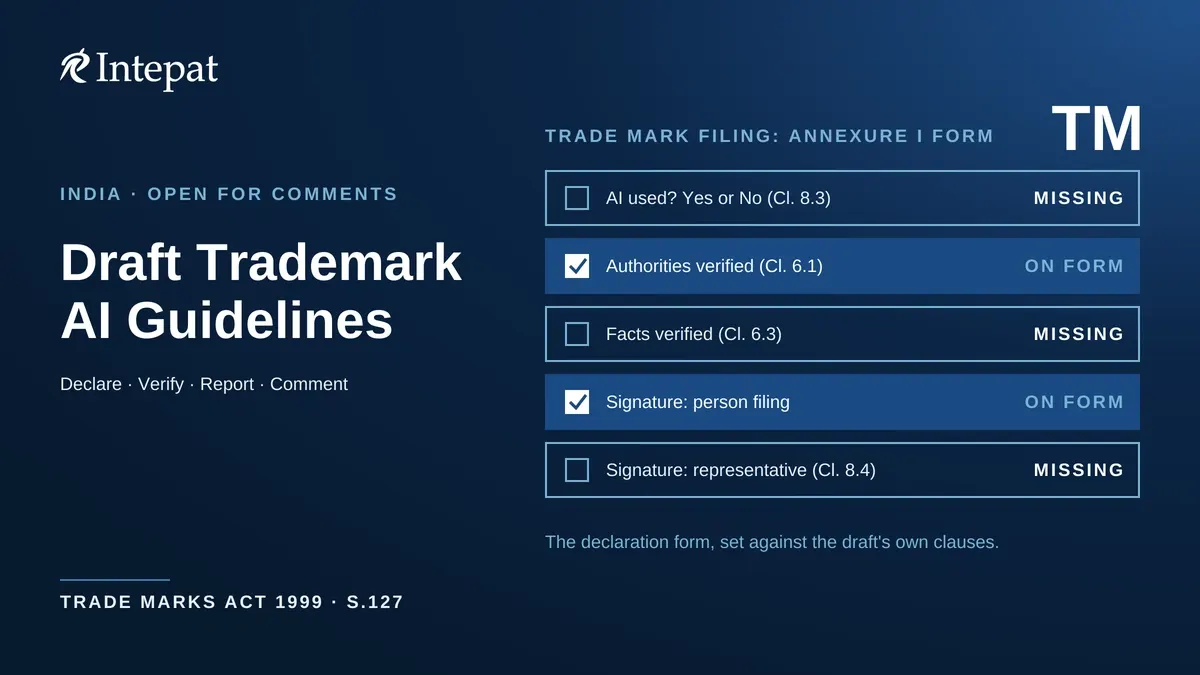
The clauses on this need harmonising. Clause 8.3 calls for a single declaration in the Annexure I format with every submission, stating whether AI was used. Clause 8.1 asks for a declaration by an authorised representative only where AI was used.
The Annexure I form has no field for answering whether AI was used. Where AI was used, the declarant must also confirm that every AI-generated or AI-suggested citation, statutory reference, rule, legal proposition and material fact was independently verified, and accept full personal responsibility for the submission (Clause 8.2). The draft treats failure to disclose AI use, where it occurred, as a misrepresentation to the Registry (Clause 5.2). Clause 10.1 lists the filings where the declaration is expressly required:
| Filing | Condition in Clause 10.1 |
| Counter-statements and replies in opposition, and interlocutory applications | None stated |
| Written submissions and synopses at any hearing | None stated |
| Affidavits by way of evidence | To the extent the affidavit or exhibits contain AI-generated content |
| Applications for rectification, cancellation or removal | None stated |
| Any representation, reply or communication in response to an examination report or show cause notice | None stated |
| Any other document | Where its substantive legal content was prepared wholly or partly with AI |
The list is not the outer limit. Clause 2.2 applies the guidelines to every stage, including filing, renewal, assignment and recordal, so read with Clause 8.3 the declaration may reach a new application or a renewal. Where AI was used and the filing goes through an authorised representative, the representative must sign as well as the person filing (Clause 8.4). For an agent handling replies to trademark examination reports, that means at least one more signed document with every reply.
What counts as AI matters for the answer. Clause 3.1(a) defines it to include large language models, generative AI systems and natural language processing tools, and adopts the definition in a 2026 Gujarat High Court AI policy. On that wording, grammar, translation and AI search tools may all count.
What verification means: the permitted non-AI sources
Verification under the draft means checking each AI-generated citation, statutory provision and legal proposition against defined non-AI sources, opened by the verifying person, and checking each AI-supplied fact against the underlying record. A citation retrieved from an AI tool does not count as verified until it is cross-checked against one of those sources.
The permitted sources in Clause 3(k) are the official websites of the Supreme Court and the High Courts; the Official Gazette and official publications of the Government of India or the CGPDTM; certified copies of judgments and orders; established Indian law reports and databases, such as AIJEL (All India Judgements Electronic Library), SCC Online, AIR (All India Reporter) and Manupatra; and the Registry’s own website and e-filing portal for the Registrar’s orders. Every listed category is Indian.
For case law, Clause 9.1 asks four things of each AI-suggested authority: that the case exists, that the citation details are accurate, that the holding attributed to it is what the judgment actually says, and that it is relevant to the point. Clause 9.2 requires the authorised representative to access the full text of each AI-suggested judgment from a permitted source and verify all four points before including it. A firm that already pulls Indian authorities from the court website or a reporter will mostly be documenting what it does now. Foreign judgments are an open question: the definition is framed as a list of Indian legal sources and does not say how a foreign authority is to be verified.
What happens when a citation turns out to be fake
The Registrar may act where a citation appears fabricated, an AI-assisted filing lacks the declaration, a declaration is false, misleading or inaccurate, or AI-generated facts mislead. For a fake citation, after a show cause notice and hearing, the Registrar may strike out the citation or, if material, the whole submission.
That remedy in Clause 12.3 is framed around fake citations. The operative clauses name no specific outcome for a missing or false declaration; only the Annexure I form warns that a false or misleading declaration may lead to the filing being struck off or disregarded, and to disciplinary proceedings. Clause 9.3 makes a non-existent citation, or one that misstates the holding of the cited case, a ground for action whether or not AI produced it. Under Clause 12.4, where the facts warrant, the Registrar may refer an authorised representative for disciplinary action under the trade mark agents’ code of conduct or, until that code is in force, to an ad hoc disciplinary committee, and may refer an advocate to the competent Bar Council.
Reporting is a duty, not an option. Under Clause 13.1, any party, representative or officer who detects a possibly fabricated or non-existent citation, or a factual misrepresentation, in any submission must report it to the Registrar at the earliest opportunity on the Annexure II form. Good-faith reports are protected (Clause 13.5), but frivolous or vexatious ones expose the reporter to action (Clause 13.6). Unless the Registrar directs otherwise for recorded reasons, a pending report does not stay the matter, and it does not extend any time limit (Clause 13.7). In trademark opposition proceedings, counsel who spots a fake case law citation in the other side’s papers would have to raise it promptly rather than hold it for the hearing.
AI-altered evidence: affidavits, invoices, translations
The draft bars AI from generating or altering the substantive content of any affidavit or declaration meant to record a person’s own knowledge. It also bars using AI to generate, fabricate, materially manipulate or digitally alter any supporting material, from invoices, labels and sales data to translations, certificates and proof of use.
The affidavit rule in Clause 14.1 matters because evidence before the Registrar is ordinarily given by affidavit under Section 129 of the Act. Read literally, it reaches AI help in drafting the substance of a user affidavit, not only fabrication. That sits uneasily with Clause 10.1(c), which expects declarations for affidavits containing AI-generated content.
Clause 14.2 reaches beyond contested evidence: it covers material filed in support of any application or request. Read literally, it would bar a machine translation of a foreign priority document or an AI-cleaned label image. Under Clause 14.4, where the Registrar has reason to believe material may be AI-generated or manipulated and liable to mislead the Registry or prejudice anyone’s rights, the Registrar may, after a hearing and with written reasons, require the native file, metadata and creation history, exclude the material if its authenticity is not established, or draw an adverse inference. Owners who plan to file documentary evidence of use should keep native files and their metadata intact from now on.
Gaps in the draft AI guidelines worth raising
The draft needs correction before it is finalised. The main issues are squatting, which the draft leaves unaddressed, declaration rules that need harmonising, a form that does not match its clauses, and evidence rules wide enough to catch routine translations. Two lists follow: drafting defects, then fairness and workability points.
Drafting defects:
- Squatting. The court’s order directs, and the notice issues, an invitation for suggestions on AI misuse and squatting, and the draft deals only with AI, so squatting is open for submissions. Those concerned with bad-faith filings may want to propose text for that half of the mandate.
- Definition of AI. Ask for a self-contained definition, with a carve-out for spelling, grammar, formatting and search tools, instead of a cross-reference to another court’s policy.
- Who must declare. Clause 8.3 says every submission; Clauses 8.1, 8.4 and 12.1(b) assume AI-assisted ones. Annexure I and Clause 12.2 expressly contemplate parties in person, and Clause 8.3 reaches every submission, but the case-law duties in Clauses 9.1 and 9.2 bind only authorised representatives, leaving parties in person with the general verification duty in Clause 6.1.
- The Annexure I form. It has no field for whether AI was used, no certification that facts were verified (Clause 6.3), and one signature block where Clause 8.4 requires two. It also certifies all authorities, while Clause 6.1 covers only AI-sourced ones.
- Cross-references. Clause 13.3 refers to the time “specified in clause 14.2”, which appears to mean Clause 13.2. Clause 13.2 links Annexure II to Clause 3(k), the verification definition, and does not say clearly whether the reporter or the filer must produce proof.
- Evidence clauses. Clause 14.2 should be limited to fabrication or misleading manipulation, with verified machine translation permitted. Clause 14.3 makes material that breaches Clause 14.1 liable to exclusion without the Clause 14.4 preconditions, but says nothing about Clause 14.2, leaving those breaches to the conditional route in Clause 14.4.
- Statutory reference. Clause 3(k)(ii) refers to material published in the Gazette under Section 159 of the Act, which deals with repeal and savings. The rule-making power is in Section 157, so the reference should be corrected or deleted.
Fairness and workability points:
- Transition. Ask for a lead time after notification, and confirmation that submissions already on file in pending matters need no declaration after the fact.
- Reporting duty. Clause 13.1 makes reporting mandatory while Clause 13.6 penalises frivolous reports; a reasonable-belief threshold, or “may” in place of “shall”, would reduce the risk to reporters.
- Two tests. For the holding and relevance duties in Clause 9.1(c) and (d), the proviso requires a non-existent citation or deliberate or reckless misattribution, while Clause 9.3 has no mental element. One standard should govern.
- Cure. Ask for a short period to file an omitted declaration, and an outcome for the declaration-based grounds in the operative clauses, matching the warning in Annexure I.
- Foreign authorities. Ask how foreign judgments are to be verified, and whether official foreign court and IP office websites count under Clause 3(k).
- Officer-side documents. Clause 11 requires officers to verify AI-generated content, but imposes no disclosure duty and gives parties no route to report a fabricated citation in an examination report or order.
- Legal basis. The draft cites no section for strike-off under Clause 12.3 or exclusion under Clause 14.3, and for Clause 14.4 relies on Section 127, which lists civil-court powers over evidence and production. Ask the CGPDTM to state the legal basis and safeguards for each new duty and sanction, and whether any need rules, which the Central Government makes under Section 157.
How and when to send comments
We recommend sending comments to llc-ipo@gov.in by 3 November 2026. The notice allows three weeks from publication: about 6 November from its printed 16 October date, or 7 November from IP India’s 17 October listing. Its paragraph 3 also ties submissions to the court’s three weeks, which run from receipt of the order.
No receipt date is published, but it cannot predate the 13 October order, so 3 November is a precautionary date rather than an announced deadline. Copy the prescribed subject line, which begins Suggestions/Objections and names Guidelines on AI and Squatting, directly from the notice. Comments tied to clause numbers, with proposed replacement text, are the easiest to compile in the three weeks the court has allowed. The public notice, the draft guidelines and the court order are each on IP India.
On the court’s timetable, compiled guidelines are due about three weeks after the window closes, ahead of the 14 December 2026 listing, and the draft would take effect immediately on notification. Until then nothing in it binds current filings. It is still worth checking citations in pending replies and written submissions against a permitted source, keeping native files for evidence, and briefing anyone who prepares filings for your trademark show cause hearings. Our trademark prosecution team can review pending filings against the draft’s verification standard.
This article summarises the consultation draft available as of 20 October 2026 on artificial intelligence in proceedings before the Trade Marks Registry in India and is for general information only. It is not legal advice. The final guidelines may differ from the draft; check the notified text before you act. For advice on your specific mark, consult a trademark attorney.