




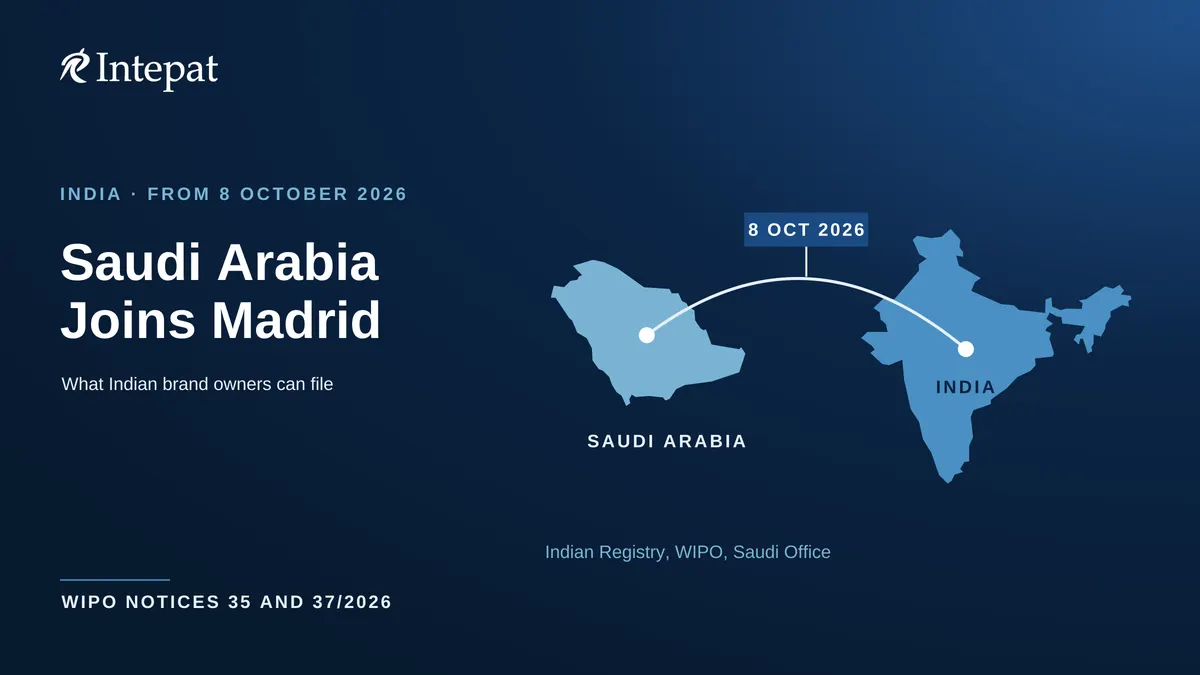
Saudi Arabia will join the Madrid System on 8 October 2026. From that date, an Indian brand owner with an Indian trademark application or registration can name Saudi Arabia in a new international application or add it to an existing international registration, paying Saudi Arabia’s own fee of CHF 1,397 per class.
This guide covers the Saudi Arabia Madrid Protocol India route for owners whose Office of origin (the national office where the basic Indian application is filed) is the Indian Trade Marks Registry. It rests on WIPO’s notices of 23 July and 1 September 2026 and on the Indian Trade Marks Rules, 2017.
| Quick answer: |
| From 8 October 2026, an international application filed through the Indian Registry can designate Saudi Arabia, and an existing international registration can add it by subsequent designation. Saudi Arabia charges CHF 1,397 per class on top of WIPO’s basic fee (verified as of October 2026), and has 18 months to notify a refusal, or longer for a refusal based on an opposition flagged to WIPO within the 18 months. Madrid suits an Indian mark with little objection risk; if the Indian mark fails within five years of the international registration, protection can end with it. Saudi Arabia Madri |
Saudi Arabia Madrid Protocol India: What Changes on 8 October 2026
On 8 July 2026 Saudi Arabia deposited its instrument of accession to the Madrid Protocol, and the Protocol will enter into force for it on 8 October 2026. WIPO’s fee notice ties Saudi Arabia’s fee to applications and subsequent designations received on or after that date, so the date decides when a filing can carry it.
Saudi Arabia’s accession comes with four declarations and notifications that shape how the route works. First, it has declared an 18-month period, in place of the standard one year, for notifying a provisional refusal, with a later refusal possible where it results from an opposition. Second, it will take an individual fee, set in Swiss francs, rather than a share of WIPO’s supplementary and complementary fee revenue. Third and fourth, its Office will not present requests for division, or for merger of registrations resulting from division, to WIPO, because Saudi law does not provide for either.
The core Madrid mechanics are unchanged for an Indian owner. Protection in Saudi Arabia is the same as if the mark had been filed directly with the Saudi Office, and the Saudi Office can still refuse it. The international registration also stays tied to the Indian mark for its first five years. Saudi national law, including local representation and the cost of a direct Saudi filing, is outside this guide.
Who Can Use the Route from India
A person whose Indian trademark application is pending, or whose Indian trademark is registered, can use the Madrid route if they are an Indian national, are domiciled in India, or have a real and effective industrial or commercial establishment there. The Indian Trade Marks Registry is then the Office of origin and certifies the international application.
The international application must be in the name of the person who holds the Indian application or registration. An Indian applicant files with the Registry, not with WIPO. The application is in English and is filed electronically through the Registry’s international application system. The Registry certifies its contents on Form MM2(E) and, where the application complies, forwards it to WIPO within two months from the date it receives the application. A non-compliant application is not forwarded, and the applicant is told to comply.
The certification step is also the limit on scope. The Registry certifies that the mark and the goods and services in the international application match the Indian application or registration, so the international filing cannot claim more than the Indian filing covers. The date matters too: the international registration takes the date the Registry received the application if WIPO receives it within two months of that date.
Before filing, owners should check the irregularities WIPO commonly raises. A separate note on common Madrid filing errors lists the usual classification, fee and translation problems. For the base process from India, see the guide to how an Indian international application works.
Adding Saudi Arabia to an Existing International Registration
A holder who already has an international registration can add Saudi Arabia by a subsequent designation received on or after 8 October 2026, filed directly with WIPO or presented by the Office of the holder’s Contracting Party. The designation takes effect on the date it is recorded in the International Register and lapses when the international registration expires.
A request filed directly with WIPO bears the date WIPO receives it, although protection takes effect from the recordal date. A later date applies only if the request is irregular as to the registration number, the designated Party or the goods and services (it then bears the date it is put in order), or if the holder asks for it to take effect after the renewal of the registration or after a recorded change or cancellation. The subsequent designation carries its own basic fee of CHF 300, plus Saudi Arabia’s individual fee for each class. It can be limited to some of the goods and services in the international registration, which suits an owner whose Saudi plans cover fewer products than the registration does.
The fees cover the period from the recorded date to the end of the registration’s current ten-year term, so check the renewal date before adding Saudi Arabia late in a term. WIPO notifies any missing or wrong details, and they must be corrected within three months, failing which the request is treated as abandoned.
An existing international registration can be extended to Saudi Arabia: the Protocol and the Regulations provide for subsequent designation, and the Indian Act lets a holder of an international registration apply to extend protection to another Contracting Party. The Indian Rules name only Form MM2(E) for certification of an international application and set out no separate procedure for presenting a subsequent designation through the Registry. Until the Registry’s current practice is confirmed, direct filing with WIPO is the safer route.
What Saudi Arabia Does with a Designation: The 18-Month Window
Saudi Arabia has declared an 18-month period, instead of one year, within which it must notify a provisional refusal to WIPO. That is a deadline for the refusal notice, not for finishing the case: a refusal based on an opposition may follow later, if Saudi Arabia has flagged oppositions to WIPO within the 18 months.
A provisional refusal is the Saudi Office’s notice to WIPO that it considers protection cannot be granted. It can rest only on grounds that would apply to a mark filed directly with that Office under the Paris Convention, and the holder has the same remedies as for a direct filing. The Office cannot refuse merely because Saudi law would allow registration in fewer classes or for fewer goods. The 18 months run from the date WIPO sends the Saudi Office notice of the designation.
A notification must state all the grounds, identify any conflicting earlier mark, give a time limit of no less than two months for a review, appeal or response, and name the authority with which it is filed. Where a representative with an address in Saudi Arabia is required, the notification must say so. The response period and procedure are Saudi Arabia’s own and are not set out in WIPO’s notices, so this guide does not state them. The 18 months are counted from WIPO’s notice to the Saudi Office, so it is prudent to identify a local representative before filing.
Opposition adds a second track. Under the Protocol, a refusal based on an opposition can be notified after the 18 months only if the Saudi Office has told WIPO, before those 18 months end, that oppositions may still be filed. It must then be notified within one month of the end of the opposition period, and no later than seven months after that period starts. If the Office notifies no refusal in time, it loses the right to refuse that designation, and the mark is protected as if it had been registered. That does not by itself shield the mark from a later invalidation action, because protection is the same as for a direct filing.
What It Costs: Saudi Fees and the Indian Handling Fee
Saudi Arabia will charge its own individual fee, CHF 1,397 per class for an ordinary mark, instead of WIPO’s CHF 100 complementary fee (a per-country charge). A holder also pays WIPO’s basic fee, and an Indian applicant filing through the Registry pays its Rs 5,000 e-filing handling fee. Saudi figures verified as of October 2026.
The Saudi individual fee, fixed by WIPO’s fee notice, is set out below.
| Transaction | Saudi Arabia individual fee (CHF per class) |
| International application or subsequent designation | 1,397 |
| The same, for a collective or certification mark | 1,719 |
| Renewal | 1,397 |
| Renewal where payment is received within the grace period | 1,612 |
These figures apply where the application or subsequent designation is received on or after 8 October 2026, or where an international registration is renewed on or after that date. Under the Schedule of Fees in WIPO Publication 207E/25, WIPO’s basic fee for an international application is CHF 653, or CHF 903 if any representation of the mark is in colour. No supplementary fee (WIPO’s charge for classes beyond three) is payable where every designated Party charges an individual fee, as Saudi Arabia does. The Saudi fee is charged for each class designated, and a designation can be limited to the classes and goods needed even if the Indian filing covers more. At renewal, WIPO’s basic fee of CHF 653 is also due, with a surcharge of half that fee if payment falls in the grace period. All payments to WIPO are made in Swiss francs.
Worked examples show the effect. For a one-class mark in black and white, sent from India with Saudi Arabia as the sole designation, the official WIPO and Saudi filing fees are CHF 653 plus CHF 1,397, which is CHF 2,050. A second class adds CHF 1,397 and brings the Madrid total to CHF 3,447. Adding Saudi Arabia to an existing registration for one class costs CHF 300 plus CHF 1,397, which is CHF 1,697. These are official filing fees only; professional fees, taxes and any refusal or opposition costs are extra.
The Indian handling fee of Rs 5,000 is payable to the Registry for certification and transmission of an international application, so a subsequent designation filed directly with WIPO does not attract it. Whether it applies to a subsequent designation presented through the Registry is unconfirmed. It is paid to the Registry electronically with the application, is the same for every applicant (the reduced rate for individuals, startups and small enterprises on the Indian application fee does not apply to it), and physical filing of an international application is not allowed.
Fees change, and a filing that designates several countries is priced differently. Run WIPO’s Madrid Fee Calculator for your own mark before you file; a separate guide explains how to use the Madrid fee calculator for an Indian applicant.
Five-Year Dependency, Transformation and No Division
For five years from the date of the international registration, protection in Saudi Arabia and every other designated country depends on the Indian basic application or registration. If it is withdrawn, lapses, is renounced, or is finally rejected, revoked, cancelled or invalidated, protection can no longer be invoked, for all or some of the goods.
The five years run from the date of the international registration, not from the date Saudi Arabia is added, so an older registration may already be independent.
The Indian Act is to the same effect: where the Indian application is withdrawn, cancelled, has expired or is finally refused within the five years, protection under the international registration ceases to have effect. Where an appeal against the decision of registration, an action for withdrawal of the application or an opposition was initiated before the five years ended, a later final decision of withdrawal, cancellation, expiry or refusal afterwards is treated as having taken place within them. The loss follows the goods and services affected, so it can be partial.
If the international registration is cancelled at the request of the Indian Registry, the holder can file the same mark in Saudi Arabia within three months of the cancellation and keep the date of the international registration (or, where Saudi Arabia was added later, the date that designation was recorded) and any priority. The goods and services must be covered by the Saudi part of the registration, and the Saudi application must meet Saudi requirements, including fees. That safety net is time-limited and does not replace a sound basic mark.
Division is not available through Saudi Arabia, as at October 2026. Its Office has notified WIPO that it will not present requests to divide an international registration in respect of Saudi Arabia, or requests to merge registrations resulting from a division, because Saudi law provides for neither. A holder who wants to split a Saudi designation across goods, for example to keep part of it alive while another part is contested, cannot rely on the Madrid division procedure for that purpose.
Madrid or Direct Saudi Filing: A Decision Rule
Madrid is the stronger fit when the Indian application has little objection risk, the goods match the Indian specification, and Saudi Arabia is one of several markets. A direct Saudi filing is the safer fit when the Indian mark faces a material risk of refusal, opposition or cancellation, or the Madrid limits do not suit the plan.
Three facts drive that rule. The Madrid route gives one filing and one set of WIPO fees, with Saudi Arabia’s fee added per class. The Saudi designation depends on the Indian mark for five years. The goods cannot exceed the Indian specification.
A direct Saudi filing is not tied to the Indian mark by Madrid’s dependency rule, and is not limited by the Madrid requirement that the goods fall within the Indian specification. Saudi Arabia has told WIPO that its law does not provide for division of registrations of a mark, so Madrid division is not available for Saudi Arabia; this guide does not address division of direct Saudi applications. Its fees and timelines are set by Saudi Arabia and are not covered in WIPO’s notices.
Applicants should check how exposed the Indian application is to objection or opposition before it becomes the basis for a Madrid filing, and should run a clearance search for the mark in Saudi Arabia, where any refusal is decided under Saudi law. Owners weighing trademark registration in Saudi Arabia from India can compare the two routes in the guide on Madrid versus direct filing. For new filings, the date to plan around is 8 October 2026: an international application received by the Indian Registry on or after that date can include Saudi Arabia, and a subsequent designation received by the holder’s Office, or filed directly with WIPO, on or after that date can add it. Direct filing with WIPO is the route to rely on until the Registry’s practice is confirmed.
Frequently Asked Questions
Yes. From 8 October 2026 a holder can designate Saudi Arabia by subsequent designation, filed directly with WIPO. The fee is CHF 300 plus CHF 1,397 per class, so CHF 1,697 for one class (verified as of October 2026). It runs to the end of the current ten-year term and can cover only some goods. The Registry’s own procedure is unconfirmed.
No. A pending Indian application can be the basic application, as can a registered mark. Because the international registration depends on the Indian mark for five years from its date, the fate of a pending application matters: if it is withdrawn, lapses or is finally rejected in that period, protection in Saudi Arabia can no longer be invoked.
Saudi Arabia has 18 months from the date WIPO notifies it of the designation to notify a refusal. A refusal resulting from an opposition can come later if Saudi Arabia tells WIPO within the 18 months that oppositions may still be filed. If none is notified in time, the mark is protected as if registered, though a later invalidation action stays possible.
If the Indian mark is finally refused, withdrawn, lapses or is cancelled within five years of the international registration, Saudi protection can no longer be invoked, for all or some goods. If the international registration is cancelled at the Registry’s request, file in Saudi Arabia within three months of that cancellation to keep its date, or the recordal date if Saudi Arabia was added later.
Yes, where the same person holds both for the same mark, the designation takes effect after the Saudi registration date, and the goods replaced are listed in the international registration. It is then deemed to replace the Saudi registration, wholly or partly, without prejudice to any rights acquired by virtue of the Saudi registration. The Saudi Office notes this on request, and the two registrations can coexist.
WIPO’s fee notice applies Saudi Arabia’s fee to international applications received by the Office of origin on or after 8 October 2026. The Protocol enters into force for Saudi Arabia on that date, so an earlier application should not be planned to carry it. Saudi Arabia can be added once the registration exists, by a subsequent designation received on or after that date and filed directly with WIPO.
This article explains the law on Madrid applications originating from India and designating Saudi Arabia as at October 2026 and is for general information only. It is not legal advice. Government fees, forms, and procedures change; confirm current figures with the Trade Marks Registry before you file. For advice on your specific mark, consult a trademark attorney.
Sources
- WIPO, Information Notice No. 35/2026, “Accession to the Madrid Protocol: Saudi Arabia”, 23 July 2026, paragraphs 1 to 4.
- WIPO, Information Notice No. 37/2026, “Declaration made under Article 8(7)(a) of the Madrid Protocol: Saudi Arabia”, 1 September 2026, paragraphs 2 and 3.
- WIPO Publication No. 207E/25: Protocol Relating to the Madrid Agreement Concerning the International Registration of Marks (Articles 2, 3, 3ter, 4, 4bis, 5, 6, 8 and 9quinquies); Regulations (Rules 9, 17, 21, 24, 27bis, 27ter and 35); Schedule of Fees (items 2, 5 and 6).
- The Trade Marks Act, 1999 (Act 47 of 1999), Sections 36B and 36D. Government of India.
- The Trade Marks Rules, 2017, Rules 63, 65, 66, 67 and 74, and the First Schedule, Entry 23. Government of India.
- WIPO, Madrid Fee Calculator.