




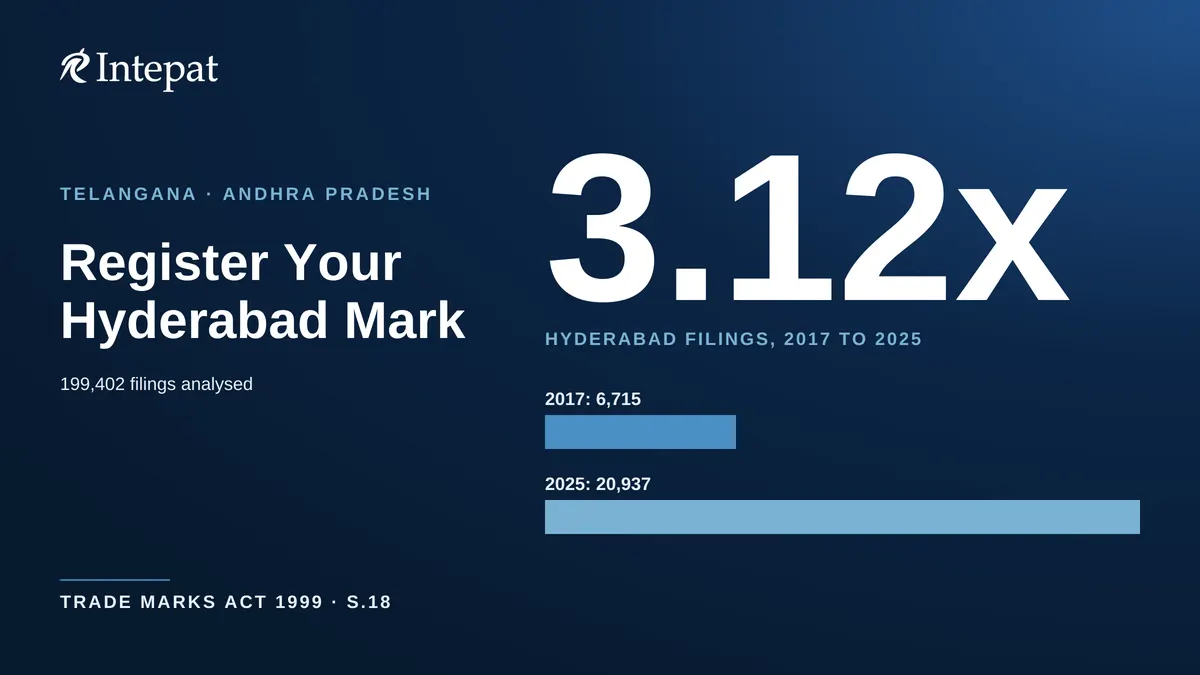
Trademark registration in Hyderabad is filed at the Chennai office of India’s Trade Marks Registry, costs Rs 4,500 or Rs 9,000 per class in government fees online, and is a fast-growing market: 199,402 applications carry a Hyderabad address, and annual filings tripled between 2017 and 2025, a steeper rise than in Intepat’s Bangalore, Chennai and Coimbatore figures.
This guide is built on those Registry records, compiled on 16 October 2026, and on the Trade Marks Act 1999 and the Trade Marks Rules 2017. The same rules apply to trademark registration in Telangana and to trademark registration in Andhra Pradesh, because both states fall under the Chennai office; it sits alongside Intepat’s guides to the Chennai trademark office and to trademark registration in Bangalore.
| Quick answer: |
| File online on Form TM-A, the application form, through the Chennai office of the Trade Marks Registry. Government fees are Rs 4,500 per class for an individual, a recognised startup or a small enterprise with the certificate to prove it, and Rs 9,000 per class otherwise; professional fees are extra. Pick classes (the 45 numbered categories of goods and services, each paid for separately) from what you sell or intend to sell, and search for your mark across all of India: about 28% of Hyderabad-address applications do not carry Telangana in the state field, probably because of the 2014 split of Andhra Pradesh, so a state filter misses them. |
How Trademark Registration in Hyderabad Works
A Hyderabad applicant files at the Chennai office of the Trade Marks Registry, the government office that examines and registers trademarks. The Act and the Rules send an application to the office covering the applicant’s principal place of business, and IP India lists Andhra Pradesh and Telangana among the states that office covers.
Chennai’s territory, per IP India’s office locations, is Andhra Pradesh, Telangana, Karnataka, Kerala, Tamil Nadu, Puducherry and Lakshadweep. A business with premises in Hyderabad and Vijayawada files at Chennai whichever it names as its principal place of business, because both cities sit in that territory, and the Rules let a multi-site business choose which of its places it names. An applicant with neither a place of business nor a residence in India is allocated instead by its address for service in India, the Indian address where the Registry sends notices.
You can file before launch: the Act allows an application for a mark used, or proposed to be used, by the applicant, provided the intention to use it is genuine.
The application itself is Form TM-A, filed online. It is the same form for brand name registration in Hyderabad (a word mark) and logo registration in Hyderabad (a device mark); Intepat’s guide to word marks against logo marks explains which to file first when the budget covers one. The Registry examines the application, and any objection in the examination report (the examiner’s written objections, or proposed conditions or amendments, if any) has to be answered within one month of receipt. Once accepted, the mark is advertised in the Trade Marks Journal, the Registry’s official publication, and anyone may oppose it within four months of that advertisement. If nobody opposes, or the opposition fails, the mark is registered for ten years and can be renewed in ten-year blocks.
Acceptance is not quite final: before registration, the Registrar (the officer who decides applications) can withdraw an acceptance given in error, or where the mark should not be registered or only with conditions. The applicant then has thirty days from receiving that objection to amend or ask for a hearing; silence withdraws the acceptance. The Rules allow the Registrar to hold any hearing by video conference, and a hearing held that way is deemed to have taken place at the appropriate office, so a Hyderabad applicant may not need to travel. Whether a particular hearing runs by video is the Registrar’s call. Intepat’s guide to the trademark registration process in India walks through each stage.
What 199,402 Hyderabad Filings Reveal
Proprietors with a Hyderabad address have filed 199,402 trademark applications as at 16 October 2026, and seven in ten were filed from 2016 onwards. Annual filings rose 3.12 times between 2017 and 2025, a steeper rise than in Intepat’s published figures for Bangalore, Coimbatore, Chennai and Tamil Nadu over the same years.
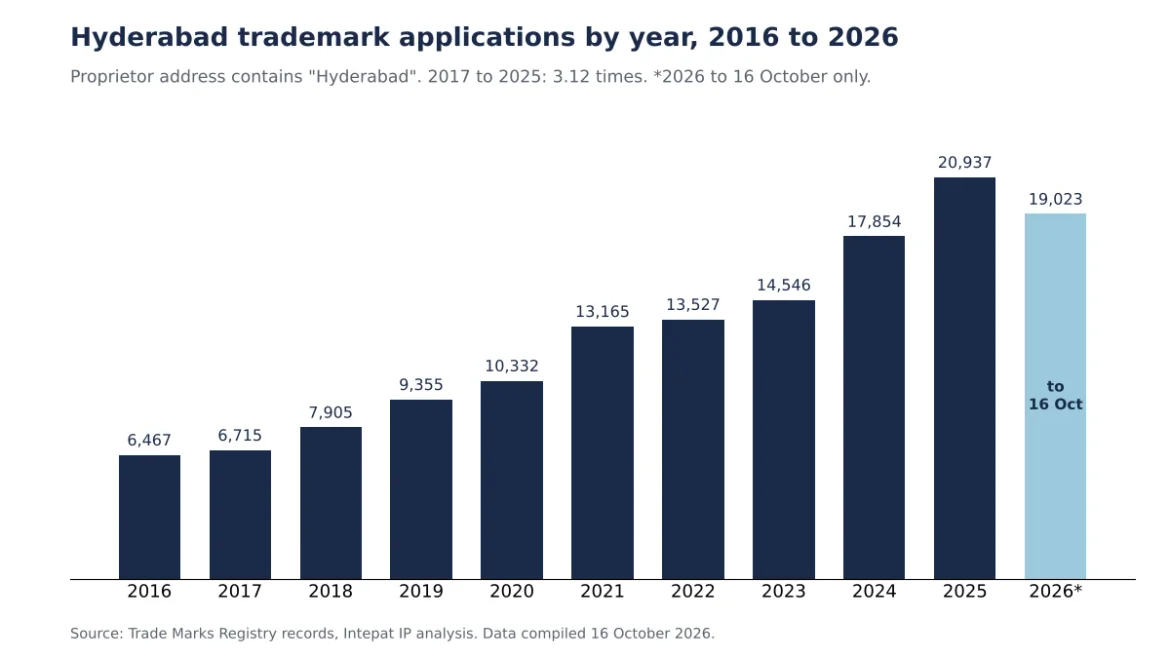
Hyderabad filed 6,715 applications in 2017 and 20,937 in 2025, about 15.3% a year compounded. On the figures Intepat has published for the other cities, Bangalore and Coimbatore each grew 2.76 times over the same eight years, Tamil Nadu 2.37 times and Chennai 2.05 times. Each year from 2017 to 2025 beat the one before. Growth slowed to 2.7% in 2022, then jumped 22.7% in 2024, and 2026 had reached 19,023 applications by 16 October, about 66 a day; at that daily rate the year would end near 24,000.
Volume is still behind Bangalore. Bangalore addresses had 306,002 applications on the register when Intepat compiled them on 20 August 2026, against Hyderabad’s 199,402 two months later, and Bangalore filed 31,166 in 2025 against Hyderabad’s 20,937. Hyderabad’s annual filings rose from about 60% of Bangalore’s in 2017 to about 67% in 2025, although the gap in absolute numbers widened. For an applicant the practical effect is more recent marks to search against every year.
Some 59,600 Hyderabad applications, about 30% of the total, were filed before 2016, and any of those still on the register remain earlier marks for a new filing. A clearance search (a check of the register for earlier marks that could block yours) has to cover that older stock as well as the recent surge. For state context, the records show 191,490 applications under Telangana and 136,933 under Andhra Pradesh, all time, as at the same date; the Andhra Pradesh figure may include older filings from what is now Telangana, Hyderabad among them.
Hyderabad’s Trademark Classes: Class 5 Leads
Class 5, the class for pharmaceuticals and medical preparations, accounts for 23% of every trademark application filed from Hyderabad, 45,887 in all, which is nearly twice the Tamil Nadu share and about 2.4 times Bangalore’s. Business services, software, education and IT services follow, and the top five classes carry 49% of all filings.
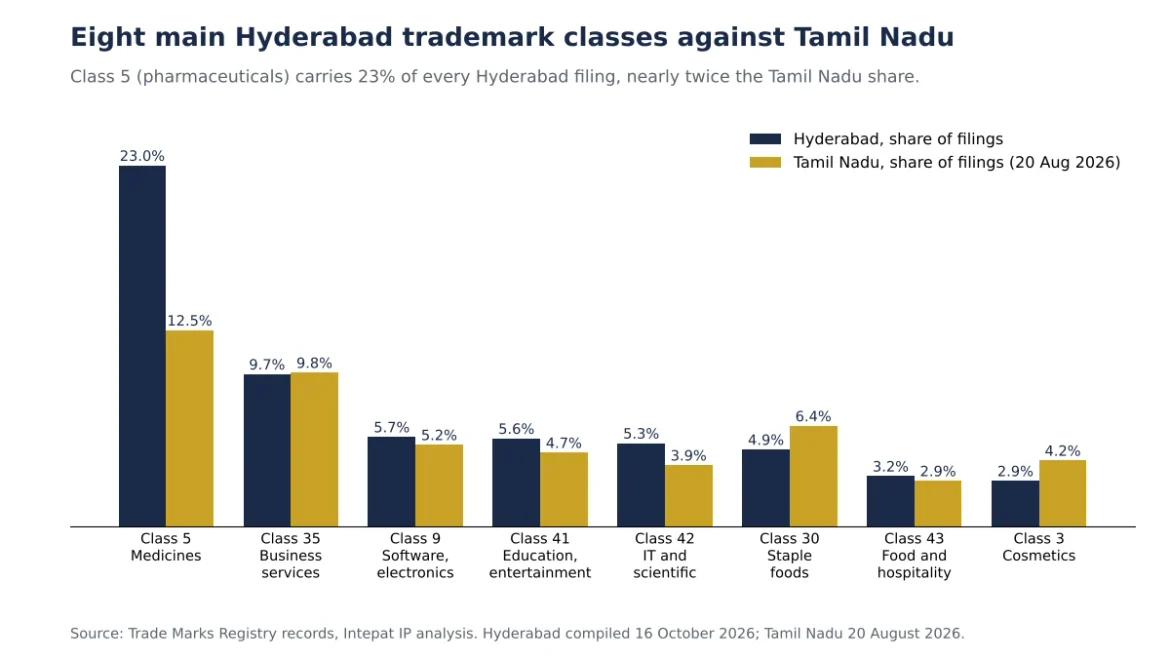
The chart reads each class twice: its share of Hyderabad’s filings, and the same class’s share of Tamil Nadu’s filings as compiled for Intepat’s Chennai guide. Class descriptions are shortened from the Nice Classification headings. After Class 5 come business services and retail (Class 35, 19,328 filings, 9.7%), software and electronics (Class 9, 11,413, 5.7%), education and entertainment (Class 41, 11,188, 5.6%) and IT and scientific services (Class 42, 10,589, 5.3%).
Class 5 is the finding that sets Hyderabad apart. Across Tamil Nadu it is a 12.5% class, and on the 306,002 Bangalore filings Intepat has published it is 9.7%; in Hyderabad it is 23%, so almost one application in four from this city is in Class 5. The class holds medicines, medical preparations and supplements, but also baby food, disinfectants and pesticides, so the count shows where filings cluster, not how many come from drug makers. The technology signal is visible but smaller: Class 9 (software and electronics) and Class 42 (IT and scientific services) together hold 11% of Hyderabad filings, against about 9% in Tamil Nadu, and neither class is limited to IT businesses. Staple foods (Class 30) and cosmetics (Class 3) run below the Tamil Nadu share, and food and hospitality (Class 43) runs a little above it.
For an applicant the class profile is a decision tool. A drug maker files in Class 5, and adds Class 10 if the product is a medical device and Class 3 if it is a non-medicated cosmetic, because the boundaries follow what the product is, not who makes it. A software company files in Class 9 for downloadable software and Class 42 for software provided as a service, and many file in both. A restaurant or cloud kitchen files in Class 43 for the service and, if it also sells packaged food under the same name, in the class that fits the food itself, which may be Class 29, 30 or 32 depending on the product.
The Rules adopt the current edition of the World Intellectual Property Organization’s (WIPO) Nice Classification by reference, so check the current heading on Intepat’s trademark class search and the fuller notes in its guide to India’s trademark classification. Several classes can be covered in a single application, with a fee for each class. The catch is that if an opponent attacks only one class, the unopposed classes do not register until the applicant divides the application on Form TM-M (Rs 1,800 online), which is one reason some applicants file a crowded class such as Class 5 separately.
What Happens to Hyderabad Applications After Filing
Of every 100 applications ever filed from a Hyderabad address, about 46 are registered today, 18 are pending or in some other status, 13 were abandoned, 12 are in objection or opposition, 7 were refused and 4 were withdrawn or removed. The profile is close to Bangalore’s, and the refusal rate matches Coimbatore’s.
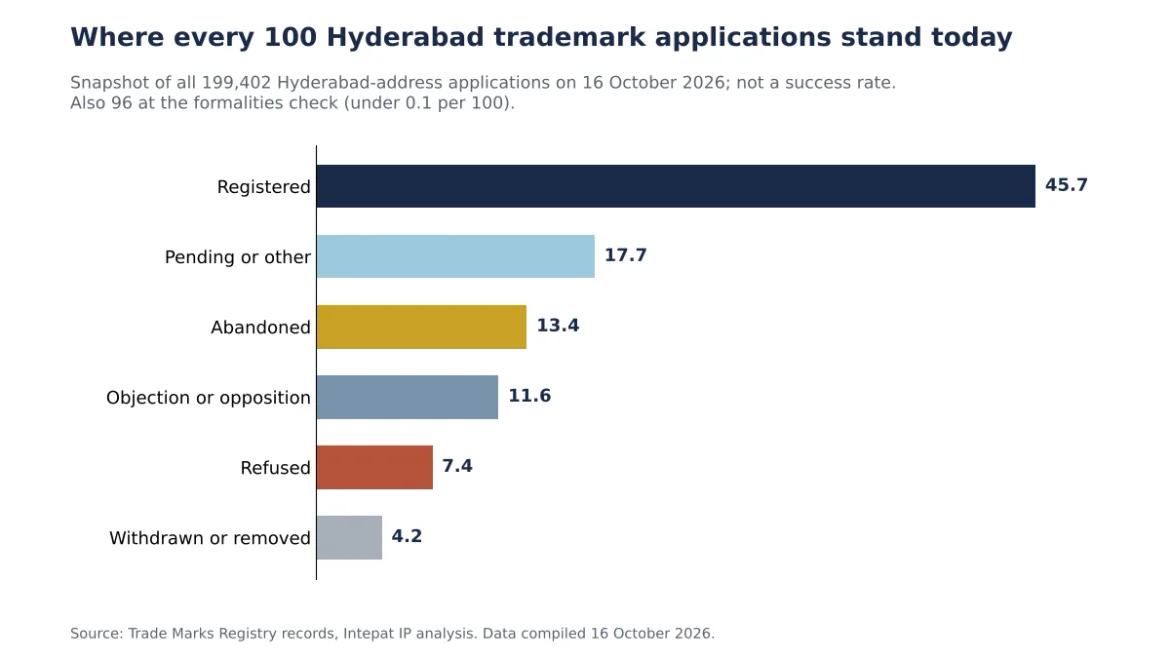
This is a snapshot of every file, including those not yet decided; it is not a success rate. The counts behind those figures are 91,118 registered, 26,700 abandoned, 16,531 in objection, 6,550 in opposition, 96 that failed the formalities check, 14,714 refused, 4,013 withdrawn, 4,371 removed, and 35,309 in another status. Bangalore’s published profile is 49 registered, 7 refused and 12 abandoned per 100; Coimbatore’s refusal rate is also 7.4 per 100. The 11.6 in objection or opposition is the figure that stands out: 8.3 per 100 are answering an examination objection and 3.3 face an opposition, a little above Bangalore’s 10 combined.
Abandonment, at 13 per 100, is the larger loss. It can be procedural (an examination report unanswered, a hearing missed, a counterstatement, the applicant’s written reply to an opposition, not filed), though some applicants simply choose to drop a file. Refusal, at 7 per 100, means the Registry examined the mark and said no; the status alone does not show whether the ground was an earlier mark, a descriptive name or something else. A refusal is not the last word: the applicant can ask for the Registrar’s written grounds within thirty days, seek a review within a month, and appeal to the High Court within three months of the decision being communicated (or, where written grounds were requested, of receiving them). Watching the application status and email prevents the avoidable abandonments; searching before filing and choosing a name that does not merely describe the goods cuts the avoidable refusals. In a class as crowded as Class 5, a drug brand has more earlier marks to clear, so the search matters more.
The figures in this article come from Trade Marks Registry records extracted on 16 October 2026 for proprietor addresses containing “Hyderabad”, with Intepat’s own analysis; addresses reading only “Secunderabad” were not included, and matches were not screened for a Hyderabad outside Telangana, such as Hyderabad in Pakistan. The total of 199,402 was read at 14:15 IST that day; the class counts were read earlier the same day, when the total stood at 199,378, and the shares are identical to one decimal place on either base. The refused count was taken as a separate pull, because the extraction’s summary panel shows a “Rejected” line of zero; “other status” is every application not labelled as registered, objected, opposed, refused, abandoned, withdrawn, removed or failed at formalities. Bangalore, Tamil Nadu and Chennai comparators are the figures published in Intepat’s guides, compiled on 20 August 2026, and Coimbatore’s on 25 September 2026. They were compiled with different search terms and geographic units (Bangalore, for instance, includes the Bengaluru and Bangaluru spellings, and Tamil Nadu is a whole state), so the multiples are indicative, not a like-for-like ranking.
Telangana or Andhra Pradesh? Why a State Filter Misses Hyderabad Marks
Only about 72% of Hyderabad-address applications carry Telangana in the records’ state field. Hyderabad addresses alone (199,402) outnumber everything recorded under Telangana from every town in the state (191,490, register-wide), so a search or watch that filters by state will miss part of Hyderabad’s own history, even allowing for any Hyderabad outside India among the matches.
The likely reason is the date. Telangana was formed on 2 June 2014 from territory of the existing state of Andhra Pradesh, including Hyderabad district, under the Andhra Pradesh Reorganisation Act 2014; before that date a Hyderabad address was an Andhra Pradesh address. Roughly 56,000 Hyderabad-address applications do not carry Telangana in the state field (the extraction did not show which state, or none, they carry), a number of the same order as the 59,600 Hyderabad applications filed before 2016 (the earliest year in the annual series; no count before June 2014 alone was available). This article has not verified those records one by one, so the explanation is an inference from the totals, not a count.
The practical consequence is for anyone clearing a new name in Hyderabad, Telangana or Andhra Pradesh. A search that narrows the register to “Telangana” can miss a mark filed from Banjara Hills in 2009, and a watch service (ongoing monitoring of new filings) set to the same filter can miss a later filing by that owner. The reverse holds for an Andhra Pradesh business: an “Andhra Pradesh” filter may pull in older Hyderabad marks alongside its own state’s. The safer method is to search the mark itself across all of India, then read the proprietor addresses in the results, and to set any watch on the mark and its owner rather than on a state. Intepat’s guides to conducting a trademark public search and to trademark watch in India explain both.
The same caution runs the other way for owners of older marks. A registration from 2010 may show an Andhra Pradesh address for a business that has been in Telangana since 2014. Where the business has moved, the Rules require the owner to ask forthwith, on Form TM-P, for the register to show the new address (Rs 900 online per mark). Where a public authority altered only the official address of the same premises, recording it is optional, and no fee is charged if a certificate of the alteration is filed and the Registrar is satisfied. The right itself is unaffected, because a registration is not limited to the state on record, but an outdated address can send a renewal reminder or a notice to the wrong place.
Pharma Names and the Risk of Sounding Alike
A new drug brand in Hyderabad enters the most crowded class on the city’s register, so the main risk is similarity to an earlier mark. The Registry refuses a mark where its similarity to an earlier one, for the same or similar goods, makes confusion likely, and the Act separately bars names close to an international non-proprietary name.
Two rules in the Act do most of the work. The first refuses a mark where identity or similarity to an earlier trade mark, combined with identical or similar goods, creates a likelihood of confusion on the part of the public, which the Act says includes the likelihood of association with the earlier mark. The second bars any word the World Health Organization has declared, and the Registrar has notified, as an international non-proprietary name (the generic name of a drug substance), or any word deceptively similar to one. A brand built by trimming a generic name is the mark most exposed to the second rule, and getting it registered does not cure it: the Act treats such a registration as one that should not be on the register, open to removal later.
In practice that means three checks before filing a Class 5 mark. Search for earlier marks that look or sound alike, including in Class 10 and Class 3 where a product sits near the boundary. Compare the candidate against the generic names of the active ingredients it would sit next to. And avoid a name that merely describes what the drug does, because a descriptive mark is refused unless it was already distinctive of one business through use before filing or is a well-known mark. Intepat’s guide to confusion between pharmaceutical trademarks covers how examiners and courts compare drug names.
Trademark Registration Fees in Hyderabad and the Small Enterprise Concession
A trademark application from Hyderabad costs Rs 4,500 per class online for an individual, a startup or a small enterprise, and Rs 9,000 per class for everyone else, and the Rules tie “small enterprise” to the investment ceiling for a medium enterprise, and a business classified Medium should not assume it qualifies.
| What you are paying for | E-filing fee (INR) | Form |
| Application, individual / startup / small enterprise, per class | 4,500 | TM-A |
| Application, all other applicants, per class | 9,000 | TM-A |
| Expedited processing, individual / startup / small enterprise, per class | 20,000 | TM-M |
| Expedited processing, all other applicants, per class | 40,000 | TM-M |
| Notice of opposition, or counterstatement, per class opposed | 2,700 | TM-O |
| Renewal, per class | 9,000 | TM-R |
| Renewal with surcharge (within six months after expiry), per class | 4,500 plus the renewal fee | TM-R |
| Restoration and renewal (after six months and within one year of expiry), per class | 9,000 plus the renewal fee | TM-R |
Fees are from the First Schedule to the Trade Marks Rules 2017, verified as of October 2026. Application and expedited fees are charged per class and per mark. E-filing fees are 10% below the physical-filing fees where physical filing is allowed, and expedited processing is available online only.
The concession covers only the application and expedited fees; renewal, opposition and other Form TM-M requests cost the same for everyone, so a small enterprise that filed at Rs 4,500 a class renews at Rs 9,000. Renewal can be filed up to a year before expiry; after expiry there is a six-month surcharge window and a further six months in which the Registrar may restore the mark. Intepat’s trademark fee guide covers every schedule entry.
The Rules peg “small enterprise” to the investment limit set for a medium enterprise under the MSME Development Act, tested on plant and machinery for a goods business and on equipment for a services business, not on turnover. The government’s current MSME classification, as revised with effect from 1 April 2025, keeps a medium-enterprise investment ceiling but now applies it together with a turnover ceiling, and the Rules do not say how that composite test maps onto their cross-reference, so this article states no rupee threshold. A Udyam Registration Certificate (the government’s standard proof of micro, small or medium enterprise status) showing Micro or Small is the safe case; an enterprise classified Medium may or may not qualify, so it should document the assessment with its trademark attorney, or pay Rs 9,000, before claiming the lower fee. The Rules treat a document filed with too little fee as not filed at all, so a wrongly claimed concession can cost the filing date, not just a top-up.
“Startup” in the Rules means an Indian entity recognised as one under the Startup India initiative, or a foreign entity that meets the Startup India turnover and age criteria and files a declaration, so for an Indian business the concession follows the recognition certificate, not the description. Form TM-A asks for the requisite certificate where a startup or small enterprise claims the lower fee; an individual needs none. Intepat’s guides to trademark registration for startups and for MSMEs cover the certificates.
How Long Trademark Registration Takes in Hyderabad
The register publishes no Hyderabad pendency figure, so this section states what the law provides rather than a number of months: the Act directs the Registrar to register an accepted, unopposed mark within eighteen months of filing, and expedited examination is available for a fee.
Three clocks apply. Once an application is accepted and either not opposed or successfully defended, the Act directs the Registrar, unless the Central Government directs otherwise and subject to the power to withdraw acceptance, to register it within eighteen months of the filing date; the Act attaches no consequence to that period being exceeded. The opposition window is four months from advertisement. An expedited processing request on Form TM-M (Rs 20,000 or Rs 40,000 per class) brings examination forward, ordinarily to within three months of the request, and the Registrar may cap the number of expedited requests by notice in the Journal.
About 18 of every 100 Hyderabad applications ever filed are in a status other than registered, objected, opposed, refused, abandoned, withdrawn, removed or failed at formalities, which includes files still pending. The register publishes no measure of pendency (how long applications wait), and the eighteen months is a direction to the Registry, not a guarantee; an objected or opposed application runs longer, and its length depends on the applicant’s response times as much as the Registry’s. Intepat’s guide to checking trademark application status explains what each status on the register means.
Six Trademark Deadlines That Start After You File
Six clocks start with a Registry notice, an examination report, a notice of opposition, the service of the counterstatement or the opponent’s evidence; two run from the date the notice bears, not the day it arrives. Three lead to automatic abandonment and three give the Registrar the option to abandon the file, and none is known on filing day.
- Deficiency notice: one month. If a deficiency the Registry notifies is not fixed within one month of the notice, the application is treated as abandoned. Mandatory. (Rule 31)
- Examination report: one month from receipt. If the applicant does not respond within one month of receiving the examination report, the Registrar may treat the application as abandoned. Discretionary in terms, so do not rely on it. (Rule 33(4))
- Hearing. If the applicant fails to appear at the scheduled hearing and has filed no reply to the objection, the Registrar may treat the application as abandoned. Both conditions must be met. In an opposition the rule is stricter: missing an adjourned hearing alone can end the application. (Rules 33(7), 50(3))
- Counterstatement: two months. If a notice of opposition is served and no counterstatement (the applicant’s written reply) is filed within two months of receipt, the application is deemed abandoned. Mandatory. (Section 21(2))
- Evidence in opposition: two months from service of the counterstatement. The opponent has two months from service of the counterstatement to file evidence, serve copies on the applicant and tell the Registrar, or to say in writing to both that it relies on its notice, failing which the opposition is deemed abandoned; a request for more time is not that action. The applicant then has two months from receiving that evidence or statement to file its own or rely on the counterstatement, failing which the application is deemed abandoned. (Rules 45, 46)
- Non-completion notice: twenty-one days. If registration is not completed within twelve months of filing because of the applicant’s default, the Registrar must first send a notice on Form RG-1; if the default is not fixed within twenty-one days of the notice’s date, or any further time up to a month the Registrar allows on Form TM-M, the Registrar may treat the application as abandoned. Discretionary in terms. (Section 23(3), Rule 52)
Because none of the dates is known in advance, the application status and the email address on record are what have to be watched, and the Rules treat an emailed notice as served when it is sent, not when it is read, so check both daily even where a clock runs from receipt. Do not plan around an extension. The Rules let the Registrar extend some times by up to one month on Form TM-M (Rs 900 online), even after they have run out, if there is sufficient cause; times with their own extension rule, such as the non-completion notice, follow that rule, and a time set by the Act itself, such as the two-month counterstatement window, cannot be extended under that power. For the opposition evidence times the position is contested: in July 2026 the Madras High Court’s Division Bench held the opponent’s two-month time mandatory and not extendable, while a Bombay High Court ruling reported in June 2026 took the opposite view, and appeals from the Chennai office ordinarily go to the Madras court. With 13 of every 100 Hyderabad applications ending in abandonment, these six dates are the cheapest intervention against the avoidable ones. Intepat’s guide to replying to an examination report covers the commonest of them.
Documents Required for Trademark Registration in Hyderabad
Most applications need the applicant’s name, address and nationality, an address for service in India with a working email, a clear representation of the mark, and the list of goods or services it will cover. An applicant claiming prior use or the concessional fee needs two documents beyond that.
- The applicant’s full name, address and nationality, an address for service in India and a working email address, and a power of attorney where an agent files
- A clear representation of the mark, in the format the e-filing system accepts
- The specification of goods or services, classified under the current Nice Classification edition
- For a mark with words or numbers in Telugu, Urdu or any script other than Hindi or English, a transliteration and translation of each, and the language they belong to (Form TM-A asks for roman script and English)
- A user affidavit (a sworn written statement) with supporting documents, where use before the filing date is claimed
- The requisite certificate, where a startup or small enterprise claims the concessional fee
The prior-use affidavit is the document most often got wrong, because Form TM-A says the statement of use, once made, is final. Claim a date you can prove with dated invoices, not the date the business started. A business that has traded under its mark for years has a defensive right worth knowing about: the Act protects continuous use of a mark on particular goods that began before both a rival’s first use and its registration date, but only where that use can be proved. Most other slips are not final: before registration, an error in the application can be corrected on Form TM-M for Rs 900 with the Registrar’s permission, so long as the change does not substantially alter the mark or add goods or services not in the application as filed. Intepat’s document checklist covers formats.
What This Means Before You File
Five decisions taken before filing move the odds, and the Hyderabad data points to each: choose classes from what you sell, search the mark across all of India, clear pharma names against generic names, test the fee concession, and set up deadline watching.
First, pick classes from what you sell or intend to sell, not from a template; the class chart above shows where Hyderabad businesses land, and a drug maker, a software firm and a restaurant need different combinations. Second, search before you file, across all of India rather than Telangana alone or Hyderabad alone, because a conflicting mark from any owner can block yours and about 28% of Hyderabad-address files do not carry Telangana in the state field. Third, for a Class 5 name, check it against earlier drug marks and the generic names of its active ingredients.
Fourth, test the small enterprise concession against the Udyam certificate before assuming the Rs 9,000 fee applies. Fifth, on filing day set a routine to check the application status and the email on record, diarise each deadline as its notice arrives, and set a trademark watch once the mark is advertised. Abandonment (13.4 per 100) and refusal (7.4 per 100) together account for about 21 of every 100 Hyderabad filings, and those five steps target the avoidable part of both, since some abandonments are deliberate and some refusals could not have been avoided.
Frequently Asked Questions
Yes. The Act and the Rules send an application to the Registry office covering the applicant’s principal place of business in India, and the Chennai office covers Telangana along with Andhra Pradesh, Karnataka, Kerala, Tamil Nadu, Puducherry and Lakshadweep. Being based in Hyderabad, Secunderabad, Warangal or anywhere else in Telangana does not change that allocation.
Also to Chennai. Andhra Pradesh is in the Chennai office’s territory, so trademark registration in AP follows the same process, fees and deadlines as in Hyderabad. The application is filed online on Form TM-A, and a business with offices in both states files at Chennai whichever office it names as its principal place of business.
Not necessarily. The Rules allow the Registrar to hold hearings by video conference and deem such a hearing held at the appropriate office, so a Hyderabad applicant may be able to attend from their own office or their attorney’s. Whether a particular hearing runs by video is the Registrar’s decision, and filing itself is online.
Yes. Unless the registration carries a limitation on area of use, it protects the mark throughout India whatever state is on record. But notices go to the address on record. A business that moved must record its new address on Form TM-P; where only the official address of the same premises changed, recording is optional and free with the authority’s certificate.
Class 5 covers pharmaceuticals, medical preparations and dietary supplements, and it already holds 45,887 Hyderabad applications, 23% of the city’s filings. Add Class 10 for medical devices and Class 3 for non-medicated cosmetics. Because the class is crowded, search for similar drug names and check the generic names of the active ingredients before filing.
Class 9 for downloadable software and apps, and Class 42 for software provided as a service or for IT and development services; many startups need both. Add Class 35 if the business runs an online marketplace or retail platform, and Class 41 for training or educational content delivered under the same brand.
Yes. The Act lets an applicant act personally, or through a legal practitioner, a registered trademark agent or its own full-time employee, duly authorised, and the application is filed online through IP India’s e-filing service. Professional help earns its fee in the riskier cases: a crowded class such as Class 5, an examination objection, or an opposition.
Rs 4,500 per class online in government fees if you qualify as an individual, startup or small enterprise, against Rs 9,000 otherwise. The Rules peg “small enterprise” to the medium-enterprise investment ceiling, which the government has since revised and combined with a turnover test, so a Udyam certificate showing Micro or Small is the safe case, and an Indian startup needs Startup India recognition.
The Act directs the Registrar, unless the Central Government directs otherwise, to register an accepted, unopposed mark within eighteen months of filing, and the opposition window alone is four months from advertisement. It is a direction, not a guarantee: an objection or opposition adds time, and the Act sets no consequence if the period is exceeded. No Hyderabad pendency figure is published.
It depends which one. Miss the one-month deadline to fix a deficiency and the application is treated as abandoned; miss the examination reply deadline and the Registrar may treat it so. Form TM-M (Rs 900) can extend some Rules-set times, not those set by the Act, and the Madras High Court has held the opponent’s evidence time cannot be extended, though a Bombay ruling disagrees.
No. A registered trademark protects the mark throughout India, subject to any limitation on the register, for ten years from filing, renewable every ten years. The Chennai office mainly decides where the file is administered. Enforcement is separate: a suit goes to a court with jurisdiction under the Act, which includes where the proprietor carries on business.
This article explains the law on trademark registration in Hyderabad, Telangana and Andhra Pradesh in India as at October 2026 and is for general information only. It is not legal advice. Government fees, forms, and procedures change; confirm current figures with the Trade Marks Registry before you file. For advice on your specific mark, consult a trademark attorney.