




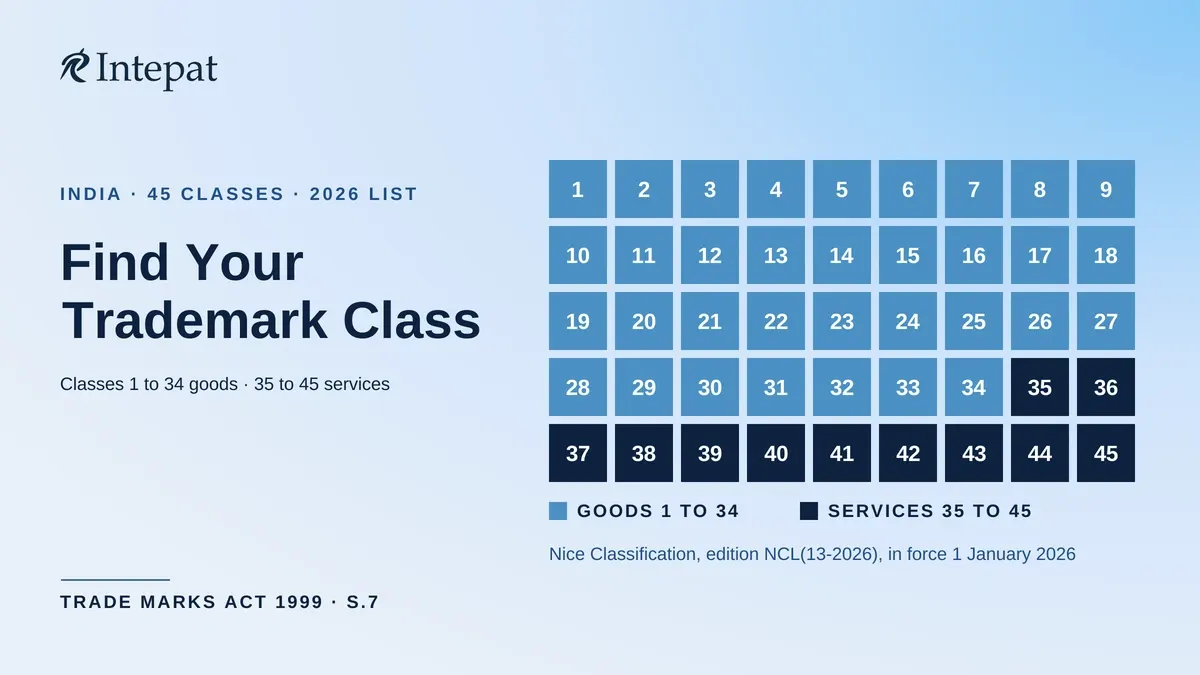
The trademark class list India follows is the Nice Classification, which sorts every product and service into 45 numbered classes: Classes 1 to 34 for goods and Classes 35 to 45 for services. Your registration, on its own, protects your mark only in the classes you file in, and only for the goods or services you describe in each class.
In India the Trade Marks Act 1999 and the Trade Marks Rules 2017 govern how the Registrar applies that list, and the full 2026 edition is set out below, with a lookup by business type first so you can reach the right rows quickly.
Quick answer: There are 45 trademark classes in India. Classes 1 to 34 cover goods and Classes 35 to 45 cover services. Pick the class by what you actually sell or provide under the mark, not by your company name, and file in every class you trade in, because the government fee is counted per class and the protection is limited to the goods or services you register in each class. If the Registrar decides your goods sit in a different class, that decision is final; you then either drop those goods from the application or add the class and pay for it.
Find your trademark class by business type
Most Indian applicants are not chemists or shipbuilders; they run a restaurant, a clothing label, a clinic or an app. The lookup below maps the common ones to the class or classes where the 2026 Nice headings and explanatory notes place them, goods first and services after.
Use it to build a short-list, then check each candidate against the full headings further down.
| What you sell or do | Class or classes to check first |
| Cosmetics, perfumes, non-medicated skincare | 3 |
| Pharmaceuticals, dietary supplements, medicated preparations | 5 |
| Mobile phones, chargers, headphones, downloadable software or apps | 9 (computers, peripherals and downloadable computer software) |
| Spectacles, sunglasses, contact lenses | 10 (now listed in the Class 10 heading) |
| Jewellery, watches | 14 |
| Furniture, mirrors, picture frames, decor | 20 |
| Kitchenware, cleaning articles, glassware | 21 |
| Sarees, dress material, fabric by the metre, bed and bath linen | 24 for fabric by the metre and household linen; 25 for sarees and other garments |
| Clothing, footwear, headwear label | 25 |
| Packaged food: snacks, spices, tea, coffee, bakery | 30, with meat, dairy and processed fruit and vegetables in 29 |
| Fresh produce, seeds, live plants, animal feed | 31 |
| Soft drinks, juices, mineral water, beer | 32, with wines and spirits in 33 |
| Your own retail store, D2C website or wholesale outlet | the goods’ own classes, plus 35 for the retail service |
| Online marketplace or platform listing other sellers’ goods | 35, plus 42 if you also provide the platform as software |
| Advertising agency, business consultancy | 35 |
| Bank, NBFC, insurance, real estate services | 36 |
| Builder, contractor, repair and installation | 37 |
| Logistics, courier, travel agency | 39 |
| Ed-tech, coaching, training, events, entertainment | 41 |
| SaaS, platform as a service, software development | 42 (software as a service is named in the Class 42 note) |
| Restaurant, cafe, cloud kitchen, hotel | 43 |
| Clinic, hospital, diagnostics, salon or spa | 44 (medical services; hygienic and beauty care) |
| Legal services, security services, matchmaking, online social networking | 45 |
Two patterns catch people out. In classification, a shop is a service separate from the things it sells: the Class 35 note covers bringing goods together so customers can view and buy them, whether through retail stores, wholesale outlets or websites. So a product business ordinarily needs the goods class and, if it also sells through its own stores or website, Class 35 as well; a restaurant that bottles its sauces needs Class 30 alongside Class 43. The lookup is a starting point and nothing more, so confirm each entry against the headings below and against the Trademark Classification Tool before you file.
The complete trademark class list India uses: 2026 edition
Here are all 45 class headings from NCL(13-2026), the edition in force since 1 January 2026, as published in WIPO’s Nice Classification. Classes 1 to 34 are goods and 35 to 45 are services, and every heading is WIPO’s own wording.
The Act requires the Registrar to classify goods and services, as far as may be, in line with the international classification, and the Rules fix that as the current Nice edition published by WIPO. A heading summarises what a class contains; it is not a specification (the list of goods or services you type into the application) that you can copy, which is the single most common classification mistake and is dealt with below. If the lookup has already answered you, skip the tables and go to the five traps.
Goods: Classes 1 to 34
The wording below is WIPO’s, reproduced exactly; use it to check that the goods you listed still sit in the class you expect.
| Class | Heading (NCL 13-2026) |
| 1 | Chemicals for use in industry, science and photography, as well as in agriculture, horticulture and forestry; unprocessed artificial resins, unprocessed plastics; fire extinguishing and fire prevention compositions; tempering and soldering preparations; substances for tanning animal skins and hides; adhesives for use in industry; compost, manures, fertilizers; biological preparations for use in industry and science. |
| 2 | Paints, varnishes, lacquers; preservatives against rust and against deterioration of wood; colorants, dyes; inks for printing, marking and engraving; raw natural resins; metals in foil and powder form for use in painting, decorating, printing and art. |
| 3 | Non-medicated cosmetics and toiletry preparations; non-medicated dentifrices; perfumes; bleaching preparations and other substances for laundry use; cleaning, polishing and abrasive preparations. |
| 4 | Industrial oils and greases, wax; lubricants; dust absorbing, wetting and binding compositions; fuels and illuminants; candles and wicks for lighting. |
| 5 | Pharmaceuticals, medical and veterinary preparations; sanitary preparations for medical purposes; dietetic food and substances adapted for medical or veterinary purposes, food for babies; dietary supplements for human beings and animals; adhesive plasters, materials for dressings; material for filling teeth, dental wax; disinfectants; preparations for destroying vermin; fungicides, herbicides. |
| 6 | Common metals and their alloys, ores; metal materials for building and construction; transportable buildings of metal; non-electric cables and wires of common metal; small items of metal hardware; metal containers for storage or transport; safes. |
| 7 | Machines, machine tools, power-operated tools; motors and engines, except for land vehicles; machine coupling and transmission components, except for land vehicles; agricultural implements, other than hand-operated hand tools; incubators for eggs; automatic vending machines. |
| 8 | Hand-operated hand tools and implements; cutlery; side arms, except firearms; razors. |
| 9 | Scientific, research, navigation, surveying, photographic, cinematographic, audiovisual, optical, weighing, measuring, signalling, detecting, testing, inspecting, life-saving and teaching apparatus and instruments; apparatus and instruments for conducting, switching, transforming, accumulating, regulating or controlling the distribution or use of electricity; apparatus and instruments for recording, transmitting, reproducing or processing sound, images or data; recorded and downloadable multimedia files, computer software, blank digital or analogue recording and storage media; mechanisms for coin-operated apparatus; cash registers, calculating devices; computers and computer peripheral devices; diving suits, divers’ masks, ear plugs for divers, nose clips for divers, gloves for divers, breathing apparatus for underwater swimming; fire-extinguishing apparatus. |
| 10 | Surgical, medical, dental and veterinary apparatus and instruments; artificial limbs, eyes and teeth; spectacles, contact lenses and sunglasses; orthopaedic articles; suture materials; therapeutic and assistive devices adapted for persons with disabilities; massage apparatus; apparatus, devices and articles for nursing infants; sexual activity apparatus, devices and articles. |
| 11 | Apparatus and installations for lighting, heating, cooling, steam generating, cooking, drying, ventilating, water supply and sanitary purposes. |
| 12 | Vehicles; apparatus for locomotion by land, air or water. |
| 13 | Firearms; ammunition and projectiles; explosives; fireworks. |
| 14 | Precious metals and their alloys; jewellery, precious and semi-precious stones; horological and chronometric instruments. |
| 15 | Musical instruments; music stands and stands for musical instruments; conductors’ batons. |
| 16 | Paper and cardboard; printed matter; bookbinding material; photographs; stationery and office requisites, except furniture; adhesives for stationery or household purposes; drawing materials and materials for artists; paintbrushes; instructional and teaching materials; plastic sheets, films and bags for wrapping and packaging; printers’ type, printing blocks. |
| 17 | Unprocessed and semi-processed rubber, gutta-percha, gum, asbestos, mica and substitutes for all these materials; plastics and resins in extruded form for use in manufacture; packing, stopping and insulating materials; flexible pipes, tubes and hoses, not of metal. |
| 18 | Leather and imitations of leather; animal skins and hides; luggage and carrying bags; umbrellas and parasols; walking sticks; whips, harness and saddlery; collars, leashes and clothing for animals. |
| 19 | Materials, not of metal, for building and construction; rigid pipes, not of metal, for building; asphalt, pitch, tar and bitumen; transportable buildings, not of metal; monuments, not of metal. |
| 20 | Furniture, mirrors, picture frames; containers, not of metal, for storage or transport; unworked or semi-worked bone, horn, whalebone or mother-of-pearl; shells; meerschaum; yellow amber. |
| 21 | Household or kitchen utensils and containers; cookware and tableware, except forks, knives and spoons; combs and sponges; brushes, except paintbrushes; brush-making materials; articles for cleaning purposes; unworked or semi-worked glass, except building glass; glassware, porcelain and earthenware. |
| 22 | Ropes and string; nets; tents and tarpaulins; awnings of textile or synthetic materials; sails; sacks for the transport and storage of materials in bulk; padding, cushioning and stuffing materials, except of paper, cardboard, rubber or plastics; raw fibrous textile materials and substitutes therefor. |
| 23 | Yarns and threads for textile use. |
| 24 | Textiles and substitutes for textiles; household linen; curtains of textile or plastic. |
| 25 | Clothing, footwear, headwear. |
| 26 | Lace and embroidery, and haberdashery ribbons and bows; buttons, hooks and eyes, pins and needles; artificial flowers; hair decorations; false hair. |
| 27 | Carpets, rugs, mats and matting, linoleum and other materials for covering existing floors; wall hangings, not of textile. |
| 28 | Games, toys and playthings; video game apparatus; gymnastic and sporting articles; decorations for Christmas trees. |
| 29 | Meat, fish, poultry and game; meat extracts for culinary purposes; preserved, frozen, dried and cooked fruits, vegetables and seaweeds; jellies, jams, compotes; eggs; milk, cheese, butter, yogurt and other milk products; oils and fats for food. |
| 30 | Coffee, tea, cocoa and substitutes therefor; rice, pasta and noodles; tapioca and sago; flour and preparations made from cereals; bread, pastries and confectionery; chocolate; ice cream, sorbets and other edible ices; sugar, honey, treacle; yeast, baking-powder; salt, seasonings, spices, preserved herbs; vinegar, sauces and other condiments; ice (frozen water). |
| 31 | Raw and unprocessed agricultural, aquacultural, horticultural and forestry products; raw and unprocessed grains and seeds; fresh fruits and vegetables, fresh herbs; natural plants and flowers; bulbs, seedlings and seeds for planting; live animals; foodstuffs and beverages for animals; malt. |
| 32 | Beers; non-alcoholic beverages; mineral and aerated waters; fruit beverages and fruit juices; syrups and other preparations for making non-alcoholic beverages. |
| 33 | Alcoholic beverages, except beers; alcoholic preparations for making beverages. |
| 34 | Tobacco and tobacco substitutes; cigarettes and cigars; electronic cigarettes and oral vaporizers for smokers; smokers’ articles; matches. |
Services: Classes 35 to 45
| Class | Heading (NCL 13-2026) |
| 35 | Advertising; business management, organization and administration; office functions. |
| 36 | Financial, monetary and banking services; insurance services; real estate services. |
| 37 | Construction services; installation and repair services; mining extraction, oil and gas drilling. |
| 38 | Telecommunications services. |
| 39 | Transport; packaging and storage of goods; travel arrangement. |
| 40 | Treatment of materials; recycling of waste and trash; air purification and treatment of water; printing services; food and drink preservation. |
| 41 | Education; providing of training; entertainment; sporting and cultural activities. |
| 42 | Scientific and technological services and research and design relating thereto; industrial analysis, industrial research and industrial design services; quality control and authentication services; design and development of computer hardware and software. |
| 43 | Services for providing food and drink; temporary accommodation. |
| 44 | Medical services; veterinary services; hygienic and beauty care for human beings or animals; agriculture, aquaculture, horticulture and forestry services. |
| 45 | Legal services; security services for the physical protection of tangible property and individuals; dating services, online social networking services; funerary services; babysitting. |
Class headings verified against WIPO’s Nice Classification publication, edition NCL(13-2026), as of October 2026. In the current edition, spectacles, contact lenses and sunglasses sit in the Class 10 heading, Class 25 reads “headwear”, and the Class 45 heading names dating, social networking, funerary and babysitting services. Older lists differ on exactly these lines: our comparison found the classification document on the Registry’s own website still reads “headgear” in Class 25 and omits power-operated tools and vending machines from Class 7.
Why the class you file in decides what you own
A trademark registration in India is not a monopoly over a word; it is a right in that word for the goods or services on the register, and that register is organised by class, so the classes you file in set the outer edge of the right.
The Act lets one application cover several classes for a single mark (a word mark and a logo are two applications), but the fee is payable for each class, and the opposition and the renewal run class by class too.
The fee makes the point concrete. The government fee for a trademark application is Rs 4,500 per class for e-filing by an individual, a startup recognised under the Startup India initiative or a small enterprise, and Rs 9,000 per class for everyone else, with physical filing costing Rs 5,000 and Rs 10,000 respectively (First Schedule to the Trade Marks Rules 2017, verified as of October 2026). Each class is also renewed separately every ten years at Rs 9,000 for e-filing or Rs 10,000 for physical filing, with no reduced rate for individuals or small enterprises, so a class carried for its full life costs several times its filing fee.
A clothing brand that files in Class 25 alone and later opens an online store has paid for one class and owns one class. What Class 35 adds is the retail service itself: a rival who runs a store or marketplace under the same name, selling other people’s goods, is using the mark for a service the Class 25 registration does not cover. Until a fresh application is filed and examined from scratch, that service sits outside the registration, and any claim against the rival has to be built on reputation rather than on the register.
Enforcement follows the same line. An infringement claim starts from the goods or services for which the mark is registered. Use of the mark on similar goods can still infringe where confusion is likely, and use on dissimilar goods can infringe where the mark has a reputation in India and the use takes unfair advantage of it, but each of those is a further question of fact and harder to win than pointing to a registration that covers the goods. The trademark registration process in India is the same for one class or five; the choice of classes is where the long-term value is set.
Five classification traps Indian applicants fall into
Classification problems in Indian filings tend to come from five habits rather than from hard cases. Each can be avoided before filing at no cost beyond a careful hour spent on the list of goods and services.
After filing, a class you left out can only be covered by starting again, and because the Registrar’s decision on class is final there is little room to argue the point later.
Filing by company name instead of by what you sell
The class is determined by the goods or services, not by the applicant’s trade name, main objects or industry label. “Technologies Private Limited” tells the Registry nothing; a company of that name that makes LED lamps belongs in Class 11, and one that runs a food delivery app may need Classes 9 (the app), 35 (the ordering platform), 39 (delivery) and 43 (the food). Start from a written list of what the mark will actually appear on.
The same test applies to future plans. The Act allows an application for a mark that is only proposed to be used, so a class for a product in development is legitimate. What the Rules let the Registrar refuse is a claim to all the goods in a class, or a large variety of them, unless the use made or intended justifies it. Cover what you sell now and what is already in development; a class for a vague “one day” idea is a fee with little behind it.
Copying the class heading as your specification
The heading describes the class; it is not a list of goods. The Rules direct that the goods and services named in an application should, as far as may be, correspond to the Registrar’s published class-wise and alphabetical index, which includes goods and services of Indian origin. Write a specification that names your products in ordinary trade terms, wide enough to cover the next two years, and no wider.
Choosing one class for a goods-and-services business
A manufacturer with its own retail outlets, a software company that sells both a downloadable app and a subscription service, a clinic that also sells its own skincare line: each of these trades in two or more classes and needs each of them. One multi-class application is usually the cleaner route. It is examined as one, and if it is opposed in one class only (opposed, meaning a third party objects before registration), the unopposed classes wait until you ask for the application to be divided on Form TM-M and pay the divisional fee of Rs 1,800 for e-filing or Rs 2,000 for physical filing; each divided application keeps the filing date of the original, so nothing is lost on priority by splitting it later. Our guide to multiple trademark classes in India weighs the multi-class route against separate filings.
Working from the Registry’s outdated class list
The Rules point to the current edition of the Nice Classification published by WIPO, but the classification document on the Registry’s website carries no edition number or date, and our comparison found its wording for several classes matches a Nice edition from more than a decade ago. The practical risk is goods that moved class in later editions, such as sunglasses, now in the Class 10 heading. Use WIPO’s publication or the tables above for the class, and treat the Registry’s published index as what the Rules make it: the list your terms should correspond to as far as may be, not the current class headings.
Assuming you can move or widen the classes after filing
You can correct or add a class after filing only within limits, and only for goods you already listed; it is not a way to add goods or services you left out. If the Registrar finds that goods you listed also fall in a class you did not apply for, you must either restrict the specification or add that class by a request on Form TM-M with the appropriate fee; the amendment request itself carries Rs 900 for e-filing or Rs 1,000 for physical filing, and expect the class fee for the added class as well. Where all the goods belong in a different class from the one specified, the Registrar may, but need not, permit a correction of class on the same form.
What you cannot do, before or after acceptance, is amend the application to substitute a new specification of goods or services not included in the application as filed. The Registry will not let you swap “restaurant services” for “packaged spices” in an existing application. Goods you left out need a new application, and that application takes its own filing date, so anyone who filed a similar mark for those goods in the meantime now stands ahead of you.
After registration there is one further route, and it is narrow. When WIPO amends the Nice Classification, a registered proprietor (the owner on the register) may apply on Form TM-P to convert the specification so that it matches the amended classification. That brings an old registration into line with a re-numbered edition; it does not add goods that were never claimed.
When one class is not enough
If your mark will appear on goods in one class and a service in another, file in both, together where you can, and write the specification inside each class with as much care as the class number itself.
The trade-offs between one multi-class application and separate filings, including the cost of dividing and the risk of a shared examination report (the Registry’s first objections letter), are covered in multi-class trademark applications: benefits and drawbacks and in our note on divisional applications for multi-class trademarks. For what the wording inside the class does to your rights, see how the specification of goods and services limits your rights.
Before you file
Write down what the mark will appear on in the next two years, find the class for each item in the 2026 list above or by typing the goods into the trademark class search tool, and then run a trademark search in each of those classes before paying a per-class fee for a mark that an earlier filer already holds there.
Then write the specification for each class in plain trade language, naming the products or services rather than pasting the heading, and keep it to what the business does or is about to do. In a multi-class application the Rules require the classes to be set out in ascending numerical order with the goods or services listed under each. A single-class filing for a single product is work many applicants can do alone; the cases that repay professional review are the ones with goods and services together, or a product that sits near a class boundary.
A class choice that looks like a formality on the application form is the boundary of everything the registration will ever do for you: what it costs, what the examiner compares it against, what an opponent can attack, and what a court will let you stop. Intepat’s trademark attorneys in Bengaluru handle class selection and specification drafting as part of every trademark registration in India, so that the classes on the form match the business behind the mark.
This article explains how goods and services are classified for trademark registration in India as at October 2026 and is for general information only. It is not legal advice. Class headings, government fees and Registry practice change; confirm the current Nice edition and fee schedule before you file. For advice on the classes that fit your business, consult a trademark attorney.