




A trademark examination report is the Trade Marks Registry’s written notice of objections under Rule 33 of the Trade Marks Rules 2017. A trademark objection reply in India must directly answer the Section 9 or Section 11 grounds raised in the examination report. If no response is filed within one month of receipt, Rule 33(4) provides that the Registrar may treat the application as abandoned.
The governing statute is the Trade Marks Act 1999; the procedural rules are the Trade Marks Rules 2017 (as amended). Where Registry practice is described, the source is the Manual of Trade Marks, a draft practice document referencing the Trade Marks Rules 2002; those descriptions are guidance on Registry procedure, not authoritative statements of current law.
This is a procedural guide. The correct response depends on the exact objections raised and the facts of use in each application. For full context on what the registration process looks like before and after the examination stage, see the complete guide to trademark registration in India.
| Item | Detail |
| Response deadline | One month from date of receipt (Rule 33(4)) |
| Service modes | At address for service (personal delivery), by post, or by email; email deemed served at time of sending (Rule 18(2)) |
| Consequence of no response | Registrar may treat application as abandoned (Rule 33(4)) |
| Extension | Form TM-M under Rule 109; capped at one month; refusal not appealable (Section 131(2)) |
| Objection types | Section 9 (absolute grounds); Section 11(1) (relative grounds) |
| Hearing | Triggered if response unsatisfactory or applicant requests one (Rule 33(6)) |
| Outcome after hearing | Registrar passes appropriate order (Rule 33(8)) |
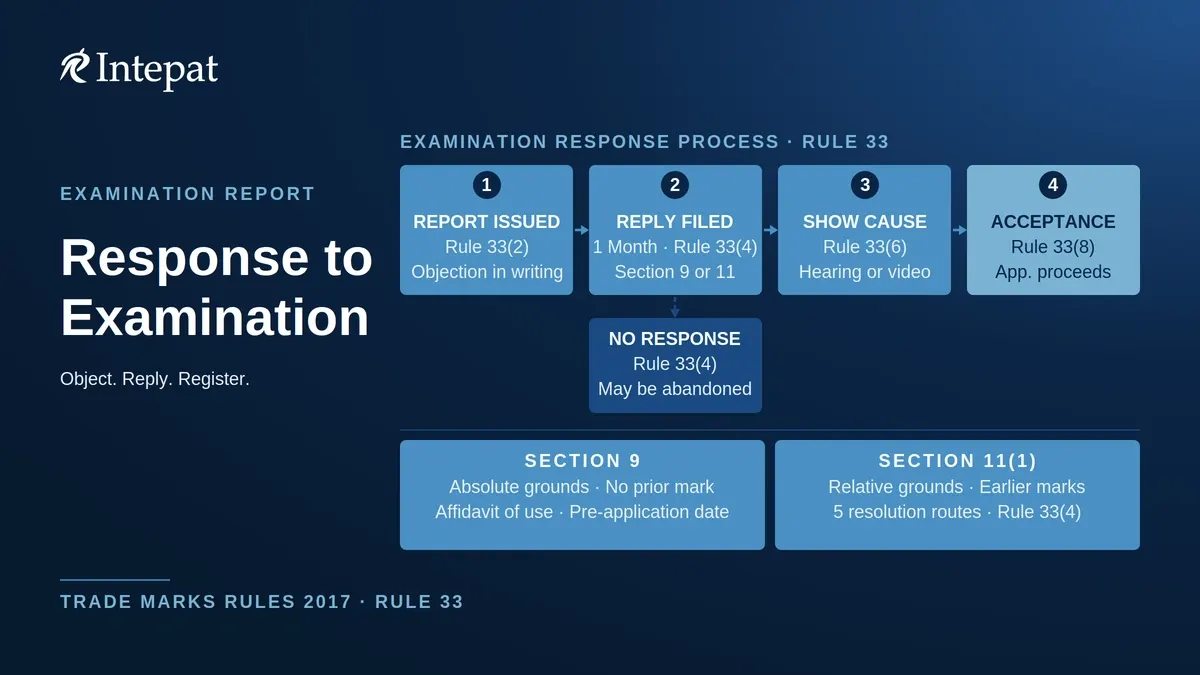
What a Trademark Examination Report Is
When a trademark application is filed under Section 18 of the Trade Marks Act 1999, the Registrar examines it. Under Rule 33(1), the examination includes a search among earlier trademarks to identify marks identical with or deceptively similar (likely to cause confusion) to the applied mark for the same or similar goods or services.
If no objection is found, the Registrar accepts absolutely under Rule 33(3) and causes the application to be advertised under Section 20(1). A report is issued when the outcome differs. Under Rule 33(2), any objection to acceptance, or a proposal to accept subject to conditions under Section 18(4), is communicated in writing as an examination report. The draft Manual of Trade Marks describes the Registry practice of publishing the report on the IP India portal and sending a copy by post or email.
Receiving a report does not mean the application has been refused. It means the application cannot proceed to advertisement until the objections are addressed. The examination stage sits within the broader trademark registration process in India.
Trademark Objection Reply Deadline in India
Rule 33(4) sets the response period at one month from the date of receipt of the examination report. If no response is filed, the Registrar may treat the application as abandoned.
Service modes and the deemed-delivery rule. Under Rule 18(1), the Registry may serve the report by leaving it at the address for service, by post, or by email. Under Rule 18(2), email service is deemed effected at the time of sending, not at the time of reading. Postal service is deemed effected when the letter would be delivered in the ordinary course of post. An applicant monitoring only the paper post may misidentify the deadline where service was by email. Checking application status on IP India as soon as an objection appears online is the more reliable approach.
Abandonment is discretionary, not automatic. Rule 33(4) uses “may,” not “shall.” Section 132 of the Trade Marks Act 1999 further provides that the Registrar may serve a notice requiring the default to be remedied before treating the application as abandoned. Per the draft Manual, if no response is received within one month of postal receipt, the system generates a Section 132 notice requiring a response within a further one month. This two-step practice is described in the draft Manual; it is not a statutory guarantee of additional time.
Extension under Rule 109. An extension may be sought under Section 131, read with Rule 109, using Form TM-M. Rule 109(1) excludes times expressly provided in the Act, times prescribed by Rule 85 or Rule 86(3), and any time for which extension provision is otherwise made in the Rules; the Rule 33(4) response period is not among those excluded, so an extension under Rule 109 is generally available. Rule 109(2) caps the extension at one month and permits it even after the original period has expired, but the Registrar retains full discretion. Section 131(2) provides that no appeal lies from any order of the Registrar on an extension application.
File a substantive response within the original period rather than rely on an extension or the Section 132 sequence.
Section 9 Objections: Absolute Grounds
Section 9 of the Trade Marks Act 1999 sets out absolute grounds, assessed without reference to any third-party mark.
Section 9(1): Three categories are prohibited: marks devoid of any distinctive character (Section 9(1)(a)), marks consisting exclusively of descriptive indications (Section 9(1)(b)), and marks consisting exclusively of indications customary in the relevant trade (Section 9(1)(c)). The proviso to Section 9(1) provides that a mark shall not be refused if, before the date of application, it has acquired a distinctive character through use, or if it is a well-known trade mark.
Section 9(2): Marks that are deceptive, likely to hurt religious susceptibilities, scandalous, or prohibited under the Emblems and Names (Prevention of Improper Use) Act 1950. The Section 9(1) acquired-distinctiveness proviso does not cure a Section 9(2) prohibition; the response must address why the specific prohibition is not attracted.
Section 9(3): Marks consisting exclusively of a shape resulting from the nature of the goods, a shape necessary to obtain a technical result, or a shape that gives substantial value to the goods.
Section 9 Trademark Objection Reply
For a Section 9(1) objection, two arguments are available: a direct challenge that the mark is capable of distinguishing, or a proviso argument that the mark acquired distinctive character through use before the application date.
Where acquired distinctiveness is claimed, the response must be supported by an affidavit of use. Per the draft Manual of Trade Marks, the affidavit must state: use in relation to the specific goods or services applied for, when use first commenced, and annual turnover from use of the mark. The Registry also considers the intensity and geographic spread of use, its duration, promotion spend, the proportion of the relevant consumer class who associate the mark with the applicant, and trade association statements.
| Evidence type | What it should show |
| Invoices and sales records | Use in commerce; goods or services sold; dates of sale |
| Annual turnover figures | Revenue attributable to the mark, pre-filing, year by year |
| Advertisements and promotional materials | Mark used in trade promotion; duration and geographic reach |
| Website and social media records | Online use; date of first web use |
| Packaging samples | Mark as used on goods placed on the market |
| Media coverage | Third-party recognition of the mark |
| Distributor or customer declarations | Trade and consumer recognition of source |
| Trade association statements | Industry recognition |
| Geographic spread evidence | Use across multiple cities, states, or regions in India |
| First-use proof | Earliest date of use prior to the filing date |
| Post-filing use and the Section 9(1) proviso |
| The proviso requires acquired distinctiveness before the application date. Post-filing use does not satisfy the proviso where pre-application acquired distinctiveness is required, though it may assist only as background or continuity evidence. The affidavit must make the pre-application use period explicit. |
Section 11 Objections: Relative Grounds
Section 11 governs relative grounds, arising from conflict with earlier rights.
Section 11(1) applies where the applied mark is identical with an earlier trade mark and the goods or services are similar, or where the applied mark is similar to an earlier trade mark and the goods or services are identical or similar, and in either case a likelihood of confusion on the part of the public results, including likelihood of association with the earlier mark.
The Section 11 Explanation defines “earlier trade mark” to include: a registered trade mark or an application under Section 18 bearing an earlier filing date; an international registration under Section 36E; a convention application under Section 154 with an earlier application date; and a trade mark entitled to well-known mark protection on the relevant date. The examination report will identify the specific earlier marks the Examiner considers conflicting.
Statutory boundary at examination. Section 11(5) limits the Registrar’s grounds for refusal at examination to Section 11(1). Grounds under Section 11(2) (well-known marks against dissimilar goods) and Section 11(3) (passing off or copyright) may only be raised by the proprietor in opposition proceedings. An Examiner may note a well-known mark in the report, but refusal on Section 11(2) grounds requires the proprietor to raise it in opposition. A thorough trademark search before filing reduces the likelihood of a Section 11(1) objection arising.
Section 11 Trademark Objection Reply
| Column | Purpose |
| Cited mark number and name | Identifies the earlier mark |
| Class and goods/services | Scope of the cited registration |
| Status (registered/applied) | Weight of the citation |
| Applicant’s use claim | Pre-filing use supporting concurrent-use argument |
| Mark similarity | Visual, phonetic, conceptual comparison |
| Goods/services similarity | Whether specifications genuinely overlap |
| Trade channels | Whether goods or services reach the same consumers |
| Proposed argument | Amendment, consent, concurrent use, non-use removal, or division |
This is a working framework, not a prescribed Registry form.
- Remove conflicting goods or services by amendment. Narrow the specification to exclude the conflict. Draft the exclusion surgically: over-broad exclusions create enforcement gaps that a third party may exploit. An amendment permanently limits the registration’s scope.
- Obtain consent from the proprietor of the cited mark under Section 11(4). A consent letter removes the Section 11 bar. However, Section 11(4) provides that “the Registrar may register the mark under special circumstances under section 12,” meaning the Registrar retains discretion and may impose conditions or require coexistence evidence. A consent letter should identify the marks, application/registration numbers, goods/services, territory, coexistence basis, and absence of likely confusion.
- File honest concurrent use evidence under Section 12. Section 12 permits the Registrar to allow registration by more than one proprietor where both marks have coexisted honestly in the market. This route requires affidavit evidence of independent parallel use.
- Pursue non-use removal under Section 47 or rectification under Section 57. Where the cited mark has not been used in bona fide commerce, apply under Section 47 for removal. Section 47(1)(b) requires a continuous period of five years from the date on which the mark is actually entered in the register, up to three months before the date of the non-use application, during which there was no bona fide use. Section 47 proceedings may be filed before the Registrar or the High Court (following the Tribunals Reforms Act 2021, which substituted “High Court” for “Appellate Board”). Where the issue is an entry wrongly remaining on the register, Section 57 applies. These are separate proceedings pursued in parallel with the examination response.
- Divide the application. Divide so that the uncontested part of the specification proceeds to advertisement while the contested part is dealt with separately.
| Practitioner note |
| Consent is the most direct resolution where markets do not genuinely overlap, but Registrar discretion under Section 12 means conditions may still apply. Narrowing the specification is the fastest step but permanently limits scope. For the opposition stage at which Section 11(2) and 11(3) grounds arise, see trademark opposition in India. |
Trademark Objection Reply Format and Documents
The trademark objection reply is not filed on a prescribed form. Connected requests (extension of time, amendment, authorisation of agent, or written grounds of decision) each require Form TM-M.
A standard trademark objection reply is structured as follows:
- Application details: number, filing date, mark, class, goods/services
- Objection summary: each objection by section number, citing the exact language from the report
- Section 9 response: with proviso argument and evidence references where applicable
- Section 11 response: with cited-mark comparison and chosen route
- Evidence relied upon: affidavit, exhibits indexed
- Amendment request: if goods or services are being narrowed
- Hearing request: if oral submissions are intended (Rule 33(6))
- Prayer: specific relief sought
Pre-submission checklist
- Application number, filing date, mark, class, and specification confirmed
- Each objection listed by section number
- Cited marks listed with registration/application numbers (Section 11 objections)
- Section 9 arguments drafted; affidavit of use prepared with exhibits indexed
- Section 11 comparison completed; chosen route confirmed
- Amendment request drafted if specification is being narrowed
- Authorisation in Form TM-M if a new agent is being appointed
- Hearing request included in response if oral submissions are intended
- Filing mode confirmed
Submission modes
E-filing through the IP India portal using the required Class III DSC or current authentication mechanism is the preferred current route. Older draft Manual practice refers to an email submission channel; verify the Registry’s active filing channels on the IP India portal before use. Physical submission is available at the head office or appropriate office of the Registry.
Rule 17(1) requires every applicant to maintain an address for service in India comprising a postal address and a valid email address. A foreign applicant must maintain such an address. Representation before the Registry may be by a legal practitioner, a registered trade marks agent, or a person in the sole and regular employment of the applicant, per Section 145 of the Trade Marks Act 1999. Authorisation of an agent is executed in Form TM-M under Rule 19(1).
International registrations designating India. International registrations designating India under the Madrid Protocol may also receive examination objections on the same substantive grounds (Section 9 and Section 11). Responses are handled through the local Indian representative within the refusal period under Article 5 of the Madrid Protocol, as preserved by Rule 68(2) of the Trade Marks Rules 2017, not the standard one-month Rule 33(4) period.
The Show Cause Hearing
Rule 33(5): if the Registrar accepts after considering the response, the application proceeds to advertisement under Section 20(1).
Rule 33(6): if the response is unsatisfactory or the applicant requests a hearing, the Registrar provides an opportunity of hearing. Per the draft Manual, this is the show cause hearing, scheduled at the appropriate office determined by the applicant’s principal place of business in India under Section 18(3), or by the address for service where the applicant has no place of business in India.
Rule 115(1): hearings may be held in person or by video conferencing. Rule 33(7): if the applicant fails to appear and no written response has been submitted, the Registrar may treat the application as abandoned. This does not apply where a written response was already on record.
Rule 33(8): the Registrar passes an appropriate order: acceptance, conditional acceptance under Section 18(4), or refusal. Section 18(5) requires the grounds and materials to be stated in writing where refusal or conditional acceptance is recorded. Further guidance on the trademark show cause hearing is available separately.
What Happens If the Application Is Refused
Request written grounds. If the applicant intends to appeal, Rule 36(1) permits a Form TM-M application to the Registrar within thirty days of communication of the decision, requiring the Registrar to state in writing the grounds and materials used. Under Rule 36(3), the date of receipt of that written statement is deemed the date of the Registrar’s decision for calculating the appeal period.
Appeal. Section 91(1) provides that an appeal may be preferred within three months from the date on which the order is communicated. Section 91 should now be read with the Tribunals Reforms Act 2021, which substituted “High Court” for “Appellate Board” in Section 91; trademark appeals from Registrar decisions are now heard by the relevant High Court. Under Section 91(2), an appeal may be admitted after the three-month period if the appellant satisfies the court that there was sufficient cause. Verified as of May 2026.
Common Mistakes in Trademark Objection Replies
- Missing the deadline because of email service. Where the report is served by email, Rule 18(2) deems service at the time of sending. Applicants monitoring only the paper post may miscalculate the one-month window.
- Relying only on post-filing use. The Section 9(1) proviso requires distinctiveness acquired before the application date. Post-filing use does not satisfy it.
- Filing a generic denial. A bare denial that “the mark is distinctive” without supporting argument or evidence is unlikely to satisfy the Registrar.
- Failing to compare cited marks. For Section 11 objections, each cited mark must be assessed individually on similarity of mark, similarity of goods, and likelihood of confusion.
- Over-narrowing goods or services. An amendment that excludes too broad a class of goods may leave the registration unable to protect the applicant’s actual commercial activities.
- Not indexing affidavit exhibits. Exhibits should be numbered and indexed, with each cross-referenced in the affidavit text.
- Not requesting a hearing where strategic. Rule 33(6) permits the applicant to request a hearing. Where objections are complex, a hearing request in the response preserves that option.
When to Instruct a Trademark Attorney
A Section 9(1) objection supported by clear, pre-filing, mark-specific use records may be manageable in-house, but the Registrar’s assessment remains fact-sensitive.
Professional handling is the more considered course where: a Section 11(1) objection involves multiple cited marks requiring individual assessment; the registration’s scope depends on the amendment drafted; a Section 9(2) objection requires a legal argument that the prohibition is not attracted; or a multi-class application carries partial conflicts across classes. Errors made in the response carry forward into the registration itself.
For examination report responses, affidavit preparation, and show cause hearing representation, Intepat’s trademark registration services provide practitioner-led support across all objection types.
Official Sources
- Trade Marks Act, 1999 (IP India)
- Trade Marks Rules, 2017 (IP India)
- IP India trademark status portal: for application status and examination report publication
- Manual of Trade Marks: draft practice guidance referencing Trade Marks Rules 2002
Frequently Asked Questions
A trademark examination report is the Trade Marks Registry’s written communication under Rule 33(2) of the Trade Marks Rules 2017, issued when the Registrar has an objection to accepting an application or proposes to accept it subject to conditions. It must be responded to within one month of receipt.
Rule 33(4) provides one month from the date of receipt. Where the report is served by email, Rule 18(2) deems service at the time of sending, so the deadline may begin earlier than the date of postal receipt. If no response is filed, the Registrar may treat the application as abandoned.
An extension may be sought under Section 131 and Rule 109, using Form TM-M. Rule 109(2) allows the Registrar, at discretion, to extend the time by not more than one month, even after the original period has expired. Under Section 131(2), no appeal lies from a refusal of the extension application.
A Section 9 objection relates to characteristics of the mark itself and is assessed without reference to any third-party mark. A Section 11(1) objection arises from an earlier trade mark the Examiner considers identical or similar to the applied mark for the same or similar goods or services.
Yes, for Section 9(1)(a), (b), or (c). The proviso to Section 9(1) provides that a mark shall not be refused if it has acquired a distinctive character through use before the application date. Post-filing use does not satisfy the proviso where pre-application acquired distinctiveness is required. A Section 9(2) prohibition is not cured by the Section 9(1) proviso; the response must address why the prohibition is not attracted.
A show cause hearing is scheduled under Rule 33(6) when the response does not satisfy the Registrar or the applicant has requested one. It is conducted at the appropriate office or by video conferencing under Rule 115(1). After the hearing, the Registrar passes an appropriate order under Rule 33(8).
Honest concurrent use under Section 12 permits the Registrar to allow registration of similar marks for similar goods where both proprietors have used their marks honestly and in parallel. It requires affidavit evidence of independent parallel use, its duration and geographic extent.
Examination reports are published on the IP India portal. Checking your application status on IP India is the most direct way to confirm whether a report has been issued.
If intending to appeal, apply in Form TM-M within thirty days under Rule 36(1) for the written grounds of decision. Under Rule 36(3), receipt of that statement starts the appeal period. An appeal may then be filed within three months under Section 91, now read with the Tribunals Reforms Act 2021 (appeals heard by the relevant High Court). Late admission is possible on sufficient cause under Section 91(2).
Under Rule 33(4) and Section 132, the pending application is no longer prosecuted and the filing date is ordinarily lost unless revived through an appropriate administrative or court remedy. A fresh application carries a later priority date; any mark applied for in the intervening period could take priority.
This article is for general information only and does not constitute legal advice. The procedure for responding to a trademark examination report depends on the specific objections raised and the facts of the application. Readers should consult a registered trademark attorney for advice on their particular report. Procedural references are verified as of May 2026 and are subject to amendment by the Trade Marks Registry.