




Electric vehicle patents in India now span a broader range of technology than a simple two-wheeler count would suggest. Common technology areas visible in the Indian EV filings reviewed here include battery management, motor and controller design, regenerative braking, and charging infrastructure, with two-wheeler manufacturers, diversified auto majors, and battery specialists all building positions in India.
Quick answer: Common technology areas in electric vehicle patent filings reviewed in India include battery management, motors and controllers, regenerative braking, and charging or battery-swapping systems. Two-wheeler manufacturers (TVS, Bajaj, Ather), diversified auto majors (Tata Motors, Mahindra), and battery or power-electronics specialists (Servotech, Shakti Pumps) are all filing in this space. Two Madras High Court rulings on TVS Motor applications, one in 2024 on an EV-specific regenerative-braking claim and one in 2025 on a general two-wheeler frame design, both show the Patent Office being sent back to re-examine rejections it had not adequately reasoned.
Where Electric Vehicle Patents in India Are Concentrated by Sector
Electric vehicle filings sit within a broader Indian patent system that crossed 1,10,375 applications in FY2024-25, but the Patent Office publishes no dedicated EV category, so sector-specific figures below draw on third-party landscape tools rather than an official count.
Patent filings in India crossed 1,10,375 applications in the financial year 2024-25, per the CGPDTM Annual Report 2024-25, with Indian-resident applicants accounting for 68,201 of those filings (61.79% of the total). The Annual Report’s own field-of-invention breakdown does not carry a dedicated electric vehicle or automotive category; EV-related filings are scattered across its Mechanical Engineering, Electrical, Computer Science & Electronics, and Communication fields alongside everything else filed in those categories.
A 2026 patent landscape analysis by PatSnap Eureka, covering 1,603 patent families worldwide, found that annual EV-technology filings globally grew from 40 families in 2017 to a recorded peak of 303 in 2024 (2025 and 2026 figures in that dataset are understated by publication lag, since a filing typically is not visible in landscape tools until well after it is made). Separately, the same analysis ranks India as the leading jurisdiction by patent-record count for electric vehicle technology, with 600 records, ahead of the United States (545) and the European Patent Office (248); records and families are counted differently, so this ranking should not be read as saying India itself produced 600 of the 1,603 global families, or that the 40-to-303 growth curve describes Indian filings specifically. A reader wanting the mechanics of how such a landscape is actually built, rather than one dataset’s headline numbers, can see Intepat’s guide to patent landscape analysis.
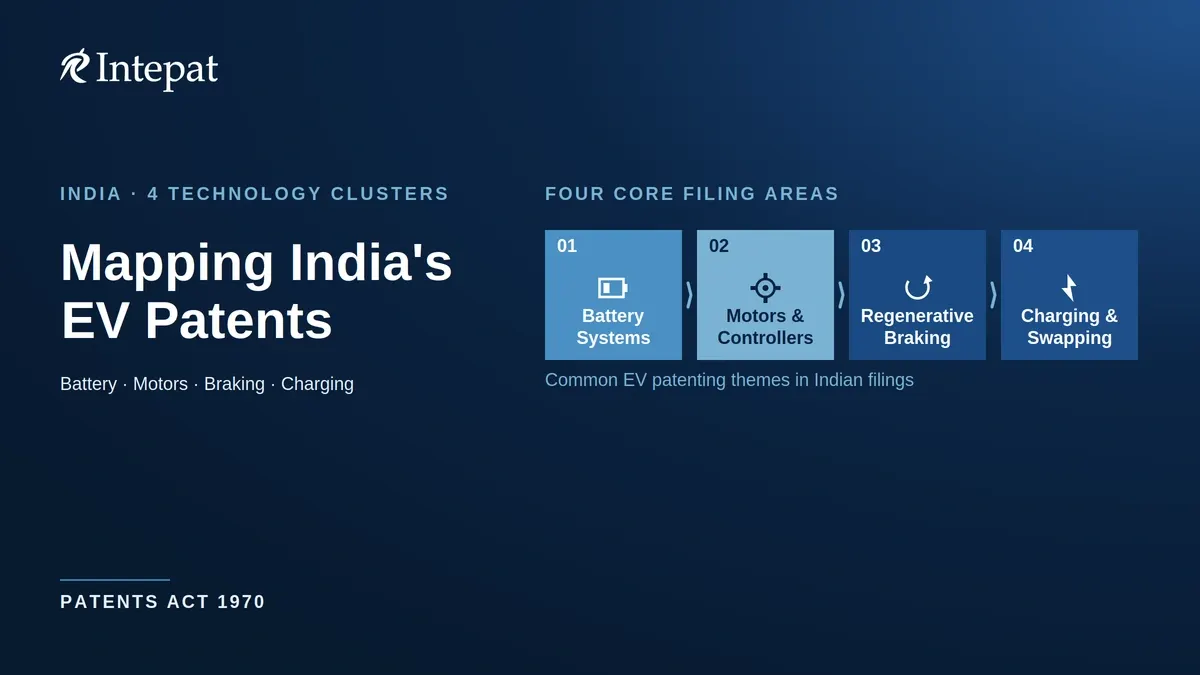
Common EV patenting themes visible in that global dataset include electric-vehicle propulsion (the largest single technology class), power supply and grid/charging systems, and batteries and cells, with business-process and drivetrain-integration claims forming smaller secondary groups. That composition is drawn from the worldwide corpus rather than an India-specific breakdown, so it should be read as an indication of where EV innovation concentrates generally, not a ranking of Indian filing activity. Common EV patenting themes visible in Indian filing activity, drawn from the reported examples below rather than a quantitative ranking, include:
- Battery systems and battery management. Cell arrangement, thermal management, and the control logic that governs charging, balancing, and fault detection.
- Motors and controllers. Hub motors, permanent-magnet designs, and the microcontroller or MOSFET-based switching systems that drive them.
- Regenerative braking. Systems that recover braking energy, increasingly claimed with user-selectable or battery-state-dependent modes rather than a single fixed mode.
- Charging and battery-swapping infrastructure. Fast-charging hardware, grid-interaction features, and swappable-battery mechanisms for shared-mobility fleets.
A patentability search scoped to the specific cluster a product sits in, rather than the sector as a whole, is what actually helps a filer assess the likely novelty and inventive-step objections and informs how a claim should be drafted.
Which Companies Are Building Patent Portfolios
Activity is spread across two-wheeler specialists, diversified auto majors, and component or power-electronics suppliers, each concentrated in a different cluster; no India-specific applicant ranking in the sources reviewed here supports naming a single leader.
Two-wheeler manufacturers are reported to be filing steadily. TVS Motor Company is reported to have filed on modular battery, hub motor, and chassis themes, and separately secured a design registration for its e.FX.30 electric motorcycle concept. The CGPDTM Annual Report 2024-25 confirms substantial international activity: TVS Motor Company was India’s second-largest filer of PCT applications through the Indian Patent Office as Receiving Office in 2024-25 (238 filings, behind only Jio Platforms Limited), and its third-largest filer choosing the Indian Patent Office as International Searching Authority (185 filings). These are company-wide PCT filing statistics covering all of TVS’s technology areas, not an EV-specific count, since the report does not break filings out by subject matter; separately, PatSnap’s global EV-technology ranking places TVS Motor at 18th among the top 100 applicants worldwide, with 16 patent families, which gives some sense of scale relative to global filers even though that ranking is not India-specific either. Bajaj Auto is reported to have filed on comparable battery and chassis themes. Ather Energy’s earlier filings, covering a turn-indication system, a battery pack management system, and a parking-assistance system for two- and three-wheelers, remain a useful reference point for how a component-level EV claim is typically structured for the Indian Patent Office. Okinawa Scooters is reported to have filed on motor controller designs; Ultraviolette Automotive’s energy-storage-housing filing is identifiable as Indian Application No. 201741010719.
Diversified auto majors bring a different filing profile. Tata Motors is reported to have filed on battery management systems and electric motor technology, and was the same report’s second-largest filer choosing the Indian Patent Office as ISA in 2024-25 (206 filings, again a company-wide figure rather than an EV-specific one). Mahindra & Mahindra is reported to have filed on battery cooling and regenerative braking technology, reflecting the fact that both companies carry EV development alongside a much larger internal-combustion portfolio.
Component and power-electronics specialists round out the picture. Servotech Power Systems is reported to have filed on grid-service optimisation for battery storage and cross-compatibility of charging connectors; Shakti Pumps India has been granted a patent for a permanent-magnet rotor assembly aimed at motor efficiency gains. Shared-mobility and EV-focused filers also appear directly in the CGPDTM’s own PCT tables: Ola Electric Mobility Limited (31 RO/IN filings, 20 as ISA-route filings) and Kinetic Green Energy and Power Solutions Limited (27 filings on both tables) both placed among the report’s top Indian applicants filing PCT applications through the Indian Patent Office as Receiving Office in 2024-25. Separately, and not among those CGPDTM entries, Yulu Bikes is reported to have filed on modular, tamper-resistant battery systems suited to fleet use rather than private ownership.
The pattern that emerges is less about which company files the most, which the sources here do not rank for India specifically, and more about which cluster each company is defending: two-wheeler makers concentrate on mechanical and chassis integration, auto majors on battery and motor subsystems shared across their wider fleet, and specialists on the specific component they sell to everyone else. A company entering any of these clusters for the first time is better served by a patentability search scoped to its specific claim than by a general sense of who else is filing nearby.
How the Madras High Court Is Reviewing Patent Office Rejections
Two Madras High Court appeals under Section 117-A of the Patents Act, 1970, both involving TVS Motor, illustrate how the Patent Office’s obviousness reasoning gets tested on appeal: one concerns an EV-specific regenerative-braking claim, the other a general two-wheeler frame design not limited to electric vehicles. Both were confirmed here against the primary judgments.
In TVS Motor Company Limited v. The Assistant Controller of Patents and Designs (CMA(PT) No.8 of 2024), decided 24 September 2024, the Madras High Court set aside a Patent Office refusal of TVS’s application for a “System for Selectively Operating Regenerative Braking in a Vehicle and Method Thereof” (Application No. 202141013547). The claimed invention let a user select between high and low regenerative-braking modes, with the controller then acting on vehicle parameters including the battery pack’s state of charge, temperature, and fault condition. The Controller had rejected the application for lack of inventive step, citing a prior-art regenerative-braking-and-reverse-switch system (D1) and, from the first hearing notice onward, a power-assisted bicycle where regeneration depended on pedalling speed (D2). Justice Senthilkumar Ramamoorthy held that the Controller’s order never actually engaged with the invention’s core distinguishing feature, the user’s ability to select between regeneration modes as the trigger for the parameter-based control logic, and so had not shown why that feature would have been obvious. On sufficiency of disclosure, the Court found the Controller had actually overlooked that claim 5 already specified a 60°C temperature threshold, while separately confirming that the predefined regenerative-current and state-of-charge values genuinely were not disclosed in the specification, an issue left open for reconsideration on remand rather than decided either way. The application was remanded to a different officer, with a reasoned order due within four months, and the Court expressly stated no opinion on the merits.
In TVS Motor Company Limited v. The Controller of Patents and Designs (CMA(PT) No.60 of 2024), decided 28 November 2025, the Madras High Court set aside a Patent Office refusal of TVS’s “vehicle frame assembly” application (Application No. 2119/CHE/2014, filed 2014), which claims a scooter frame that mounts a utility box on gusset plates positioned between the cross members and side tubes rather than directly on the cross members, reducing load-related cracking and allowing a larger box. This invention is not EV-specific; it applies to a two-wheeler frame regardless of powertrain, though the specification notes that the freed-up space could also accommodate an auxiliary battery. The Controller had rejected the claim for lack of inventive step over two cited documents, D1 (a motorcycle frame using gusset plates for a different purpose) and D3 (a scooter storage-box design). The Court went further than simply finding the reasoning inadequate: it held that even combining D1 and D3, a person skilled in the art could not arrive at the claimed invention, so the cited combination did not on its own establish obviousness. It nonetheless remanded rather than ordering grant, reasoning that the invention’s simplicity warranted a more robust obviousness analysis than the record contained, and permitting the Controller to cite further prior art and TVS to submit further load-shifting data on reconsideration.
Read together, the cases illustrate the need for a reasoned, feature-specific obviousness analysis. Neither resulted in an order directing grant of the patent; both applications were remanded for fresh consideration.
What the Government’s EV Push Adds to the Picture
Government schemes aimed at EV manufacturing and battery production shape the commercial environment filers operate in, but none of them alters the statutory patent examination framework under the Patents Act and Rules, including novelty, inventive step, industrial applicability, the Section 3 exclusions, and specification and claim requirements.
The Union Budget 2025-26 fully exempted Basic Customs Duty on cobalt powder and waste, lithium-ion battery scrap, lead, zinc, and 12 other critical minerals used in battery manufacturing, and added 35 capital goods to the exempted list for EV battery production, measures aimed at cutting domestic production costs. Separately, the Scheme to Promote Manufacturing of Electric Passenger Cars in India (SPMEPCI), notified 15 March 2024, allows businesses committing a minimum investment of ₹4,150 crore (roughly USD 500 million) to local EV production to import fully built electric vehicles above USD 35,000 at a reduced 15% customs duty. Alongside these, PM E-DRIVE supports EV adoption, charging infrastructure, and the wider EV ecosystem, while the PLI-Auto and PLI-ACC programmes are separate, manufacturing-linked incentive schemes; PM E-DRIVE has also been extended and amended since its original 2024 timetable, so its current terms should be checked rather than assumed. None of these schemes alters patentability; they form the commercial backdrop against which a filing decision gets made, and they are a reason filing activity in this sector is likely to keep growing rather than a shortcut through examination.
What This Means for an EV Company’s Filing Strategy
The clustering described above is a starting point for portfolio planning, not a substitute for a claim-by-claim assessment of a specific invention: which cluster a company files in changes how crowded the prior art is, how a claim should be drafted to survive an inventive-step objection, and how much weight a single granted patent actually carries.
A company entering battery management or regenerative braking should expect crowded prior art in the broad category and should focus claim drafting on the specific technical feature that distinguishes its implementation, since that is exactly what the Madras High Court found the Patent Office had failed to properly weigh in the regenerative-braking case discussed above, and what drove the remand in the frame-assembly case even after the cited prior art was found insufficient on its own. A company entering a newer cluster, such as battery-swapping infrastructure for shared mobility, should still run a patentability search before committing claim language. For the statutory filters that decide whether a given EV claim survives examination in the first place, including the Section 3(k) treatment of BMS software and the Section 3(f) risk for retrofit and conversion kits, see Intepat’s guide to EV patent strategy in India. A company with several filings already on record is better placed after a patent portfolio audit that checks the existing filings against where the cluster is actually moving.
Frequently Asked Questions
Battery systems and battery management, motors and controllers, regenerative braking, and charging or battery-swapping infrastructure are common EV patenting themes visible in global landscape data and in reported filer activity across two-wheeler, auto-major, and component-specialist companies in India; no India-specific ranking of filing volume by technology area is available from the sources reviewed here.
Two-wheeler manufacturers including TVS Motor and Bajaj Auto, diversified auto majors including Tata Motors and Mahindra & Mahindra, and component specialists including Servotech Power Systems and Shakti Pumps India have all filed EV-related patents in India in recent years, each concentrated in a different technology cluster.
In CMA(PT) No.60 of 2024, decided 28 November 2025, the Madras High Court set aside a Patent Office refusal of TVS Motor’s vehicle frame assembly application, a general two-wheeler design not limited to electric vehicles, holding the cited prior art insufficient to establish obviousness on its own but remanding for a more robust analysis.
In CMA(PT) No.8 of 2024, decided 24 September 2024, the Madras High Court set aside a Patent Office refusal of TVS Motor’s application for a user-selectable regenerative-braking system, holding the Controller had not properly examined whether the user’s choice between braking modes supplied the inventive step, and remanded the application for fresh consideration.
Not necessarily. Both Madras High Court appeals discussed here resulted in remands because the Patent Office’s reasoning was found inadequate, not because the underlying inventions were found patentable or unpatentable; a remand sends the application back for fresh examination rather than deciding the outcome.
No. Schemes such as PM E-DRIVE, PLI-ACC, and SPMEPCI provide manufacturing and cost incentives. They form the commercial backdrop for a filing decision but do not alter the novelty, inventive-step, industrial-applicability, or Section 3 exclusion analysis the Patent Office actually applies.
This article is for informational purposes only and is not legal advice. Figures and scheme terms are verified as of August 2026 and are subject to change; confirm current thresholds with the relevant government notification before relying on them. Filing decisions should be made in consultation with a registered patent agent.