




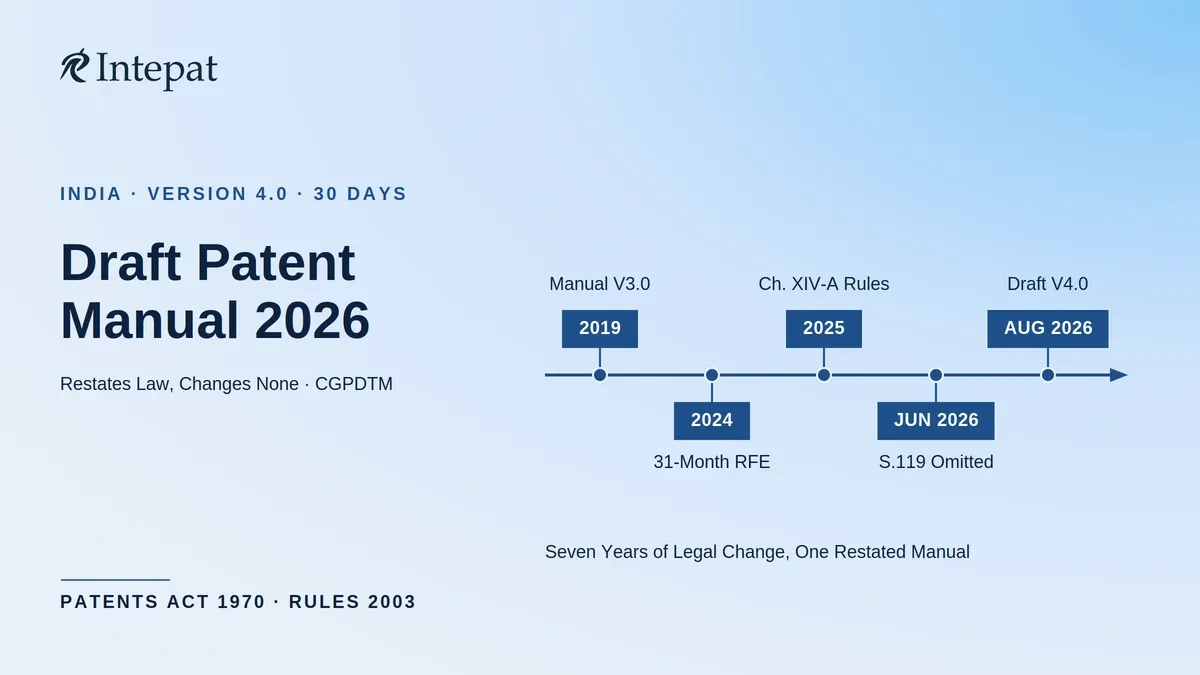
On 19 August 2026, the Indian Patent Office released a new Draft Manual of Patent Practice and Procedure, Version 4.0, 2026, and invited stakeholders to send comments within 30 days. The Manual is a 200-plus page guide to how the Patent Office runs its day-to-day work: filing, examination, publication, opposition and everything in between. The last full version dates to 2019, so this is the first ground-up update in seven years.
Most coverage of the draft has focused on things the Manual has described since 2019: automation, e-filing, digital signatures. What is actually new is more specific, and more useful to know, than that.
Quick answer: The Patent Office has published a draft update to its 2019 practice manual to reflect the amended Patents Rules and several years of court decisions on patentability. It is a draft, open for comments for 30 days from 19 August 2026, and by its own terms it is a procedural guide, not a substitute for the Act, the Rules or a court’s ruling.
What this document is, and what it is not
A “manual of practice and procedure” is the Patent Office’s own account of how it runs its work day to day, across its four locations (Delhi, Mumbai, Kolkata and Chennai). The draft describes itself plainly: it is meant to codify existing Patent Office practice and serve as a procedural guide for applicants, agents and other users, and it states in its own opening chapter that it is not intended to be the interpretation of the Patents Act or the Rules made under it. It goes further and directs its own officers not to be guided solely by the Manual, but to base their decisions on the Act, the Rules and the case law.
That caveat matters for how much weight to place on any single line in the draft. The Manual can tell you what the office currently expects a filing to look like. It cannot change what the statute requires, and where the two are read as being in tension, the statute and the courts win.
What has genuinely changed since 2019
The request-for-examination deadline has moved to 31 months. Under the 2019 Manual, the standard window to file a request for examination was 48 months from the priority or filing date. The 2026 draft reflects the shorter 31-month deadline that followed the 2024 amendment to the Patents Rules, while preserving the old 48-month period for applications filed before that amendment took effect. This is a genuine, load-bearing update: an applicant working from a downloaded copy of the old Manual would be tracking the wrong deadline.
The extension and condonation framework is wider. Rule 138, as substituted in 2024, lets the Controller extend a time limit set under the Rules, or condone a delay, by up to six months on a Form 4 request, provided the request itself is made before that six-month window runs out; such requests can be made more than once within the six months. The 2019 Manual did not carry this flexibility.
The penalties framework has changed, though the draft has not kept pace with the latest round. The draft incorporates the Jan Vishwas (Amendment of Provisions) Act, 2023, which took effect on 1 August 2024 and replaced several criminal penalties in the Patents Act with monetary ones, adjudicated by a designated officer with a right of appeal. That much is a genuine update over 2019. But the Patents Act was amended again by the Jan Vishwas (Amendment of Provisions) Act, 2026, effective 1 June 2026, which omitted the offence of falsifying register entries entirely and added a proviso protecting inventions unrelated to defence or atomic energy from punishment for certain foreign-filing violations. The draft, published 19 August 2026, still lists the falsification offence as live and still states the foreign-filing offence without that proviso. On this point, the draft is itself already out of date relative to the Act it is meant to reflect.
Post-2019 patentability case law is now built into the text. This is the most substantial update for anyone drafting or prosecuting software or computer-related applications. The draft incorporates the Delhi and Madras High Courts’ 2023 and 2024 rulings on when a computer-related invention shows the technical effect needed to clear the software exclusion, and sets out a non-exhaustive list of examples that the draft says could possibly constitute a technical effect, including faster processing, reduced memory or storage overhead, more precise control of physical equipment such as a robotic arm, improved signal transmission or reception, real-time monitoring and control, stronger security or encryption, and more efficient image or signal processing, with the draft noting that further effects may be recognised on a case-by-case basis. None of this could have been in the 2019 edition; the cases it draws on were decided in 2023 and 2024. Separately, the draft’s discussion of divisional applications now incorporates a 2023 Delhi High Court ruling on how a plurality of distinct inventions must be identifiable in the original disclosure before a divisional application will be accepted.
Sequence listings now distinguish between two WIPO formats. The 2019 Manual already required nucleotide and amino acid sequence listings to be filed in computer-readable text form with no printed copy, referencing the older WIPO ST.25 standard. The 2026 draft adds a scenario-by-scenario table telling applicants which of the two current WIPO standards, ST.25 or the newer ST.26, applies depending on filing route and filing date, plus how the associated fee is calculated. For biotechnology, pharmaceutical and life sciences applicants, this is the part of the update actually worth reading closely.
Electronic signature guidance has two real additions. The 2019 Manual already said that a digitally signed document needs no separate physical signature. What is new in 2026 is explicit recognition of Aadhaar-based e-sign as an accepted method, and an express statement that pasting a scanned copy of a physical signature onto a form is not an acceptable substitute for signing it electronically.
What has not changed
The draft’s description of automation, comprehensive e-filing and electronic workflow as the normal way of dealing with the office is carried forward from the 2019 Manual almost unchanged; it is a restatement, not a new development. The same is true of the mechanics for converting an ordinary request for examination into an expedited one, which the 2019 Manual already set out in detail, including the fee, the supporting documents and the office’s internal timelines. If you have read coverage describing digitisation or expedited examination as new features of the 2026 draft, treat that with caution.
What this means if you already have a pending application
Publication of a draft manual does not itself change any filing obligation or deadline. Your application continues to be governed by the Patents Act and the Patents Rules currently in force, exactly as it was before 19 August 2026. The draft is not adopted, and stakeholder comments could still change its final text.
Where it is worth paying attention now is anywhere the draft’s genuine updates intersect with live work: a pending request for examination where the 31-month or 48-month deadline needs confirming, a software or computer-related application where the technical-effect analysis could shape how claims are argued, a sequence listing that needs to be filed to the correct WIPO standard, or a deadline that has been missed and might be recoverable through the wider Rule 138 condonation window, where Rule 138 applies to it.
The takeaway
The headline point about this draft is not automation or e-filing; those have been Patent Office practice since well before 2026. The real update is the incorporation of the 2024 Rules amendments, the 2023 Jan Vishwas penalty reforms, and post-2019 court decisions on patentable subject matter and divisional applications into a single current reference. The draft itself has not caught up with the 2026 Jan Vishwas amendment to the very penalties chapter it updates, a reminder that even a freshly drafted practice manual is not the last word on what the Act currently says. That is what makes this worth reading closely if your work touches examination timelines, software patentability, or life sciences filings, and worth treating as a draft, not a rulebook, everywhere else.
This article reflects the text of the Draft Manual of Patent Practice and Procedure, Version 4.0, 2026, the 2019 Manual it is intended to update, and the Indian Patent Office’s public notice of 19 August 2026. It is provided for general information only and is not legal advice. For guidance on a specific application or filing, consult a registered patent agent.