




Initially Published: March 2020; Republished: August 2026
A freedom to operate search asks one narrow question: could anything on file in the market you are entering stop you selling your product? Infringement turns on granted, in-force claims, but the search must cover published pending applications too. What the answer is worth depends on the remedies a court can order.
The remedies half is where clearance work in India often goes wrong. The Patents Act 1970 gives a patentee the right to stop you, but it also gives you defences, restricts when money is payable, and lets a patent lapse and come back. Those provisions decide what your search result is worth.
Quick answer: A freedom to operate search tests a product against granted, in-force patent claims in each territory you are entering, and reports published pending applications as a separate, contingent risk. An FTO opinion turns that search into a legal risk assessment. In India, section 111(1) withholds damages and an account of profits only from a claimant facing a defendant who proves that, at the date of the infringement, he was unaware of the patent and had no reasonable grounds for believing it existed. Section 111(4) leaves the court free to injunct anyway.
What a freedom to operate search actually answers
A freedom to operate search compares your product, feature by feature, against patent claims in each territory you are entering. Two document sets matter. Granted, in-force patents decide whether you infringe today. Published pending applications decide what could block you tomorrow, and WIPO’s freedom to operate methodology says the search should cover both.
Only a granted patent can be enforced, so the infringement conclusion rests on granted, in-force claims. A published application is reported differently, as a contingent risk with a date attached, because its claims can change before grant and may not be allowed at all. Expired patents and foreign patents drop out of both sets.
The claims are the numbered sentences at the end of a patent that fix what it actually covers, and the distinction between search types is worth money because commissioning the wrong one wastes the budget. A patentability search asks whether you can get a patent, and it is not confined to what has been published: the Act’s definition of a new invention reaches anticipation by publication in any document and by use in India or elsewhere (section 2(1)(l)). An invalidity search hunts for prior art that would knock out a specific granted claim. We set out how prior art, invalidation and FTO searches differ separately.
Two consequences follow from that narrowing. Journals, manuals and other non-patent literature matter enormously to patentability and very little to clearance, because you cannot infringe a journal article. And the comparison is claim-driven: what counts is the wording of the claims, not the title or the abstract. A patent landscape analysis answers a field-level question and substitutes for neither.
The deliverables differ too. A search produces a list of documents; the FTO analysis produces a reasoned view on whether those claims read on your product, and it is that view an investor can act on.
What an Indian patent search will not tell you on its own
Four features of Indian patent law sit outside a claim-by-claim search and can each reverse its conclusion: a patent bites only inside India, applications are not ordinarily published for eighteen months, a lapsed patent can be brought back to life, and some uses are not infringement at all.
Territory comes first. An Indian patent “shall have effect throughout India” (section 46(1)), and nowhere else, so a US or European patent with no Indian family member cannot be enforced against your Indian sales, however close the claims look. Clearing India tells you nothing about your export markets.
Then check which kind of claim you are up against, because section 48 has two limbs and clearance work that reads only the first is incomplete. Limb (a) covers a product. Limb (b) covers a patented process, and separately “the product obtained directly by that process in India”, so goods you manufacture abroad and import can meet an Indian process claim you do not work under. A business that sells no physical article is not outside the section; the process limb is the one that reaches it.
Process claims also carry a burden the reader should know about. In a suit on a process patent the court may direct you, not the patentee, to prove that your process is different (section 104A). That reversal is not automatic. The patentee must first prove your product is identical to the product directly obtained by the patented process, and must then show either that the patent is for a process making a new product, or that an identical product is substantially likely to have been made by that process and reasonable efforts failed to determine the process you actually used.
The second gap is timing. An application is not ordinarily open to the public for eighteen months (rule 24), so a recent filing may be invisible to a search run today, although an applicant who wants publication sooner can request it (section 11A(2)).
Once published, the applicant has “the like privileges and rights as if a patent for the invention had been granted on the date of publication”, subject to a proviso barring infringement proceedings until the patent is actually granted (section 11A(7)). A competitor’s application can therefore sit unseen while you build, surface at publication, and reach back to that date once it grants.
These are the dates that decide an Indian clearance question. Priority date is not one date per patent: section 11 gives each claim its own, fixed by the earliest application that fairly discloses the matter that claim covers.
| What | Period | Trigger |
| Application opens to the public | 18 months, or sooner on the applicant’s request | The earlier of the filing date and the priority date (rule 24, section 11A(2)) |
| Anyone may oppose before grant | Until grant, with six months assured | Publication of the application (section 25(1), rule 55(1A)) |
| A person interested may oppose after grant | 1 year | Publication of the grant (section 25(2)) |
| Renewal fee due, extendable on Form 4 | From the end of the second year, plus up to 6 months | The date of the patent (rule 80(1), rule 80(1A)) |
| Restoration of a patent that has ceased | 18 months | The date the patent ceased to have effect (section 60(1)) |
| Term | 20 years | The filing date, or for a patent that entered India through the PCT national phase the international filing date (section 53(1) and its Explanation) |
Third, an in-force patent may not stay in force. A patent “shall cease to have effect” if a renewal fee goes unpaid within the prescribed or extended period (section 53(2)), which is why lapsed, abandoned and revoked patents are worth checking on the register rather than assumed. A patent shown as lapsed is not a free option. The patentee may still be inside the payment extension, and may still apply for restoration within the window in the table above, so the register entry tells you the position today rather than the position that will hold.
Restoration is less dangerous than it looks, provided you know which half of the timeline you are in. No suit may be brought for infringement committed between the date the patent ceased to have effect and the publication of the restoration application, so activity inside that window cannot be sued on at all (section 62(2)). What happens afterwards is different: the restored patentee’s rights become subject to whatever terms the Controller imposes to protect people who began, or took definite steps to begin, using the invention in that window (section 62(1)).
Fourth, certain uses are carved out. Making or using a patented article or process “for the purpose merely of experiment or research” is permitted and is a defence in a suit (sections 47(3) and 107(2)).
Two further carve-outs sit in section 107A. Limb (a) excludes acts done “solely for uses reasonably related to the development and submission of information required under any law” regulating manufacture, use, sale or import, in India or abroad, which covers regulatory work but not a commercial launch. Limb (b) does cover a commercial act: “importation of patented products by any person from a person who is duly authorised under the law to produce and sell or distribute the product” is not an infringement, so for an importer the clearance question is partly a supply-chain question about who authorised the overseas source. Checking legal status alongside the claims is the practical step, and searching the Indian Patent Office databases is where that starts.
What you are buying: the remedies an Indian court can order
An FTO opinion prices a risk, and the price is set by what a court can do to you. In India the reliefs include an injunction, meaning an order stopping you selling, and at the claimant’s option either damages or an account of profits, which is measured by what you made rather than by what the patentee lost.
That list is inclusive rather than closed, and any injunction comes “subject to such terms, if any, as the court thinks fit” (section 108(1)). The court may also order that infringing goods, and implements used predominantly to make them, be seized, forfeited or destroyed without compensation (section 108(2)). For a business with inventory on the ground, that second power, not the damages figure, is often the one that decides how a dispute is fought.
Then comes the provision that shapes Indian clearance strategy. Damages or an account of profits “shall not be granted against the defendant who proves that at the date of the infringement he was not aware and had no reasonable grounds for believing that the patent existed” (section 111(1)). Both limbs have to be satisfied, and the burden sits on the defendant. The Explanation narrows it further: stamping an article “patent” or “patented” does not by itself fix a competitor with knowledge “unless the number of the patent accompanies the word or words in question”.
That cuts both ways, and the point is easy to miss. The test looks at what you knew at the date of the infringement, so a search that finds a patent ends the defence for everything you do afterwards. Running the search early is not how you preserve ignorance; it is how you buy a design change while a design change is still cheap. The injunction is unaffected either way (section 111(4)), so ignorance protects money rather than market access.
Marking your own goods deserves its own caution. Words such as “patent”, “patented” or “patent pending” on an article sold in India are deemed to refer to an Indian patent or application unless the packaging carries an accompanying indication that the patent was obtained or applied for outside India (section 120, Explanation 2). A company entering India with packaging already marked for a US or European portfolio is therefore making a representation about India, and a false one attracts a penalty of up to ten lakh rupees plus a further one thousand rupees for every day it continues.
Validity is the other half of the picture, and India is unusually open here. Every ground on which a patent can be revoked is available as a defence in an infringement suit (section 107(1)), and the Delhi High Court has said that “although the patent has been granted in this case, its validity cannot be presumed” (Merck Sharp and Dohme Corporation v. Glenmark Pharmaceuticals, FAO(OS) 190/2013, 20 March 2015, paragraph 36).
The defendant’s burden at the interim stage is calibrated to that. In F. Hoffmann-La Roche Ltd. v. Cipla Ltd. the Division Bench held that a court facing an injunction application and a validity plea “must enquire whether the defendant has raised a credible challenge”, and dismissed the appeal against a refusal of an injunction (FAO(OS) 188/2008, 24 April 2009, paragraphs 55 and 87). The standard was restated in 2025: a defendant pleading a section 107 defence “has only to set up a credible challenge to the validity of the suit patent” and “is not required to make out a cast iron case” (F. Hoffmann-La Roche AG v. Natco Pharma Limited, FAO(OS)(COMM) 43/2025, 9 October 2025, paragraph 20.7.2).
How the claim is read decides the rest. Claims “define the scope of the invention” and construction “has to be done as a whole”, and while the analysis compares claim elements with the product, it is “the pith and marrow of the invention claimed that is required to be looked into” (Sotefin SA v. Indraprastha Cancer Society and Research Center, CS(COMM) 327/2021, 17 February 2022, paragraphs 30 and 32). The same judgment records that infringement “is to be adjudged objectively and Defendant’s intention may not be a material criterion” (paragraph 18). A good-faith design change that still falls within the claims is therefore no answer, a point we develop in our note on patent infringement analysis.
One procedural point changes the shape of a dispute. A suit lies in a district court or above, and once the defendant counterclaims for revocation the suit and the counterclaim are transferred to the High Court for decision (section 104), so the forum for the dispute is not settled by where it starts.
The same product in the United States and in Europe
The United States presumes a granted patent valid and can enhance damages for willful infringement. Europe is not one question but three, because a European patent can be litigated nationally, before the Unified Patent Court, or held with unitary effect. The table sets the broad contrast; the European routes are separated below.
| Question | India | United States | Europe |
| Where does one granted right bite? | Throughout India (section 46(1)) | Within the United States, and on imports, including a product made abroad by a patented US process (35 U.S.C. 271(a) and (g)) | Each contracting state in respect of which the patent was granted, with the same rights as a national patent there (EPC Article 64(1)) |
| Which law decides infringement? | The Patents Act 1970 (sections 48 and 107) | Title 35 of the United States Code (35 U.S.C. 271) | Depends on the route. See the European table below |
| Central window to attack the right | Representation before grant, then opposition within one year of publication of grant (sections 25(1) and 25(2)) | Outside the scope of this article | Opposition at the EPO within nine months of publication of the mention of grant (EPC Article 99(1)) |
| What limits the money | Neither damages nor an account of profits against a defendant who proves he was unaware and had no reasonable grounds to believe the patent existed (section 111(1)) | No damages before marking or actual notice where the patentee sells a patented article, and up to treble damages for willfulness (35 U.S.C. 287(a) and 284) | National law before a national court; before the Unified Patent Court, damages appropriate to the harm actually suffered and expressly not punitive (UPCA Article 68) |
Two United States provisions repay attention from an Indian exporter. Infringement reaches acts inside the United States and importation into it, and separately extends to importing, selling or using there “a product which is made by a process patented in the United States”, wherever the making happened, until the product is “materially changed by subsequent processes” or becomes “a trivial and nonessential component of another product” (35 U.S.C. 271(g)). An Indian plant shipping to the United States therefore has to clear US process claims that carry no force in India.
Money runs differently there as well. Where a patentee makes, sells or imports a patented article and fails to mark it, “no damages shall be recovered … except on proof that the infringer was notified of the infringement and continued to infringe thereafter”, damages then running only from that notice, and filing suit counts as notice (35 U.S.C. 287(a)).
Enhancement is the exposure that shapes how US clearance opinions are commissioned. A court may “increase the damages up to three times the amount found or assessed” (35 U.S.C. 284), and in Halo Electronics, Inc. v. Pulse Electronics, Inc., 579 U.S. 93 (2016), a unanimous Supreme Court discarded the Federal Circuit’s Seagate test. Subjective willfulness “may warrant enhanced damages, without regard to whether his infringement was objectively reckless”, though enhancement “should generally be reserved for egregious cases typified by willful misconduct”.
Because “culpability is generally measured against the knowledge of the actor at the time of the challenged conduct”, what you knew and when you knew it is the live issue. Failing to obtain advice of counsel “may not be used to prove that the accused infringer willfully infringed the patent” (35 U.S.C. 298), so that failure cannot be held against you on willfulness. An opinion you did commission cuts the other way: the Federal Circuit has said that reliance on an opinion of counsel on non-infringement or invalidity “remains relevant to the infringer’s state of mind post-Halo”, and that opinions written after suit was filed were “appropriately excluded since they were not contemporaneous with the infringing activity”. On the same page the court confined the point further: counsel’s analysis bears on state of mind only so far as it was communicated to the company’s decision-makers before the infringing acts (Omega Patents, LLC v. CalAmp Corp., No. 2018-1309, Federal Circuit, 8 April 2019, pages 24 and 25). An opinion that nobody in the company read does nothing.
A European patent starts life as a bundle. It confers, in each contracting state in respect of which it is granted and from the date the mention of grant is published in the European Patent Bulletin, “the same rights as would be conferred by a national patent granted in that State” (EPC Article 64(1)). Validation, meaning bringing the granted patent into force country by country, decides where that bundle can bite. Since 1 June 2023 two further routes have existed alongside it, and they answer the clearance question differently.
| European route | Which law decides infringement | How far one decision reaches |
| Conventional European patent, national court | The law of each state where the patent was validated, because “any infringement of a European patent shall be dealt with by national law” (EPC Article 64(3)) | That state alone |
| Conventional European patent, Unified Patent Court | The Court’s own cascade: Union law, the Agreement, the European Patent Convention, other applicable international agreements, then national law (UPCA Article 24), with the infringing acts and the remedies supplied by the Agreement itself (UPCA Articles 25 to 27, 63 and 68) | The Contracting Member States for which that patent has effect (UPCA Article 34) |
| European patent with unitary effect | The law of a single participating state, selected by the applicant’s residence or place of business at filing and defaulting to Germany, applied uniformly across the whole territory (Regulation (EU) 1257/2012, Articles 5 and 7) | Every state in that patent’s own generation, fixed for life at registration: 18 states for one registered on or after 1 September 2024, 17 for an earlier one |
Three consequences follow for a clearance file. A conventional patent’s reach still depends on where it was validated, so a validation in the United Kingdom, Switzerland or Spain sits outside the Unified Patent Court and is enforced nationally (verified as of August 2026). A unitary patent’s reach does not depend on validation at all, and does not grow when further states ratify. And “national law decides infringement in Europe” is no longer a safe shorthand, although the opposite shorthand is equally unsafe: national law remains the last step of the Court’s own cascade.
Scope is set by the claims read with the description and drawings, and equivalents count: “due account shall be taken of any element which is equivalent to an element specified in the claims” (EPC Article 69(1) and Article 2 of its Protocol on Interpretation). A literal-only comparison understates European risk.
Two dates belong on any European file. Any person may oppose centrally at the EPO within nine months of publication of the mention of grant (EPC Article 99(1)), which is shorter than India’s post-grant year. And during the Court’s seven-year transitional period, where no action has already been brought before it, the proprietor of a conventional European patent may opt out of its exclusive competence (UPCA Article 83), which a unitary patent’s proprietor cannot do. The forum for a given patent therefore has to be checked rather than assumed. Our comparison of European and Indian patent law covers the wider divergences.
When to run it, and what to do when the answer is bad
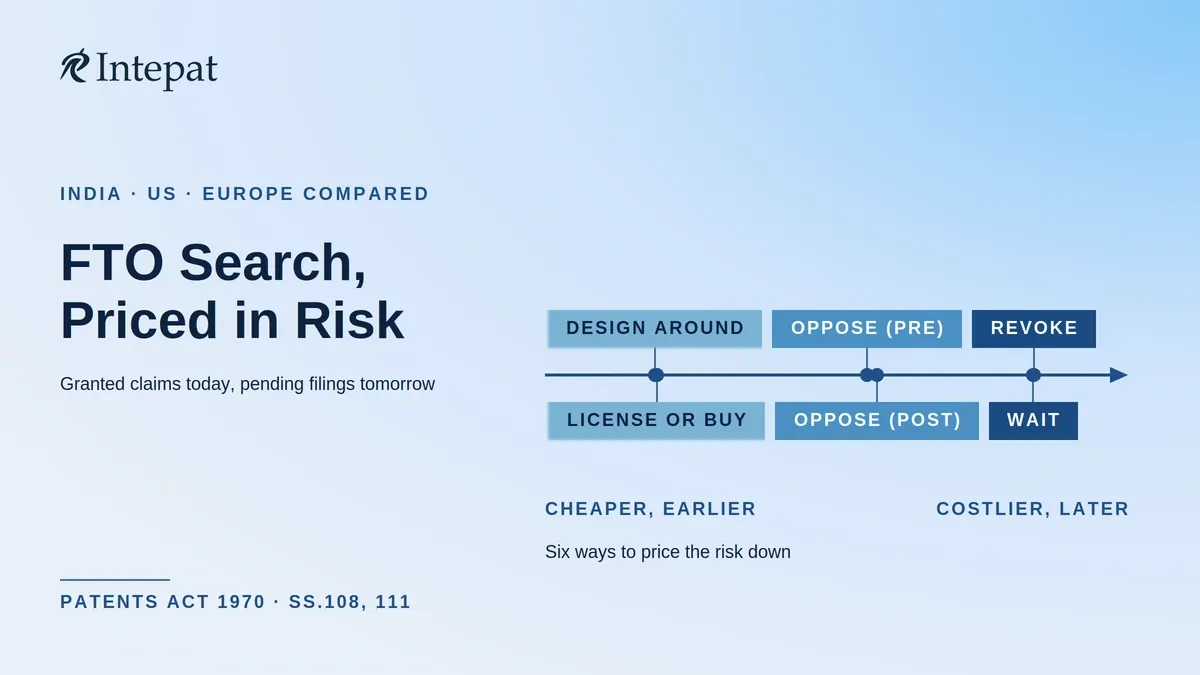
Run the search while the design can still change and before you commit to tooling, launch or a funding round. If it comes back badly, six responses are available in India, and which ones remain open depends almost entirely on how early you looked.
The timing rule is short. Commission the search where a design change is still cheaper than a redesign, then refresh it before a launch, before entering a new territory, and before a diligence exercise. Because recent filings may not yet be published, a refresh is doing real work rather than repeating itself. The same discipline applies during patent due diligence, where a stale clearance file is itself a finding.
Where a blocking claim is found, these routes are open:
- Design around the claim. The redesigned product has to fall outside the claim as properly construed, and Indian construction looks to the pith and marrow of the invention, so dropping a required element helps only if you have not substituted an equivalent for it.
- Take a licence, or buy the patent. Cross-licensing is worth raising where you hold rights the other side wants.
- Oppose before grant. Where the blocker is still an application, any person may represent against grant, and the six-month floor in the table above is the window that makes this route usable (section 25(1)).
- Oppose after grant. Within one year from the date of publication of grant, a person interested may give notice of opposition; the Act defines a person interested to include anyone engaged in, or promoting, research in the same field (sections 25(2) and 2(1)(t)).
- Seek revocation in the High Court, on the petition of a person interested or as a counterclaim in an infringement suit, on one of the grounds the Act lists (section 64).
- Wait. On expiry of the term, or on cessation for non-payment, “the subject matter covered by the said patent shall not be entitled to any protection” (section 53(4)). Our renewal fees calculator shows the schedule a patentee has to keep meeting.
Two further routes are rarely used. You may sue for a declaration that your product does not infringe even where the patentee has asserted nothing, provided you first asked the patentee or exclusive licensee in writing for an acknowledgment with full particulars and were refused or met with neglect; you ordinarily bear all parties’ costs, and validity is not in issue (section 105). If a competitor is circulating threats, an aggrieved person may sue for a declaration that the threats are unjustifiable, an injunction and damages, and the court may grant all or any of those reliefs unless the defendant proves the threatened acts would infringe a claim not shown to be invalid, a mere notification of the existence of a patent not being a threat (section 106).
What to demand in the written FTO opinion
A usable opinion states its own boundaries before it states a conclusion: which countries, which product version, which databases, which date the search closed. It maps each claim element against your product in a chart you can read, and it says plainly what it could not see.
Ask for four things. A scope statement naming the territories, the product configuration examined and the search cut-off date. A claim chart for every patent carried forward, covering the relevant claim set rather than one claim: every independent claim, meaning each claim that does not refer back to another, and any dependent claim whose extra features your product may have. WIPO describes a formal freedom to operate analysis as a claim-by-claim construction of each claim of each document, so a chart that stops at one claim per patent is not that analysis. A legal-status check on each patent showing renewals are current. And an explicit list of what falls outside the work.
That last item is the honest part. No clearance exercise can see an unpublished application, predict how a pending claim will be amended before grant, or bind a court to one construction. An opinion that states those limits survives a diligence process; one that reads as a guarantee does not.
Frequently Asked Questions
Yes. In practice the names are used interchangeably: testing a product against granted, in-force patent claims in a chosen territory before commercialisation, and reporting published pending applications alongside them as contingent risks. Providers differ on where they draw the line between the search and the written opinion, so confirm which deliverable a quotation covers before comparing prices.
Yes. Only a granted patent can be enforced, so the infringement conclusion rests on granted claims, but WIPO’s freedom to operate methodology says the search should cover published pending applications as well. They are reported as contingent risks, because their claims can still change before grant and may not be allowed.
Not immediately. Section 11A(7) gives a published applicant the same privileges and rights as a granted patentee from the date of publication, but its proviso bars infringement proceedings until the patent is granted. Once granted, the patentee can reach back to the publication date, so a pending application is a deferred risk rather than no risk.
No. An Indian patent has effect throughout India under section 46(1) and nowhere else, and the same territorial logic applies in reverse to foreign patents. Every market you intend to sell in needs its own search against that jurisdiction’s in-force rights, which is why the territories should be fixed in writing before any work begins.
A court may injunct you and order seizure or destruction of infringing goods under section 108. Damages and an account of profits are both barred if you prove that at the date of the infringement you were unaware of the patent and had no reasonable grounds to believe it existed (section 111(1)). The injunction survives regardless (section 111(4)).
Refresh it before a launch, before entering a new territory, and before any diligence exercise. Indian applications are not ordinarily open to the public for eighteen months from filing or priority under rule 24, so a single search can miss recent filings, and material inside that window becomes visible only to a later search.
Section 129 restricts practice as a patent agent to registered persons, and its Explanation treats giving advice on the validity of patents or their infringement, other than advice of a scientific or technical nature, as such practice. For a cross-border launch, expect separate opinions from professionals qualified in each of the jurisdictions you are entering.
No. Clearance tests granted, in-force claims in one country and tracks published pending applications. Patentability asks whether the invention qualifies for grant, where novelty covers prior use too: section 2(1)(l) reaches what was “used in the country or elsewhere in the world”, though section 64(1)(e) confines prior use to India. You can be clear to sell and still fail patentability.
It changes what a court can award, not whether you are sued. In India the section 111(1) defence turns on what you knew at the date of the infringement, so an opinion that found the patent closes it off for later acts. In the United States, section 298 stops a failure to obtain advice being used to prove willfulness.
This article explains the law on freedom to operate searches and FTO opinions in India as at August 2026 and is for general information only. It is not legal advice. Government fees, forms, and procedures change; confirm current figures with the Indian Patent Office before you file. For advice on your specific invention, consult a registered patent agent.