




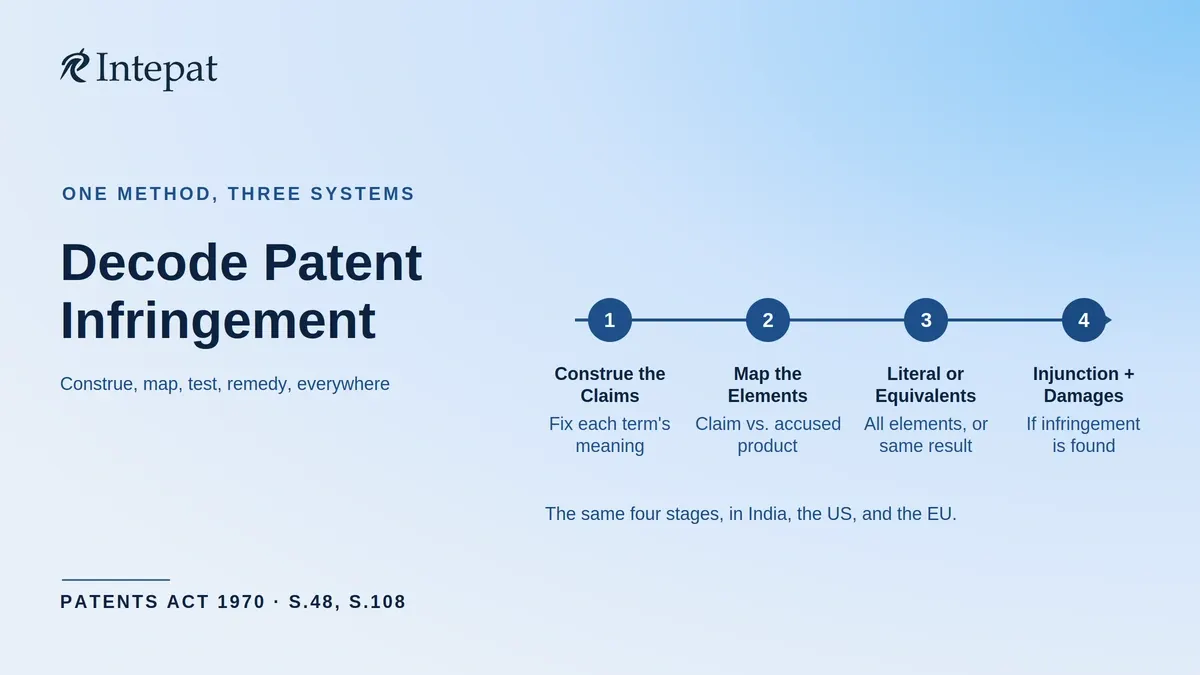
Patent infringement analysis compares a specific product or process against the claims of one granted patent, not against a competitor’s commercial product. No single global patent or worldwide infringement law exists: each country’s courts apply their own statute to their own grant, though the comparison method itself stays remarkably consistent everywhere.
This guide sets out that method: how courts construe a patent’s claims, compare them against an accused product, and decide infringement, illustrated primarily through India’s Patents Act 1970 and Indian case law, with brief comparison notes on United States and European patent practice. For the mechanics of reading a patent’s claims in detail, see Intepat’s guide to patent claim construction.
Quick answer
- Every system compares your product or process against a specific granted patent’s claims, never against the patent owner’s own commercial product, and no country’s answer applies everywhere else, since patents are granted, and infringed, one jurisdiction at a time.
- Two tests recur in some form almost everywhere: literal infringement, every claim element present in what you make, and a doctrine of equivalents, which can catch a product that swaps or drops a component but keeps substantially the same function, way, and result.
- Holding your own patent does not excuse infringing someone else’s; a patent is a right to exclude others, not a right to practise your own invention.
- How quickly a dispute resolves also depends heavily on where it is filed: interim relief carries more weight in India than in the United States, where more disputes are decided at a full trial.
- If you are accused, the patent’s own validity is almost always your strongest line of defence, wherever the case is heard.
What Patent Infringement Analysis Actually Compares
Patent infringement analysis compares one accused product or process against the claims of one specific granted patent, in one country, to decide whether that patent’s owner can stop the accused activity there, regardless of what the owner itself sells. The World Intellectual Property Organization states the underlying territorial point plainly: patents are territorial rights, and “at present, you cannot obtain a universal ‘world patent’ or ‘international patent.’” Even the Patent Cooperation Treaty, which lets an applicant file once across many countries, only centralises filing and search; the grant, and any later infringement dispute, stay with each country’s own office and courts.
That territorial split matters for a founder weighing risk in more than one market: clearing a patent in one country says nothing about a parallel patent covering the same invention elsewhere, since each grant, and each infringement analysis, stands on its own. It also matters in reverse: holding a patent on a related improvement does not excuse infringing someone else’s earlier, still-valid patent, since, as India’s Patents Act frames it in Section 48, a patent is a right to exclude others from the claimed invention, not a right to practise it yourself.
Claim Construction: The Universal First Step
Before any court, anywhere, can decide infringement, it has to work out what the patent actually covers. That step, claim construction, means reading each disputed claim term to fix its meaning and scope, so the claim can then be measured against the accused product. Intepat’s dedicated guide to patent claim construction walks through that process in depth.
A single judge in Guala Closures SPA v AGI Greenpac Ltd (2024) suggested reading a claim in two parts, an introductory preamble and a characterising clause describing what is new, with the monopoly running only to what that characterising clause covered. A Delhi High Court Division Bench has since rejected that approach: in Automat Irrigation Pvt Ltd v Aquestia Limited (FAO(OS)(COMM) 123/2025, decided 5 January 2026), the Bench rejected the view that “any especial consideration is to be assigned to” the characterising portion of a claim, holding instead that a claim “has to be construed, holistically and in its entirety,” since the two-part method borrowed a UK and European convention with no counterpart in Indian statute. Which words a claim uses, and how they interact, still decides its scope; no shortcut through only part of the claim is reliable.
The same basic method holds well beyond India. United States courts follow Markman v Westview Instruments, which held that claim construction “is exclusively within the province of the court,” not the jury, and Phillips v AWH Corp, which ranks the claim language and specification above dictionaries or expert testimony. Under the European Patent Convention, Article 69 says the claims determine the extent of protection while the description and drawings interpret them, though the European Patent Office confines itself to grant and opposition and states plainly that “any infringement of a European patent shall be dealt with by national law,” a gap only partly closed, for its eighteen member states, by the Unified Patent Court since 2023. National courts alone still decide infringement in the UK, Switzerland, Norway, and EU states such as Spain and Poland that have not joined.
Once the claim is construed, the next step is claim mapping: setting each claim element side by side with the corresponding feature of the accused product, to see whether every element is present. Intepat’s guide to claim mapping covers the practical mechanics, and the explainer on the patent specification is the right starting point if a patent’s claims and specification are unfamiliar.
Literal Infringement and the Doctrine of Equivalents
Once the claim is construed, courts in most systems run two different tests, and neither has displaced the other. The first, literal infringement, sometimes called the all-elements rule, asks whether every claim element appears in the accused product. The second, a doctrine of equivalents, asks whether the accused product does substantially the same job in substantially the same way, achieving substantially the same result, even if a component has been swapped, removed, or redesigned around; Indian courts still often call this the invention’s “pith and marrow.”
The clearest recent Indian illustration is Vishal Choudhary v SNPC Machines Pvt Ltd (FAO(OS)(COMM) 64/2024), a dispute over a mobile brick-making machine. A single judge applied the pith and marrow approach and granted an interim injunction; on appeal, the accused infringer argued the all-elements rule should have applied instead, since not every claim element appeared in the accused machine. The Division Bench upheld the injunction in January 2026 but declined to rule on which test should control, though it found on the facts that “the mobility of the machine… is the essence of the invention,” so that changing how the machine moves, without removing the mobility itself, could still “amount to intruding the patent rights of the patentee.”
The doctrine has a longer paper trail in the United States, where Graver Tank v Linde Air Products first asked whether the accused product performs “substantially the same function in substantially the same way to obtain the same result,” and Warner-Jenkinson v Hilton Davis Chemical later confirmed it must be applied element by element, not to the invention as a whole. The Unified Patent Court’s own version is still unsettled: its first reported ruling, Plant-e Knowledge v Arkyne Technologies in November 2024, applied a four-part test, but the appeal settled before the Court of Appeal could rule, and commentators were still calling the UPC’s law developing, not fixed, in late 2025.
This matters for founders on both sides. Redesigning around a patent by changing a visible component, without changing what the product does and how it does it, is not a reliable way to avoid infringement, as the SNPC mobility finding shows. The reverse is also true: a claim’s protected scope runs only to what its full construction covers, and courts will not stretch that scope to catch a competitor’s product merely because it serves the same general purpose.
Recognising the Warning Signs Before You Are Sued
For a founder who has not been accused of anything yet, the practical question is different: how do you find out if your own product is walking into someone else’s patent before it becomes a legal problem? This is where infringement analysis overlaps with, but is not the same as, a freedom-to-operate search. An FTO search is commissioned before launch, to surface third-party patents in the countries a new product will reach, so the comparison in this article can be run deliberately, rather than in response to a demand letter.
A few signals should prompt that search rather than a guess: entering a market segment where a competitor is known to hold patents, launching a product that improves on a design after reviewing existing patents, or hearing informally that a rival believes your product is “too close” to theirs. None of these confirms infringement on its own. All of them are reasons to get a professional comparison done before scaling spend, when redesigning is still cheap and litigation has not begun. Where a rival has said as much informally, without a formal notice, India’s Patents Act also lets a company force the question by applying in writing for the patentee’s acknowledgment and, if refused, suing under Section 105 for a declaration of non-infringement. Intepat’s patent team runs these searches across India and, through its foreign associate network, other markets a product will reach, issuing a written opinion that flags the patents worth a closer look.
If You Receive an Infringement Notice or Legal Threat
A cease-and-desist letter, or a lawyer’s notice alleging infringement, is not a court order. Some systems go further and give the recipient a direct weapon against an unjustified threat: India’s Patents Act lets anyone aggrieved by a threat of infringement proceedings, made by circular, advertisement, or any written or oral communication, sue under Section 106 for a declaration that the threat is unjustified, an injunction stopping it, and damages, unless the person making the threat can show the accused acts do genuinely infringe a valid claim. A plain notice that a patent exists is not, by itself, a threat under that section, so the line between a lawful notice and a groundless threat depends on what the letter says.
If the dispute does reach a suit, Indian law opens defence gateways. Intepat’s dedicated guide to patent revocation sets out the ground-by-ground procedure behind the first row below, a patent invalidity search is how the evidence for that row is assembled, and the explainer on Section 47 covers the second row in detail.
| Defence gateway | What it covers | Governed by (India) |
| Patent invalidity | Every ground on which the patent could be revoked, most often that the invention was not new, was obvious, or was not patentable subject matter | Section 107(1), importing Section 64 |
| Government or experimental use | Machine, apparatus, or article made, used, or imported; process used; or medicine or drug imported, used, or distributed, each under Section 47’s conditions | Section 107(2) |
| Acts not treated as infringement | Regulatory-filing work for a product regulated under any law, most often a generic or biosimilar, and importing genuine patented goods from an authorised supplier | Section 107A |
On that last row: Section 107A means these acts are not infringement at all, rather than excused infringement. Intepat’s guide to the Bolar exemption covers that provision in detail.
None of these defences is available on request, in India or anywhere else. Each carries its own evidentiary burden, and a defence that looks strong at first can look different once the patent’s file history and the accused product’s specifications are compared side by side, which is why founders should treat a credible notice as a signal to get a proper claim comparison done, not to panic or ignore it.
If You Are the Patent Holder: Proving Infringement and Seeking Relief
The other side of this analysis is the patent holder deciding whether, and how, to enforce a patent; the available relief is where systems most resemble each other even while the mechanics differ. Most systems offer a two-part remedy: an injunction stopping the infringing activity, and a monetary award. Under India’s Patents Act, Section 108 gives the court an injunction and, at the patentee’s choice, either damages or an account of the infringer’s profits, plus the power to order infringing goods seized, forfeited, or destroyed.
United States law reaches a related but narrower result through separate provisions of the Patent Act: Section 284 guarantees damages “in no event less than a reasonable royalty,” with no separate profits election, and the court may treble it; Section 283 gives courts the power to grant an injunction “in accordance with the principles of equity,” the same discretion that means a US infringement finding does not automatically produce one.
For most product patents, the patentee carries the burden of proving infringement; process patents get a narrow, court-directed exception under India’s Section 104A: where the process yields a new product, or an identical product likely came from the patented process and the patentee’s reasonable efforts could not identify the process used, a court may shift the burden to the defendant, but only after the patentee first proves the products are identical. Knowledge can also change the outcome after infringement is found: India’s Section 111 blocks both a damages award and an account of profits entirely against a defendant who neither knew nor had reason to know the patent existed, though the court can still grant an injunction. United States law reaches a related result differently, through a discretionary damages enhancement that turns on more culpable conduct rather than a strict knowledge bar.
Many disputes in interim-injunction-friendly systems like India are decided before any full trial; a preliminary injunction is harder to win in the United States, where more of the fight happens at trial. Indian courts apply a three-part test associated with the English case American Cyanamid Co v Ethicon Ltd, later tightened by India’s own courts: a prima facie case, balance of convenience, and irreparable harm, weighed alongside whether the patentee is working the invention in India and, for medicines, the public interest in access.
What Litigation Actually Looks Like
Two real Indian disputes show how these rules play out over time. In Roche v Cipla, over the lung cancer drug erlotinib, a single judge refused an interim injunction in 2008, weighing that Cipla’s generic version sold at roughly a third of Roche’s price. The dispute continued for years; the Division Bench’s 2015 final judgment found that Cipla’s product did infringe Roche’s patent, but still refused an injunction since the patent was about to expire, ordering Cipla to pay costs and render accounts instead. Infringement and injunction are two separate findings in Indian practice, and a patentee can win the first without getting the second.
Standard-essential patents run on a different playbook, since the comparison is not claim-by-claim against a product but whether the accused device implements an industry standard the patent covers. In Lava International Ltd v Telefonaktiebolaget LM Ericsson, decided in 2024, the Delhi High Court reportedly found seven of Ericsson’s eight suit patents valid and infringed, revoked the eighth, and ordered damages of roughly ₹244 crore, after finding Lava had not negotiated in good faith. Most disputes settle for far less, or produce none at all. Intepat has covered a related Philips dispute in more depth, including the evidentiary standard the same court applied.
The procedural shape varies by country, but the underlying rhythm does not. Indian patent litigation routes through the Commercial Courts framework, with case-management hearings and, under the Delhi High Court’s dedicated patent-suit rules, separate briefs on claim construction, validity, infringement, and damages, filed before trial. United States litigation carries its own name for the same claim-construction step, a Markman hearing, usually held well before any trial. Wherever the case is heard, a contested infringement suit, unlike an interim injunction application, typically runs for years, not months.
Reducing Infringement Risk Before It Becomes a Dispute
Most of the cost in a patent dispute is avoidable: the comparison this article describes can be run before a product ships, not after a notice arrives. A freedom-to-operate search before launch, a claim comparison before a competitor’s product goes to market, and a documented, good-faith design process all change the practical risk a founder carries, even though none of them is a guarantee. Which search fits which decision, and when, is mapped in the guide to the types of patent search.
For a founder already in a dispute, the decision that matters most is usually not “am I right,” but “what does resolving this cost, in time and money, compared with the alternatives,” since patent litigation, in India and elsewhere, rewards early, well-evidenced positions over late, improvised ones. Getting a qualified comparison done early, on either side of the dispute, is what makes that judgment possible.
Frequently Asked Questions
You compare your product’s features against the granted claims of the specific patent in question, in the specific country you are asking about, not against the patent owner’s commercial product. A freedom-to-operate search identifies which patents to check before launch; a full infringement analysis, ideally by a patent professional, then maps your product against each claim element to reach a reasoned opinion.
Generally, the law of the country where the patent was granted and where the accused activity, making, using, offering for sale, selling, or importing, takes place. A product cleared in one country can still infringe an equivalent patent granted elsewhere, since each grant stands on its own; selling into several markets usually means a separate comparison for each.
It depends on how much technical and legal comparison the question actually needs, but a written opinion from a patent professional is a small fraction of the cost of even a few weeks of litigation. Getting that opinion early, before a dispute escalates, is usually what keeps the overall cost down.
Do not ignore it, and do not assume it is valid. Read the notice carefully, identify the exact patent and claims cited, and get a professional comparison against your product before responding. Some jurisdictions also let you challenge a groundless threat directly; India’s Patents Act, for example, allows this under Section 106 if the notice turns out to be unjustified.
This depends on the jurisdiction, but publication before grant can matter in more than one system. In India, a published application already carries patent-like rights, creating exposure once the patent is later granted. Other systems, including the United States, recognise a related concept of pre-grant rights; the mechanics differ by country.
Literal infringement means every element of a patent claim is present in the accused product; most systems call this, or something close to it, the all-elements rule. A doctrine of equivalents catches products that perform substantially the same function, in substantially the same way, to reach substantially the same result, even with a component changed or removed. Indian courts still often call this the invention’s “pith and marrow.”
No. A patent gives you the right to stop others from using your invention; it does not give you the right to practise it if doing so uses someone else’s still-valid patent. Patents are generally understood as exclusionary rights only, so a defendant’s own patent portfolio is not, by itself, a defence.
Start with a claim comparison to confirm the case is real, since infringement suits are expensive to bring on a weak claim. You can then send a carefully worded notice, negotiate a licence, or sue for an injunction and damages or an account of profits, but expect the defendant to challenge your patent’s validity in response, wherever the case is filed.
There is no fixed timeline anywhere, and it depends heavily on the country. In India, an interim injunction application can be decided in months, and courts are directed to move infringement litigation quickly, but a fully contested trial on infringement and validity, especially where the defendant counter-claims for revocation, commonly runs for years rather than months.
This article explains how patent infringement analysis generally works, illustrated primarily through Indian law and Indian case law, with brief comparison notes on United States and European patent practice, as at August 2026. It is for general information only and is not legal advice. Patent law varies significantly by country, and provisions, court rules, and procedures referenced here can change; confirm the current position in the specific country that matters to you before you act. For advice on a specific dispute or product, consult a registered patent agent or litigation counsel qualified in the relevant jurisdiction.
Deadlines and procedural requirements in patent litigation are strict, and missing one can affect your rights. The case outcomes and figures described here illustrate reported decisions in their own jurisdictions, not a prediction of how any other dispute, anywhere, will be resolved; where the stakes warrant it, take professional advice before acting.