




Trademark ownership India law starts with one test: the applicant must be the person claiming to own the mark. For most businesses that is the company, firm or individual that owns and uses the brand, not necessarily the founder. A wrong name on the filing can mean a dispute or a second round of fees.
This article covers applications to the Indian Trade Marks Registry under the Trade Marks Act, 1999, with fees and forms checked as of November 2026. It is written for founders and owners of small and family businesses choosing the applicant.
| Quick answer: File in the name of whoever truly owns and controls the brand: the company if a company runs the business (or, if the company does not yet exist, the founder filing on the intention to assign to the company about to be formed), the firm if partners do, the founder only if the founder personally owns the brand and lets the business use it. If the wrong name is already on file, an assignment, a correction by the registered owner, a correction of a pending application (for errors, not clearly a change of applicant) or a rectification petition each repairs a different problem; a licence regulates use and is not a repair for a wrong name. |
Trademark ownership India: who can file as the owner
The Act lets “any person claiming to be the proprietor” (owner) of a mark used or proposed to be used by him apply for registration (Section 18(1)). The application is made by that person, so the applicant should be the one who really owns the brand, not whoever handles the paperwork, save for the company-to-be-formed route below.
The form asks for the applicant’s full name and nationality, and for a partnership firm the full name and nationality of every partner (Rule 15). A firm or body corporate must also state its country of incorporation or the nature of its registration, if any (Rule 15). Give the applicant’s full legal name as it appears on its own registration papers.
The court rulings below turn largely on agreements, deeds and family arrangements, as well as on who held the registration. A title such as founder or director does not by itself settle ownership. The starting questions are factual: who adopted the brand, who uses it, who controls its quality, and what the signed papers say. If those answers point to different people, settle them in writing before filing. Our checklist of documents required for trademark registration in India covers the paperwork.
Who should file: five common set-ups
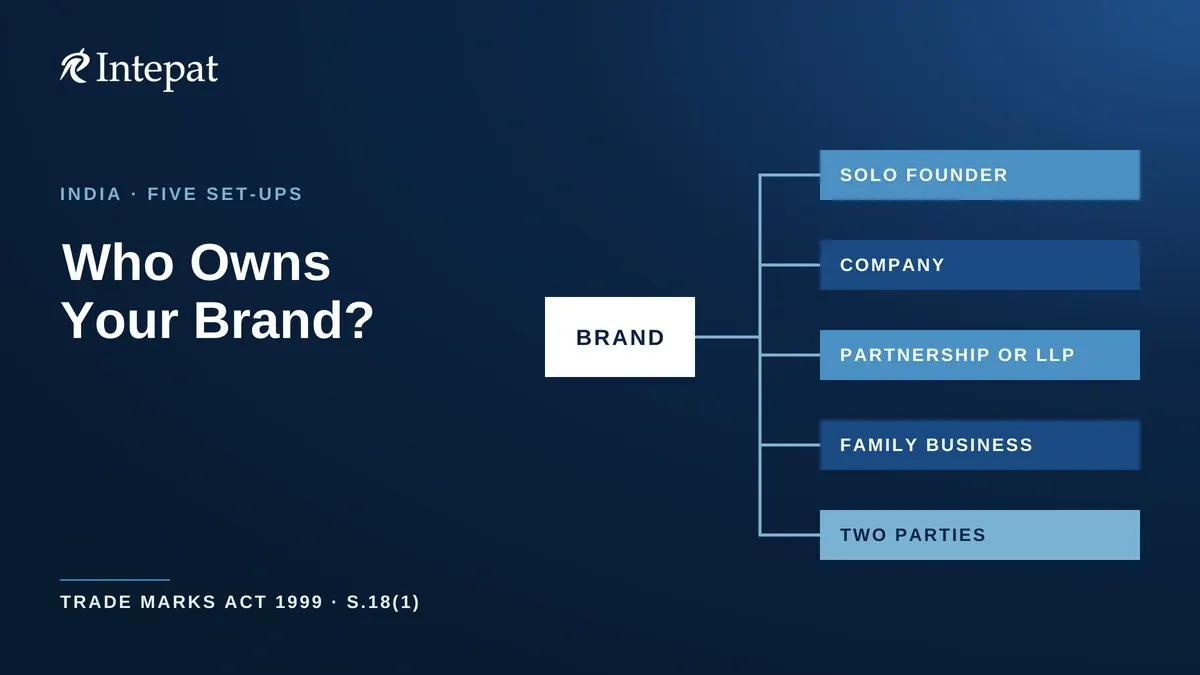
Five set-ups cover the common cases: a solo founder, a company, a partnership or LLP, a family business and two parties sharing one brand. The choice between trademark registration as an individual or as a company follows the owner. A single named owner for each mark, with others under a written licence, avoids shared claims.
| Set-up | Who usually files | What to watch |
|---|---|---|
| Solo founder, no company yet | The founder, as owner; or the founder, relying on the intention to assign to a company about to be formed | A company-route registration lapses if the company is not registered as proprietor in time (see below) |
| Company runs the business | The company, in its own registered name | A founder or director who files personally for a company brand leaves the company dependent on an assignment and possibly exposed to challenge |
| Partnership firm or LLP | The firm or LLP, in its own name | For a partnership firm, every partner’s name and nationality goes on the form |
| Family business (a family business trademark) | One named family member, or a family company or firm, with others using the mark under licence | One co-owner may not be able to transfer a jointly held family mark alone (Dasaprakash, below) |
| Two parties sharing a brand (founder and funder, owner and manager) | The party who will own it, or both, only if the relationship fits the joint-registration test below | A sole registration can see its assignment put on hold by the other side (Instant Bollywood, below) |
For individuals, startups and small enterprises the lower filing fee (Rs 4,500 a class against Rs 9,000) depends on the applicant type, so the choice of applicant also affects cost. The lower fee applies to an individual, a recognised startup or a small enterprise as the Rules define them, so a company can qualify too. A founder who files personally for the lower fee and later assigns the mark pays the assignment fee on top. Our guides to trademark registration for startups and trademark registration for MSMEs explain the concession.
Filing before the company exists
A founder can apply before the company exists. The application cannot be refused only for non-use where the Registrar is satisfied that a company is about to be formed and registered and that the applicant intends to assign the mark to it. The registration ceases to have effect unless the company is registered as proprietor in time (Section 46(1) and (4)).
In such a case the Registrar or the High Court may require security for the costs of any opposition or appeal, and may treat the application as abandoned if it is not given (Section 46(3)).
The period is six months from the advertisement of the registration (not of the application) in the Trade Marks Journal, the Registry’s official publication. The Registrar may allow up to six months more on a Form TM-P application by the company or the registered proprietor, made before or during that further period, and the company’s own recordal is a separate Form TM-P application (Rule 85). Put the assignment to the new company on the incorporation checklist, with a date.
The Section 46 route turns on relying, when applying, on an intention to assign to a company about to be formed. A founder who files personally and later wants the company to hold the mark would, on the better reading, proceed by an ordinary assignment, covered below.
What goes wrong when the wrong person files
Three disputes show the pattern. An interim ruling left a mark assigned to a company with it (Ramdev, 2006); a family mark was held not freely transferable by one member (Dasaprakash, Madras, 2025, then an interim restraint in Delhi, 2026); and a sole registration saw its assignment put on hold, before the petitions were withdrawn (Instant Bollywood, 2025 and 2026).
Ramdev, the Delhi Division Bench order and Instant Bollywood are interim or prima facie rulings, meaning a first view before a full trial. The Madras decision finally dismissed the appeal before it, and a review petition against it was dismissed, although special leave petitions were later listed in the Supreme Court. Treat all of them as showing risk, not settled law.
In Ramdev Food Products v Arvindbhai Rambhai Patel (29 August 2006), the family’s partnership firm had assigned its registered mark to the family company, with the goodwill passing under a second deed of 20 May 1992 (page 1 of the Court’s PDF). The Supreme Court held, prima facie, that “The trade mark Ramdev, thus, belonged exclusively to the Company” (page 14), reasoning that the family members had only a limited right under their memorandum of understanding (page 19). They were restrained from using “Ramdev Masala” but could trade under another name for manufacturing spices; the company had to deposit Rs 50 lakh (or furnish a bank guarantee) as security and keep supplying seven of their outlets (pages 33 to 34). The ruling was decided under the older 1958 Act (page 1).
In Dasaprakash Restaurant and Ice Cream Parlour v Deputy Registrar of Trademarks, the Madras High Court (16 December 2025) dismissed a company’s appeal against the Registrar’s refusal to record it as co-proprietor of a registered mark. It treated DASAPRAKASH as a family mark jointly owned by the nine sons of the founder and said “one of the proprietors cannot transfer the rights in favour of any person or entity” (paragraph 22). Other grounds were that the agreement pre-dated the company, the court found that the transferor was not a majority shareholder as the family arrangement required, and he had been adjudged insolvent.
In the related Delhi suit over the same mark, a Division Bench (21 January 2026) dismissed the company’s appeals and, for its own reasons, restrained the company’s side from using the mark, or a deceptively similar one, for ice creams, restaurants or other allied or cognate goods or services pending the suit (paragraph 32). It treated the Madras judgment, which stood undisturbed, as making out a clear prima facie case that the company’s permission to use the mark did not survive the co-owner’s adjudication as insolvent, so the company could not be treated as a permissive user of a mark registered to the other side (paragraphs 26 to 29). It left the other defences open and called its view prima facie and not binding on the trial court (paragraphs 34 to 36).
The Madras High Court dismissed a review petition against its judgment on 22 January 2026. The petition argued that the family arrangement also covers a director, not only a major shareholder, and the court said that even if that ground were accepted it would not displace the many other reasons given (paragraphs 5 to 7). Special leave petitions in the matter were listed in the Supreme Court on 7 April 2026; their outcome has not been checked.
In Mandeep Singh v Shabir Momin (Delhi High Court, 11 December 2025), the INSTANT BOLLYWOOD brand dispute, four registrations stood in one respondent’s name, described by the petitioner as the managing director of the company that had signed a 2019 agreement with him. The agreement said the brand would be “jointly owned” 50:50. On rectification petitions the court prima facie acknowledged the petitioner’s 50 per cent rights, relying on the respondents’ own documents, and directed status quo on the registrant’s assignment to a third party, with no new third-party interests, until the interim applications were decided (paragraphs 19, 22 and 23). It also imposed costs of Rs 5 lakh in each of the four petitions on the petitioner for suppressing facts (paragraph 26). On 12 May 2026 the court allowed withdrawal of all four petitions after a settlement between the petitioner and the third respondent (paragraphs 4 and 7), so the rectification proceedings ended without a final ruling on ownership.
Joint ownership and licences
Joint proprietors cannot be registered where they use the mark independently, or propose to. They may be registered where, as between them, neither is entitled to use the mark except on behalf of both, or for an article or service with which both are connected in the course of trade (Section 24).
Family members who each run their own outlet under the same name are likely to be treated as using the mark independently, unless the arrangement fits the exception; take advice before relying on joint registration. In Dasaprakash the Madras High Court, noting Section 24, observed that where the joint proprietors of a registered mark are in issue, one co-proprietor has no right to use it exclusively and any use by one is only for the benefit of the others (paragraph 23). If joint ownership of trademark rights in a family mark already exists, one option is for all the co-owners to sign a transfer to a single owner or a family company, with licences back, after taking advice.
A person who becomes entitled to a registered mark by transmission, which includes devolution on a deceased owner’s personal representative (Section 2(1)(zc)), applies in the same way as an assignee (Section 45(1)).
An alternative to sharing is one owner plus licences. A person other than the registered owner may be registered as a registered user (Section 48). Use is “permitted use” only if it is by a registered user, for goods or services with which that user is connected in the course of trade, for which the mark remains registered and the user is registered, within any conditions or limitations of the user registration; or by someone who is neither the owner nor a registered user, for goods or services with which that person is connected in the course of trade and for which the mark remains registered, with the owner’s consent in a written agreement and within any conditions or limitations that bind that person and the registration (Section 2(1)(r)).
Permitted use counts as use by the owner where use is material, for example against a challenge for non-use (Section 48(2)). A permitted user who is not a registered user cannot sue for infringement (Section 53).
To register a user, the mark must already be registered. The owner and the user apply jointly (Section 49(1); Rule 86) with the written agreement and an affidavit on the relationship, including the degree of the owner’s control.
The application is not entertained unless filed within six months from the date of the agreement (Rule 86(3)). The Act gives a registered user no assignable or transmissible right to use the mark (Section 54). Our guides on registered users of a trademark and licensing trademark rights cover the process.
How to fix a wrong name: four routes
The route depends on what is wrong. A different person who should own a registered mark takes it by assignment; an error in the owner’s own name or description is corrected by the registered owner; an error in a pending application goes through a correction request; and a challenge to someone else’s registration is a rectification petition.
Assignment: once the mark is registered, a person who becomes entitled to it by assignment or transmission applies to register title on Form TM-P (Rule 75).
While an application is still pending, an unregistered mark may be assigned with or without goodwill (Section 39, subject to the restrictions below), but that route is not covered here and needs advice.
The application carries a certified copy of the deed and a statement of case, the Registrar ordinarily disposes of it within three months, and an insufficiently stamped deed is impounded (Rules 76 and 78). Until the application is filed, the assignment is ineffective against a person who acquires a conflicting interest without knowing of it. If the validity of the assignment is in dispute between the parties, the Registrar may refuse to register it until a court decides (Section 45(3) and (4)).
Further conditions bite. An assignment made without the goodwill of the business takes effect only if the assignee applies to the Registrar for advertisement directions within six months from the date of the assignment, extendable by up to three months in all, and advertises as directed (Section 42). A mark also cannot be assigned where, as a result, exclusive rights in identical or nearly resembling marks would subsist in more than one person for the same, same-description or associated goods or services and deception or confusion would be likely, unless limits on the rights mean they cannot both be exercised for goods sold in India, goods exported to the same outside market, or the same services (Section 40(1)).
Sections 41 and 44 add limits. An assignment that would leave one person with an exclusive right limited to one part of India, and another with such a right in an identical or nearly resembling mark for the same, same-description or associated goods or services in another part, needs the Registrar’s approval as not contrary to the public interest. Associated marks are assignable only as a whole.
Correction by the registered owner: the Registrar may correct an error in the name, address or description of the registered proprietor, or enter a change in them (Section 58(1)).
This is done on Form TM-P (Rule 101(6)).
Section 58(1) deals with the name, address or description of the person registered, not with replacing that person; a different legal person taking over is, on the better reading, an assignment or transmission.
Pending application: the Registrar may permit correction of “any error in or in connection with the application”, or an amendment (Section 22).
The request is made on Form TM-M before registration and cannot substantially alter the mark or substitute a new specification of goods or services not in the application as filed (Rule 37).
The text does not say that this lets a different person replace the applicant, so do not assume it does. The Rules expressly provide for substitution on the applicant’s death (Rule 55), and the Rules read for this article show no other substitution rule, so take advice before relying on this route to change the applicant.
Rectification: any person aggrieved by an entry made without sufficient cause, or wrongly remaining on the register, among other grounds, may apply to the High Court or to the Registrar (Section 57(2)).
A Registrar application is made on Form TM-O with a statement of the applicant’s interest, the facts and the relief sought (Rule 97).
A registered owner who receives it sends a counterstatement on Form TM-O within two months, extendable by one month at most (Rule 98).
Where, in an infringement suit, the defendant questions the validity of the plaintiff’s registration (or relies on Section 30(2)(e) and the plaintiff questions the defendant’s registration), that question is decided only on a rectification application made to the High Court (Section 125(1)). In Instant Bollywood the court directed status quo on the other side’s assignment until the interim applications were decided, but an interim order is not a final result. Our guide to rectification of a registered trademark gives background.
| Step | Form | E-filing fee (Rs) |
|---|---|---|
| Application, individual, startup or small enterprise (each class) | TM-A | 4,500 |
| Application, all other applicants (each class) | TM-A | 9,000 |
| Record an assignment (each mark) | TM-P | 9,000 |
| Change of owner’s name or description (each mark) | TM-P | 1,800 |
| Extend the time for registering a company as proprietor | TM-P | 1,800 |
| Amend a pending application | TM-M | 900 |
| Register a user (each mark) | TM-U | 4,500 |
| Rectification application to the Registrar | TM-O | 2,700 |
These are government e-filing fees verified as of November 2026 on the IP India forms and official fees page; physical filing costs more, and professional fees are separate. An assignment made without goodwill also needs the Section 42 directions application on Form TM-P (Rs 2,700). See also our guide to assignment of trademarks in India.
Three questions to settle before you file
Three questions settle the applicant in the common cases: who owns the business, who will license the brand, and what the existing agreements say. If the answers differ, write the owner down in a signed document first, such as an assignment deed or a licence.
- Which legal entity will sell the goods or services, and does its registered name match the applicant name on the form?
- Does anyone else use or fund the brand (a relative, a co-founder, a distributor, an investor), and is that use covered by a written licence?
- Do any family, founder or investor agreements already say who owns the brand, and does the application name that person?
If you are unsure, ask before filing, because correcting a wrong owner (a different person) after registration means an assignment and a second round of fees.
FAQ
Yes, if the founder owns the brand when filing. Once registered, a transfer to the company is an assignment, recorded on Form TM-P at Rs 9,000 e-filing for each mark. Until that application is filed, it is ineffective against a person who acquires a conflicting interest without knowing of it (Section 45). The company-to-be-formed route has its own deadline, above.
Only if the director is the proprietor. If the company owns and uses the brand, the application should name the company, because the Act asks the person claiming to be proprietor to apply (Section 18(1)). A director who files personally leaves the company dependent on an assignment, with its own fee, and possibly exposed to challenge.
Registered joint ownership is allowed where, as between them, no one may use the mark except on behalf of all, or for goods or services with which all are connected in the course of trade (Section 24(2)). Relatives trading separately under one name may not fit; one option is a single owner with licences.
Except for the joint-use exception, the Act does not authorise registering people as joint proprietors where they use or propose to use a mark independently (Section 24(1)). In Ramdev the Supreme Court also noted that ordinarily there can be only one mark, one source or one proprietor (page 15), though under the 1958 Act. Agree the single owner first.
A person aggrieved by an entry made without sufficient cause, or wrongly remaining on the register, can apply to the High Court or the Registrar (Section 57(2)); the Registrar application is on Form TM-O at Rs 2,700 e-filing. A pending infringement suit can send validity to the High Court. Gather the agreements and proof of use first.
Yes. A licensee can be recorded as a registered user once the mark is registered, on Form TM-U within six months of the written agreement (Rule 86), and permitted use within the licence’s limits counts as use by the owner where use is material (Section 48).
This article explains the law on trademark ownership and the choice of applicant in India as at November 2026 and is for general information only. It is not legal advice. Government fees, forms, and procedures change; confirm current figures with the Trade Marks Registry before you file. For advice on your specific mark, consult a trademark attorney.
Sources
- Trade Marks Act, 1999 (consolidation as on 1 June 2026), India Code: https://www.indiacode.nic.in/bitstream/123456789/1993/1/a199947.pdf
- Trade Marks Rules, 2017, First Schedule and forms, IP India (forms and official fees page, as at November 2026): https://ipindia.gov.in/pages/trade-marks/learn/forms-and-official-fees
- Ramdev Food Products Pvt. Ltd. v Arvindbhai Rambhai Patel, Supreme Court, 29 August 2006: https://api.sci.gov.in/jonew/judis/27994.pdf
- Dasaprakash Restaurant and Ice Cream Parlour Pvt Ltd v Deputy Registrar of Trademarks, (T) CMA (TM) No. 2 of 2023, Madras High Court, 16 December 2025 (Madras High Court portal), with the review order of 22 January 2026 in REV.PET(IPD) No. 1 of 2026 (https://indiankanoon.org/doc/50368471/); the Supreme Court cause list of 7 April 2026, items 9 and 9.1 (https://api.sci.gov.in/jonew/cl/2026-04-07/M_J_1.pdf); and Dasaprakash Restaurant and Ice Cream Parlour Pvt Ltd v Mysore Dasaprakash, FAO(OS)(IPD) 1/2023 and connected appeals, Delhi High Court, 21 January 2026: https://delhihighcourt.nic.in/app/showFileJudgment/CHS21012026FAOI12023_183610.pdf
- Mandeep Singh v Shabir Momin, C.O. (COMM.IPD-TM) 275/2025, Delhi High Court, order of 11 December 2025 (https://delhihighcourt.nic.in/app/downloadOrderbByDate/C.O.%20(COMM.IPD-TM)/275/2025/11-12-2025) and order of 12 May 2026 (https://delhihighcourt.nic.in/app/downloadOrderbByDate/C.O.%20(COMM.IPD-TM)/275/2025/12-05-2026)