




A foreign company can register a trademark in India in its own name, with no Indian subsidiary and before any Indian sales. It can file directly with the Indian Trade Marks Registry or designate India in a Madrid international registration. A direct filing needs an address for service in India from the start; a Madrid designation needs one, or a local representative, only for certain later steps.
This guide covers trademark registration in India for foreign companies under the Trade Marks Act 1999 and the Trade Marks Rules 2017: which route to choose, how to keep an earlier filing date, who may act for you, the government fees and deadlines, and the risks once the mark is registered.
| Quick answer: Search the Indian register first, then file directly in India or designate India through the Madrid System. For five years from the international registration date, a Madrid designation depends on your home mark, so file directly if the home mark could still fall. A filing in India within six months of your first filing in a convention country can claim its date. Government fees are charged for each class, and an unused registered mark can later be removed. |
Who can apply: trademark registration in India for foreign companies
The Act lets any person who claims to own a trademark that it uses, or proposes to use, apply to register it. A foreign company needs neither an Indian entity nor Indian sales before filing. For a direct application, what it must have is an address for service in India: a postal and an email address.
The application is made in the name of the company that owns the brand, and the Rules ask an applicant with no principal place of business in India to give its home address as well as its address for service in India. If the applicant does not act itself, only three kinds of person can act for it before the Registry: a legal practitioner, a registered trade marks agent, or someone in the applicant’s sole and regular employment. Affidavits sit outside that authority: the agent cannot make them, so a company’s affidavit is made by a person who can depose for it, and one sworn abroad can be made before a notary public, a judge or magistrate, or an Indian diplomatic or consular officer. That matters early if you claim use in India before the filing date, because the claim must be backed by an affidavit testifying to that use. For a direct application, where the mark contains words or numbers in a script other than English or Hindi, the application must give a transliteration and translation into English or Hindi and state the language.
Before filing, search the Indian register and the market for the mark and close variants, because an earlier Indian mark or user changes the strategy. The complete guide to trademark registration in India explains the underlying process for every applicant.
Direct filing in India or designating India through Madrid
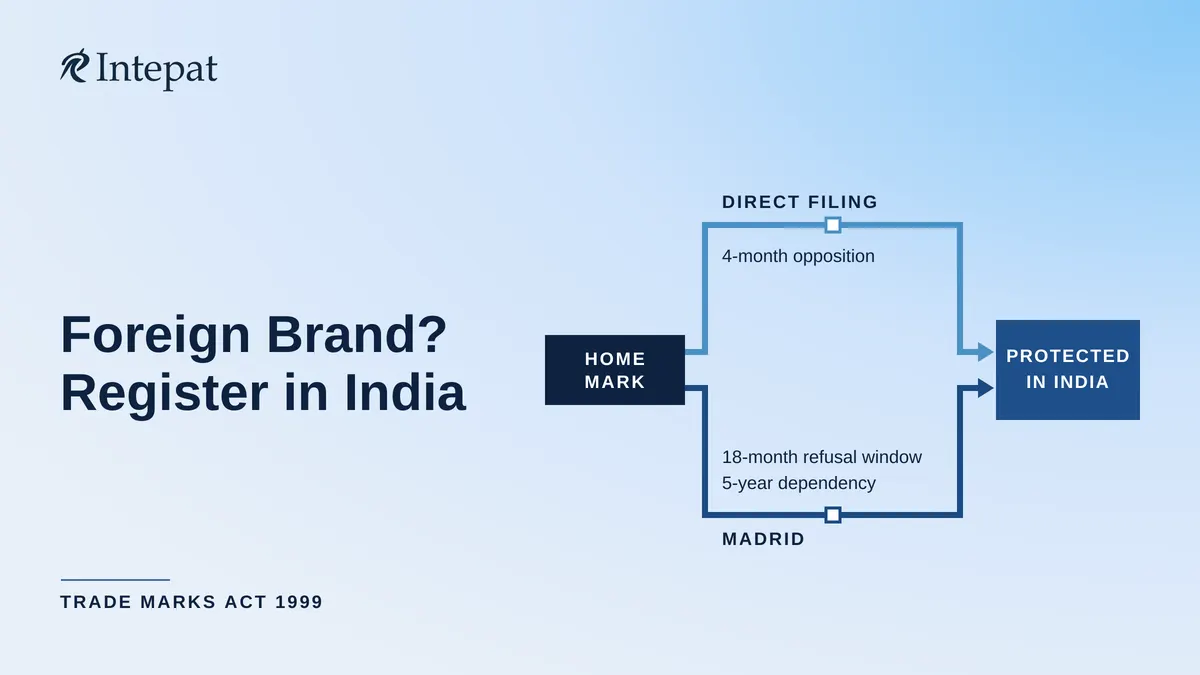
Both routes lead to the same protection in India. A designation of India is examined and opposed as if it were an Indian application. If it is not opposed and the opposition period has ended, the Registry must notify acceptance within 18 months of receiving WIPO’s notification, failing which protection is treated as extended.
| Point of comparison | Direct filing in India | Designating India through Madrid |
|---|---|---|
| What you need first | The mark and a specification, the list of goods or services to be covered | A home application or registration (the basic mark) with the office of a Madrid member where the company is a national, is domiciled or has a real and effective business establishment |
| How it is filed | By you or your Indian agent, with the Registry | Through that office, as an international application whose particulars match the basic mark; India can also be added later to an existing international registration |
| Examination and opposition in India | Examination, advertisement in the Trade Marks Journal, four-month opposition window | The same steps, applied to the designation |
| Time limit for India to refuse a Madrid designation | No equivalent; the Act separately directs registration within 18 months of filing, subject to its conditions | 18 months from the Registry’s receipt of WIPO’s notification; a refusal based on an opposition can follow later, within limits set by the Protocol |
| Tie to the home mark | None | Depends on the basic mark for five years from the international registration date, and longer if a challenge to it begun in that period succeeds later |
| What India issues | A registration certificate | A statement of grant of protection sent to WIPO; no local certificate |
A refusal notified within those 18 months must still be answered. A designation of India must also carry a declaration that the holder intends to use the mark, a requirement India has notified to WIPO and which appears in WIPO’s Madrid member profile for India. India has also declared under the Protocol that it cannot be added to an international registration made under the Protocol before 8 July 2013, the date the Protocol took effect for India. It has also declared that a licence recorded in the international register has no effect in India, so a licence to an Indian distributor or manufacturer needs to be dealt with under Indian law rather than through WIPO alone.
If the home mark fails within five years, or later on a proceeding begun within them, and the international registration is cancelled at the home office’s request, the Rules apply the Protocol’s transformation provision to designations of India. The holder can then file an Indian national application for the same mark within three months of the cancellation, for goods and services the designation covered and meeting the Indian filing requirements and fees, and it is treated as filed on the international registration date, or the date India was added, with any priority it enjoyed.
Madrid suits an owner who holds a stable home mark and wants several countries in one filing. A direct filing is the safer route where the home mark could still be cancelled or narrowed, because a narrowing at home within the five years, or later on a challenge begun in them, narrows India for the goods affected. Our comparison of Madrid and direct national filing, written for Indian owners filing abroad, sets out the same structural trade-offs from the other direction.
Claiming priority from your home application
If you first filed in a convention country, one India has notified as such, an Indian application filed within six months of that filing and claiming priority takes that filing date once registered, for the goods and services the earlier filing covered. The Indian applicant must be the home applicant or its legal representative or assignee.
The earlier date gives no damages for infringement before the Indian filing. Where you filed in several convention countries, the six months run from the earliest filing. A direct Indian application has to state the earlier filing date, the country, the serial number where there is one, and that priority is claimed. A certificate from the office of first filing goes in with the application or within two months of filing it, confirming the filing date, the country, the representation of the mark and the goods or services.
Take a company that files at home on 10 February and in India on 5 July, claiming priority. Once registered, the Indian application takes the 10 February date for the goods its home application covered, ahead of an Indian business that filed the same mark in May, although an Indian business that has used the mark continuously since before 10 February, and before any use of it by the foreign company in India, can still rely on that use.
Two limits catch foreign groups: only a single priority can be claimed for all the goods and services, and goods or services not in the home application get no priority. A group that files at home through one entity and in India through another should settle ownership before the Indian filing.
Agent, address for service and authorisation
A direct applicant must give an address for service in India, a postal and an email address. Without one the Registry need not send notices, and an order made meanwhile cannot later be challenged for want of notice. The agent’s authorisation is executed on Form TM-M.
The deadline to diarise: if the authorisation is revoked or the agent withdraws and the application mentions no principal place of business in India, a new address for service is due within two months, or the application is deemed abandoned. In practice, when changing counsel, file the new agent’s Form TM-M and give a postal and email address for service in India at the same time as the revocation, rather than relying on the two-month window.
Madrid designations work differently at the start, because the home mark carries the filing. A holder with no address for service in India must appoint a local representative for specific steps before the Registry: contesting a provisional refusal, which is the Registry’s objection notified through WIPO, and earlier steps such as filing a letter of consent. The regulations for a collective or certification mark are due within one month of WIPO’s advice. WIPO’s profile for India records that the power of attorney must be properly stamped and notarised or legalised as per the applicable law, that a copy is enough, and that it can be filed with the response to a refusal.
Official fees for a foreign applicant
Government fees are charged for each class and each mark. The lower filing fee applies to an individual, a startup or a small enterprise, and a foreign company can qualify: a foreign enterprise counts as a small enterprise if it meets the same investment limits, and a foreign startup must meet the Startup India criteria and file a declaration.
| Government fee, for each class | E-filing | Physical filing |
|---|---|---|
| Application on Form TM-A, individual, startup or small enterprise | Rs 4,500 | Rs 5,000 |
| Application on Form TM-A, all other applicants | Rs 9,000 | Rs 10,000 |
| Expedited processing on Form TM-M, on top of the filing fee, individual, startup or small enterprise | Rs 20,000 | Not allowed |
| Expedited processing on Form TM-M, on top of the filing fee, all other applicants | Rs 40,000 | Not allowed |
| Opposition, rectification or counter-statement, Form TM-O | Rs 2,700 | Rs 3,000 |
| Renewal, Form TM-R | Rs 9,000 | Rs 10,000 |
| Renewal within six months after expiry, surcharge on top of the renewal fee | Rs 4,500 | Rs 5,000 |
Fees were verified as of November 2026 against IP India’s forms and fees page. A Madrid designation or renewal pays India’s individual fee of CHF 83 for each class instead, under WIPO’s notice applying from 28 June 2026. An expedited application is examined ordinarily within three months, which can matter before a launch; with the filing fee, expedition brings the e-filing cost to Rs 49,000 a class for applicants outside the lower-fee group. A request to have a mark listed as well known costs Rs 1,00,000 for the mark. The small enterprise test uses the investment limit for a medium enterprise under India’s MSME law, converted at Reserve Bank of India reference rates, so check the figures before claiming the lower fee. A Madrid filing also pays WIPO’s own fees, which our guide to the Madrid fee calculator explains. Professional fees are separate; more is in our article on trademark registration fees in India.
Examination, publication and opposition
A foreign applicant goes through the same examination, advertisement and four-month opposition window as an Indian one, and the deadlines are short. For a direct application, a reply to the examination report is due within one month of receiving it, or the application may be treated as abandoned.
Agree in advance who can approve a reply quickly, because time zones and internal sign-off do not extend the month.
The objection is answered in writing and, if the reply does not satisfy the Registrar or you ask for one, at a hearing the Registrar must offer. Once the mark is advertised in the Trade Marks Journal, any person can oppose it. The applicant then has two months from receiving the opposition to file a counter-statement. It then has two months from receiving the opponent’s evidence, or the opponent’s notice that it will file none, to file its own evidence by affidavit, serving copies on the opponent and telling the Registrar it has done so, or to tell the Registrar and the opponent that it relies on its counter-statement. Doing nothing at either step means the application is deemed abandoned.
In an opposition, an opponent, or an applicant that has filed a counter-statement, that neither resides nor carries on business in India may be asked for security for costs, and if it is not given the Registrar may treat the opposition or application as abandoned.
For a designation of India, an objection on examination reaches the holder as a provisional refusal, to be answered within one month of receiving it, and an opposition as a provisional refusal based on the opposition, with two months to reply. Those are the periods in WIPO’s profile for India, which also records that the Madrid minimum response period does not apply to India. Our guide to responding to a provisional refusal from India covers that stage. The trademark opposition guide explains the domestic procedure.
Use in India and the risk of removal
An application can rest on intended use, but a registered mark can be removed if it goes unused for a continuous five years from its entry on the register, counted up to three months before the removal application. A mark registered with no genuine intention to use it, and not used, can be removed without waiting five years.
Any aggrieved person can apply for removal. Against the five-year ground, non-use caused by special circumstances in the trade, including legal or regulatory restrictions on using the mark in India, is excused, provided it does not reflect an intention to abandon or not to use the mark. File on an intended-use basis where there is a real launch plan, and keep dated records of sales, distribution and advertising in India from the first shipment. Use by a distributor or licensee counts as the owner’s use where it has the owner’s consent in a written agreement, is for goods or services the mark remains registered for and the user trades in, and keeps within any conditions or limitations on the user and on the registration. Our article on the consequences of non-use sets out what counts as use.
If someone used or filed your mark in India first
A filing date is not the whole story in India. A registered owner cannot stop a person who, alone or through a predecessor, has used the same or a similar mark continuously for particular goods or services from before the owner’s own first use or registration, whichever is earlier.
A foreign mark can be recognised as well known without use, registration or filing in India, but that status does not by itself defeat a local registration obtained in good faith with the material information disclosed. If a local business has already filed, the main Registry routes are an opposition during the four-month window or, once the conflicting mark is registered, rectification, an application to correct or cancel the entry on the register. A passing-off action in court is also possible where the foreign owner has goodwill in India. Indian courts apply a territorial test, so the case depends on proof that its reputation had reached Indian consumers before the other party adopted the mark, which our article on transborder reputation examines through the case law. Where the brand is widely recognised, the well-known trademark route is worth assessing.
Two time-based bars apply. Where the owner holds a trade mark registered in India and its own agent or representative uses, registers or tries to register the mark in its own name without authority, the owner can oppose it or have the registration cancelled or assigned to itself, but must act within three years of becoming aware of it. Separately, the owner of an earlier mark who knowingly tolerates use of a later registered mark for five continuous years can no longer, on the basis of that earlier mark, seek to have the later registration declared invalid, or oppose its use for the goods or services on which it has been used, unless the later mark was not applied for in good faith.
After registration: renewal and customs
A direct Indian registration lasts ten years from the Indian filing date, or the earlier convention filing date where priority was claimed. Renewal, for ten years at a time, can be filed up to one year before expiry or within six months after it with a surcharge; after that, restoration within one year of expiry needs the Registrar to be satisfied it is just.
A designation of India is renewed through WIPO together with the international registration, every ten years, with six months’ grace on payment of a surcharge.
A registered owner can also give Indian Customs notice of the mark, through a single point of registration, so that suspect imports can be held at the border. The notice carries an application fee of Rs 2,000, and the right holder executes a bond covering liability to the importer and demurrage, detention and destruction costs, and an indemnity bond in favour of Customs. The Rules set a minimum of one year unless the right holder asks for less, and CBIC has fixed the validity at five years. Protection applies at the ports named in the notice and only to goods meant for sale or use in India that bear a false trade mark or a false trade description; goods in transit are excluded. The right holder may examine a consignment whose clearance has been suspended. Our article on customs recordal in India covers the practical steps.
The decision for a foreign company comes down to four questions asked before filing: is the mark clear in India, which route fits the state of the home mark, is the priority window still open, and when will genuine use in India begin. Intepat IP’s trademark team files and prosecutes Indian applications for foreign owners through our trademark registration service in India.
FAQ
No. A foreign company claiming to own a mark it uses or proposes to use can apply and hold it in its own name. A direct application needs an address for service in India; the company acts itself or through a legal practitioner, registered trade marks agent or sole and regular employee. A Madrid holder lacking an Indian address for service needs a local representative only for certain later steps.
Yes. An application can rest on a mark proposed to be used, so you can file before launch. A registration is exposed to removal after five continuous years without use from its entry on the register, counted to three months before the removal application, and sooner if registered without a genuine intention to use and not used. Plan the launch.
Not to file, because the designation is part of the international application. A holder without an address for service in India needs a local representative to contest a provisional refusal or for steps such as a letter of consent. WIPO’s profile says the power of attorney must be stamped and notarised or legalised as the applicable law requires, and a copy is accepted.
It can, if it meets the Startup India criteria for turnover and period of incorporation or registration and files a declaration to that effect. A foreign enterprise can also qualify as a small enterprise on the investment limits. The lower e-filing fee is Rs 4,500 for each class, against Rs 9,000 for other applicants.
A Madrid designation of India depends on the home mark for five years from international registration. If that mark lapses, is withdrawn, renounced, or finally refused or cancelled then, or later on a challenge begun then, protection in India falls for the goods affected. Within three months of WIPO cancelling the international registration, you may file nationally in India, keeping the earlier date and any priority, on the conditions above.
Oppose within four months of advertisement; if you are aggrieved, seek rectification once it is registered; or, with goodwill in India, sue for passing off. If you hold an Indian registration and your own agent or representative filed in its own name without authority, you can oppose, cancel or take an assignment within three years of learning of it.
This article explains trademark registration in India for foreign companies as at November 2026 and is for general information only. It is not legal advice. Government fees, WIPO fees and Registry practice change; confirm the current position before you file. For advice on your mark and filing route, consult a trademark attorney.
Sources
- The Trade Marks Act, 1999 (Act 47 of 1999), India Code consolidation as on 1 June 2026. https://www.indiacode.nic.in/bitstream/123456789/1993/1/a199947.pdf
- The Trade Marks Rules, 2017 (G.S.R. 199(E)), IP India. https://ipindia.gov.in/storage/uploads/docs-operator/f558da2b-ff4f-46bb-9f26-80d7ff16eba9.pdf (fees: IP India forms and official fees page, read 6 November 2026, https://ipindia.gov.in/pages/trade-marks/learn/forms-and-official-fees)
- Madrid Protocol and Regulations (Regulations as in force on 1 November 2026), WIPO publication 207. https://www.wipo.int/edocs/pubdocs/en/wipo-pub-207-2026-en-protocol-relating-to-the-madrid-agreement-concerning-the-international-registration-of-marks-regulations-administrative-instructions-schedule-of-fees.pdf
- WIPO, Madrid System member profile: India (profile last updated 5 March 2025), read 7 November 2026. https://www.wipo.int/madrid/memberprofiles
- WIPO, Madrid System Information Notice No. 27/2026, India individual fee. https://www.wipo.int/documents/d/madrid-system/information-notices-en-2026-madrid_2026_27_in_indfee_e.pdf