




The United States and Canada both register trademarks federally, but the systems diverge in structure: the US maintains a Principal and a Supplemental Register while Canada keeps one; Canada dropped its use-based filing requirement in 2019; and both charge per-class fees under the Nice Classification, though the amounts and timelines differ.
This comparison of US and Canadian trademark procedure covers federal registration only: the US Patent and Trademark Office (USPTO) system under the Lanham Act, and Canada’s system under the Trademarks Act, administered by the Canadian Intellectual Property Office (CIPO). Provincial trade name registries and Indian trademark procedure are outside its scope.
| Quick answer: |
| USPTO’s current first-action pendency runs close to five months from filing; CIPO’s current-fiscal-year service standard is 14 months. USPTO charges $350 per class to start; CIPO charges roughly $491 for the first class and $149 for each additional class. The US runs two federal registers, Principal and Supplemental, while Canada runs one, and the US still distinguishes use-based filings from intent-to-use filings while Canada dropped every filing-basis requirement in 2019. Both systems charge per Nice Classification class, and both belong to the Madrid Protocol; registration is ordinarily nationwide in each country, though both have narrower exceptions described below. Since April 1, 2025, Canada’s Registrar can also award costs against bad-faith filers and neutralize stale official-mark claims by public notice. |
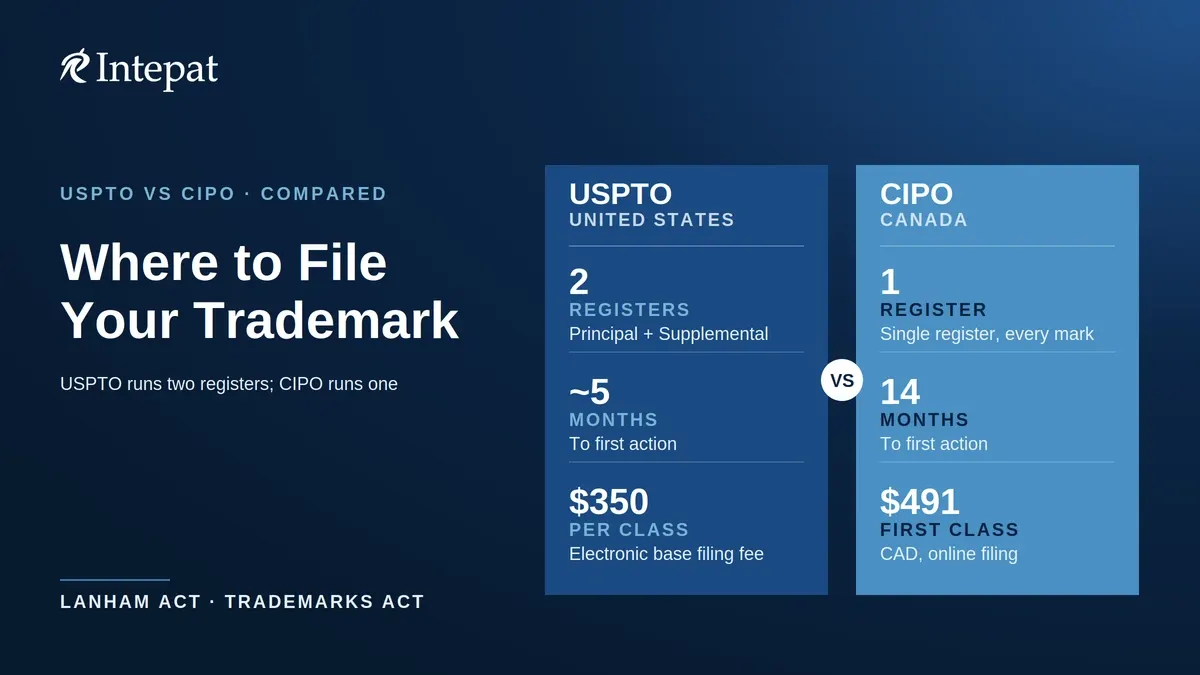
Two laws, two agencies: the foundation of US and Canadian trademark procedure
Federal trademark protection in the United States runs on the Lanham Act, signed into law on July 5, 1946. USPTO administers registration under that Act, though its predecessor office predates the Act and remains the sole federal trademark authority today.
Canada’s equivalent is the Trademarks Act, originally passed in 1953 and brought into force in 1954. A 2014 law renamed it, but the rename did not take legal effect until June 17, 2019, the same date as the broader reform discussed below; the law was still officially called the “Trade-marks Act” until then. CIPO administers it, and Intepat’s Canadian trademark registration procedure guide walks through that filing process step by step.
A common point of confusion is the “trademark” versus “service mark” distinction. The Lanham Act formally uses two separate terms throughout its text, trademark for goods and service mark for services, though practitioners often use “trademark” loosely to cover both. Canada’s Act defines a single term, trademark, that already covers both goods and services under one definition.
Why Canada’s Registrar can now award costs against bad-faith filers
The most significant change either country has made recently is not the 2019 reform itself, it is what took effect nearly six years later. On April 1, 2025, a set of powers Canada had quietly written into law back in December 2018, months before the 2019 filing-basis reform, but never activated, finally came into force. The government’s stated purpose was broader than any one problem: discouraging undesirable conduct in opposition proceedings and clearing overly broad official-mark protection, not a targeted response to the 2019 reform specifically.
The Registrar gained a fixed cost-award power: ten times the opposition fee where an application is refused for bad-faith filing, twice the fee for a divisional application filed after advertisement or for withdrawing a hearing request within 14 days of the hearing, and five times the fee for conduct causing undue delay or expense, though no award issues if the opposition ends before a final decision. The Registrar can also issue confidentiality orders for sensitive evidence, and, separately, can now issue a public notice that a stale “official mark” (a status only public authorities can claim; a related, unaffected category covers university and armed-forces marks) no longer blocks other applicants, where the entity that obtained it is not in fact a public authority, or no longer exists, without the Federal Court proceeding that was previously the only route.
The underlying bad-faith ground for opposition and invalidity has existed since 2019; what changed in 2025 is the Registrar’s power to actually penalize it.
Principal and Supplemental Registers vs. Canada’s single register
USPTO maintains two federal registers. The Principal Register is available to marks that are inherently distinctive, or that have acquired distinctiveness, and carries the strongest legal benefits: automatic nationwide notice of the registrant’s ownership claim, plus automatic nationwide priority tied to the filing date once registered (with exceptions for earlier users or filers), a legal presumption of validity, eligibility for incontestable status after five years, and eligibility for recordation with US Customs and Border Protection. Marks that are merely descriptive or primarily a surname, but still capable of distinguishing the applicant’s goods or services, can register on the Supplemental Register instead: a standard use-based application must already be in lawful use; an application based on a foreign registration need not be, and a Madrid-based application cannot use it at all.
A Supplemental Register registration is still a federal registration, and still supports an infringement suit, but it carries none of the automatic nationwide benefits above; those are reserved for the Principal Register by law. It is not a “regional” registration; what is geographically limited is unregistered common-law use, not a Supplemental Register filing.
Canada keeps one register for every mark. A mark that is merely descriptive or primarily a surname is refused until the applicant shows it is distinctive at the filing date, having regard to all the circumstances, including length of use; there is no separate, lesser-benefit register to fall back on in the meantime, and even a successful showing can come with the territorial limits described below.
Filing basis: why Canada no longer asks “use or intent to use”
US applicants must still choose a registration basis: use in commerce, a genuine intent to use the mark, a qualifying foreign registration, or an extension of protection under the Madrid Protocol. A foreign application filed within the last six months adds a priority filing date to any of these, but is not itself a basis for registration. An intent-to-use applicant cannot register until filing a Statement of Use or an Amendment to Allege Use, a real, separate procedural step.
Before June 17, 2019, Canadian applicants also had to elect a basis, use in Canada, making known in Canada, proposed use in Canada, or use and registration abroad; proposed use was always permitted, but a proposed-use application could not register until the applicant filed a Declaration of Use. The 2019 reform removed the entire scheme: an applicant today need only be using, or propose to use, and be entitled to use, the mark in Canada. No basis is declared, and no declaration of use is filed. That change is why a US applicant used to the intent-to-use track should not assume Canada still works the same way.
Classification and current filing fees
Both countries classify goods and services under the Nice Classification (45 classes: 1 to 34 for goods, 35 to 45 for services) and charge a government fee per class. Both also expect the specification of goods and services to be specific and definite, not open-ended; each office’s pre-approved wording is optional but lowers the risk of objections, since a poorly drafted specification is a common, avoidable cause of delay in either country.
USPTO’s fee structure changed substantially on January 18, 2025, replacing its old two-tier filing system with a single base electronic filing fee plus targeted surcharges. Current figures, verified as of August 2026:
| USPTO fee (per class unless noted) | Amount (USD) |
| Base application, electronic | $350 |
| Base application, paper (generally unavailable since Feb. 2020, limited exceptions) | $850 |
| Madrid Protocol application | $600 |
| Surcharge, insufficient information | $100 |
| Surcharge, free-form identification | $200 (plus $200 per extra 1,000 characters) |
| Declaration of Use (years 5-6) | $325 |
| Renewal | $325 |
| Incontestability declaration | $250 |
| Notice of opposition | $600 |
| Dividing an application (electronic; paper $200) | $100 per new application, plus a full base filing fee if the split is within a class |
Source: 37 CFR §2.6, effective January 18, 2025 (Madrid-related figures effective February 18, 2025).
Most CIPO fees are indexed every January 1, though some, like the extension-of-time fee below, stay flat. Current figures, verified as of August 2026:
| CIPO fee | Amount (CAD) |
| Application, first class (online) | $491.06 |
| Application, each additional class | $149.04 |
| Renewal, first class (online) | $595.06 |
| Renewal, each additional class | $185.49 |
| Statement of opposition | $1,115.08 |
| Extension of time request | $150.00 |
Source: CIPO trademark fee schedule, effective January 1, 2026.
USPTO separately surcharges a free-form or overlong identification of goods and services; CIPO’s opposition fee is a flat CAD amount rather than a per-class fee. Neither office discounts its trademark fee for a small entity or startup, unlike US patent fees; the figures above apply regardless of applicant size. Convert currencies and check your own specification against the schedule before assuming either jurisdiction is cheaper; see Intepat’s guide on reducing trademark registration costs for filing choices that affect the total.
Examination, publication, and opposition windows
USPTO’s current first-action pendency target is five months from filing; actual pendency reached about 4.7 months as of late July 2026, and USPTO’s stated longer-term goal is four months by FY2028. If the examining attorney issues an office action, the applicant has three months to respond, shortened from six months by the Trademark Modernization Act of 2020 for most applications filed on or after December 3, 2022, with one paid three-month extension available; a Madrid-based application keeps the full six months, unchanged. Publication and opposition timing appear in the table below.
CIPO’s service standard for the current fiscal year is 14 months to a first examiner’s report; CIPO updates this standard annually and it has shifted by months in recent years, so treat it as a current snapshot. Publication, opposition windows, and extensions (including a consent-based cooling-off period intended to support settlement) also appear in the table below.
| Stage | US (USPTO) | Canada (CIPO) |
| First action from filing (Madrid: from territorial extension) | ~5 months | 14 months (current fiscal year) |
| Standard office-action response window | 3 months (6 for Madrid-based filings) | 6 months |
| Publication/advertisement after approval | ~1 month | ~2 weeks |
| Initial opposition window | 30 days | 2 months |
| Opposition window, maximum extension | 180 days total | Up to 7 months via cooling-off, plus benchmark and exceptional extensions |
Registration term, renewal, and incontestability
Both countries register a trademark for an initial ten-year term; Canada shortened its term from 15 to 10 years as part of the 2019 reform. Both renew in ten-year increments, and both offer a six-month grace period after expiry.
The US adds a maintenance step Canada does not have: a Declaration of Use, or excusable nonuse (distinct from Canada’s abolished pre-2019 use declaration above), due between the fifth and sixth year after registration and again with every renewal. Miss it, even with a timely renewal fee paid, and the registration is cancelled. A US registrant can also seek incontestable status by filing an affidavit within one year after five consecutive years of continuous use following registration, provided the mark is still in use, is not generic, and no final decision or pending proceeding challenges the owner’s ownership, registration, or right to keep the mark registered. Incontestability narrows, but does not eliminate, the grounds to challenge the mark later, including fraud and abandonment.
Canada has no declaration-of-use maintenance filing, and its own incontestability rule is much narrower: once five years pass after registration, it can no longer be challenged on the ground someone else used or made known a confusing mark earlier, unless the registrant knowingly adopted it despite that earlier use. Starting three years after registration, any person can ask, in writing and for a fee, that the Registrar require the owner to prove use in Canada during the preceding three years or explain the non-use (the Registrar can also act on its own initiative); failing that, the registration is liable to be cancelled or narrowed. The US has a comparable pair of tools since the Trademark Modernization Act of 2020: expungement, available three to ten years after registration against a mark never actually used, regardless of the original filing basis, and reexamination, a narrower review available only in the first five years against a use-based registration not actually in use when it was filed.
Dividing an application in either country
Both systems let an applicant split a single application into two or more, keeping the original filing date on each resulting application. In the US, this is called a Request to Divide Application, commonly used to separate goods or services on different filing bases, or to separate an opposed or refused portion from one that can proceed to registration. Canada introduced an equivalent divisional-application mechanism only in 2019; before that, an applicant covering both used and proposed-use goods could not separate them while keeping one filing date, and typically had to resolve the whole application together or refile the rest later under a new date.
Foreign priority and Madrid Protocol filing
A foreign registration can support a US application on its own, provided the registration is from the applicant’s country of origin and owned by the applicant; a corresponding foreign application filed within the last six months can instead support a priority claim. Canada dropped its old use-and-registration-abroad filing basis in 2019; what remains is a Paris Convention priority claim, available if the Canadian application is filed within six months of the first corresponding foreign filing.
Both countries are Madrid Protocol members, the US since November 2, 2003, and Canada since June 17, 2019. A single international application, filed through the applicant’s Office of Origin, can extend protection into either country, or both, from one base application or registration, though it is worth comparing against direct national filing first. The trade-off is real: for five years, the international registration stays dependent on its base application or registration, including a challenge begun within that window but decided afterward. If the base mark is withdrawn, lapses, or is finally rejected, revoked, cancelled, or invalidated, the international registration is cancelled to the same extent in every designated country, including any US or Canadian protection obtained through it. The holder can generally preserve the filing date and priority by transforming the affected designation into a national application within three months, covering only its originally listed goods and services.
USPTO also requires foreign-domiciled applicants, including Canadian filers by name, to appoint a US-licensed attorney, a rule in effect since August 3, 2019, applying whether the application is filed directly or through a Madrid designation.
Nationwide protection: where the two systems agree
Registration is ordinarily nationwide in both countries, though each has its own exception. A Canadian registration is nationwide regardless of where the owner operates, unless it registered on proven rather than inherent distinctiveness: the law then restricts it to the specific goods or services, and territorial area, the evidence actually covers, the same descriptive-and-surname-mark category discussed above. A US Principal Register registration works the same way, nationwide regardless of the registrant’s actual footprint, but its exception sits inside the US system rather than between the two countries: that benefit is Principal Register-specific; unregistered common-law rights, and Supplemental Register rights, remain tied to the area where the mark is actually used or known.
Choosing where to file first
A business planning to operate in only one country near-term can usually let that decide the filing order. A business planning both markets at once has a real choice: file directly in each and manage two prosecution timelines, or file one base application and extend it to both through Madrid, trading a single filing date for the five-year dependency risk above.
The Canadian filing-basis change removes a step that used to slow this decision down: no declaration of use to plan around before a Canadian mark can register. The US filing basis and maintenance schedule, by contrast, still rewards planning use dates and Declaration of Use deadlines well ahead of time. Neither system is simpler across the board.
Frequently asked questions
USPTO’s current first-action pendency runs close to five months from filing; CIPO’s standard for the current fiscal year is 14 months to a first examiner’s report. Both extend if the examiner objects or a third party opposes. CIPO’s standard shifts year to year, so check both offices’ current figures before relying on either for a launch date.
USPTO charges $350 per class for a standard electronic filing, plus surcharges for an incomplete or free-form identification of goods and services. CIPO charges roughly $491 for the first class and $149 for each additional class. Renewal, opposition, and division fees differ too, so compare the specific fee lines against your own filing rather than assuming one country is cheaper overall.
Not as a single national filing, since USPTO and CIPO are separate registries. You can, however, file one international application under the Madrid Protocol and designate both the US and Canada for extension of protection, provided you hold a qualifying base application or registration in a Madrid member country.
It was never barred. Before June 17, 2019, Canadian applicants could file on a proposed-use basis but had to file a Declaration of Use before registration would issue. The 2019 reform removed the filing-basis requirement entirely, so applicants no longer declare use, proposed use, or any other basis at all.
It still confers federal registration status, use of the ® symbol, and standing to sue for infringement in federal court, and it can block confusingly similar later applications. It does not carry the Principal Register’s automatic nationwide notice, incontestability, or US Customs recordation benefits, so it is generally a fallback, not a first choice.
For the US, yes if domiciled outside the United States: USPTO’s rule, since August 3, 2019, requires such applicants, including Canadian filers by name, to appoint a US-licensed attorney. Canada does not require an agent at any stage, including office-action responses, unless the applicant chooses to appoint one; and unlike the US, Canada dropped its agent-residency requirement in 2021.
Effective April 1, 2025, Canada’s Registrar gained power to award costs against bad-faith filers, issue confidentiality orders, and neutralize stale official-mark claims by notice. It does not retroactively invalidate existing registrations, though existing rights aren’t fully insulated: the official-mark power targets notices from well before 2025, and the cost-award and confidentiality powers can reach proceedings already pending on that date.
Both last ten years and renew in ten-year terms. The US requires a Declaration of Use between years five and six, or the registration is cancelled regardless of the renewal fee paid. Canada has no equivalent filing, but either country’s registration can face a non-use challenge, so renewal alone does not guarantee unused goods stay protected.
Yes, in both. The US allows a Request to Divide Application; Canada added an equivalent divisional-application mechanism in 2019. Both let an applicant separate goods or services, commonly to isolate a refused or opposed portion, while keeping the original filing date.
This article explains US and Canadian federal trademark procedure as at August 2026 and is for general information only. It is not legal advice. USPTO and CIPO fees, forms, and timelines change; confirm current figures directly with USPTO or CIPO, or with a licensed US or Canadian trademark attorney, before you act. For advice on your specific mark or filing strategy, consult a qualified trademark professional in the relevant jurisdiction.
Deadlines in this area are strict, and missing one, an office action response, an opposition period, a use declaration, a renewal, can result in the loss of rights. The figures and timelines here are indicative and change; do not rely on them for a specific filing without confirming the current position and, where the stakes warrant it, taking professional advice.