




Initially Published in 2016; and Updated in 2026
The Patents (Amendment) Rules, 2016 created expedited examination, introduced Forms 18A, 29 and 30, fixed a six-month period to put an application in order, and widened the list of deadlines the Controller could not extend. As at August 2026, some of that still governs Indian patent practice and some has been rewritten.
This article separates the two. It is written for practitioners and in-house readers in India who have hit a citation to the 2016 Rules in a file note, an opinion or an older precedent and need to know whether the provision cited still says what it said.
Quick answer: The rule 24C expedited route survives from 2016, though not its grounds or its filing window. So do the six-month period under section 21, the marked-copy amendment rule, and Form 29 withdrawal with a 90 per cent refund where the withdrawal beats the first statement of objections. Video-conference hearings survive too, reached through rule 28A rather than as a free-standing power. A note written before September 2019 is already out of date on the expedited grounds; one written before March 2024 is out of date on those grounds and on the examination window and rule 138 besides.
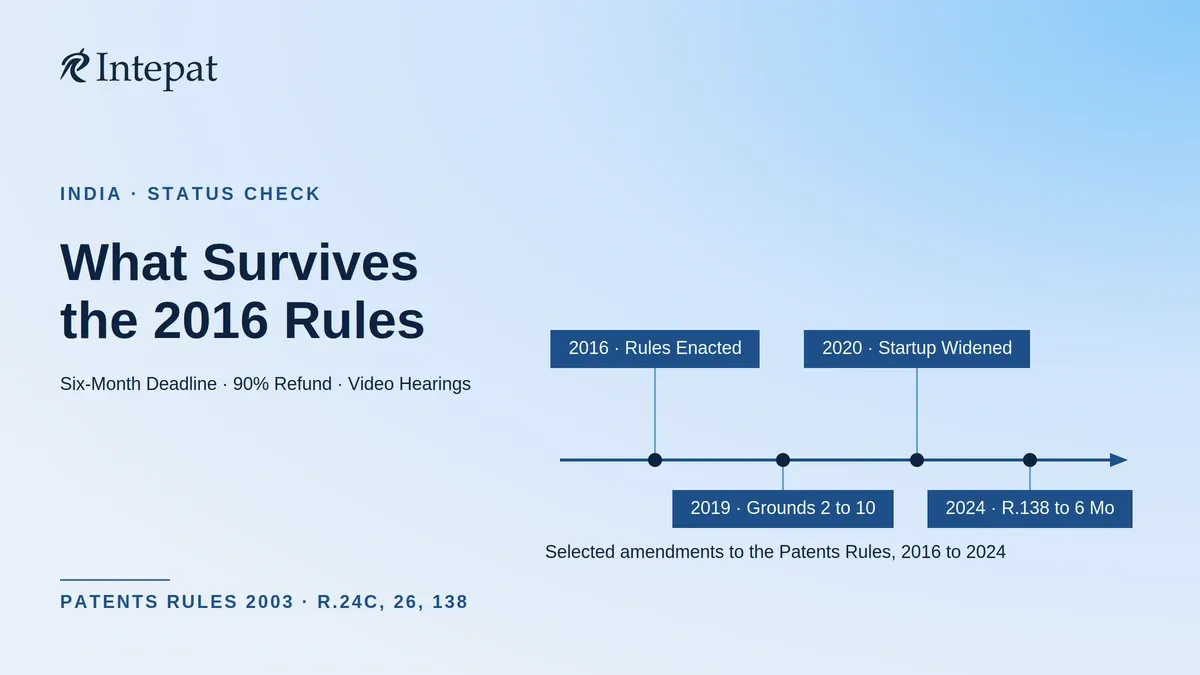
What the Patents (Amendment) Rules, 2016 changed
The instrument runs to thirty-one clauses. It substituted the First Schedule in full, amended the Second Schedule list of forms, inserted three entirely new rules, and touched rules governing service, fees, specifications, examination, hearings, opposition, scientific advisers, patent agents and extensions of time.
The three new rules were 24C on expedited examination (clause 11), 103A on disqualifications for the roll of scientific advisers (clause 18), and 129A on adjournment of hearings (clause 26). Rule 103A is outside the scope of this article; the other two are covered below.
The instrument followed a draft published for objections as G.S.R. 806(E) on 26 October 2015 under section 159(3) of the Patents Act, 1970. Rule 1(2) of the final instrument reads: “They shall come into force on the date of their publication in the Official Gazette.” The notification itself is dated 16 May 2016.
Two points a practitioner citing this instrument should know. First, it names no commencement date of its own; commencement runs off the date of Gazette publication. Second, the instrument has no G.S.R. number that can be verified. Three copies were checked for this article, on IP India’s own site, at WIPO Lex, and at the Himachal Pradesh Patent Information Centre. Each is the pre-publication text headed “[TO BE PUBLISHED IN THE GAZETTE OF INDIA…]”, and each prints the number as “GSR———- (E)”.
The practical consequence is a citation rule: cite these rules by date, as the Patents (Amendment) Rules, 2016, notification dated 16 May 2016. Where a secondary source supplies a G.S.R. number for this instrument, that number cannot be checked against the instrument itself. The date 13 May 2016, which circulates in some commentary, appears nowhere in the text on any of the three copies checked.
Expedited examination under Rule 24C: two grounds in 2016, ten today
Rule 24C was new in 2016 and was enacted with thirteen sub-rules. It let an applicant request expedited examination in Form 18A, with the First Schedule fee, only by electronic transmission duly authenticated, within the period prescribed by rule 24B. As enacted it offered two grounds. It now offers ten.
Two further conditions sit in the rule and are easy to miss. Rule 24C(3) requires the request to be accompanied by a request for publication under rule 24A unless the application has already been published or a publication request is already on file. Rule 24C(4) then sends a non-complying request back into ordinary rule 24B examination, keeping its original filing date.
The grounds in the 2016 text of rule 24C(1), verbatim, were “(a) that India has been indicated as the competent International Searching Authority or elected as an International Preliminary Examining Authority in the corresponding international application; or (b) that the applicant is a startup.”
Rule 24C(1)(a) to (j) as they now stand, against the 2016 position:
| Ground | In the 2016 text | In the current text |
| India indicated as ISA or elected as IPEA, clause (a) | Yes | Yes, unchanged |
| Applicant is a startup, clause (b) | Yes | Yes |
| Applicant is a small entity, clause (c) | No | Yes |
| Natural person applicants where at least one is female, clause (d) | No | Yes |
| Department of the Government, clause (e) | No | Yes |
| Institution established by a Central, Provincial or State Act and owned or controlled by the Government, clause (f) | No | Yes |
| Government company under section 2(45) of the Companies Act, 2013, clause (g) | No | Yes |
| Institution wholly or substantially financed by the Government, clause (h) | No | Yes |
| Application in a sector notified by the Central Government, clause (i) | No | Yes |
| Applicant eligible under an IP India arrangement with a foreign patent office, clause (j) | No | Yes |
The current text of the rule, clause by clause, is published on IP India’s rule 24C page.
That expansion, from two grounds to ten, came from the Patents (Amendment) Rules, 2019 (G.S.R. 663(E), 17 September 2019), whose clause 4 substituted clause (b) alone with the run of clauses (b) to (j). Clause (a) was left untouched. Anyone reading a 2016-era note that describes expedited examination as a startup route is reading an accurate statement of the 2016 position and an incomplete statement of the present one. The mechanics of filing are covered on our expedited patent examination page.
One further change is easy to miss. The proviso to rule 24C(5) protects an applicant whose status lapses after filing. In 2016 it covered a startup that ceased to be one “due to the lapse of more than five years from the date of its incorporation or registration”. The Patents (2nd Amendment) Rules, 2020 (G.S.R. 689(E), 4 November 2020) substituted it to cover a “startup or small entity” and replaced the five-year test with “the lapse of the period during which it is recognised by the competent authority”.
Rule 24C(2) also allows an ordinary request under rule 24B to be converted into an expedited one, on payment of the relevant fees and submission of the documents rule 24C(1) requires. The First Schedule prices that conversion separately.
The examination clock the 2016 Rules built, and what 2024 moved
Rule 24B governs ordinary examination and rule 24C governs expedited examination, and rule 24C borrows several of rule 24B’s periods rather than restating them. The 2016 instrument rewrote parts of both. Most of the expedited timetable in rule 24C survives word for word; what moved sits upstream of it, in rule 24B.
The expedited stages, each unchanged since 2016:
| Stage | Sub-rule | Period | Ordinary equivalent |
| Examiner makes the report under section 12(2) | 24C(6) | Ordinarily one month, not exceeding two, from the Controller’s reference | No equivalent period stated |
| Controller disposes of the examiner’s report | 24C(7) | One month from receipt of the report | No equivalent period stated |
| First statement of objections issues | 24C(8) | Fifteen days from disposal of the report | One month, rule 24B(3) |
| Controller disposes of the application | 24C(12) | Three months from the last reply or from the last date to put the application in order, whichever is earlier, disapplied where there is a pre-grant opposition | No equivalent period stated |
That compression at the first-statement-of-objections stage, and the three-month disposal limit, are what the expedited fee buys. The response window itself is not shortened.
Upstream, rule 24C(1) requires the expedited request to fall “within the period prescribed in rule 24B”, and that period is no longer what it was. The Patents (Amendment) Rules, 2024 (G.S.R. 211(E), 15 March 2024) substituted “thirty-one months” for “forty-eight months” wherever it occurred in rule 24B(1). The saving clause inserted at rule 24B(1)(vi) is narrower than the substitution: on its terms it preserves the old period only for a request under section 11B(1) on an application filed before commencement, and not for the periods in clauses (ii), (iii) and (iv).
Rule 24B, ordinary examination, then and now:
| Provision | 2016 position | Position in August 2026 |
| Rule 24B(1), request for examination | Within forty-eight months of priority or filing | Within thirty-one months, with a saving clause of limited reach |
| Rule 24B(2)(i), order of examination | In the order requests are filed, a further application under section 16 taking the parent’s place in the queue | Unchanged |
| Rule 24B(3), first statement of objections | Within one month of the Controller disposing of the examiner’s report | Unchanged |
| Rule 24B(5), putting the application in order | Six months from the date the first statement of objections issues | Unchanged |
| Rule 24B(6), extension | A further three months, on Form 4, requested before expiry | Unchanged in substance |
The six-month period under section 21 is worth stating precisely because it is often paraphrased loosely. Rule 24B(5) provides that the time “shall be six months from the date on which the first statement of objections is issued to the applicant to comply with the requirements”. It runs from issue of the first statement of objections, not from the applicant’s receipt of it, and not from the date of the examination request. Rule 24C(10) applies the same six months in expedited cases. Our patent examination procedure page covers what goes into that response.
One drafting change in 2024 is easy to overstate, and it reaches further than rule 24B(6) alone. Rule 24B(6) opens “as prescribed under sub-rule (5)” and, since 2024, closes “specified herein” rather than “specified under sub-rule (5)”, so it now mixes both formulations. The same instrument made the identical substitution to rule 24C(11), the expedited equivalent, replacing its own closing “specified under sub-rule (10)” with “specified herein”. Nothing substantive turns on either change: the three-month period on Form 4, and the requirement to ask before expiry, are unchanged in both sub-rules. The request for examination page sets out the thirty-one month window in full.
Withdrawal, Form 29 and the 90 per cent refund
The 2016 Rules created a route out of examination that can recover most of the fee. Rule 26 as substituted requires a request to withdraw under section 11B(4) to be made in Form 29. Rule 7(4A), inserted by the same instrument, makes a refund available where the withdrawal comes before objections issue.
Withdrawal and refund are two different things, and the conditions belong to the refund. Withdrawal itself is open to the applicant at any time after filing and before grant, under proviso (i) to section 11B(4). Rule 26 in full reads: “A request for withdrawing the application under sub-section (4) of section 11B shall be made in Form 29.” It is one line, and it provides one route.
The refund is narrower. Rule 7(4A) reads: “Notwithstanding anything contained in sub-rule (4), upon the withdrawal of an application in respect of which a request for examination has been filed, but before issuance of first statement of objection, the fee may be refunded to the extent prescribed in the First Schedule on a request made by the applicant in Form 29.”
The precision point matters if you are advising on the number. Rule 7(4A) sets no percentage. It refers out to the First Schedule, and it is Table II of that Schedule that supplies the figure: “Refund of fees under sub-rule (4A) of rule 7” gives “90% of fee paid for request for examination or request for expedited examination”. A sentence attributing 90 per cent to rule 7(4A) itself is citing the wrong provision.
Three conditions are cumulative. The examination request must have been filed, so there is nothing to refund before it. The withdrawal must precede issue of the first statement of objections, so a file that has already drawn a report is outside the refund even though it can still be withdrawn. And the request goes on Form 29.
Note the verb: on the text the fee “may be refunded”, permissive rather than mandatory wording. Whether that gives the Controller a genuine discretion once the three conditions are met, or is standard drafting for a conditional refund, is not settled by the wording alone; no case law or IPO practice statement resolving it was located in session. Verified as of August 2026.
Hearings: video-conference, adjournment and the fifteen-day submission
Three hearing provisions entered the Rules in 2016 and none has been amended since, on a rule-by-rule check against the 2019, 2020, 2021, 2024 and 2025 instruments. Rule 28(6) permits a hearing by video-conference. Rule 28(7) fixes fifteen days for written submissions. Rule 129A governs adjournments, and caps them.
Rule 28(6) is not, on its face, a general power to hold any Patent Office hearing by video-conference. It is a sub-rule inside rule 28, which is headed “Procedure in case of anticipation by prior publication”, and its Explanation is expressly scoped “for the purposes of this rule”. The bridge to an ordinary examination hearing is rule 28A, which provides that where “the applicant contests any of the objections communicated to him, the procedure specified under rule 28 may apply”. The operative verb is permissive, and the route is conditioned on the applicant contesting.
Within that scope, rule 28(6) provides that “the hearing may also be held through video-conferencing or audio-visual communication devices”, with a proviso deeming such a hearing to have taken place at the appropriate office. The deeming provision does real work: it fixes the appropriate office for a hearing conducted from anywhere.
Rule 129A allows a party to request an adjournment with reasonable cause and the prescribed fee, “at least three days before the date of hearing”, and caps the relief: “no party shall be given more than two adjournments and each adjournment shall not be for more than thirty days”. Three days is a floor on the request, not a target. Rule 28(7) then requires written submissions and relevant documents within fifteen days of the hearing, and its own opening words are “In all cases of hearing”.
Service, agent e-filing and marked-copy amendments
Four administrative changes from 2016 shape daily filing practice, and three of them stand unamended. Rule 5 requires an address for service including “a postal address in India and an e-mail address”, with a proviso that a patent agent must also furnish a mobile number registered in India. Rule 5 has not been amended since.
The two obligations have different reach. The e-mail address is required of every person concerned in proceedings and every patentee, in the main limb of the rule. The mobile number, which the proviso requires to be “registered in India”, falls on patent agents alone.
Rule 6 dropped courier service as a route for leaving and serving documents and inserted sub-rule (1A), which made electronic filing compulsory for patent agents. That sub-rule has since been rewritten, and the difference is operational. The 2016 text required agents to file only by electronic transmission “including scanned copies of documents that are required to be submitted in original”. The Patents (Amendment) Rules, 2019 substituted it, dropping the scanned-copies limb and changing the trigger for producing originals from documents “that are required to be submitted in original” to any document “if asked to be submitted in original”. The fifteen-day period for producing originals, failing which the documents are deemed not to have been filed, survives in both versions.
Rule 14 as substituted in 2016 still governs how an amended specification is put on file, and it is the source of the marked-copy requirement practitioners work to daily. Sub-rule (2) requires “a marked copy clearly identifying the amendments carried out and a statement clearly indicating the portion (page number and line number) of the specification or drawing being amended along with the reason”. Sub-rule (1) requires retyped continuous pages, sub-rule (3) prohibits slips, footnotes and margin notes, and sub-rule (4) deems superseded pages cancelled.
Rule 8(2) and new Form 30 completed the set: where no form is specified for a purpose, the applicant may use Form 30. It remains the catch-all.
Rule 138: what the 2016 Rules did, and what 2024 undid
This is the provision where a 2016-era note is most likely to mislead, and where commentary on the 2016 Rules most often overstates their effect. The 2016 instrument substituted rule 138, but it did not invent the one-month cap. What it did was lengthen the list of periods the power could not reach.
The one-month extension and the requirement to ask before expiry had both stood since the Patents (Amendment) Rules, 2005, whose clause 70 substituted a rule 138 reading “may be extended by the Controller for a period of one month” with a sub-rule (2) requiring the request “before the expiry of prescribed period”. Rule 24B was already outside the power by 2013. The 2016 substitution replaced that short list with a specific one that added rules 20(4)(i), 20(6), 21, 24C(10), 24C(11), 130(1) and 130(2).
| Rule 138 as substituted in 2016 | Rule 138 as substituted in 2024 | |
| Length | One month, as before | Up to six months |
| Relief available | Extension of time | Extension of time, or condonation of a delay that has already happened |
| Timing of the request | Before expiry of the time prescribed | Before expiry of the six-month period |
| Repeat requests | Not provided for | Expressly permitted “any number of times within the specified period of six months” |
| Form | Not specified in the rule | Form 4 |
| Excluded periods | A list in rule 138(1) itself, including rules 24B(1), (5) and (6) and 24C(10) and (11) | No list at all |
The last row is where careful reading is needed, because it is widely got wrong. The 2016 exclusion list did not move anywhere. Rule 138 as substituted in 2024 carries no exclusion list and opens “Notwithstanding anything contained in these rules”. A similar list does now appear at rule 137(2), inserted by the same 2024 instrument, but rule 137(2) says in terms that it disapplies “the provisions contained in sub-rule (1)”, and rule 137(1) is the Controller’s general power to amend documents and correct procedural irregularities, not a power to extend time.
On the face of the Rules, then, rule 137(2) restricts rule 137, not rule 138. The two lists are not identical either: rule 137(2) adds rule 12(5) and rule 131(2), neither of which was in the 2016 rule 138 list.
The consequence is that whether the section 21 periods in rules 24B(5) and (6) and rules 24C(10) and (11), and the request-for-examination period in rule 24B(1), now fall inside rule 138’s six-month power is not settled on the text, and the Patent Office has not clarified it. The rule also does not say in terms when its six months begins; read naturally, it runs from expiry of the period being extended. Until the position is clarified, the safe course is the old one: treat the section 21 date as a date to meet. Section 21(1) provides that an application “shall be deemed to have been abandoned” unless the applicant complies within the prescribed period, and an abandoned application is not revived by argument about rule 138.
Fees: the 2016 schedule and what applies now
The 2016 Rules substituted the First Schedule in full and created two fee entries for expedited examination. All four figures have survived, through two later substitutions of Table I and one amendment of its headings. What changed is the shape of the table: the applicant categories went from three to two, and physical filing remains unavailable for the expedited entries.
The 2016 entries were 14A, for a request for expedited examination under rule 24C on Form 18A, and 14B, for converting an ordinary request into an expedited one. Table I then ran three applicant columns. Figures in rupees.
| Entry | Natural person or startup | Small entity | Others |
| 14A, expedited examination request | 8,000 | 25,000 | 60,000 |
| 14B, conversion to expedited | 4,000 | 15,000 | 40,000 |
Table I as substituted by the Patents (Amendment) Rules, 2024 renumbers those to entries 29 and 30 and runs two applicant categories, the concessional column reading “natural person or startup or small entity or educational institution”. Small entity is defined at rule 2(fa) and educational institution at rule 2(ca). Figures in rupees, verified as of August 2026.
| Entry | On what payable | Form | E-filing, concessional | E-filing, other | Physical filing |
| 29 | Request for expedited examination under rule 24C | 18A | 8,000 | 60,000 | Not allowed |
| 30 | Conversion of a rule 24B request to expedited under rule 24C | 18A | 4,000 | 40,000 | Not allowed |
| 28(i) | Ordinary request for examination. The Schedule enters it as “under section 11B and rule 24(1)”; the provision that actually governs the request is rule 24B(1). Reproduced here as it stands. | 18 | 4,000 | 20,000 | 4,400 concessional, 22,000 other |
Two observations for anyone quoting these. A small entity now pays 8,000 rather than 25,000 for an expedited request, because the Patents (2nd Amendment) Rules, 2020 collapsed the three columns into two and moved small entities into the concessional column; the Patents (Amendment) Rules, 2021 (G.S.R. 646(E), 21 September 2021) then added educational institutions to that same column rather than creating a new one. Current figures across all entries are set out on our patent fees page.
The second observation is a curiosity worth flagging rather than explaining. Both entries carry the phrase “expedited or delayed examination”: entry 29 as “On request for expedited or delayed examination of application for patent under rule 24C”, and entry 30 as a conversion to “expedited or delayed examination under rule 24C”. Rule 24C is headed “Expedited examination of applications” and contains no delayed-examination mechanism.
The wording appears in the Gazette text of the 2024 instrument and on IP India’s published First Schedule alike, so it is not a transcription artefact. It is reported here as it stands; no delayed-examination route exists in the rule the entry points to. The wider set of 2024 changes is covered in our Patent Amendment Rules 2024 overview.
Frequently Asked Questions
The instrument did its work on commencement by amending the Patents Rules, 2003, so it does not stay in force or lapse. What matters is whether a given provision it inserted still stands. Most do, but rules 2(fb), 24C(1), 24C(5), 24B(1), 6(1A), 55 and 138 and the fee entries have since been amended.
No verifiable number could be found. The copies published by IP India and by WIPO Lex are both the pre-publication text and print the number as a blank placeholder, as does the Himachal Pradesh copy. Cite the instrument by its notification date of 16 May 2016. G.S.R. 806(E) belongs to the 2015 draft.
No. Rule 2(fb) as inserted in 2016 turned on five years since incorporation, turnover within rupees twenty-five crores, and innovation-driven work, with provisos excluding entities formed by splitting up or reconstruction. The Patents (Amendment) Rules, 2017 (G.S.R. 1472(E), 1 December 2017) replaced it with a recognition test under the Startup India initiative.
Six months from the date the first statement of objections issues, under rule 24B(5), extendable by three months on Form 4 if the request reaches the Controller before the six months expire. Rule 24C(10) and (11) apply the same periods to expedited cases. Miss it and section 21(1) deems the application abandoned.
Rule 28(6), inserted in 2016 and unamended since, permits it and deems the hearing to have taken place at the appropriate office. Rule 28 is headed as the anticipation procedure, so hearings on an examiner’s report reach it through rule 28A, which provides that the rule 28 procedure “may apply” where the applicant contests objections.
Ninety per cent of the fee paid for the request for examination or for expedited examination, under Table II of the First Schedule read with rule 7(4A). The withdrawal must be made on Form 29, after the examination request has been filed and before the first statement of objections issues. Verified as of August 2026.
Yes. Clause 14 amended rule 55, substituting sub-rules (1), (3), (4) and (5) and omitting sub-rule (6), to require the representation on Form 7(A) and a speaking order deciding the application and representation together. The three-month reply period it set was cut to two months in 2024.
Three. The expedited examination grounds, two to ten in 2019. The examination window, cut to thirty-one months in 2024. And rule 138, widened from one month to six with condonation in 2024, and stripped of its exclusion list. A note before September 2019 is wrong on the first; one before March 2024 is wrong on all three.
This article explains the law on the Patents (Amendment) Rules, 2016 in India as at Jan 2026 and is for general information only. It is not legal advice. Government fees, forms, and procedures change; confirm current figures with the Indian Patent Office before you file. For advice on your specific invention, consult a registered patent agent.