




Patent examination in India begins only when a Request for Examination (RFE) is filed. For applications filed on or after 15 March 2024, that deadline falls at 31 months from the priority date, the same point as PCT national phase entry.
Patent examination in India operates on a deferred request model. Filing a patent application does not automatically trigger examination. The applicant, or any interested person, must formally request examination by submitting the prescribed form and fee within a statutory deadline. Missing that deadline results in deemed withdrawal under Section 11B(4) of the Patents Act. This is a statutory lapse distinct from voluntary withdrawal, with no mechanism for reinstatement.
For foreign applicants and their counsel, this deferred model creates a calendar management obligation that sits entirely outside the Patent Cooperation Treaty timetable. The Patents (Amendment) Rules, 2024, effective 15 March 2024, introduced the most significant procedural change in a decade: the examination request deadline was reduced from 48 months to 31 months for applications filed on or after that date, effectively requiring PCT national phase applicants to file the examination request simultaneously with national phase entry.
This guide covers the complete examination procedure under the Patents Act, 1970 and Patents Rules, 2003 (as amended): from the request for examination through to grant, including the current state of examination pendency at the Indian Patent Office and its practical implications for prosecution planning.
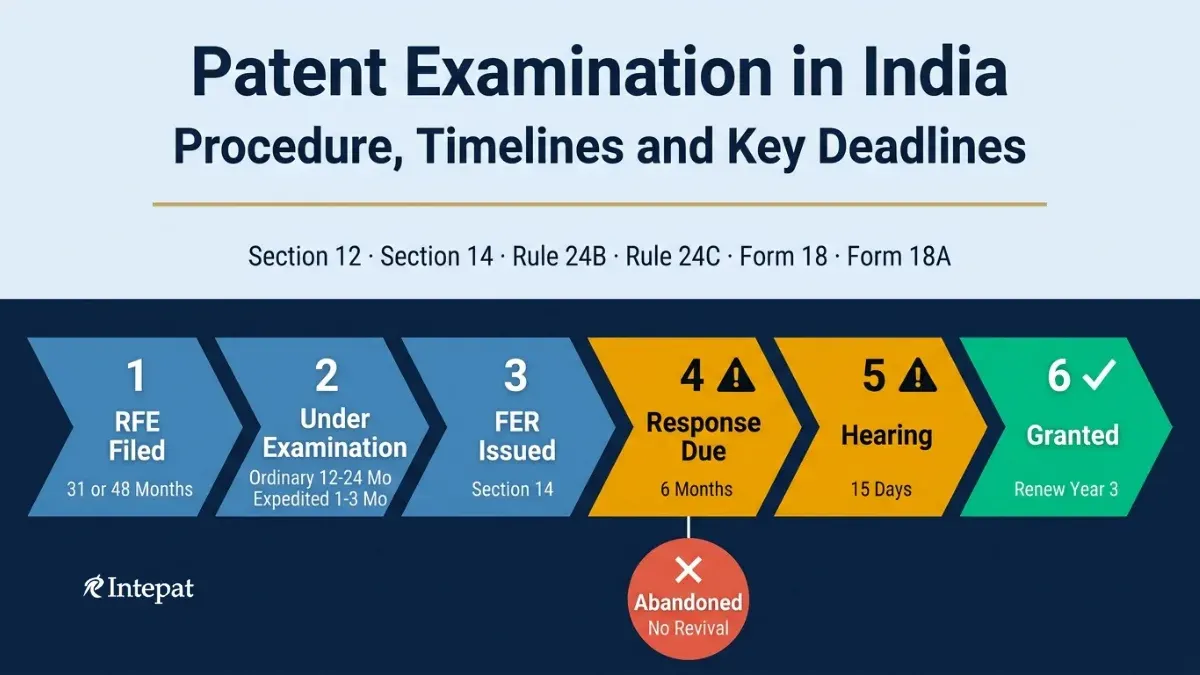
Quick Reference: Key Deadlines and Timelines
| Deadline / Metric | Ordinary Route | Expedited Route |
| RFE deadline (filed on/after 15 Mar 2024) | 31 months (prospective extension up to 6 months available under Rule 138 before expiry) | 31 months (prospective extension up to 6 months available under Rule 138 before expiry) |
| RFE deadline (filed before 15 Mar 2024) | 48 months (firm) — no extension or condonation available | 48 months (firm) — no extension or condonation available |
| FER issuance from RFE (current practice) | 12-24 months or more | 1-3 months |
| FER response window | 6 months + 3-month extension | 6 months + 3-month extension |
| Form 3 (FER-triggered) | Within 3 months of FER | Within 3 months of FER |
| Typical grant timeline | 2-4 years | 1-2 years |
All timelines are current-conditions estimates. Statutory minimums differ. For full procedural detail see the linked satellite articles in Sections 2, 3, 5, and 7.
Why India Uses Deferred Examination
Under Section 11B of the Patents Act, 1970, examination commences only upon receipt of a formal Request for Examination (RFE). Until the RFE is filed, an application may remain on file without substantive review. The deferred model serves two purposes: it allows applicants time to assess commercial value before incurring examination costs, and it avoids burdening the Patent Office with applications likely to be abandoned before examination.
The RFE deadline must be treated as a firm date in practice. The only mechanism for additional time is a prospective Form 4 request under Rule 138, filed before the deadline expires. Once the deadline passes, Rule 137 condonation is expressly barred by Rule 137(2)(iv) and no retrospective remedy exists. Missing the deadline without a prior Form 4 extension triggers deemed withdrawal under Section 11B(4), with no provision for restoration.
Practical Note: Applicants can monitor application status at every stage through the Indian Patent Office online portal. File the RFE well ahead of the deadline, ideally at national phase entry. Last-minute filing creates unnecessary risk, particularly where system outages on the Patent Office e-filing portal (ipindia.gov.in) could prevent upload before midnight on the deadline date.
Request for Examination
The Request for Examination (RFE) is the procedural trigger for all substantive examination. Two deadline regimes apply depending on filing date. For applications filed on or after 15 March 2024, the RFE must be filed within 31 months from the earliest priority or filing date under Rule 24B(1)(i) as amended. For applications filed on or before 14 March 2024, the deadline is 48 months under Rule 24B(1)(vi), with no extension or condonation available under either regime.
For post-2024 applications, a prospective extension of up to six months is available under Rule 138 via Form 4, but only if the Form 4 request is filed before the original deadline expires. Rule 137 condonation is expressly excluded for the RFE deadline by Rule 137(2)(iv). Missing the deadline without a prior Form 4 extension results in deemed withdrawal under Section 11B(4) with no mechanism for reinstatement. For PCT applicants entering India on or after 15 March 2024, the 31-month RFE deadline coincides with the national phase entry deadline: Form 18 or Form 18A must be filed at national phase entry.
The RFE is filed using Form 18 (ordinary examination) or Form 18A (expedited examination). Fees vary by entity classification: natural persons, startups, and small entities pay Rs. 4,000 for Form 18; large entities pay Rs. 20,000. Physical filing attracts a 10% surcharge. For full deadline analysis, the Rules 137 and 138 distinction, worked examples, and entity classification fee tables, see: Request for Examination in India: Deadlines, Forms and Fees.
Expedited Examination: Eligibility and Practical Value
Rule 24C provides a fast-track mechanism for eligible applicants filing Form 18A. Eligible categories under Rule 24C(1) include DPIIT-recognised startups, small entities, female natural person applicants, government bodies and companies, institutions owned or financed by the Government, and PCT applicants who designated India as ISA or IPEA. Expedited examination does not alter patentability standards: it accelerates queue position only. Under current conditions, the FER issues within 1 to 3 months on the expedited route compared to 12 to 24 months or longer on the ordinary route, making eligibility assessment a material prosecution decision. For full eligibility criteria, Form 18A procedure, conversion fees, and a prosecution readiness checklist, see: Expedited Patent Examination in India: Eligibility and How to Apply.
The Examination Process: Sections 12 and 13
Once the RFE is validly filed, the Controller assigns the application to an examiner under Section 12 of the Patents Act. The examiner assesses: compliance with the requirements of the Patents Act and Rules; any lawful ground of objection to the grant; and the results of the prior art investigation under Section 13.
Under Section 13, the examiner conducts a search for anticipation by prior publication and by prior claim. This covers all four branches of the Indian Patent Office (Delhi, Mumbai, Chennai, Kolkata) and all available international patent and non-patent literature databases, with reference to the date of filing of the complete specification.
Practical Note: Section 13(4) of the Patents Act expressly states that examination and investigation shall not be deemed to warrant the validity of any patent subsequently granted, and that no liability is incurred by the Central Government on account of them. A grant following examination is not a guarantee of patent validity and can be challenged through post-grant opposition or revocation proceedings.
Statutory Timelines for Examination
| Procedural Step | Ordinary Examination | Expedited Examination |
| Controller refers application to examiner | In order of RFE receipt; no statutory period prescribed for the referral step itself (Rule 24B(2)(i)) | In order of expedited RFE receipt (priority queue); no statutory period prescribed for the referral step itself (Rule 24C(5)) |
| Examiner submits report to Controller | Ordinarily 1 month, not exceeding 3 months (Rule 24B(2)(ii)) | Ordinarily 1 month, not exceeding 2 months (Rule 24C(6)) |
| Controller disposes of examiner report | Ordinarily within 1 month of receipt (Rule 24B(2)(iii)) | Within 1 month of receipt (Rule 24C(7)) |
| Controller issues FER to applicant | Within 1 month of disposal of examiner report (Rule 24B(3)) | Within 15 days of disposal of examiner report (Rule 24C(8)) |
| Practical FER wait from RFE (current conditions) | 12-24 months or more (see Section 8) | 1-3 months |
Statutory timelines are prescribed under Rule 24B(2) and Rule 24C(5)-(8). Practical timelines reflect current IPO capacity and are not guaranteed. Source: Patents (Amendment) Rules, 2024 (Official Gazette).
The First Examination Report
The First Examination Report (FER) is issued by the Controller under Section 14 after review of the examiner’s report. It communicates objections across all applicable grounds and triggers the applicant’s response obligations under Rule 24B(5). For the FER’s four-part structure, all seven objection categories, response drafting strategy, and Section 59 amendment constraints, see: First Examination Report in India: Structure, Objections and How to Respond.
The FER Response Window
The initial response period is 6 months from the date of FER issuance under Section 21(1) and Rule 24B(5). A 3-month extension is available via Form 4 under Rule 138, giving a maximum response window of 9 months from FER issuance. Rules 24B(5) and (6) are expressly excluded from Rule 137 condonation by Rule 137(2)(iv): the 9-month outer deadline is absolute, and missing it without a prior Form 4 extension puts the application at risk of abandonment with no remedy. For response strategy, Section 59 amendment constraints, substantive examination replies, and hearing procedure, see: First Examination Report in India: Structure, Objections and How to Respond.
Form 3 Obligation Triggered by the FER
FER issuance triggers an obligation under Section 8(1) of the Patents Act to file an updated Form 3 (details of corresponding foreign applications). Under the Patents (Amendment) Rules, 2024, Form 3 is now required only twice: first within 6 months of filing the Indian application (or at the time of filing), and second within 3 months of the FER issuance date. This replaces the former requirement to file within 6 months of each foreign prosecution event.
| Form 3 Filing Event | Deadline | Notes |
| First Form 3 (filing stage) | Within 6 months of filing Indian application (or at time of filing). For PCT national phase entries, the clock runs from the national phase entry date, not the PCT international filing date. | Discloses all foreign applications filed for same or substantially same invention. |
| Second Form 3 (FER stage) | Within 3 months of FER issuance (extendable by 3 months) | Updated status of all corresponding foreign applications; prosecution details on request from Controller within 2 months. |
Source: Patents (Amendment) Rules, 2024, amending Rule 12(2). Section 8(2): Controller may use accessible databases for foreign prosecution details; may separately request Form 3 within 2 months. For full Section 8 obligations and compliance requirements, see: Form 3 obligations under Section 8 of the Patents Act.
Hearing, Grant, and Pre-Grant Opposition
Hearing Procedure
Where the examiner’s report is adverse, the applicant may request a hearing under Section 14. The Controller must give at least 10 days’ notice before the hearing date (Rule 30); written submissions must be filed within 15 days of the hearing. For full hearing procedure including video conference options, written submission requirements, and the examiner’s limited role at hearing, see: First Examination Report in India: Structure, Objections and How to Respond.
Grant
After the hearing, or where the written response fully addresses all objections, the Controller may grant the patent, require amendments, or refuse the application under Section 15 by a reasoned order. No refusal is issued without first giving the applicant an opportunity of being heard. A refusal under Section 15 is appealable before the relevant High Court (jurisdiction transferred from the Intellectual Property Appellate Board following its abolition by the Tribunals Reforms Act, 2021). Upon grant, Letters Patent are issued and published in the Patent Journal. The patent term is 20 years from the earliest priority or filing date under Section 53, with annual renewal fees payable from the third year.
Pre-Grant Opposition (Section 25(1))
Any person may file a pre-grant opposition after publication of the application but before grant, on grounds specified in Section 25(1). The 2024 Rules introduced three changes: the Controller must first assess whether a prima facie case is made out before initiating full proceedings; the applicant’s reply period was reduced from 3 months to 2 months; and a statutory filing fee is now payable by the opponent at the time of filing. Pre-grant oppositions must be filed online. For full grounds, procedure, and Opposition Board practice, see: Patent Opposition Proceedings in India.
Practical Note Pre-grant oppositions can significantly extend prosecution timelines, as they must be resolved before grant can issue. Where an application covers commercially sensitive subject matter (pharmaceuticals, standard-essential technology, life sciences), applicants should anticipate opposition risk and factor it into commercial planning.
Current State of Examination at the Indian Patent Office
Statutory timelines describe the procedural minimum. Since 2022, the operational reality at the Indian Patent Office has diverged significantly from those minimums, with direct implications for prosecution planning.
FER Issuance Decline
| Period | FER / Applications Examined | Context |
| FY 2019-20 | ~80,000 FERs issued | Peak year following backlog clearance push |
| Calendar 2023 | ~24,027 FERs issued | Record filings year; grants exceeded 100,000 |
| Calendar 2024 | ~13,777 FERs (down 42%) | 110,375 applications filed in FY2024-25 |
| FY 2024-25 | ~9,600 applications examined | 407 new examiners onboarded; recovery expected |
Sources: CGPDTM Annual Report 2024-25 (official); practitioner commentary (IAM, August 2025).
This gap between filings and examination output has widened the practical timeline between RFE and FER issuance, making expedited examination significantly more valuable for eligible applicants.
Practical Implications for Foreign Counsel and Corporate Filers
The examination gap has two direct consequences for prosecution strategy. Ordinary examination timelines should be planned at 2 to 4 years from RFE filing to grant under current conditions. In technology-intensive sectors, practitioners have reported potential additions of 2 to 3 years to prosecution timelines. Expedited examination under Rule 24C has become materially more valuable for eligible applicants. The expedited queue has remained operational at 1 to 3 months for FER issuance, providing a significant time advantage over the ordinary queue.
Practical Note The IPO onboarded 407 new patent examiners in FY2024-25 per the CGPDTM Annual Report 2024-25. Some practitioners report a recovery in FER issuances since mid-2025. However, examination timelines should be treated as variable in client advisories until the position stabilises.
Common Pitfalls and How to Avoid Them
Pitfall 1: Missing the RFE Deadline
The most consequential error in Indian patent prosecution. The RFE deadline cannot be extended retrospectively once missed. Maintain a calendar alert at the 28-month mark for post-March 2024 applications as an internal review window. For PCT national phase applicants, treat the RFE as a standard deliverable at national phase entry, not a separate calendar event.
Pitfall 2: Incorrect Entity Classification
Entity classification determines applicable fee rates. Paying at the individual, startup, or small entity rate without filing Form 28 and supporting evidence, or claiming startup status for an entity whose DPIIT recognition has lapsed, creates a fee deficiency that can obstruct prosecution. Verify entity status at each major filing event: RFE, response filing, and any amendment.
Pitfall 3: Missing the Form 3 FER Trigger
The 2024 amendment replaced the rolling Form 3 obligation with a single FER-triggered filing due within 3 months of FER issuance. Many applicants miss this deadline because it is not flagged at the time of the FER response. Include the Form 3 update as a standard line item in every FER response task list.
Pitfall 4: Defaulting to Ordinary Examination Without Assessing Expedited Eligibility
Many foreign applicants file Form 18 by default without evaluating whether they qualify for expedited examination under Rule 24C. Under current IPO conditions, the practical gap between the two queues is material: FER issuance on the ordinary route takes 12 to 24 months or more, while the expedited route consistently delivers an FER within 1 to 3 months. Eligibility must be assessed and Form 18A filed at the time of the RFE; it cannot be claimed retrospectively after Form 18 has been filed without paying the conversion fee.
Pitfall 5: Failing to Account for Pre-Grant Opposition in Commercial Planning
Any person may file a pre-grant opposition after publication of the application and before grant under Section 25(1). Pre-grant oppositions must be resolved before the patent can issue, and they can add months to the examination lifecycle. In commercially sensitive sectors (pharmaceuticals, standard-essential technology, life sciences), pre-grant opposition is a routine competitive tactic. Where an application covers commercially sensitive subject matter, opposition risk should be flagged at the prosecution planning stage, not discovered after grant is delayed. For full grounds and procedure, see: Patent Opposition Proceedings in India.
Full Prosecution Timeline: Application to Grant
| Stage | Event | Statutory Trigger / Deadline | Form(s) |
| 1 | Application filing (provisional or complete specification) | Day 0: establishes priority/filing date | Form 1 (+ Form 2, Form 3, Form 5 as applicable) |
| 2 | Publication of application | Automatic at 18 months; early publication available | Form 9 (early publication, optional) |
| 3 | Request for Examination (RFE) | 31 months (post-15 Mar 2024) or 48 months (pre-15 Mar 2024): firm for legacy; prospective extension available for post-2024 | Form 18 (ordinary) or Form 18A (expedited) |
| 4 | Examiner assigned; prior art investigation (Sections 12 and 13) | Referred in order of RFE receipt. Examiner report: ordinarily 1 month, not exceeding 3 months. Practical: see Section 8. | — |
| 5 | First Examination Report (FER) issued under Section 14 | Within 1 month of Controller receiving and disposing of examiner report | — |
| 6 | Second Form 3 (updated foreign application information) | Within 3 months of FER issuance (extendable 3 months) | Form 3 |
| 7 | Applicant response to FER (arguments, amendments, formal compliance) | Within 6 months of FER; extendable to 9 months by Form 4 | Form 4 (extension), Form 13 (amendments) |
| 8 | Hearing (if applicant contests objections under Section 14) | On request; minimum 10 days’ notice from Controller (Rule 30). Written submissions within 15 days of hearing. | — |
| 9 | Grant, further office action, or refusal under Section 15 | As expeditiously as possible after all requirements met | Letters Patent issued; published in Patent Journal |
| 10 | Annual renewal fees (annuities) | Payable from 3rd year onwards (Section 53) | First Schedule, Patents Rules |
Patent Examination in India: What to Get Right from Day One
Patent examination in India requires active case management from the date of filing. The Request for Examination deadline must be treated as a firm date in practice: for applications filed on or after 15 March 2024, it falls at 31 months, the same point as national phase entry. A prospective extension of up to six months is available under Rule 138 via Form 4, but only if filed before the original deadline expires. Once the deadline passes without a prior Form 4, Rule 137(2)(iv) bars condonation and the application is deemed withdrawn under Section 11B(4) with no remedy. For applications filed before 15 March 2024, the 48-month deadline is firm with no extension or condonation available under either the pre- or post-amendment rules.
Once examination begins, the First Examination Report (FER) provides a structured roadmap of objections that must be addressed within the 9-month Rule 24B response window from issue. The FER also triggers a separate Form 3 obligation due within 3 months. Under current conditions, realistic grant timelines on the ordinary route should be planned at 2 to 4 years. Eligible applicants are strongly advised to evaluate expedited examination under Rule 24C as a prosecution tool. For international applicants, aligning RFE filing, FER response preparation, and Form 3 compliance into a coordinated prosecution strategy is essential for avoiding irreversible loss of rights in India.
Review Your India Patent Prosecution Deadlines
Share your application details and priority date for a preliminary India-specific filing and deadline review.
Get a response within 24 hours. All consultations remain 100% confidential.
LEGAL DISCLAIMER
This post is for informational purposes only and does not constitute legal advice. For advice specific to your situation, consult a registered patent or trademark agent. Laws and procedures may change: verify current requirements with the Indian Patent Office (ipindia.gov.in) before acting.
Frequently Asked Questions
Two deadlines apply depending on filing date. For applications filed on or before 14 March 2024, the deadline is 48 months from the earliest priority date or filing date (whichever is earlier), under Rule 24B(1)(vi). This deadline is firm: no extension or condonation is available under either the pre- or post-amendment rules. For applications filed on or after 15 March 2024, the deadline is 31 months under Rule 24B(1)(i) as amended, which coincides with the national phase entry deadline for PCT applications. A prospective extension of up to six months is available for post-2024 applications under Rule 138 via Form 4, but the request must be filed before the original deadline expires. If the deadline passes without a prior Form 4 extension, Rule 137(2)(iv) bars condonation and the application is deemed withdrawn under Section 11B(4) with no restoration available.
The application is deemed withdrawn under Section 11B(4) of the Patents Act. Rule 137 condonation is expressly excluded by Rule 137(2)(iv). Rule 138 permitted a prospective extension of up to six months via Form 4, but that window required action before the original deadline expired. It cannot be invoked after the fact. The application cannot be reinstated once the deadline has passed without a prior Form 4 extension having been filed and granted.
The initial response period is 6 months from the date of FER issue under Rule 24B(5). Following the 2024 amendment, the applicant may request a 3-month extension at any time during the extension period itself, giving a maximum window of 9 months from FER issuance. Rule 24B(5) and (6) are expressly excluded from Rule 137 condonation. A prospective extension under Rule 138 via Form 4 is available but must be filed before the 9-month outer deadline expires. File a complete response well within the 9-month window.
Expedited examination under Rule 24C(1) is available to: DPIIT-recognised startups; small entities under the MSME Act 2006; female natural person applicants (sole or at least one co-applicant); government departments; institutions established by Central, Provincial or State Act and owned or controlled by the Government; government companies under the Companies Act 2013; institutions wholly or substantially financed by the Government; and PCT applicants who designated India as ISA or IPEA. Government-established or government-funded educational institutions may qualify under one of the last three sub-categories depending on their structure. Applicants eligible under bilateral arrangements such as the JPO Patent Prosecution Highway (PPH) may also qualify. Eligibility must exist on the date of filing Form 18A.
Statutory timelines prescribe that the examiner’s report shall ordinarily be completed within 1 month and not exceed 3 months from the date of reference, with the Controller issuing the FER within 1 month of disposal of that report. In practice, ordinary examination timelines have lengthened substantially. FER issuances fell from approximately 80,000 in FY2019-20 to around 9,600 applications examined in FY2024-25. Under current conditions, realistic planning for ordinary examination should assume 12 to 24 months or more from RFE to FER, with overall grant timelines at 2 to 4 years. Expedited examination remains at 1 to 3 months to FER in practice.
Under Section 8(1) of the Patents Act read with Rule 12(2) as amended by the Patents (Amendment) Rules, 2024, applicants must file Form 3 within 3 months of the date of FER issuance (extendable by a further 3 months). The Form 3 must contain updated information on all corresponding foreign applications. The Controller may also separately request prosecution details for foreign applications within 2 months of such a request. Missing the FER-triggered Form 3 deadline can impede prosecution and, in cases of persistent non-compliance, provide grounds for pre-grant opposition.
No. Once an application is deemed withdrawn under Section 11B(4) for failure to file the RFE within the prescribed period, there is no statutory mechanism for revival or restoration. Rule 137 condonation is expressly excluded by Rule 137(2)(iv). Rule 138 required a prospective Form 4 extension to be filed before the deadline expired and cannot be invoked retrospectively. The loss of rights is permanent. The only available course of action is to file a new patent application, which will carry a later priority date and may face prior art consequences from the earlier, now-abandoned application. This underscores why the RFE deadline must be diarised and monitored as a hard date from the moment of national phase entry or original filing.