




A trademark owner in India can allow a third party to use the mark under the Trade Marks Act 1999 without transferring ownership. Trademark licensing in India takes two statutory forms: registration as a registered user (a formal licensed-user status under Sections 48-54) and permitted use by written consent (Section 2(1)(r)(ii)). Each route carries different enforcement rights.
At a glance
• Licensing does not transfer ownership. The proprietor keeps the mark.
• Two statutory routes: (1) registered user under Sections 48-49; (2) permitted use by written consent under Section 2(1)(r)(ii). Both count as the proprietor’s use under Section 48(2) where the respective conditions are met.
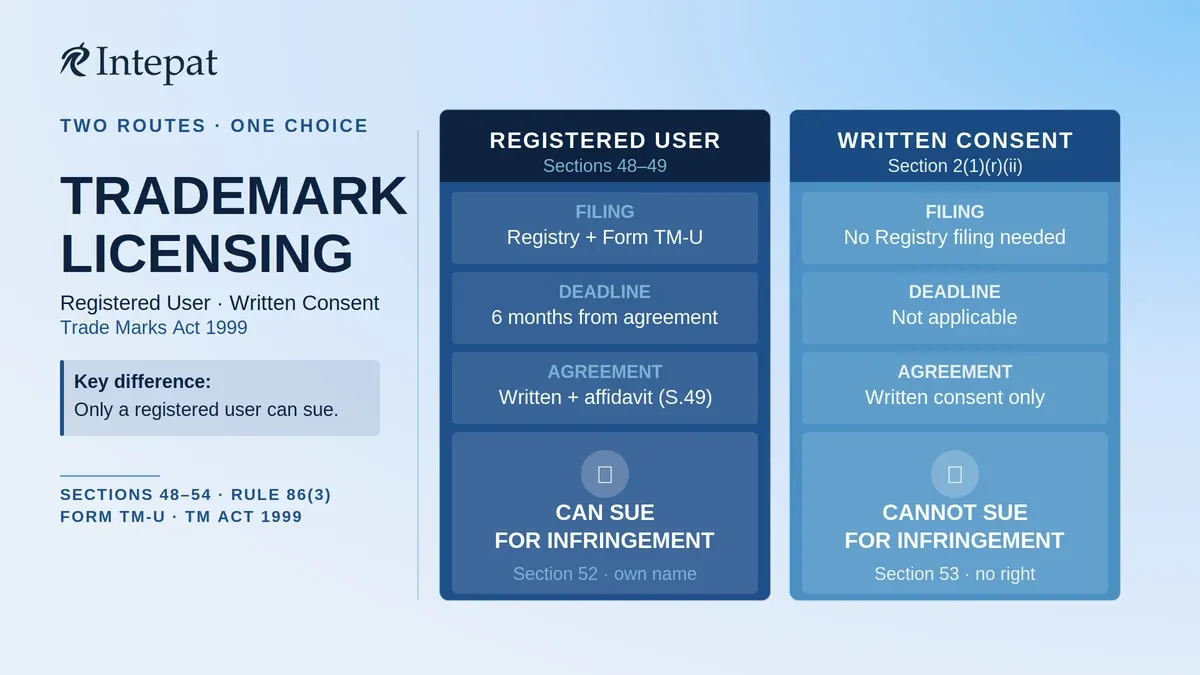
• Only a registered user may sue for infringement in their own name (Section 52). A consent-only user cannot (Section 53).
• The joint application (Form TM-U) must be filed within six months of the licence agreement (Rule 86(3), Trade Marks Rules 2017).
• The proprietor must enforce quality conditions; failure may lead to cancellation of the registered user entry (Section 50(1)(d)).
• Filing fee for Form TM-U: Rs 5,000 per mark (physical) or Rs 4,500 per mark (e-filing), per First Schedule Entry 10, Trade Marks Rules 2017. Verified as of June 2026.
Assignment vs Licence: The Core Distinction
Assignment transfers ownership of the mark; after a completed assignment, the original proprietor ceases to hold it. A licence does the opposite: it permits use of the mark on agreed terms while ownership stays with the proprietor throughout.
Every benefit or obligation that flows to the licensee therefore traces back to what the proprietor authorises, and the proprietor’s registration remains the legal foundation of the arrangement.
The Two Licensing Routes Under the Act
Route 1: Registered User (Sections 48-54)
The Act creates a formal status called “registered user.” Under Section 48(1), a person other than the registered proprietor of a registered trademark may be registered as a registered user in respect of any or all of the goods or services for which the mark is registered, subject to Section 49.
Registration gives the licensee a defined statutory position with two significant consequences. Most importantly, Section 52(1) allows a registered user to institute infringement proceedings in their own name as if they were the registered proprietor, naming the proprietor as a defendant. This right is subject to any contrary agreement between the parties.
A second consequence, significant for proprietors, flows from Section 48(2): any “permitted use” of a trade mark (which under Section 2(1)(r) covers both registered-user use and consent-only use meeting that definition’s conditions) is deemed to be use by the proprietor for the purposes of Section 47 (non-use removal proceedings) and for any other purpose under the Act. This means the mark stays in active use on the register even when the proprietor themselves is not using it directly.
Route 2: Permitted Use by Written Consent (Section 2(1)(r)(ii))
The Act also recognises a lower-formality path. A person who is not the registered proprietor or a registered user may use the mark as “permitted use” (use authorised by written consent of the proprietor, without Registry registration) if: (a) they are connected with the goods or services in the course of trade; (b) the mark remains registered; (c) the proprietor has consented in a written agreement; and (d) the user complies with any conditions in that agreement and in the registration.
This route requires no application to the Trade Marks Registry. However, Section 53 is explicit: a person using a trademark under Section 2(1)(r)(ii) has no right to institute proceedings for infringement under the Act.
Where the four conditions of Section 2(1)(r)(ii) are satisfied, the consent-only permitted user’s use is also deemed to be use by the proprietor under Section 48(2), for the purposes of Section 47 and any other purpose under the Act. The practical difference between the two routes is therefore the right to enforce: only a registered user may sue for infringement in their own name. Businesses that want the licensee to act independently against infringers should use the registered user route.
Why Trademark Licensing Matters in India
Three commercially meaningful reasons explain why proprietors choose to license rather than use the mark themselves in every market.
- Revenue. A licence typically generates royalty income. The rate and payment structure are governed by the agreement between the parties.
- Territorial reach. A proprietor seeking presence in a market without establishing a local operation can grant a licence to a business already operating there. This arrangement is common in franchising contexts; see our guide on
See our guide on trademarks and franchising. A proprietor licensing to multiple franchisees may register each franchisee as a separate registered user, with each Form TM-U application filed within six months of the respective franchise agreement.
- Maintaining registration. Where the licensee’s use qualifies as “permitted use” under Section 2(1)(r), that use is deemed to be use by the proprietor under Section 48(2), protecting the registration against non-use proceedings under Section 47. This applies to both registered-user use and consent-only use that meets the Section 2(1)(r)(ii) conditions.
One point on revenue transmission outside India: Rule 90 of the Trade Marks Rules 2017 provides that registration as a registered user does not imply approval for transmitting money as consideration for the trademark use to any place outside India. In practice, FEMA reporting or compliance requirements under the Foreign Exchange Management Act 1999 may apply to cross-border royalty payments; the licence agreement alone does not constitute regulatory clearance.
Quality and Usage Control: The Proprietor’s Obligation
The benefits above come with a corresponding obligation. Consumers rely on a trademark as a signal of consistent quality from a single source. When a licensee makes goods or provides services under the mark, consumers associate that quality with the proprietor. The Act reflects this in the grounds for cancellation of a registered user entry.
Section 50(1)(d) allows the Registrar to cancel the entry, on their own motion or on application by any person, where any quality stipulation in the licence agreement is either not being enforced or not being complied with.
Additionally, Section 50(1)(c)(i) permits any person to apply for cancellation where the registered user has used the mark in a way that causes or is likely to cause deception or confusion.
In practice, licence agreements should include two categories of control:
- Usage control. How the mark is used, including presentation standards, marketing formats, and territory restrictions. Conditions of this type are captured in the affidavit filed under Section 49(1)(b)(iii).
- Quality control. The characteristics the goods or services must meet before the mark is applied. These are also stated in the affidavit and remain enforceable via Section 50(1)(d) throughout the registration.
Registered User vs Written-Consent Permitted User: Decision Summary
| Point | Registered User (Sections 48-49) | Written-consent Permitted User (Section 2(1)(r)(ii)) |
| Registry filing required | Yes, Form TM-U | No |
| Agreement required | Written, filed with affidavit | Written consent required |
| Deadline for application | Within 6 months of agreement (Rule 86(3)) | Not applicable |
| Use counts as proprietor’s use for Section 47 | Yes, if Section 2(1)(r)(i) conditions met (Section 48(2)) | Yes, if Section 2(1)(r)(ii) conditions met (Section 48(2)) |
| Right to sue for infringement under the Act | Yes, in own name (Section 52(1)) | No (Section 53) |
| Can assign or sub-licence | No (Section 54) | Governed by agreement only |
How to Register a Licensee as a Registered User
The registration of a registered user requires a joint application. Section 49(1) of the Trade Marks Act 1999 is the governing provision; Rule 86 of the Trade Marks Rules 2017 prescribes the procedural requirements. Applications can be filed with the Trade Marks Registry through the IP India e-filing portal at www.ipindia.gov.in.
Step 1: Execute a Licence Agreement
The registered proprietor and the proposed registered user must enter into a written agreement. Rule 86(3) imposes a strict deadline: the application to the Registry must be filed within six months of the date of this agreement. Filing after six months means the application will not be entertained.
Step 2: Prepare the Application Documents
The application is made jointly on Form TM-U, filed at the appropriate office of the Trade Marks Registry, accompanied by:
- The written licence agreement or a duly authenticated copy (Section 49(1)(a)).
- An affidavit made by the registered proprietor (or an authorised person) setting out:
- (i) the relationship between the parties and the degree of control the proprietor will exercise over permitted use;
- (ii) the goods or services for which registration is proposed;
- (iii) any conditions or restrictions on characteristics, mode, or place of use; and
- (iv) whether the permitted use is for a defined period or without limit of period (Section 49(1)(b)(i) to (iv)).
- Any further documents or evidence required by the Registrar (Section 49(1)(c)).
If more than one application is made by the same proprietor and proposed registered user under the same agreement, the Section 49 documents may be filed with any one application, with cross-references in the others (Rule 86(4)).
Step 3: File and Pay the Fee
The fee for Form TM-U is Rs 5,000 per mark for physical filing, or Rs 4,500 per mark for e-filing, per Entry 10 of the First Schedule to the Trade Marks Rules 2017 (verified as of June 2026). This fee applies whether the application is for registration, variation, or cancellation of a registered user entry, with the per-mark rate applying in each case.
Step 4: Registry Examination and Hearing
Under Rule 87, the Registrar examines whether the application and documents comply with the Act and Rules, and registers the proposed registered user for the goods or services for which the Registrar is satisfied. If the Registrar proposes to refuse or impose conditions, Rule 88 requires an opportunity of hearing to be given to the parties before any such order.
Step 5: Entry in Register and Publication
When the Registrar accepts the application, Rule 89(1) requires the Registrar to register the person as registered user and publish the entry in the Trade Marks Journal. Under Rule 91, written communication of the registration is sent to the registered proprietor, the registered user, and any existing registered users of the same mark, and published in the Journal within three months of the register entry.
The register entry states the date on which the application for registration as registered user was made; that application date is deemed to be the date of registration as registered user (Rule 89(2)).
Maintaining the Registered User Status
Registrar’s Power to Call for Information
Section 51(1) allows the Registrar to require the registered proprietor by written notice to confirm within one month that the agreement filed under Section 49(1)(a) remains in force.
If the proprietor fails to furnish confirmation within one month, Section 51(2) provides that the registered user ceases to hold that status on the day immediately after the expiry of the one-month period. The Registrar then notifies the cessation. The failure to respond, not any finding of breach, triggers the loss of status.
Variation and Cancellation
Section 50 sets out five routes for varying or cancelling a registered user entry:
- Variation by the proprietor: application on Form TM-U (Section 50(1)(a)), with a copy of the registered user’s written consent to variation (Rule 92).
- Cancellation by the proprietor or any registered user: application on Form TM-U (Section 50(1)(b)).
- Cancellation by any person: on grounds of non-compliant use causing deception or confusion, misrepresentation at application, changed circumstances, or rights vested by contract (Section 50(1)(c)).
- Cancellation for non-enforcement of quality stipulations: by any person or on the Registrar’s own motion (Section 50(1)(d)).
- Cancellation where the mark’s registration has lapsed for the relevant goods or services (Section 50(1)(e)).
In every case under Section 50, the Registrar is required to issue notice to the registered proprietor and each registered user (other than the applicant) of the trademark in respect of the application (Section 50(2)).
Where a registered user was entered for a defined period, Rule 93(2) requires the Registrar to cancel the entry at the end of that period without the need for a separate application.
No Right to Assign or Sub-Licence
Section 54 states that nothing in the Act confers on a registered user any assignable or transmissible right to use the trademark. A registered user does not receive any assignable or transmissible statutory right to use the trademark. Any downstream use by another party should be separately authorised by the proprietor and, where required, separately assessed for registered-user recordal. Where a licence is being misused by a third party, the remedies for trademark infringement available to the proprietor include injunction and damages.
Frequently Asked Questions
An assignment transfers ownership of the trademark to another person; after assignment, the original proprietor no longer owns the mark. A licence allows a third party to use the mark on agreed terms while the proprietor retains ownership throughout. Both are governed by the Trade Marks Act 1999, in separate chapters covering assignment (Sections 37-45) and registered users (Sections 48-54).
Any person other than the registered proprietor may be registered as a registered user under Section 48(1) of the Trade Marks Act 1999, covering any or all of the goods or services in the registration. The application must be made jointly with the proprietor on Form TM-U and filed within six months of the licence agreement (Rule 86(3)).
The Form TM-U application must be accompanied by: the written licence agreement or an authenticated copy; an affidavit from the registered proprietor setting out the relationship, degree of control, goods or services, conditions on use, and duration; and any further documents required by the Registrar (Section 49(1), Trade Marks Act 1999; Rule 86, Trade Marks Rules 2017).
Yes. Under Section 52(1) of the Trade Marks Act 1999, a registered user may institute infringement proceedings in their own name as if they were the registered proprietor, naming the proprietor as a defendant. This right is subject to any agreement between the parties. A consent-only permitted user has no right to institute such proceedings (Section 53).
Under Section 50(1)(d) of the Trade Marks Act 1999, the Registrar may cancel the registered user entry, on their own motion or on application by any person, where any quality stipulation is not being enforced or complied with. The Registrar must give the registered proprietor a reasonable opportunity of being heard before cancelling (Section 50(3)).
No, registration is not mandatory, but the two routes have different consequences. A consent-only arrangement under Section 2(1)(r)(ii) is valid without Registry filing, but that user cannot sue for infringement (Section 53). Registration as a registered user under Section 49 is needed for the licensee to hold independent enforcement rights under Section 52(1).
No. Section 54 of the Trade Marks Act 1999 provides that nothing in the Act confers on a registered user any assignable or transmissible statutory right to use the trademark. Sub-licensing is not possible under the registered user framework; any formal licensing arrangement with a third party would typically require a separate registered user application to the Registry.
The fee for Form TM-U to register a person as a registered user of one trademark is Rs 5,000 per mark for physical filing and Rs 4,500 per mark for e-filing, under Entry 10 of the First Schedule to the Trade Marks Rules 2017. Verified as of June 2026.
Under Rule 86(3) of the Trade Marks Rules 2017, no application for registration as a registered user will be entertained unless filed within six months from the date of the licence agreement. There is no provision for extending this period, and filing after the deadline means the application is not accepted.
Yes. Section 48(1) of the Trade Marks Act 1999 does not restrict registered user status to Indian entities. Under Rule 89(2) of the Trade Marks Rules 2017, if the registered user does not carry on business in India, the register entry must state an address for service in India. All Section 49(1) requirements apply regardless of incorporation.
This article provides general information on trademark licensing under the Trade Marks Act 1999 and Trade Marks Rules 2017 as they stand in India. It does not constitute legal advice for any specific transaction or arrangement. Licence structures, quality control obligations, and registration requirements vary by facts; consult a registered trademark attorney for advice on your situation.