




A subsequent designation adds countries to an international registration you already hold under the Madrid Protocol. You file WIPO’s form MM4, pay one basic fee of CHF 300 per request plus a fee for each country, and each new country then examines the mark. If it does not refuse, protection runs to the end of the registration’s current ten-year term and renews with the rest.
This guide is for Indian brand owners whose international registration was filed through the Trade Marks Registry in India, and for foreign owners who want to add India. WIPO (the World Intellectual Property Organization) runs the Madrid System. The guide follows the Madrid Protocol, the Regulations under it as in force on 1 November 2026, WIPO’s Schedule of Fees, and India’s Trade Marks Act 1999 and Trade Marks Rules 2017. If you have not yet filed internationally, start with our guide to the Madrid Protocol.
Quick answer: A holder still entitled to hold the international registration can add countries during its term, for all or some of the goods and services already listed. File form MM4 with WIPO or through the Indian Registry and pay CHF 300 plus each country’s fee. For the first five years the registration, including every country added later, still depends on the basic mark it was built on.
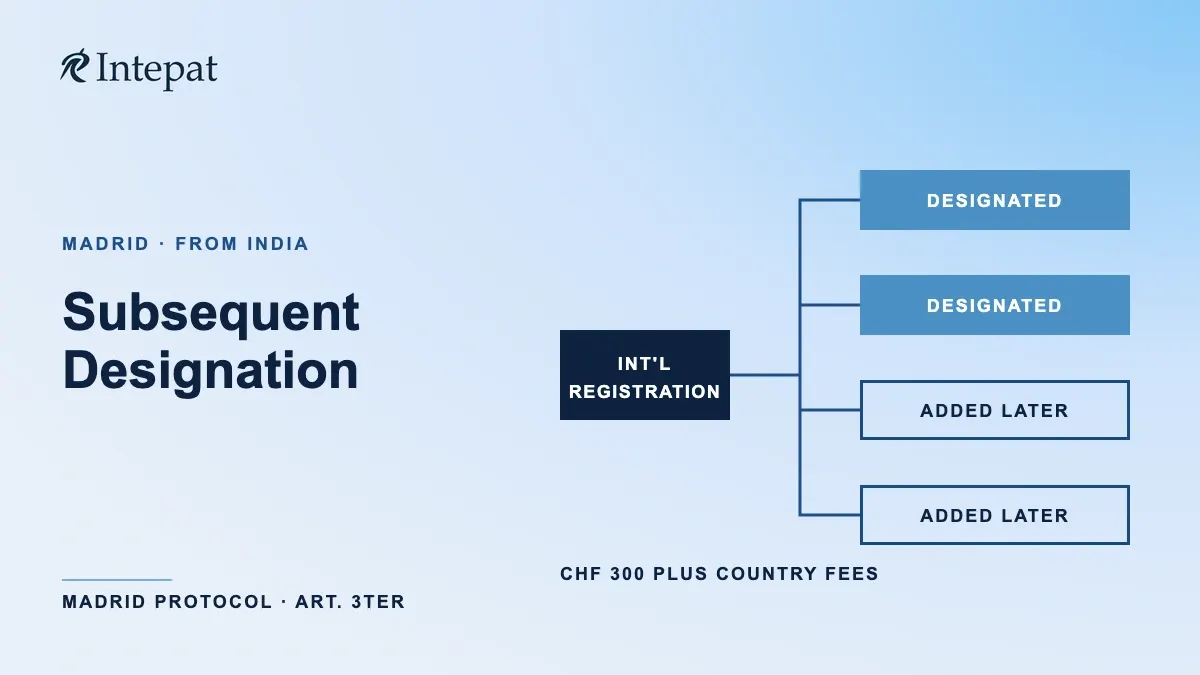
What a subsequent designation does
A subsequent designation is how you add countries to an international registration: it extends the protection of an existing registration to countries you did not name when you filed. It does not create a new registration. It attaches to the one you hold, uses its number and its list of goods and services, and runs only until that registration’s current term ends.
The Protocol treats the request as a territorial extension made after registration. WIPO records it in the International Register, notifies the office of each country designated, and publishes it in its Gazette. The extension takes effect from the date it is recorded in the International Register, and it stops being valid when the international registration it relates to expires.
You can designate a country for every item in the registration or for only some of them, but you cannot add anything new. Goods or services that are not already listed need a fresh application. The office of each newly designated country examines the mark under its own law and may refuse it within its refusal period. If no refusal is notified within that period, the mark is protected there as if that office had registered it. Some countries, India among them, may notify a refusal based on an opposition after 18 months, but only if they warned WIPO of that possibility before the 18 months ran out and then notify the refusal within one month of the end of the opposition period. India’s Act says that where the mark has not been opposed and the opposition period has ended, protection is treated as extended if the Registry does not notify WIPO of its acceptance within 18 months of receiving WIPO’s notification.
Later, every designation shares one renewal date, whenever it was recorded. At renewal you pay for the countries you want to keep, with six months’ grace on payment of a surcharge, as our guide to Madrid Protocol renewal explains.
Who can file a subsequent designation from India
The holder of the international registration files it, and must still meet the Protocol’s entitlement conditions when filing. For a registration based on an Indian mark and still held by the original owner, that means being an Indian national, being domiciled in India, or having a real and effective industrial or commercial establishment in India (under India’s Act, a genuine working branch or factory is enough; it need not be the head office).
That condition is tested again at filing, not only when the international registration was first made, so a business that has since moved abroad should check it before paying any fees. Formal defects can usually be put right within three months of WIPO’s notice, but a request presented by anyone other than the holder or the office of the holder’s country is not treated as a subsequent designation at all, and a conversion must be presented by the regional organisation’s office. If the registration has been transferred, the new holder qualifies through its own country instead, and files directly with WIPO or through that country’s office.
One party cannot be added at all: the country or regional organisation whose office is the office of origin (the national or regional office the international registration was filed through). For a registration filed through the Indian Registry, that country is India, so it cannot designate India. Separately, a country joining the Protocol can declare that registrations made before it joined cannot be extended to it; India made that declaration.
How to file: directly with WIPO or through the Indian Registry
The Regulations let the holder present a subsequent designation to WIPO directly, or through the office of the holder’s country. Either way it goes on WIPO’s official form, form MM4, and a form filed by the holder must be signed by the holder or its recorded representative. One request can name several countries.
The form gives the international registration number, the holder’s name, each country designated, the goods and services covered (all, or the part you choose), the fees and how they are paid, and email addresses for the holder and any representative if WIPO does not already have them. Some countries, India among them, require a declaration of intention to use the mark in their territory; for India it is made by ticking the box on form MM4, while some countries require it on a separate form signed by the holder. You may also ask for the designation to take effect after WIPO records a change or a cancellation, or after the registration is renewed.
Filing through the Indian Registry goes through its electronic Trade Marks International Application System. India’s Act treats a request to extend an international registration to another country as an international application. The Rules’ handling fee of Rs 5,000 (filing must be electronic) is written for the international application form (MM2(E)) and does not name form MM4, so check what the Registry’s system charges before you pay. The Rules let the Registry hold a defective international application until you comply within the period in its notice; that procedure is written around form MM2(E), so confirm with the Registry how it handles form MM4.
The route also affects the date. A subsequent designation filed directly takes the date WIPO receives it. One filed through an office takes the date the office received it, but only if WIPO receives it within two months; otherwise it takes WIPO’s date, so a slow reply to a Registry notice can cost you the earlier date. Filing directly with WIPO avoids the Registry step and any Registry fee.
Subsequent designation fees
WIPO charges one basic fee for each request, however many countries it names, plus a fee for each country: a complementary fee for a country that has not set its own fee, or the individual fee that country has fixed (where the holder’s country and the designated country are both bound by both Madrid treaties, the complementary fee and the one-year refusal limit apply instead; this does not affect India). WIPO fees are paid in Swiss francs (CHF), whichever route you use.
| WIPO fee item | Amount (CHF) |
|---|---|
| Basic fee, once per request (one request can name several countries) | 300 |
| Complementary fee, for each country with no individual fee (flat, whatever the classes) | 100 |
| Individual fee, for each country that has fixed one | Set by that country |
| India’s individual fee, per class (foreign-based registrations only; from 28 June 2026) | 83 |
These amounts come from WIPO’s Schedule of Fees and WIPO’s notice on India’s individual fee, verified as of November 2026. A foreign holder adding India for a mark in two classes pays CHF 300 plus two times CHF 83, so CHF 466 to WIPO; an Indian holder adding one country that takes the complementary fee pays CHF 400. If a country changes its fee while a Registry filing is in transit, the fee in force when the Registry received it applies. Individual fees vary by country, and a country can collect its fee in two parts, with the second due later on pain of losing that country. Our guide to the Madrid fee calculator shows how to estimate a country list.
Timing changes what you get for the money. The fees cover only the period from the designation’s effective date to the end of the registration’s current term. A country added with about a year of the term left is paid for about a year and is then renewed with the whole registration. Near renewal, you can ask for the designation to take effect after the renewal, so that on the Schedule’s wording the fees run to the end of the renewed term; the trade-off is that the country is unprotected until then and the designation takes the later date.
Adding India from abroad
A holder can designate India if the international registration was filed through another office of origin, not the Indian Registry, and is dated on or after 8 July 2013, when the Protocol took effect for India; India has declared that older registrations cannot be extended to it. The fee is CHF 300 plus India’s CHF 83 per class, and the declaration of intention to use is made by ticking the box on form MM4.
India has declared an 18-month refusal period, and a refusal based on an opposition can come later where the Registry has told WIPO, before the 18 months end, that oppositions may be filed after that time, and then notifies the refusal within one month of the end of the opposition period: the Registry advertises the mark in the Trade Marks Journal, and third parties then have four months, which cannot be extended, to oppose. India has told WIPO that the usual minimum of two months to respond to a provisional refusal does not apply to it, so use the period stated in the notice. A holder without an address for service in India must appoint a local representative to contest an examination refusal, with a power of attorney stamped and notarised or legalised as required; our guide to responding to a provisional refusal in India covers the procedure. The India designation also depends, for five years, on the basic mark at the office of origin, even if the registration has since been transferred. Adding India does not start a new five-year period: it runs from the international registration date. For a collective or certification mark, the regulations governing its use must reach the Registry within one month of WIPO’s advice.
Dates, defects, refusals and the five-year dependency
Four things decide whether a subsequent designation works as planned: the date it bears, the deadline for fixing any defect WIPO finds, each new country’s refusal period, and the five years during which the registration depends on the basic mark.
If WIPO finds the designation irregular, it tells the holder, and the office if one presented it. A defect not remedied within three months of that notice means the designation is treated as abandoned, and WIPO refunds the fees less half the basic fee, which is CHF 150. Even then, WIPO’s continued processing lets you rescue it within two further months by filing WIPO’s request form, signed by the holder or its recorded representative, paying CHF 200 and correcting the defect at the same time. Where a declaration of intention to use that must be made on a separate form personally signed by the holder is missing or defective for some countries, those countries are dropped and their country fees refunded, while the rest proceed. Defects in the registration number, the countries, the goods and services or a separately signed declaration move the designation’s date to the day it is put in order, unless a designation filed through an office is corrected within two months of the office receiving it.
Each new country’s office has its own refusal period, running from WIPO’s notification to that office: one year at most, or 18 months for countries that have declared the longer period, with some allowing later refusals based on opposition. The refusal notice states the time allowed to respond. WIPO can also excuse a missed time limit caused by force majeure, such as war, natural disaster or a failure of postal or electronic services beyond your control, if you show evidence and act within six months. Where a regional designation, such as one of the European Union, is withdrawn, refused or ceases to have effect, the holder can ask that organisation’s office to convert it, as a subsequent designation with its usual fees, into designations of its member states that are party to the Protocol, to the extent of the loss, keeping the original regional date; check that organisation’s own rules on how and when to ask.
The five-year dependency still applies, counted from the date of the international registration, not the date of the subsequent designation. If the basic mark is withdrawn, cancelled, expires or is finally refused within those five years, for all or some of the goods or services, protection ceases to the same extent in every country, including those added later. The same applies if an opposition, appeal or cancellation action against the basic mark began within the five years and ends against it later, or if you withdraw or surrender the basic mark after the five years while such a proceeding is still pending. If WIPO then cancels the registration at the request of the office of origin because the basic mark has fallen, you can still file a national application in each affected country within three months, for the same mark and goods or services covered there, and it keeps the date the designation was recorded (and any priority), provided it meets that country’s requirements and fees. India’s Rules apply this rule to an international registration so far as it designates India.
When a national filing is the better route
A subsequent designation is often the simplest way to add a country to a mark you already hold internationally, but not always the right one. File nationally instead when the goods or services you need are not in the registration, or when the basic mark faces, or may face, an opposition or other challenge within the first five years.
A direct national application gets its own filing date and its own term, and it does not depend on the basic mark. It carries local fees and a separate renewal, may need local counsel or a local address for service depending on the country, and the cost comparison depends on the countries chosen. If you already hold a national registration in a country in the same name, a later designation of that country covering all its goods or services replaces it, without losing the rights it gave. Our comparison of the Madrid route and direct national filing sets out the trade-offs in more detail.
Before a subsequent designation, confirm four points: that you are still entitled to hold the international registration, that the goods or services you need are already listed, whether each target country requires a declaration of intention to use, and how long the current term has left to run. Before a national filing, check that country’s own filing and representation rules.
FAQ
No. A subsequent designation can cover all the goods and services already listed in the international registration, or only some of them, but it cannot add anything new. For goods or services outside the existing list, you need a fresh application, which can be a new Indian application followed by a new international application.
Yes. One request on form MM4 can name several countries, and WIPO’s basic fee of CHF 300 is paid once for the request. Each country then adds its own fee: CHF 100 where it takes the complementary fee, or its individual fee, which some countries charge per class.
No. A subsequent designation lasts only until the current term of the international registration ends, and the fees cover only that period. At renewal, every country shares the registration’s single renewal date, and you pay for the countries you want to keep.
Not if the registration was filed through the Indian Registry, because the office of origin’s country cannot be designated. A registration based elsewhere can add India if it is dated on or after 8 July 2013. WIPO’s fee is then CHF 300 plus India’s CHF 83 per class, with the intent-to-use box ticked on form MM4.
For five years from the international registration, every country, including those added later, depends on it; a challenge begun in that time that succeeds later counts too. If WIPO then cancels the registration at the office of origin’s request, a national application for the same mark and covered goods or services, filed within three months of the cancellation and meeting local requirements, keeps the international or designation date.
Not if you file directly with WIPO. Through the Registry, check what its system charges: the Rules’ Rs 5,000 handling fee is written for the international application form (MM2(E)), and the Act counts a request to extend protection as an international application. WIPO’s own fees are separate and paid in Swiss francs.
This article explains subsequent designation under the Madrid Protocol for owners filing from India, and for foreign owners designating India, as at November 2026. It is for general information only and is not legal advice. WIPO fees, individual fees and office practice change; confirm current figures with WIPO and the Trade Marks Registry before you file. For advice on your registration, consult a trademark attorney.
Sources
- The Trade Marks Act, 1999 (Act 47 of 1999), India Code consolidation as on 1 June 2026: https://www.indiacode.nic.in/bitstream/123456789/1993/1/a199947.pdf
- The Trade Marks Rules, 2017, G.S.R. 199(E), Ministry of Commerce and Industry, 6 March 2017 (IP India copy): https://ipindia.gov.in/storage/uploads/docs-operator/f558da2b-ff4f-46bb-9f26-80d7ff16eba9.pdf
- WIPO publication 207: Madrid Protocol, Regulations (as in force on 1 November 2026) and Schedule of Fees: https://www.wipo.int/edocs/pubdocs/en/wipo-pub-207-2026-en-protocol-relating-to-the-madrid-agreement-concerning-the-international-registration-of-marks-regulations-administrative-instructions-schedule-of-fees.pdf
- WIPO, Madrid System Information Notice No. 27/2026, change in the amounts of the individual fee, India: https://www.wipo.int/documents/d/madrid-system/information-notices-en-2026-madrid_2026_27_in_indfee_e.pdf
- WIPO, Madrid System member profile, India (profile last updated 5 March 2025, read November 2026): https://www.wipo.int/madrid/memberprofiles