




On 21 August 2026, the Trade Marks Registry published a revised draft of its Manual of Trade Marks Practice and Procedure. The document brings together, in one place, how the Registry expects trademark matters to move from filing and examination through hearings, opposition, renewal and other post-registration work. For applicants, however, the immediate position is straightforward: the manual is still a draft and does not change the law or any current filing requirement.
The Trade Marks Act, 1999 and the Trade Marks Rules, 2017 therefore remain the controlling law. The draft is useful because it shows how the Registry proposes to standardise its own practice, and it contains a few procedural details worth watching, particularly around show cause hearings and well-known mark proceedings. Those points should be read as proposed Registry practice until the manual is finalised.
What the draft manual actually does
The Draft Manual of Trade Marks Practice and Procedure is not legislation and it is not a new set of Trade Marks Rules. It is the Registry’s operational guide: how officers should receive filings, examine applications, conduct hearings, deal with oppositions and rectifications, and handle matters after registration.
That distinction matters. The stated aim is to bring greater consistency across Trade Marks Registry offices and make procedure easier to follow for applicants, agents and officers. The manual itself acknowledges that the Act and Rules prevail if there is any inconsistency. In other words, the manual can explain and standardise practice, but it cannot override the statute or the Rules.
Why the Registry has published a revised draft
The revised draft was issued through a public notice dated 21 August 2026, inviting comments within 15 days. It follows an earlier draft on which stakeholders, including IP practitioners, had commented in 2025, and appeared two days after the Patent Office released its own updated draft practice manual.
Industry commentary has described the exercise as a substantial refresh of the Registry’s long-standing practice manual, reportedly in preparation for several years. That history comes from secondary commentary. What is directly confirmed by the Registry is the publication of the revised draft, the 15-day consultation period and the channels for submitting comments.
What the 2026 draft covers
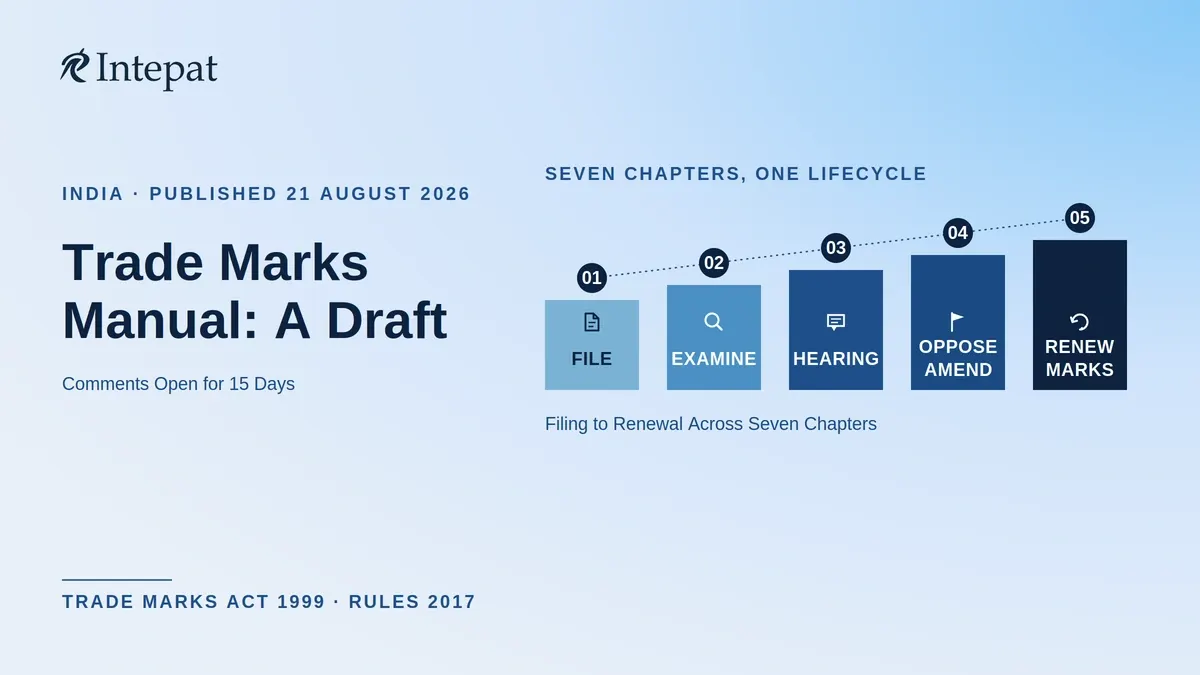
The manual is organised into seven chapters and follows the life of a trademark application in roughly the order a user encounters it: filing, examination, post-examination disposal, opposition and rectification, pre-registration amendments, renewal and post-registration matters, and finally prior use and well-known marks.
Chapters 1 and 2 deal with filing and examination. They explain what must be filed, how the Registry scrutinises an application and the absolute and relative grounds that may stand in the way of registration. For most applicants, this will look familiar; much of it consolidates existing law and Registry workflow rather than introducing a new route.
Chapter 3 is more immediately interesting. It deals with cases that are not resolved at the examination stage and proceed to a show cause hearing. The draft says the hearing notice should be sent by email to the applicant or agent approximately 30 days before the hearing date, referring to a 2024 Delhi High Court order. The Trade Marks Rules do not presently prescribe a fixed 30-day notice period, so this is best treated as proposed practice rather than a new enforceable deadline.
Chapters 4 and 5 turn to contested and corrective proceedings: opposition and rectification on the one hand, and amendments or division of an application before registration on the other. Here too, the emphasis is mainly on explaining how existing procedures are administered.
Chapter 6 brings together renewal and restoration, assignment and transmission, registered-user recordal and post-registration amendments. Chapter 7 deals with prior-user claims and well-known marks. On well-known mark determinations, the draft adds useful procedural detail: objections are to be forwarded to the applicant, the applicant gets 30 days to respond, both sides may be heard, and the Registrar is to issue a reasoned order. These steps sit alongside the 30-day public objection window already contemplated by the Rules.
Does anything change for your application today?
For an application already on file, no. The draft does not alter an existing deadline, fee, form or evidentiary requirement. Until it is finalised, proceedings continue under the Trade Marks Act, 1999, the Trade Marks Rules, 2017 and the Registry’s existing practice.
So if your mark is under examination, listed for a show cause hearing, opposed, awaiting renewal or involved in another Registry proceeding, follow the deadline and notice that actually applies to that case. The draft is useful for understanding the direction of Registry practice, not for replacing an instruction already issued in a live matter.
How to comment on the draft
The 21 August 2026 public notice invited comments and suggestions within 15 days, taking the original consultation window to about 5 September 2026. The notice lists cgoffice.in@gov.in and llc-ipo@gov.in for submissions.
The invitation is not limited to professional bodies. Applicants, businesses, trademark agents, attorneys and other regular users of the system can comment. The companion Draft Manual of Patent Office Practice and Procedure, Version 4.0, 2026, published on 19 August, has a separate 30-day comment period and uses the same email addresses. Because consultation periods can be extended or a manual can be finalised later, check the Registry’s notices page before relying on these dates.
What to watch once the manual is finalised
Once finalised, the manual should become an important reference for day-to-day Registry practice, especially where the Rules state the legal framework but leave operational detail to the office. Its real value will be consistency: the same procedure should be applied more predictably across Registry offices and by different officers.
The legal hierarchy will not change. A statement in the manual that merely restates the Act or Rules can be read together with the governing provision. A procedural point found only in the manual – such as the proposed approximately 30-day hearing-notice period – should be treated as Registry guidance, and not as if Parliament or the Rules had created a new statutory deadline. That distinction is especially important when advising on missed deadlines, abandonment or procedural rights.
Where each chapter sits in the law today
The table below maps each chapter to the principal provisions that govern the subject today. It is a guide, not an exhaustive cross-reference: several chapters draw on additional sections and rules depending on the issue. ‘Section’ refers to the Trade Marks Act, 1999 and ‘Rule’ to the Trade Marks Rules, 2017.
| Draft Manual chapter | What it covers | Principal governing provisions today |
| Chapter 1, Filing of a document | How applications and other documents are filed, and in what form | Section 18 and applicable Rules |
| Chapter 2, Examination | Absolute and relative grounds on which an application can be refused | Sections 9 and 11; Rules 33 to 36 |
| Chapter 3, Post-examination disposal (including show cause hearings) | What happens if objections are not resolved on paper, the hearing that follows, and when an application can be treated as abandoned | Sections 20, 128 (opportunity of being heard) and 132 (abandonment); Rules 33 and 115 |
| Chapter 4, Opposition and rectification | Third-party challenges to an application or an existing registration | Sections 21 and 57 |
| Chapter 5, Pre-registration amendment | Correcting an application, or dividing it, before it registers | Section 22, including its proviso on division; Rules 37 and 108 |
| Chapter 6, Renewal, assignment, registered users, post-registration amendment | Keeping a registration alive, transferring it, and recording a permitted user | Sections 25, 37 to 45, 48 to 50 and 58 |
| Chapter 7, Prior user and well-known marks | Evidence supporting an earlier-use claim; determination of well-known marks | Section 34; Section 11(6) to 11(9); Rules 25(2) and 124 |
The practical takeaway
The 2026 draft is not a rewrite of Indian trademark law. It is an attempt to make Registry practice clearer and more consistent. For most applicants, there is nothing to re-file or change today. The provisions worth watching are the operational details that go beyond the text of the Rules, because those are the points most likely to affect how hearings and other Registry proceedings are managed once the manual is finalised.
For the underlying law and procedure, see our guides to the Trade Marks Rules 2017, the trademark registration process in India, filing a trademark application on Form TM-A, show cause hearings and well-known trademarks.
This article explains the position on India’s Trade Marks Registry practice, including the Draft Manual of Trade Marks Practice and Procedure, 2026, as at September 2026, and is for general information only. It is not legal advice. Government fees, forms and procedures can change; confirm the current position with the Trade Marks Registry before filing or acting on a deadline. For advice on a specific mark or proceeding, consult a trademark attorney.