




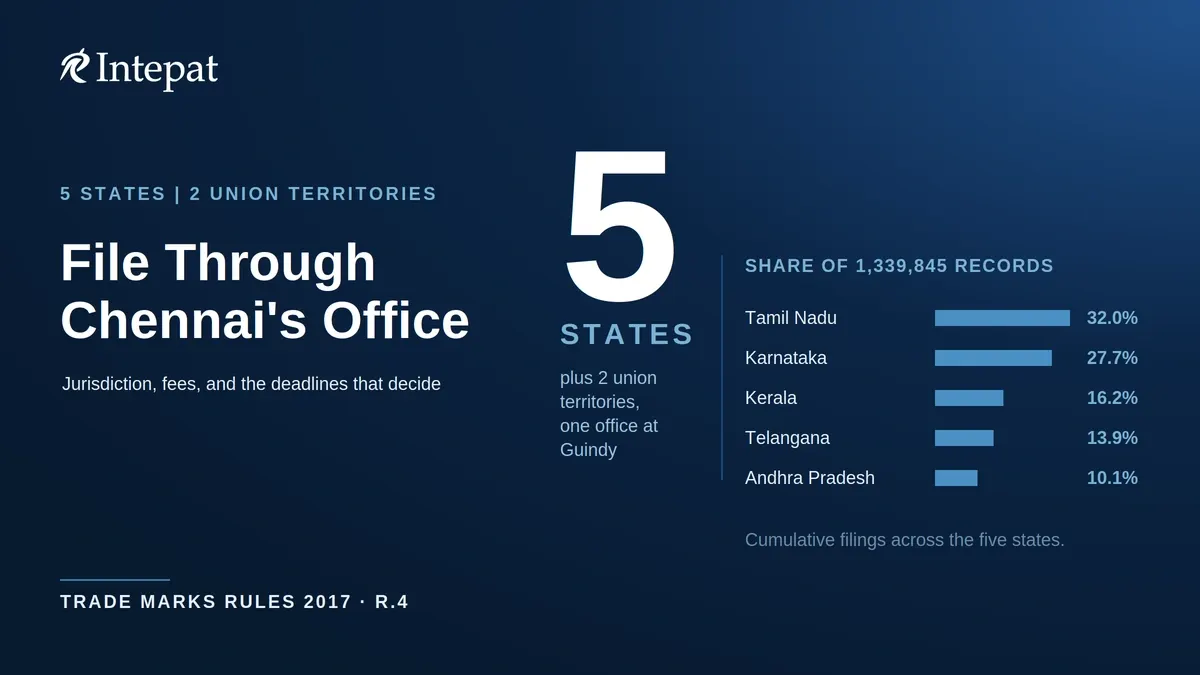
The Chennai trademark office is the branch of India’s Trade Marks Registry at Guindy, and it handles applications for five states and two union territories, not Tamil Nadu alone. This guide covers what the office does, how trademark registration in Chennai works, what it costs, and what the register shows.
Trade mark registration in Chennai is governed by national law. A mark registered through the Chennai office protects the brand across the whole country under the Trade Marks Act 1999, exactly as one registered through Delhi or Mumbai does. What the office determines is administrative: which branch of the Registry examines your file, advertises it, and hears any objection to it.
| Quick answer: |
| The Chennai Trade Marks Registry covers Andhra Pradesh, Telangana, Karnataka, Kerala, Tamil Nadu, Puducherry and Lakshadweep. E-filing Form TM-A costs INR 4,500 per class for individuals, startups and small enterprises, and INR 9,000 per class for other applicants. |
What the Chennai Trademark Office Covers
The Chennai office of the Trade Marks Registry has territorial jurisdiction over Andhra Pradesh, Telangana, Karnataka, Kerala, Tamil Nadu, and the union territories of Puducherry and Lakshadweep. It sits in the Intellectual Property Office Building on G.S.T. Road, Guindy. E-filing through the IP India portal is the standard route, and it carries lower fees than physical filing.
Which office handles your file is not a choice. For a new application, Rule 4 of the Trade Marks Rules 2017 fixes the appropriate office by the applicant’s principal place of business in India as disclosed in the application; where the applicant has none in India, the address for service determines the office. A Chennai business therefore files at Chennai because it is based there, and a Bengaluru or Kochi business files at Chennai for the same reason.
Two consequences follow for a Chennai applicant. The Chennai office is the appropriate administrative office for the application, which carries no advantage of its own; examination applies the same statutory tests wherever the file sits. And if a hearing is fixed, a hearing may be held at a place within the appropriate office’s territorial jurisdiction, and Rule 115 also allows it to be held by video conference, in which case it is deemed to have taken place at the appropriate office.
Where Chennai-Jurisdiction Filings Come From
Across the five states in the Chennai office’s territory, the register holds 1,339,845 trademark applications filed over the years. Tamil Nadu accounts for 32.0% of them, Karnataka 27.7%, Kerala 16.2%, Telangana 13.9% and Andhra Pradesh 10.1%. Chennai addresses account for about 15% of that five-state total.
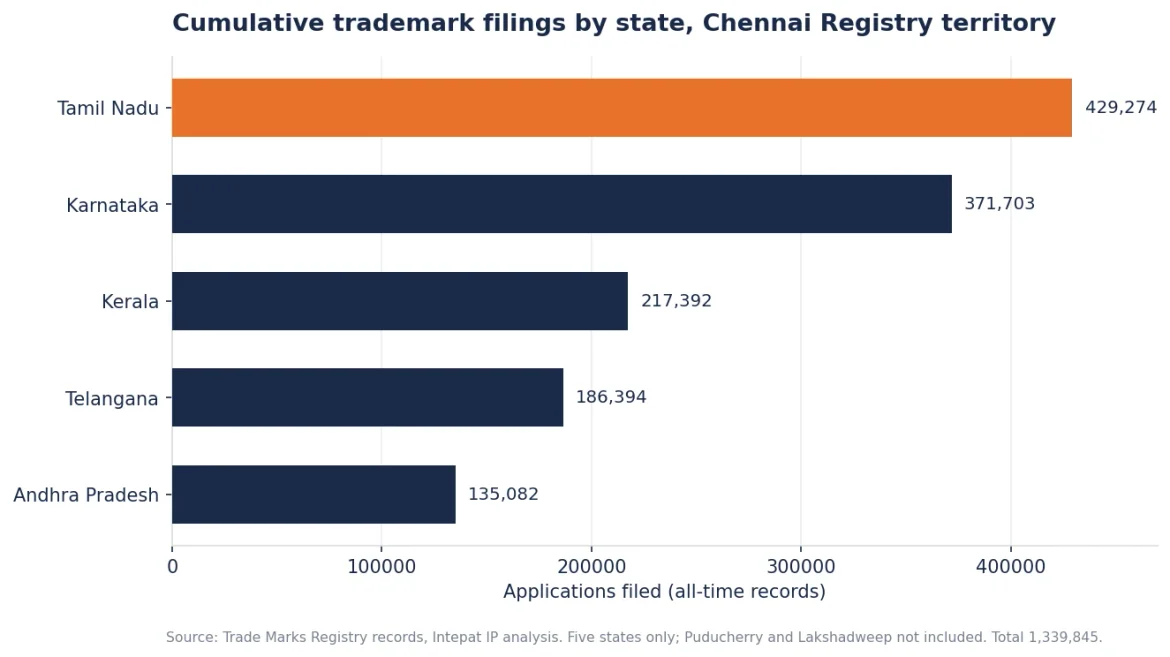
These are cumulative records, not a pending workload: the figure counts every application ever filed from those states, whatever became of it. What it shows is the spread. Roughly six in seven of these records come from outside Chennai, and the largest contributor after Tamil Nadu is Karnataka, where Bengaluru proprietors alone account for more than 300,000. Our guide to trademark registration in Bangalore covers that side of the same territory.
The practical reading is simple. Sharing a city with the Registry confers nothing procedurally, so the things that do move an application, a proper search before filing and a reply to every notice on time, matter as much in Chennai as anywhere else.
A note on method before the figures go further. The data here was compiled on 20 August 2026 from Trade Marks Registry records. State figures match the register’s state field. The all-time city figure matches proprietor addresses containing Chennai or Madras; the year-by-year series matches the Chennai spelling only, so filings at Madras-spelling addresses fall into the elsewhere-in-Tamil-Nadu series in that chart. Puducherry and Lakshadweep were not extracted and sit outside the five-state total. Class and status figures below are Tamil Nadu totals, not Chennai city totals, because the register’s city-level breakdown for those fields was not available.
Chennai Is Less Than Half of Tamil Nadu
Tamil Nadu proprietors account for 429,274 trademark applications. Chennai and Madras addresses together account for 202,513 of them, which is 47.2%. The state capital is a minority of its own state’s register, and its share has been falling: Chennai addresses were 46.1% of Tamil Nadu’s new filings in 2017 and 39.8% so far in 2026.
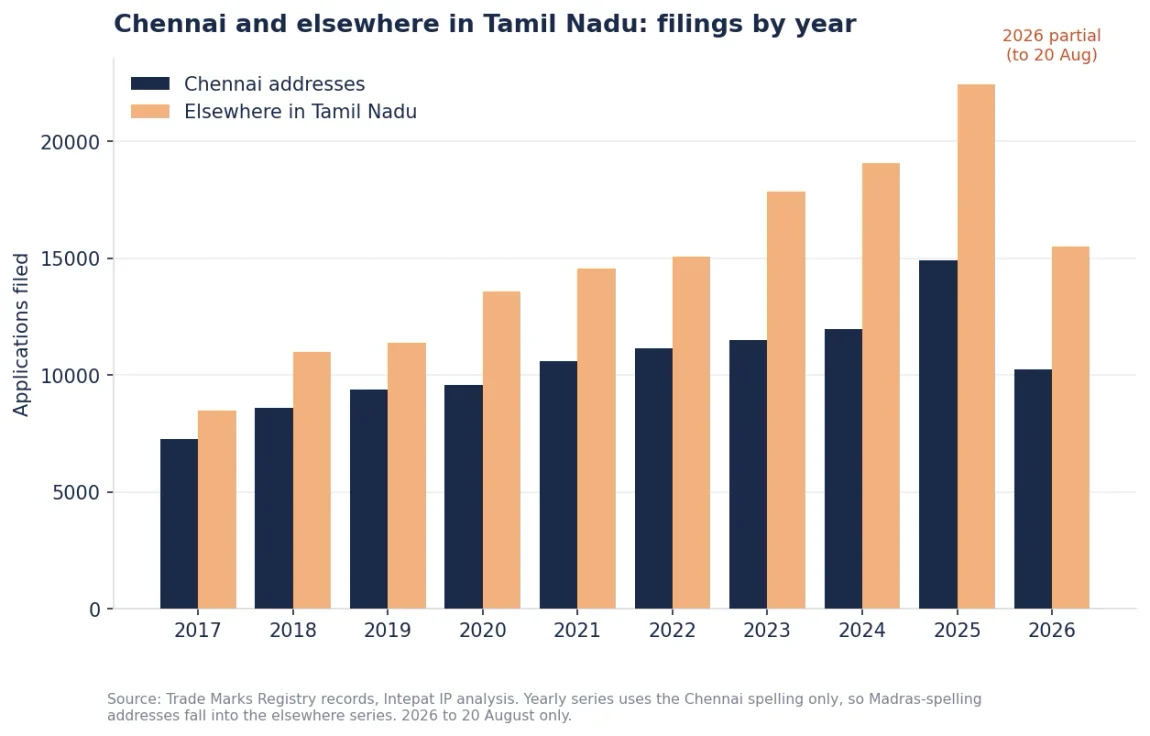
Both series rose, which is the first thing to see. Filings from Chennai addresses roughly doubled between 2017 and 2025, from 7,260 to 14,904. Filings from elsewhere in Tamil Nadu grew faster over the same period, from 8,486 to 22,444.
Coimbatore is the largest contributor outside the capital, with 49,848 applications, 11.6% of Tamil Nadu, more than Madurai, Salem and Trichy combined. A third of the state’s filings carry addresses in none of those five cities, which is the industrial-town pattern in the register: Tiruppur, Erode, Karur and the rest of the Kongu belt filing steadily.
One thing this pattern does not change is how you search. The Indian register is national, and examination looks for earlier marks that are identical or deceptively similar for the same or similar goods or services, wherever in India they were filed (Rule 33). A Chennai applicant searches the whole register for that reason, not because Coimbatore’s share has risen.
What Tamil Nadu Files: The Class Picture
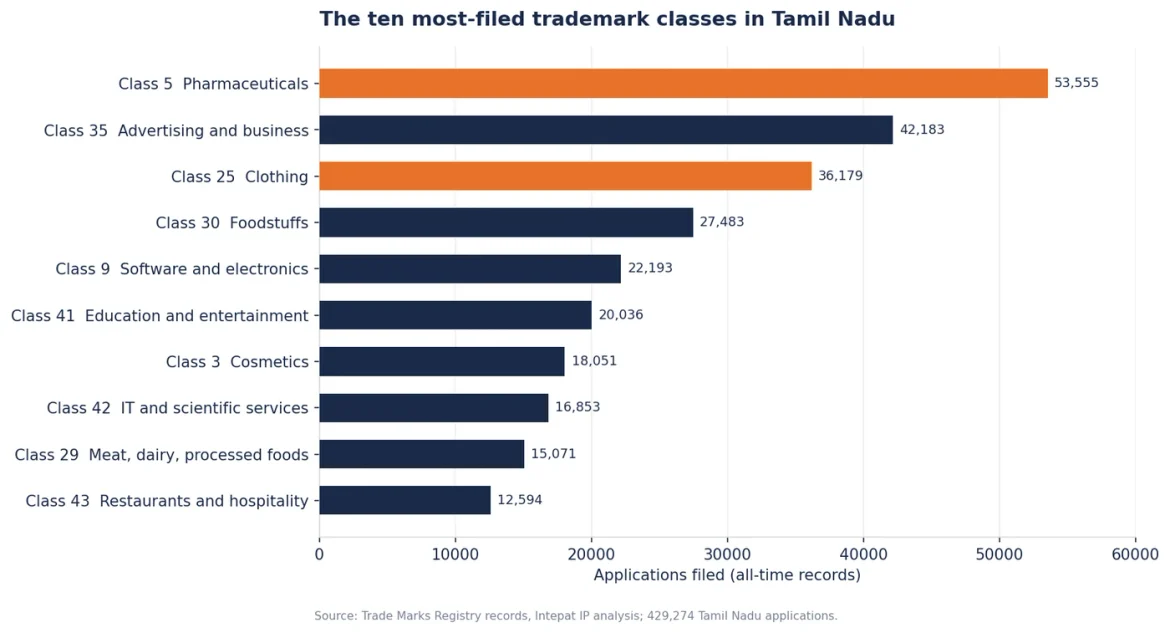
Tamil Nadu’s most crowded class is Class 5, pharmaceuticals, with 53,555 applications, followed by Class 35 (advertising and business services) at 42,183 and Class 25 (clothing) at 36,179. The five largest classes take 43.4% of all filings from the state, and the ten largest take 63.2%.
| Rank | Class | Applications | What it covers |
| 1 | 5 | 53,555 | Pharmaceuticals |
| 2 | 35 | 42,183 | Advertising, business services, retail |
| 3 | 25 | 36,179 | Clothing and footwear |
| 4 | 30 | 27,483 | Coffee, flour, foodstuffs |
| 5 | 9 | 22,193 | Software and electronics |
| 6 | 41 | 20,036 | Education and entertainment |
| 7 | 3 | 18,051 | Cosmetics |
| 8 | 42 | 16,853 | IT and scientific services |
| 9 | 29 | 15,071 | Meat, dairy, processed foods |
| 10 | 16 | 11,021 | Paper and printed matter |
The shape of that list is a goods economy. Classes 1 to 34, which cover goods, take 67.1% of Tamil Nadu’s filings, against 30.6% for the service classes 35 to 45; the small remainder is recorded against class code 99, the register’s marker for multi-class applications. Clothing, foodstuffs and processed foods together outnumber the two software classes by a wide margin.
Read this as a picture of what Tamil Nadu businesses protect, not as a risk ranking. The examination search runs against earlier marks across the national register, so a state-level count cannot tell you how crowded your class is for clearance purposes. It does show which sectors here file actively.
What the Tamil Nadu Register Looks Like Today
Of the Tamil Nadu records in this extraction, about 51% currently carry a registered status, 13% abandoned, 9% objection or opposition, 6% refused, 6% withdrawn or removed, and the remaining 15% sit across pending and other statuses. This is a snapshot of where records stand today, not a history of how each application fared.
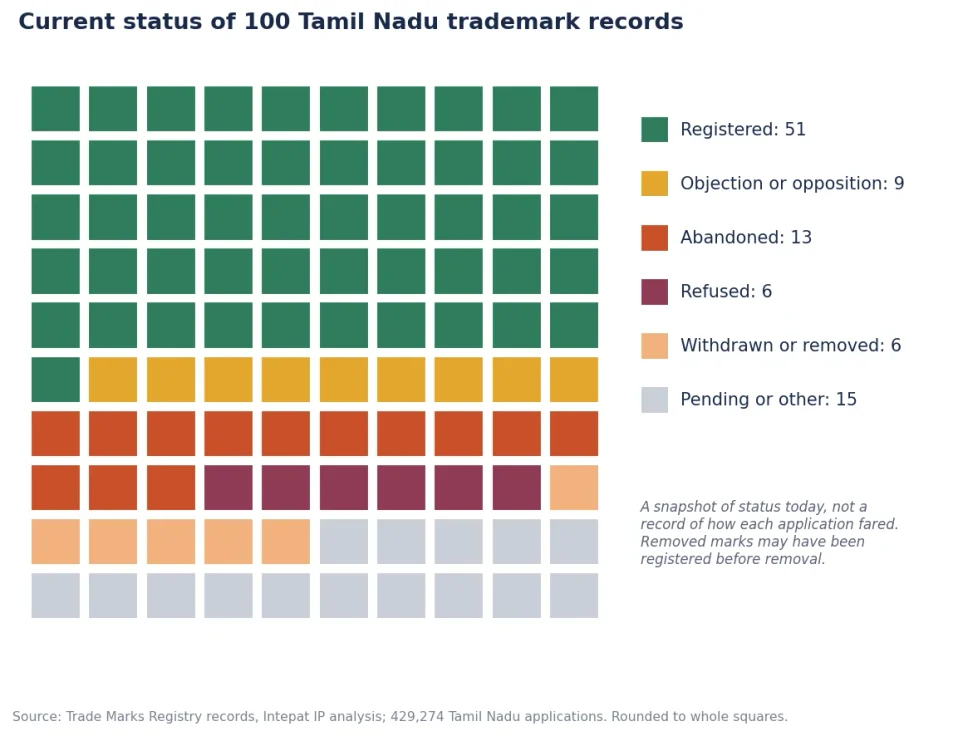
The number worth carrying away is the relationship between two of those figures. Refusal is real: 27,412 Tamil Nadu records carry a refused status. Abandoned records, at 55,249, are roughly twice as many.
A note on two of those categories. Withdrawal is the applicant’s own act of pulling an application. Removal attaches to marks that reached the register and were later taken off it, including on the ground of non-use (Section 47), so a removed record is not an application that failed to register.
These are status labels, not explanations. The register records that an application is abandoned without recording which step produced that status, and the Rules provide several distinct routes to it. What can be said is that several important abandonment provisions arise from a failure to take a prescribed action within a specified period, so deadline control materially reduces avoidable abandonment risk. Those periods are short, and they are listed further down this article.
The 9% currently facing an objection or an opposition are not failures in waiting. An objection is a normal stage of examination and it is answerable on the merits. The risk sits on the other side of it: an unanswered examination report is one of the routes the Rules provide into abandonment.
Government Fees for a Chennai Filing
Government fees are the same at every branch of the Registry. For e-filing Form TM-A, an individual, a startup or a small enterprise pays INR 4,500 per class per mark, and every other applicant pays INR 9,000 per class per mark (First Schedule, Entry 1).202641104086
| What you are paying for | E-filing fee (INR) | Form |
| Application, per class: individual, startup or small enterprise | 4,500 | TM-A |
| Application, per class: all other applicants | 9,000 | TM-A |
| Expedited processing, per class: individual, startup or small enterprise | 20,000 | TM-M |
| Expedited processing, per class: other applicants | 40,000 | TM-M |
| Notice of opposition or counterstatement, per class | 2,700 | TM-O |
| Renewal, per class | 9,000 | TM-R |
| Renewal with surcharge (within six months after expiry), per class | 4,500 plus renewal fee | TM-R |
The fee is charged per class and per mark, so a word mark and a logo filed across two classes each attract four fees rather than one. The concession for individuals, startups and small enterprises applies to the filing fee and does not carry into renewal a decade later, which costs INR 9,000 per class for every proprietor.
The concessional categories are defined in the Rules: startup means an entity recognised as such by the competent authority under the Startup India initiative, and small enterprise is separately defined by reference to the investment limits in the MSMED Act 2006 (Rule 2). The statutory category is small enterprise, not MSME status at large, and the supporting certificate should be in hand before filing rather than after. Physical filing remains available at higher fees, INR 5,000 and INR 10,000 respectively for the application. Professional fees are separate from all of these and vary with the matter.
Family Businesses: Who Actually Owns the Mark
Tamil Nadu is full of businesses run across generations of a family, and a particular trademark problem surfaces there. It is usually not whether the brand is registered, but who owns it, on what terms a relative or a separate firm uses it, and what happens to the mark when the business divides.
Start with what registration does and does not settle. It gives the registered proprietor the exclusive right to use the mark for the registered goods or services, and to obtain relief for infringement (Section 28(1)). Registration in one family member’s personal name gives that person those rights, not the business that trades under it.
Where nothing is registered at all, the position is narrower still: no proceeding lies to prevent or recover damages for infringement of an unregistered trade mark (Section 27(1)), though the same provision preserves the right of action for passing off.
Four decisions follow, and all are cheap to make early and expensive to make late. Settle who owns the mark, and register it in the name of the entity that actually trades, unless there is a considered reason to do otherwise. Put any arrangement allowing a relative or a separate firm to use the mark in writing rather than leaving it as an understanding.
When a business divides or a branch separates, record the change in title: a person who becomes entitled to a registered trade mark by assignment or transmission is required to apply to register their title (Section 45(1)). And note that a genuinely older user is not automatically displaced by someone else’s registration, because the Act saves continuous prior use of an identical or nearly resembling mark from a date earlier than the registered proprietor’s use or registration (Section 34).
When Names Sound Alike
Marks drawn from Tamil, Sanskrit and other Indian-language words raise a recurring question: how close is too close when two marks share a distinctive word. The test is not spelling but whether the marks are deceptively similar for the same or similar goods or services, the search the Registry itself runs at examination (Rule 33).
A recent Madras High Court decision shows how that plays out locally. In an ex parte judgment in March 2026, the Court found SRI AACHI MESS deceptively similar to the plaintiffs’ AACHI-containing marks for similar restaurant services, noting that both marks contained the element AACHI and that the defendant served non-vegetarian food while the plaintiffs’ restaurants were vegetarian did not make the services dissimilar; the restaurant was permanently restrained from using the name (Mr. A.D. Padmasingh Isaac v Sri Aachi Mess, C.S. (Comm.Div.) No. 208 of 2025, decided 9 March 2026).
For a Chennai applicant the working rule is to search phonetically and across transliterations, not just for the exact string you intend to file. Latin-script spellings of Indian-language words vary legitimately, and a search that checks one spelling can miss the earlier mark that later objects to yours. This is where a pre-filing trademark search earns its cost.
Five Deadlines to Calendar on Filing Day
The status figures showed how large the abandoned pile is. Here are five clocks the Rules set for a pending application, each ending in abandonment, automatic or discretionary. Each is short and each runs from a trigger you must watch for. They are the core of the calendar, though not the only abandonment provisions in the Rules.
- One month to fix filing deficiencies. If the application does not satisfy the Rules and you fail to remedy notified deficiencies within one month of the Registrar’s notice, the application shall be treated as abandoned (Rule 31).
- One month to answer the examination report. If you fail to respond within one month of receiving the report, the Registrar may treat the application as abandoned (Rule 33(4)).
- The hearing date. If you neither replied to the objections nor appear at the scheduled hearing, the Registrar may treat the application as abandoned (Rule 33(7)).
- Two months for the counterstatement. If your advertised mark is opposed and you do not file a counterstatement within two months of receiving the notice of opposition, you are deemed to have abandoned the application (Section 21(2)).
- Two months to act on evidence in an opposition. Within two months of receiving the opponent’s evidence, or their intimation that they will file none, you must file your own evidence or intimate that you rely on the counterstatement; take no action and you are deemed to have abandoned the application (Rule 46(2)).
One more clock arrives after success. Registration lasts ten years and is renewable indefinitely (Section 25), and the Registry sends a renewal notice before expiry.
Miss the date and the mark is not removed if a surcharge application is made within six months of expiry (Rule 59). After that window, restoration and renewal must be sought within one year of expiry, and the Registrar weighs the interests of other affected persons (Rule 60).
Notice what is absent from the list above: any deadline the Registry must meet to grant you the mark. The clocks in this process run against the applicant, which is why professional prosecution and maintenance is mostly a discipline of calendars.
If It Goes Wrong: Appealing a Registry Order
An applicant refused by the Registry is not at the end of the road. A person aggrieved by the Registrar’s decision or order may appeal to the High Court, within three months of its communication to them (Section 91). Appeals lie to the High Court because the Intellectual Property Appellate Board, which formerly heard them, was abolished in 2021.
Which High Court hears a given appeal is a question that has itself been litigated since the Board was abolished, and it does not follow automatically from the office that passed the order. Where the Madras High Court is the appropriate forum, appellants have the benefit of a dedicated Intellectual Property Division, created under Rules notified in the Tamil Nadu Government Gazette on 5 April 2023. Cases received from the abolished Board are renumbered and listed before that Division without any fresh or additional court fees (Rule 17).
The practical point is one of sequence, not tactics. Refused records are 6% of the Tamil Nadu register while abandoned records are 13%, so appellate rights matter after the ordinary work of answering the Registry on time has been done, not instead of it.
Documents You Need
The documentary burden is light. An individual filing in their own name needs identity and address details and a representation of the mark; no proof of trading is required, because a person may apply for a mark used or proposed to be used by them (Section 18(1)). A company or LLP files in its corporate name.
Three additions cover most real cases. If you claim use prior to the application date rather than proposed use, Rule 25(2) requires an affidavit testifying to that use along with supporting documents. If you claim the concessional fee, attach the startup recognition or small-enterprise documentation that brings you within the Rule 2 definitions. If an agent or attorney files for you, a signed authorisation accompanies the application. The full list, with formats, is in our guide to documents required for trademark registration in India.
What to Do Before You File
Three decisions carry most of the weight, and all sit before the filing date. Search the national register, and search phonetically and across transliterations rather than only the exact string you intend to file. Choose your applicant category deliberately, since the gap between INR 4,500 and INR 9,000 per class multiplies across marks and classes.
Then treat the deadlines as the real work. Abandoned records outnumber refused ones two to one on the Tamil Nadu register, and several of the abandonment provisions in the Rules turn on a prescribed action not taken within a set period. The process itself is the same from Guindy as anywhere, and it rewards applicants who stay in it.
For the process end to end, our trademark registration guide for India covers each stage, with companion pieces on registration fees, the Form TM-A application and the end-to-end process. Founders and smaller businesses have dedicated guides on trademark registration for startups and trademark registration for MSMEs.
Frequently Asked Questions
The Chennai branch of the Trade Marks Registry is at the Intellectual Property Office Building, G.S.T. Road, Guindy, Chennai. E-filing through the IP India portal is the standard route, so the address is rarely needed in practice. It matters chiefly for identifying which office administers your file.
The Chennai office covers Andhra Pradesh, Telangana, Karnataka, Kerala, Tamil Nadu, and the union territories of Puducherry and Lakshadweep: five states and two union territories in all. Telangana is sometimes omitted from jurisdiction lists published before the state was formed, so check the date on any table you rely on.
Generally no. E-filing is the standard route, and Rule 115 permits a hearing to be held by video conference, in which case it is deemed to have taken place at the appropriate office. The same rule contemplates hearings at a place within the office’s territorial jurisdiction, so a physical hearing remains possible.
Because Rule 4 fixes the appropriate office by the applicant’s principal place of business in India, and Karnataka and Kerala fall within the Chennai office’s territorial jurisdiction. It is not a matter of choice or convenience, and it does not affect the scope of the resulting registration.
The government fee for e-filing Form TM-A is INR 4,500 per class per mark for an individual, startup or small enterprise, and INR 9,000 per class per mark for other applicants (First Schedule, Entry 1, verified as of August 2026). Fees are identical at every branch of the Registry; professional fees are separate.
TM is commonly used in the marketplace to signal a claimed but unregistered mark, and businesses typically begin using it once the application is filed. The R in a circle is different: Section 107 penalises falsely representing a mark as registered, so switch symbols only after the registration certificate issues.
The Registrar may treat the application as abandoned under Rule 33(4), and the filing fee is not refunded. The remedial options then depend on the procedural circumstances, and a fresh application may be required; a fresh filing also means a fresh filing date, losing the benefit of the original one.
Yes. Registration under the Trade Marks Act 1999 gives the registered proprietor the exclusive right to use the mark for the registered goods or services across India, whichever branch of the Registry processed it (Section 28(1)). Protection abroad requires separate filings, country by country or through the Madrid Protocol.
This article explains the law on trademark registration in India as at August 2026 and is for general information only. It is not legal advice. Government fees, forms, and procedures change; confirm current figures with the Trade Marks Registry before you file. For advice on your specific mark, consult a trademark attorney.